- Free Consultation 24/7: (813) 727-7159 Tap Here To Call Us


From First DUI to Death Penalty



Can You Get a DUI for Marijuana in Florida? (2026)


Updated October 25, 2026
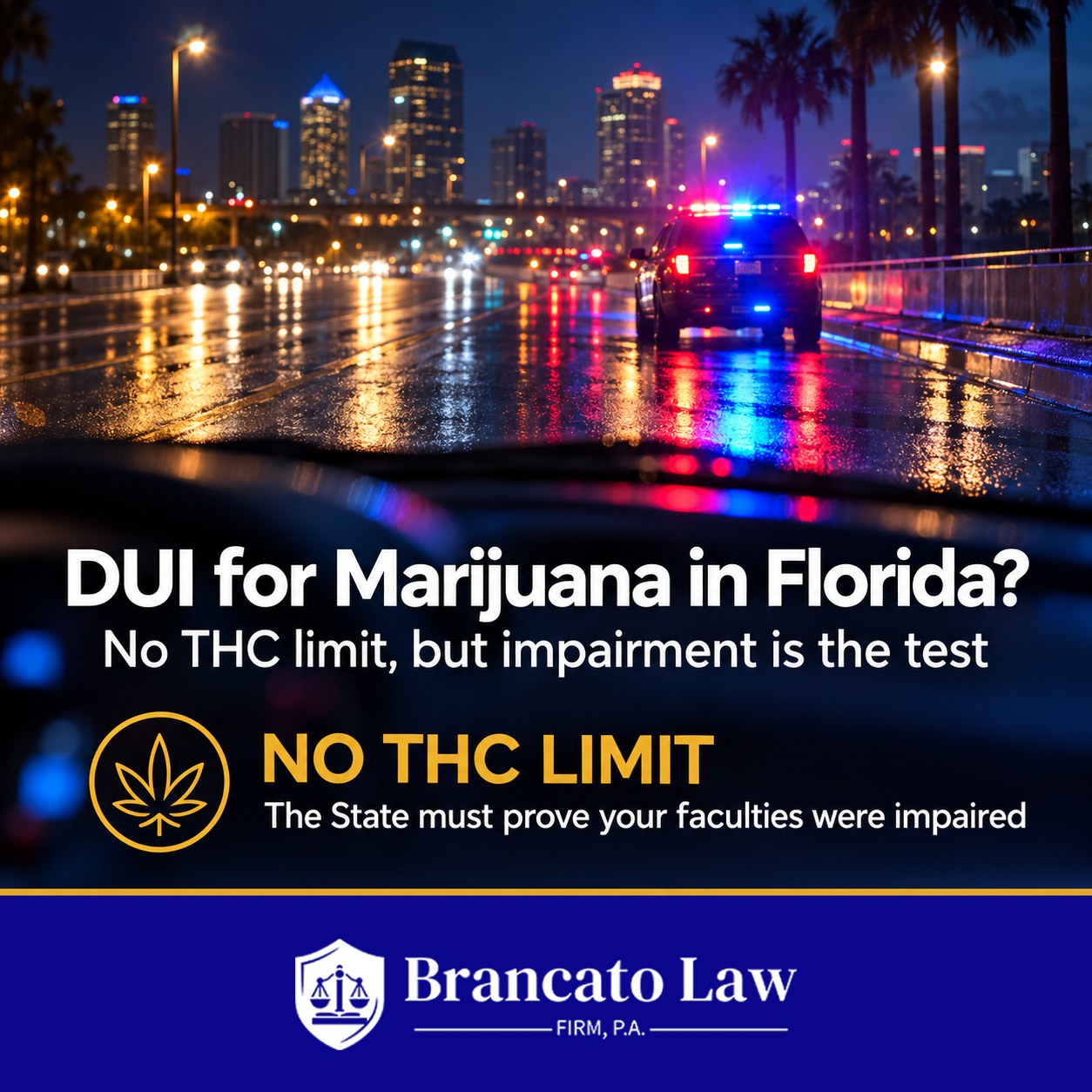
Yes. Florida charges a marijuana DUI under section 316.193 when a driver is under the influence of a controlled substance “to the extent that the person’s normal faculties are impaired.” Florida has no legal THC limit for drivers, so the State must prove actual impairment, usually through driving behavior, roadside exercises, a drug recognition expert, and a urine or blood test. A medical marijuana card is not a defense, and a THC test result does not prove impairment by itself, because federal research has found that THC levels do not reliably track impairment.
As founder of The Brancato Law Firm, P.A., a Tampa criminal defense firm, and a former police academy instructor, I know how much of a marijuana DUI case rests on one officer’s opinion about a driver’s eyes, speech, and balance. I am a member of the National College for DUI Defense, and I have tried more than 150 jury trials to verdict. Our attorneys defend marijuana and drug DUI cases across Hillsborough, Pinellas, and Pasco Counties by testing that opinion against the video, the lab report, and the science.
Can you be charged with DUI for marijuana in Florida?
Yes. Under section 316.193(1)(a), Florida Statutes, a person commits DUI if the person “is under the influence of alcoholic beverages, any chemical substance set forth in s. 877.111, or any substance controlled under chapter 893, when affected to the extent that the person’s normal faculties are impaired.” Cannabis and THC are controlled under chapter 893, so driving while impaired by marijuana is DUI.
The key words are “normal faculties are impaired.” The State has to prove that marijuana actually impaired your normal faculties while you were driving, which is more than proving you had used it. Our Tampa DUI lawyer team builds the defense around that element, because it is the hardest one for the State to prove in a drug case.
Is there a legal THC limit for driving in Florida?
No. Section 316.193 sets a per se limit only for alcohol, a blood or breath alcohol level of 0.08 or higher. There is no THC number that makes driving a crime by itself, so a marijuana DUI is always an impairment case.
| Question | Alcohol DUI | Marijuana DUI |
|---|---|---|
| Is there a legal limit? | Yes, 0.08 blood or breath alcohol | No THC limit |
| Usual chemical test | Breath | Urine, or blood at a hospital or after a serious crash |
| Does the number prove the crime? | 0.08 or higher is DUI by itself | No; the State must still prove impaired normal faculties |
| Refusing the usual test | Second-degree misdemeanor for a first refusal | Second-degree misdemeanor for a first urine refusal |
| Penalties | Section 316.193 | The same statute and the same penalties |
Without a number to point to, prosecutors lean on the officer’s observations and on drug recognition testimony. That is where our attorneys at The Brancato Law Firm focus cross-examination.
Why is THC in your blood not proof of impairment?
Because research shows THC levels do not line up with how impaired a person is. The National Highway Traffic Safety Administration told Congress in Marijuana-Impaired Driving: A Report to Congress (DOT HS 812 440, July 2017) that “the level of THC in the blood and the degree of impairment do not appear to be closely related,” and that “THC level in blood (or oral fluid) does not appear to be an accurate and reliable predictor of impairment from THC.”
A controlled driving study points the same way. In Marcotte and colleagues, Driving Performance and Cannabis Users’ Perception of Safety, published in JAMA Psychiatry in 2022, 191 regular cannabis users were randomly assigned to placebo, 5.9% THC, or 13.4% THC cannabis and then tested in a driving simulator. Driving scores in the THC groups dropped at 30 minutes and 1.5 hours, were borderline at 3.5 hours, and were gone by 4.5 hours. The authors concluded that impairment “cannot be inferred based on … THC blood concentrations.”
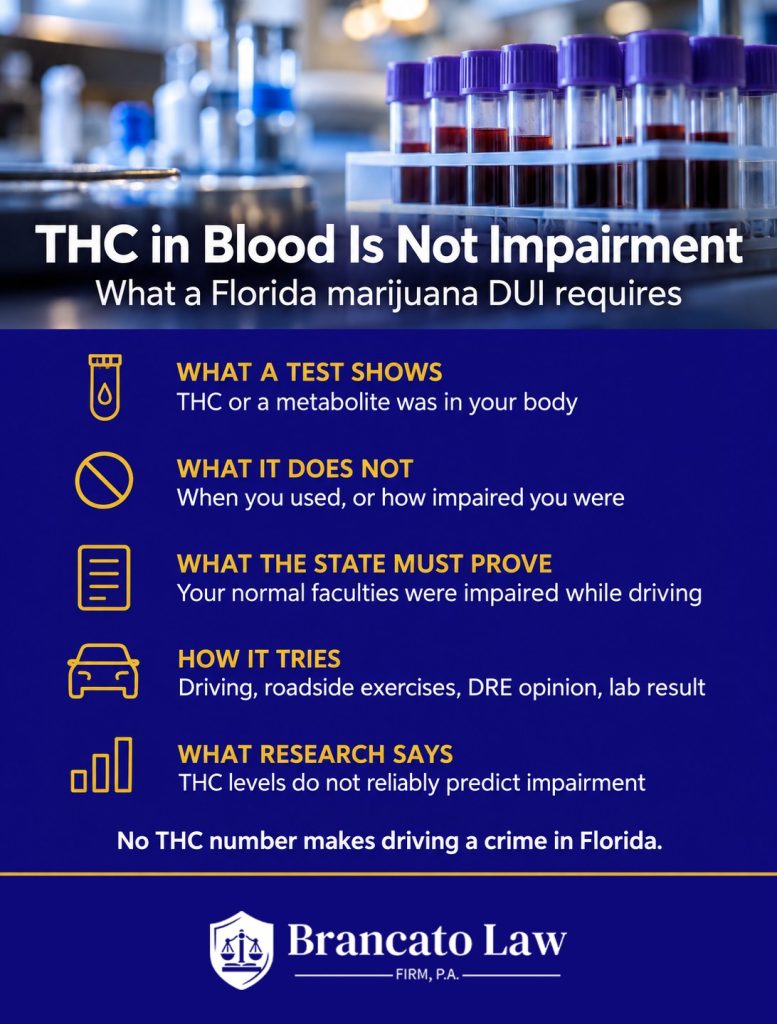
The AAA Foundation for Traffic Safety reached a similar conclusion in its 2016 study of DUI arrest data, An Evaluation of Data from Drivers Arrested for Driving Under the Influence in Relation to Per se Limits for Cannabis, finding that “a quantitative threshold for per se laws for THC following cannabis use cannot be scientifically supported.” The foundation reported that 70% of cannabis-positive DUI arrestees in its data had THC levels below 5 ng/mL. Our attorneys at The Brancato Law Firm use these sources with defense toxicologists to show a jury why a positive test is the start of the question.
How do police test for marijuana after a DUI arrest in Florida?
Usually with a urine test, and sometimes with blood. Under section 316.1932, Florida Statutes, a driver lawfully arrested for DUI has consented to a urine test, which “must be incidental to a lawful arrest and administered at a detention facility or any other facility, mobile or otherwise, which is equipped to administer such tests … in a reasonable manner that will ensure the accuracy of the specimen and maintain the privacy of the individual.”
| Test | When police can require it | If you refuse |
|---|---|---|
| Urine | After a lawful DUI arrest, at a properly equipped facility | 1-year license suspension (18 months with a prior refusal), and a second-degree misdemeanor for a first refusal |
| Blood under implied consent | Reasonable cause, the driver is at a hospital or other medical facility (including an ambulance), and a breath or urine test is impractical or impossible | License suspension; no refusal crime |
| Blood by force | Probable cause that an impaired driver caused death or serious bodily injury | Officers “may use reasonable force if necessary” |
| Any other blood draw | Requires consent or a warrant | Not applicable |
The forced blood draw comes from section 316.1933, Florida Statutes. The refusal crime comes from Trenton’s Law, chapter 2025-121, Laws of Florida, effective October 1, 2025, which made a first refusal of a lawful breath or urine test a second-degree misdemeanor under section 316.1939, Florida Statutes. A blood refusal is still not a crime. Our post on breath test refusal in Florida walks through the warnings an officer must give.
Can THC test results be used against you at trial?
Often, but a judge can keep them out when they mislead more than they prove. In State v. Sercey, 825 So. 2d 959 (Fla. 1st DCA 2002), an Alachua County DUI manslaughter case, the court held that standard THC testing is not novel science, so evidence of THC “is therefore admissible even if it cannot be quantitatively related to impairment, unless it is excluded under section 90.403.” The court also upheld the exclusion of expert opinions that tried to estimate when the driver last used marijuana.
Section 90.403, Florida Statutes, is the rule that excludes evidence when unfair prejudice substantially outweighs its value. In Estrich v. State, 995 So. 2d 613 (Fla. 4th DCA 2008), a Palm Beach County fatal crash case, the State introduced 39 nanograms of carboxy-THC, a THC metabolite. The evidence showed it “probably did not affect” the driver at the time of the crash, so the court held it should have been excluded and ordered new trials.
Together these cases set the defense playbook. Our attorneys at The Brancato Law Firm look at exactly what the lab measured, whether it was THC itself or a metabolite, and how long after driving the sample was taken, and we file a motion to exclude when the number cannot speak to impairment.
What is a drug recognition expert, and is the opinion reliable?
A drug recognition expert, or DRE, is an officer trained to run a 12-step evaluation and give an opinion about which drug category is impairing a driver. In Williams v. State, 710 So. 2d 24 (Fla. 3d DCA 1998), the court held that the 12-step protocol “is not ‘scientific'” and allowed the officer’s opinion that the driver was impaired by specific drug categories. The court treated the horizontal gaze nystagmus eye test as “quasi-scientific,” admissible only with a foundation that a qualified officer administered it properly. A dissenting judge warned that a DRE “is not a toxicologist.”
Williams was decided under an older standard for scientific evidence, so our attorneys challenge DRE opinions under the current rules and test whether each of the 12 steps was done and recorded. Our post on drug recognition experts in Florida explains the evaluation step by step.
Does a medical marijuana card protect you from a DUI?
No. Section 381.986(14)(g), Florida Statutes, states that the medical marijuana law “does not exempt a person from prosecution for a criminal offense related to impairment or intoxication resulting from the medical use of marijuana or relieve a person from any requirement under law to submit to a breath, blood, urine, or other test to detect the presence of a controlled substance.”
The card also does not cover use in a car. “Medical use” excludes use “In a school bus, a vehicle, an aircraft, or a motorboat,” except for low-THC cannabis not in a form for smoking, and using marijuana in a vehicle is a first-degree misdemeanor under section 381.986(12)(c). A lawful patient can still be a sober driver, though, and our attorneys at The Brancato Law Firm show the jury the difference between a patient who has THC in the body and a driver whose faculties were impaired. Possession rules for patients are covered in our guide on how to fight a marijuana possession charge in Florida, and our guide on how to legally transport medical marijuana in Florida covers the packaging rules, the registry card, and odor-based car searches.
Can you get a DUI for delta-8 or hemp products in Florida?
Possibly, and the question is unsettled. Delta-8 THC is listed in Schedule I at section 893.03(1)(c)190.a., Florida Statutes, but section 581.217, Florida Statutes provides that hemp-derived cannabinoids “are not controlled substances or adulterants if they are in compliance with this section.” A compliant hemp product therefore has a strong argument that it is not a “substance controlled under chapter 893” for the DUI statute. We have found no Florida appellate decision on that argument.
The State will answer that the product was not compliant, for example because it exceeded 0.3% total delta-9 THC or was synthesized. The federal picture also changes on November 12, 2026, when Public Law 119-37 narrows the federal definition of hemp and excludes cannabinoids synthesized outside the plant, according to the Congressional Research Service. Florida’s hemp statute does not adopt the federal text, so a Florida DUI still turns on Florida law. Hemp products in Florida are legal to sell to adults 21 and older when they meet section 581.217, but legal to buy never means legal to drive impaired. Our attorneys at The Brancato Law Firm get the product, its label, and its certificate of analysis into evidence early, because lab proof of the exact cannabinoid can decide the case.
How common are marijuana-involved crashes in Florida?
Hundreds a year. In 2023, marijuana was reported in 417 Florida crashes, down from 554 in 2020, according to the Florida Department of Highway Safety and Motor Vehicles report Impaired Driving Education Campaign, presented to the Governor and Cabinet on January 31, 2025. The same report counted 969 impaired-driving fatalities statewide in 2023, involving alcohol, drugs, or both.
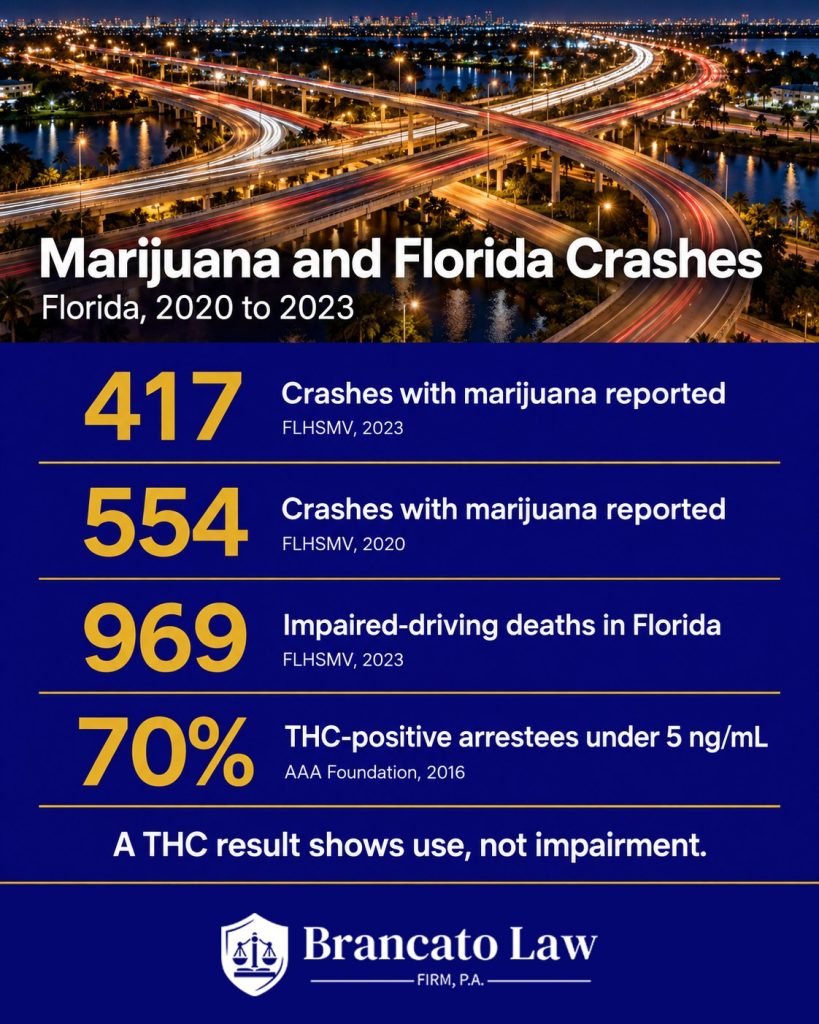
These figures count crashes where marijuana was reported, and one crash can count under more than one drug. They do not show that marijuana caused the crash. Our attorneys at The Brancato Law Firm keep that distinction in front of the jury, because the State often treats “reported” as “impaired.”
What are the penalties for a marijuana DUI in Florida?
The same as for an alcohol DUI. Under section 316.193, a first conviction carries up to 6 months in jail, a fine of $500 to $1,000, probation of up to 1 year, at least 50 hours of community service, and a 10-day vehicle impoundment. DUI with property damage or injury is a first-degree misdemeanor, DUI with serious bodily injury is a third-degree felony, and DUI manslaughter carries a 4-year mandatory minimum. Our guide to the penalties for DUI in Hillsborough County covers every tier.
Your license is a separate case. If you refused a urine or breath test, your license is suspended for the refusal, and you have 10 days from the notice of suspension to request review. Our post on how to protect your driver’s license after a DUI arrest explains the choices, and our attorneys at The Brancato Law Firm handle the license review and the criminal case together.
What are the penalties for a second or third marijuana DUI in Florida?
They rise with each conviction and with how recent the last one was. Under section 316.193, Florida Statutes, a second DUI carries a fine of $1,000 to $2,000 and up to 9 months in jail, and a third DUI within 10 years of a prior conviction, or any fourth DUI, is a third-degree felony punishable by up to 5 years in prison under section 775.082, Florida Statutes. License revocation periods come from section 322.28, Florida Statutes, and they apply the same way whether the impairment came from marijuana or alcohol.
| Conviction | Fine | Jail or prison | Vehicle impoundment | License revocation |
|---|---|---|---|---|
| First | $500 to $1,000 | Up to 6 months | 10 days | 180 days to 1 year |
| Second | $1,000 to $2,000 | Up to 9 months; at least 10 days if within 5 years of a prior | 30 days if within 5 years of a prior | At least 5 years if within 5 years of a prior |
| Third, within 10 years of a prior | Up to $5,000 (third-degree felony) | Up to 5 years in prison; at least 30 days | 90 days | At least 10 years |
| Fourth or later | At least $2,000 (third-degree felony) | Up to 5 years in prison | 90 days if within 10 years of a prior | Permanent |
A third DUI more than 10 years after the last conviction stays a misdemeanor, with a fine of $2,000 to $5,000 and up to 12 months in jail. The court must also order an ignition interlock device for at least 1 year after a second conviction and at least 2 years after a third. These are the base penalties; a minor in the vehicle raises them. Because prior convictions drive every number in this table, our attorneys at The Brancato Law Firm pull the dates and court records of each prior before advising on any plea.
How do our attorneys fight a marijuana DUI charge?
We take apart each piece of the impairment case:
- The stop. We review whether the officer had a lawful reason to stop the car and to extend the stop for a drug investigation.
- The driving. We compare the arrest report with the dash camera and body camera video.
- The roadside exercises. We check how they were explained and scored, and whether the video matches the report.
- The DRE evaluation. We check every one of the 12 steps against the DRE’s own written record.
- The lab. We identify whether the result was THC itself or a metabolite, when the sample was taken, and how the urine collection was handled under section 316.1932.
- The product. For delta-8 and hemp, we test whether the substance was a controlled substance at all.
- The science. We use the NHTSA, AAA, and JAMA Psychiatry research, with defense experts, to show why THC in the body is not proof of impairment.
What should you do after a marijuana DUI arrest in Tampa?
Move fast on the license and the evidence. A person arrested in Hillsborough County sees a judge at first appearance within 24 hours, usually at the Orient Road Jail. Then:
- Mark the 10-day deadline if your license was suspended for a refusal.
- Write down the timeline of when you last used any product and when you were tested.
- Keep the product and its packaging, including any hemp label or certificate of analysis.
- Do not discuss the case on jail calls or social media.
- Call a DUI lawyer before the first court date, so video and lab records can be requested early.
Frequently asked questions about marijuana DUI in Florida
Can marijuana DUI charges be dropped in Florida?
Yes, when the State cannot prove impaired normal faculties, when a THC result is excluded, or when the stop is suppressed. The Brancato Law Firm puts those weaknesses in front of the prosecutor early, as described on our Tampa DUI defense page.
How long after smoking marijuana can you be charged with DUI in Florida?
Florida has no time rule; the question is whether you were impaired when you drove. In the 2022 JAMA Psychiatry simulator study, measured driving impairment was gone by 4.5 hours, and our attorneys at The Brancato Law Firm build the timeline of use, driving, and testing to show the gap.
Is refusing a urine test for marijuana a crime in Florida?
Yes, since October 1, 2025, a first refusal of a lawful urine test is a second-degree misdemeanor, and it also brings a 1-year license suspension. The Brancato Law Firm checks whether the officer gave the warnings the law requires, as our post on refusal in Florida explains.
Is a medical marijuana card a defense to DUI in Florida?
No; section 381.986(14)(g) says the medical marijuana law does not protect a patient from an impairment prosecution. Our attorneys at The Brancato Law Firm still use the patient’s records to explain why THC was present without impairment, and our marijuana possession guide covers the card’s limits.
Can you get a DUI for delta-8 in Florida?
You can be arrested for it, but whether a compliant hemp product is a “controlled substance” under the DUI statute is unresolved in Florida’s appellate courts. The Brancato Law Firm gets the product tested and challenges the State’s proof of what the driver actually used.
Does a drug recognition expert’s opinion prove I was high?
No; it is one officer’s opinion, and a Florida court has held the 12-step protocol “is not ‘scientific.'” Our attorneys at The Brancato Law Firm cross-examine DREs step by step, as described in our post on drug recognition experts.
Will a marijuana DUI suspend my license in Florida?
It can, through a refusal suspension at arrest or a revocation after conviction. The Brancato Law Firm requests the license review within the 10-day window and coordinates it with the criminal defense, and our DUI license guide explains the options.
Speak with a Tampa marijuana DUI lawyer
Your license and your criminal case run on separate clocks after a marijuana DUI arrest, and the license clock can be as short as 10 days. The Brancato Law Firm, P.A., founded by Tampa Criminal Defense Attorney Rocky Brancato, will request the video and lab records, challenge the DRE opinion, and protect your driving privilege. Call (813) 727-7159 for a free, confidential consultation. You can call us at any hour; our office is two blocks from the courthouse. Our firm has Spanish-speaking staff, and attorney Jean-Luc Adrien speaks Spanish, Haitian Creole, and French.
For more about our defense strategies, visit our Tampa DUI Lawyer page.
The Brancato Law Firm, P.A.
620 E. Twiggs Street, Suite 205, Tampa, FL 33602
(813) 727-7159
Serving Hillsborough, Pinellas, and Pasco Counties
The Brancato Law Firm, P.A. is a Tampa-based criminal defense practice. We are not affiliated with any other Brancato-named law firms.
Visit Us

Tampa, FL 33602

Contact Us Now
Free Legal Consultation (813) 727-7159
