Strategic Defense,
From First DUI to Death Penalty
From First DUI to Death Penalty






| Accused of a sex crime in Tampa? The Brancato Law Firm, P.A. defends people who are under investigation for, or charged with, sex crimes in Hillsborough, Pinellas, and Pasco Counties. Our attorneys step in before the State Attorney’s Office decides whether to file charges, test every interview and lab result the State relies on, and fight the sex offender registration that follows a conviction. Call (813) 727-7159 for a free, confidential consultation. |
A Florida sex crime conviction can mean decades in prison and lifetime registration, and registration applies even when the judge withholds adjudication. Our attorneys at The Brancato Law Firm, P.A., a Tampa criminal defense firm founded by Rocky Brancato, defend these cases from the first call from a detective through trial. Before founding the firm, Rocky worked in a Major Crimes Unit defending homicide, sex crime, and child abuse cases, then served as Chief Operations Officer of the Hillsborough County Public Defender’s Office, overseeing a staff of over 100 attorneys.
Rocky has tried more than 150 cases to a jury verdict. Our attorneys work with independent DNA analysts, physicians, digital forensic examiners, and psychologists, because sex crime cases are usually decided by how an accuser was interviewed, what a lab report actually says, or what a phone actually contains.
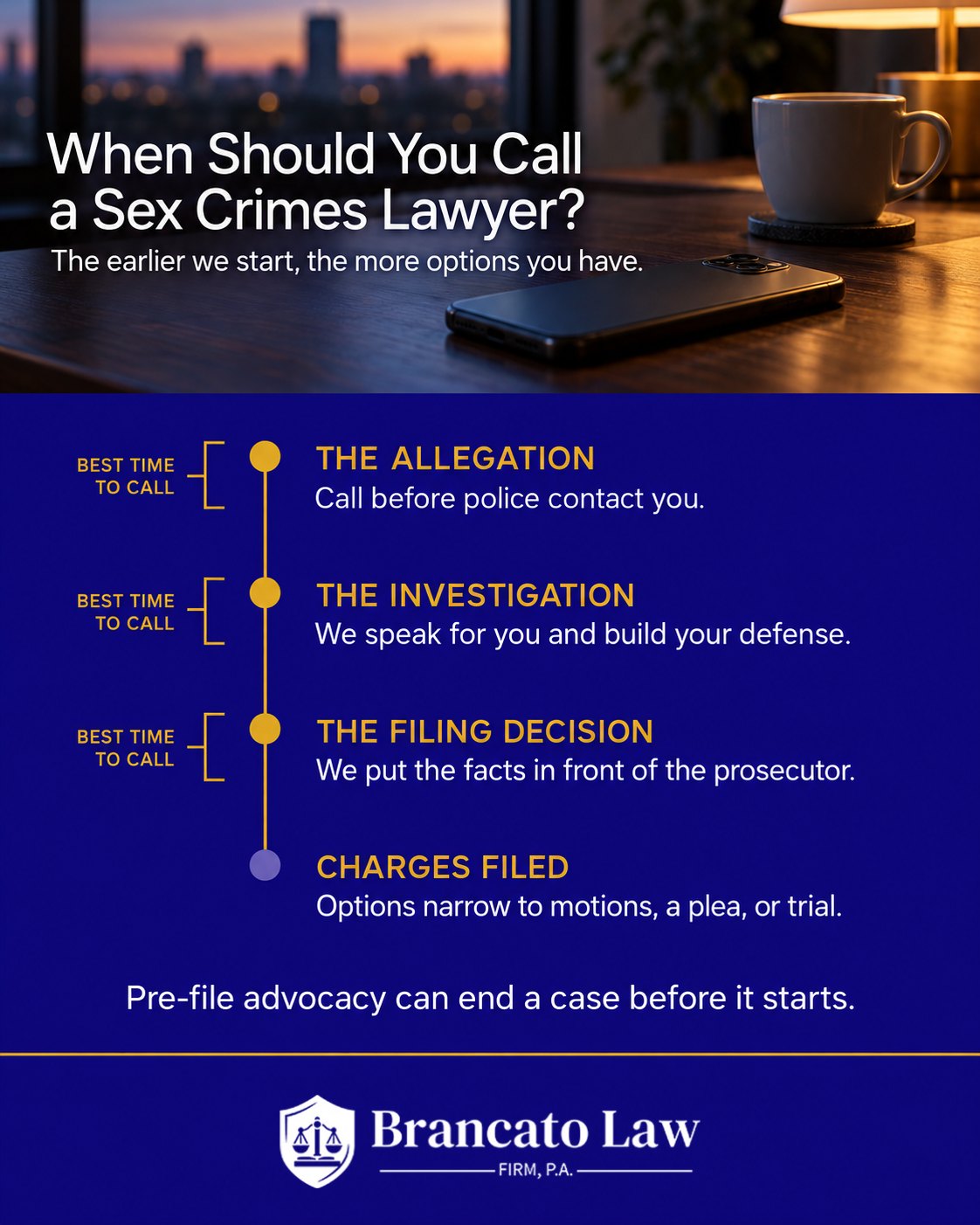
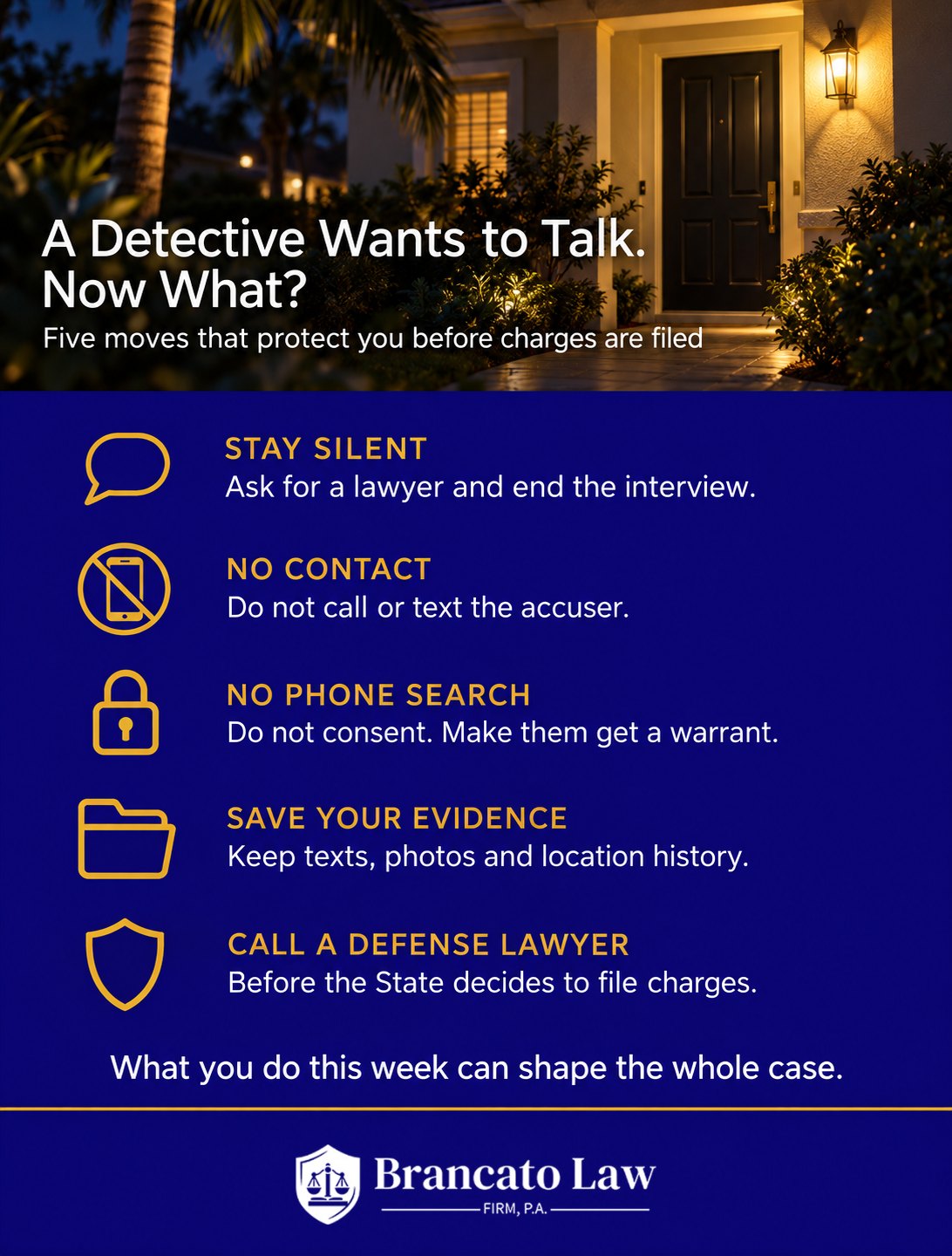
Tell the detective you want a lawyer, end the conversation, and call a defense attorney before any interview. Most sex crime investigations in Tampa Bay begin with a phone call or a request to “come in and tell your side.” By then the detective has usually interviewed the accuser, and in cases involving a child, a forensic interviewer has often recorded the child’s statement. Your interview is the State’s chance to fill the gaps in its case with your own words.
When The Brancato Law Firm is hired during an investigation, our attorneys take over communication with the detective, investigate the allegation, and present the defense to the prosecutor before the filing decision through our pre-file advocacy practice. Cases can end at this stage with no arrest and no charges, as several of the results below show.
If you have not hired a lawyer yet, follow these rules until you do:
Florida sex offenses range from a first-degree misdemeanor to a capital felony. The degree depends on the ages of the accused and the alleged victim, the use of force, and the relationship between them. The table below lists the statutory maximums for the sex crime charges our attorneys see most often in the 13th Judicial Circuit and the surrounding counties.
| Charge | Florida statute | Degree | Maximum penalty |
|---|---|---|---|
| Sexual battery by a person 18 or older on a child under 12 | 794.011(2)(a) | Capital felony | Death or life imprisonment |
| Sexual battery on a person 12 or older with a deadly weapon or force likely to cause serious injury | 794.011(3) | Life felony | Life imprisonment |
| Sexual battery by a person 18 or older on a person 12 to 17, without that level of force | 794.011(5)(a) | First-degree felony | 30 years |
| Sexual battery by a person 18 or older on an adult, without that level of force | 794.011(5)(b) | Second-degree felony | 15 years |
| Sexual battery by a person in familial or custodial authority on a person 12 to 17 | 794.011(8)(b) | First-degree felony | Up to life |
| Lewd or lascivious molestation by a person 18 or older on a child under 12 | 800.04(5)(b) | Life felony | Life, or at least 25 years in prison followed by lifetime probation (775.082(3)(a)4.) |
| Lewd or lascivious molestation by a person 18 or older on a child 12 to 15 | 800.04(5)(c)2. | Second-degree felony | 15 years |
| Lewd or lascivious battery on a child 12 to 15 | 800.04(4) | Second-degree felony (first-degree with certain prior convictions) | 15 years (30 with priors) |
| Lewd or lascivious conduct or exhibition by a person 18 or older | 800.04(6) and (7) | Second-degree felony | 15 years |
| Unlawful sexual activity by a person 24 or older with a 16- or 17-year-old | 794.05 | Second-degree felony | 15 years |
| Possession or intentional viewing of child sexual abuse material (offenses on or after July 1, 2026) | 827.071(5) | Second-degree felony for each image and each child depicted | 15 years per count |
| Human trafficking for commercial sexual activity involving a minor | 787.06(3)(g) | Life felony | Life imprisonment |
| Soliciting prostitution, first offense | 796.07(2)(f) | First-degree misdemeanor | 1 year in jail, plus 100 hours of community service and a $5,000 civil penalty |
These are maximums. Florida’s Criminal Punishment Code scoresheet sets the lowest sentence a judge can impose without a legal reason to go below it. A conviction for most of these offenses also brings sex offender registration and, for anyone placed on probation, the conditions in section 948.30, including a 10 p.m. to 6 a.m. curfew and court-ordered sex offender treatment at the probationer’s expense.
Our attorneys defend felony and misdemeanor sex offense cases in Hillsborough County, Pinellas County, and Pasco County courts, including:
Our defense starts with the evidence the State needs most. Most sex crime cases rest on one person’s account, and Florida law does not require that account to be corroborated under section 794.022. That makes how the account was gathered, and whether it holds up, the center of the case.
Children and adults can both be shaped by repeated or suggestive questioning. Psychologists Stephen Ceci and Maggie Bruck reviewed a century of research in “Suggestibility of the Child Witness: A Historical Review and Synthesis,” Psychological Bulletin, vol. 113, no. 3 (1993), and found reliable age differences in how suggestible children are. Our attorneys compare every recorded statement, from the first outcry to a parent through the forensic interview, for leading questions, adult vocabulary, and details that grew over time.
When the State wants to use a child’s out-of-court statements, section 90.803(23) requires a hearing where the judge must find that the time, content, and circumstances of the statement provide sufficient safeguards of reliability. The exception now covers child victims with a physical, mental, emotional, or developmental age of 17 or less. That hearing is often the best chance to keep a coached statement away from the jury. Our child hearsay defense guide explains how it works.
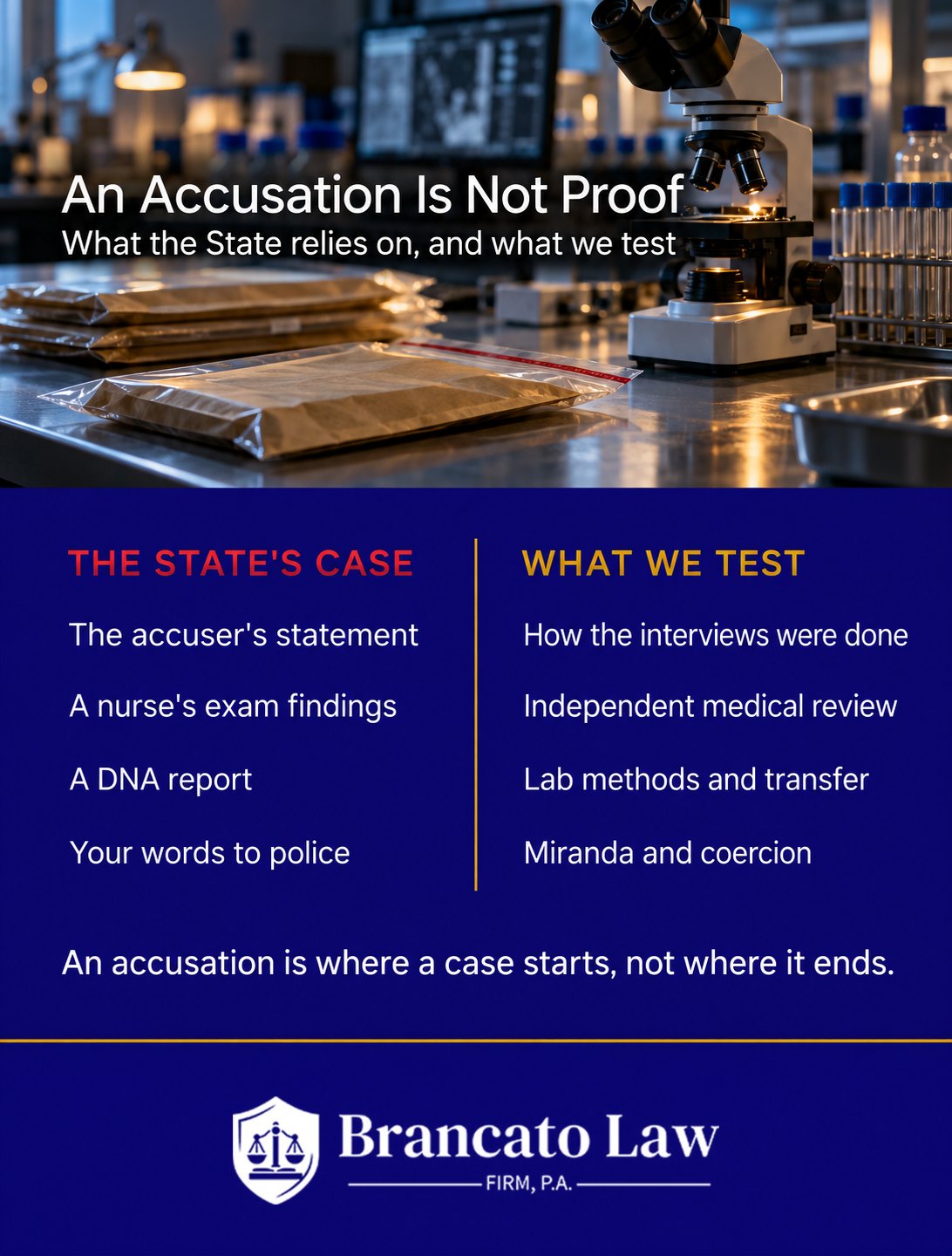
Forensic evidence is often presented as proof of guilt when it only proves contact, or proves nothing about consent. DNA shows that biological material is present, not when or how it got there. A sexual assault nurse examiner’s finding that an injury is “consistent with” the allegation is often equally consistent with consensual activity. Our firm retains independent DNA analysts, physicians, and digital examiners to review the State’s work through our Tampa forensic science defense practice.
Faulty forensics is a documented cause of wrongful convictions. The Innocence Project’s review of 375 DNA exonerations in the United States from 1989 to 2020 found misapplied forensic science in 43 percent of those cases and false confessions in 29 percent.
A statement taken in violation of Miranda, or obtained through coercion, can be suppressed. Rocky Brancato taught criminal procedure and courtroom testimony at the police academy, so our attorneys know the interview techniques detectives use at the Orient Road Jail and in station interview rooms. A common tactic in statutory cases is minimization: “I know you didn’t force her.” The admission to consensual contact that often follows can still prove the charge, which is why we review every recording for the point where the questioning crossed the line.
Florida lets the State offer evidence of other acts of child molestation or other sexual offenses in a sex crime trial under sections 90.404(2)(b) and (c), for any relevant purpose. That is a lower bar than the usual rule against character evidence, so our attorneys fight the issue well before trial.
The Florida Supreme Court set the limits in McLean v. State, 934 So. 2d 1248 (Fla. 2006). The defendant there was accused of molesting a child, and the State offered testimony that he had molested another child. The Court held that before a jury hears about prior acts, the judge must find them proved by clear and convincing evidence and must weigh their value against the danger of unfair prejudice, considering how similar the acts are, how close in time, how frequent, and whether anything intervened. The prior acts cannot become a feature of the trial, and on request the jury must be told it may consider them only for a limited purpose.
The Second District Court of Appeal, which hears appeals from Hillsborough, Pinellas, and Pasco Counties, applied those rules in State v. Riggleman, 397 So. 3d 1152 (Fla. 2d DCA 2024). A Sarasota County judge had excluded a father’s alleged prior molestation of his daughter in a case involving his young son because the acts were too different. The appeals court quashed that order because the judge skipped the required relevance analysis and the weighing under section 90.403. The lesson for the defense is that winning this issue takes a full record on every factor from McLean v. State, 934 So. 2d 1248 (Fla. 2006), not just an argument that the acts look different. Our guide to the Williams rule in sex crime cases explains the process.
Consent is a complete defense to sexual battery of an adult under section 794.011, and our attorneys build consent cases from messages, witnesses, and timelines. Consent is not a defense to lewd or lascivious offenses under section 800.04, and a mistaken belief about a person’s age is not a defense under section 794.021 or section 800.04(3), even if the other person lied about being an adult.
Florida’s rape shield statute, section 794.022, bars most evidence of an accuser’s sexual history with other people. It has two exceptions our attorneys use. After a private hearing, the evidence may be admitted to show the accused was not the source of semen, pregnancy, injury, or disease, or, when consent is at issue, to show a pattern of conduct so similar to the allegation that it bears on consent. Our guide to common defenses to sex crime charges in Florida and our explainer on Florida’s rape shield law cover both in more detail.
| Evidence the State relies on | What our attorneys test |
|---|---|
| SANE exam “consistent with” findings | Whether the same findings occur with consensual activity, reviewed by an independent physician |
| Child forensic interview | Earlier interviews by police or parents, leading questions, adult vocabulary, and timing within custody disputes |
| Police interview of the accused | Miranda compliance, minimization tactics, and any unrecorded portion of the interview |
| DNA report | Whether the analyst knew the allegation before testing, how mixtures were interpreted, and innocent transfer |
| Phone and computer extractions | Who had access to the device, malware, timestamps, and whether files were ever opened |
Our attorneys have ended sex crime cases before charges were filed, won not guilty verdicts at trial, and removed registration requirements that never should have applied. Representative results:
| Outcome | Charge | How our firm handled it |
|---|---|---|
| No charges filed | Lewd or lascivious molestation (investigation) | Hired right after the allegation was made; investigated and worked with law enforcement to avoid an arrest and the filing of charges |
| No charges filed | Lewd or lascivious conduct (investigation) | Interviewed witnesses, kept the client out of a police interview, and showed the child’s account was fabricated |
| Not guilty | Capital sexual battery and molestation | Proved the child had been coached by a parent during a contentious divorce |
| Not guilty | Sexual molestation | Exposed coaching: the child’s language matched the mother’s phrasing, and text messages showed coordination |
| Not guilty | Sexual battery (family home) | Visited the home and proved the allegation was physically impossible |
| Not guilty | Sexual battery | Presented a consent defense and challenged the State’s forensic evidence |
| Dismissed | Unlawful sexual conduct with a minor | Independent investigation exposed false statements on the accuser’s social media |
| Dismissed | Cold case rape | Our independent DNA analyst found errors in the state lab’s DNA analysis |
| Reduced by jury to a non-sex misdemeanor | Felony lewd conduct | Cross-examination exposed contradictions; the client avoided registration |
| Designation removed | Sexual predator | Identified and corrected a prior attorney’s critical error |
| No registration | Out-of-state registrant moving to Florida | Showed the client did not meet Florida’s registration criteria and obtained assurances from the Sheriff’s Office |
Each case is unique. Past results do not guarantee future outcomes. More outcomes are on our case results page.
A conviction for most Florida sex offenses requires registration with the Florida Department of Law Enforcement for life, and Florida counts a guilty or no contest plea as a conviction even when the judge withholds adjudication under section 943.0435. Registration is where many people get into trouble years after the case closes, so our attorneys plan for it from the first day of the case.
| Rule | Sexual offender | Sexual predator |
|---|---|---|
| Who | A person convicted of a listed offense under section 943.0435 | A person the sentencing court designates in writing under section 775.21, generally for a capital, life, or first-degree qualifying felony, or a second qualifying felony |
| In-person reporting | Twice a year (birth month and six months later); four times a year for listed offenses, including sexual battery and lewd molestation of a child under 12 | Four times a year (birth month and every third month after); every 30 days if transient |
| Public notice | Listed on FDLE’s public registry | FDLE registry plus notice by the sheriff or police chief to the community, including schools and child care facilities within 1 mile, within 48 hours |
| How long | Life, unless relief is granted | Life, unless the person is pardoned or the conviction is set aside |
| Paths to removal | A petition 25 years after release with no new arrests (not available after an adult conviction for sexual battery under section 794.011, lewd molestation of a child under 12, and other listed offenses), or a Romeo and Juliet motion | A full pardon, a conviction set aside in postconviction, or a Romeo and Juliet motion for those who qualify |
Florida’s Romeo and Juliet law, section 943.04354, lets a court remove the registration requirement only when the offense was under section 800.04, section 827.071, or section 847.0135(5); the victim was 13 to 17; the person was no more than 4 years older than the victim; and that offense is the only reason the person must register. Sexual battery under section 794.011 does not qualify, and a denied motion cannot be filed again. Our guide on how to get off the Florida sex offender registry walks through each path.
Hillsborough County enforces these rules closely. In November 2025, FDLE, the Hillsborough County Sheriff’s Office, and the Florida Department of Corrections ran a four-day operation that contacted 63 registrants under state supervision and arrested 29 of them, 19 sexual offenders and 10 sexual predators. The charges included failing to report a vehicle, email address, or internet identifier, and probation violations as minor as displaying Halloween decorations, according to the FDLE news release on Operation Lights Out.
Clients hire our firm because sex crime cases are won on courtroom experience, forensic depth, and an early start. These are the credentials behind our sex crime practice:
| Credential | Why it matters in a sex crime case |
|---|---|
| Former Major Crimes Unit attorney (homicide, sex crimes, child abuse) | Years of defending the most serious sex and child abuse allegations |
| Former Chief Operations Officer, Hillsborough County Public Defender’s Office, overseeing a staff of over 100 attorneys | Inside knowledge of how the 13th Judicial Circuit charges and resolves cases |
| Former police academy instructor in criminal procedure and courtroom testimony | Knows how detectives are trained to interview suspects and testify |
| More than 150 jury trials to verdict | Prosecutors know the case is ready for trial if it is not resolved fairly |
| 25+ years in Hillsborough County courts | Working knowledge of local procedure, prosecutors, and judges |
| AV Preeminent (Martindale-Hubbell), Super Lawyers selection, 10.0 Avvo rating, National Trial Lawyers Top 100 | Peer and independent recognition of legal ability and ethics |
Our office is at 620 E. Twiggs Street, two blocks from the Hillsborough County Courthouse. Trial attorney Jean-Luc Adrien is fluent in Spanish, Haitian Creole, French, and English, and our office has Spanish-speaking staff. Our firm charges flat fees quoted on the facts and complexity of the case, usually asks for half up front with the balance paid while the case is pending, and accepts LawPay Pay Later, a third-party financing service approved based on credit. Our guide to the cost of a sex crimes defense attorney in Florida explains typical fee ranges.
Hire a lawyer before you speak with police, and no later than first appearance if you have been arrested. After an arrest in Hillsborough County, the accused is booked at the Orient Road Jail and sees a judge at first appearance within 24 hours, where bond and release conditions are set. Hillsborough County does not offer pretrial services supervision as a release option, though some nearby counties do, so the bond argument has to stand on its own facts. Release conditions in a sex case can include no-contact orders that affect where a person can live and whether they can see their own children.
Before charges are filed, the State Attorney’s Office reviews the investigation and decides what to charge. Our attorneys use that window to give the prosecutor the facts the detective did not collect. Once charges are filed, every week gives the State more time to shore up its case.
Yes. The State Attorney’s Office can decline to file charges, drop them by nolle prosequi, or have them dismissed when the evidence does not hold up. Our attorneys at The Brancato Law Firm push for that result through pre-file advocacy, suppression motions, and independent investigation, and our common sex crime defenses guide explains the strategies we use.
No. Say you want a lawyer and end the conversation, because an interview is the State’s best chance to fill gaps in its case. The Brancato Law Firm takes over communication with detectives for clients under investigation through our representation before charges are filed, so the defense can reach the prosecutor without the client giving a statement.
No. Florida treats a guilty or no contest plea as a conviction for registration purposes even when adjudication is withheld, under section 943.0435. Before any plea is discussed, The Brancato Law Firm evaluates whether a reduced charge falls outside the registration statutes.
Usually not. An adult conviction for sexual battery under section 794.011 bars both the 25-year petition and Romeo and Juliet removal, which leaves only a full pardon or setting aside the conviction. Attorneys at The Brancato Law Firm review registration cases for legal errors, which is how our firm has removed a wrongful sexual predator designation; see our Florida registry removal guide.
Often there is none. Under section 775.15, capital and life felonies, sexual battery on a victim under 18 committed on or after July 1, 2020, adult sexual battery reported within 72 hours, and lewd battery or molestation of a child under 16 (unless the accused was also a minor within 4 years of the child’s age) can be charged at any time. The Brancato Law Firm defends old and cold-case allegations, including a cold case rape charge dismissed after our independent DNA analyst found errors in the state lab’s work.
No. Under section 794.021 and section 800.04(3), ignorance of a minor’s age, a lie about age, or an honest belief that the person was an adult is not a defense. Our attorneys at The Brancato Law Firm focus instead on what the State can prove, such as whether the contact happened, who sent the messages, and whether police overreached in an online sting.
Sex crime defense is usually charged as a flat fee set by the charge and the complexity of the case, so published ranges are only a starting point. The Brancato Law Firm offers free, confidential consultations on sex crime charges and investigations and lets clients pay half up front with the balance while the case is pending.
If a detective has called you, or someone you love has been arrested, the next 24 hours matter. Call The Brancato Law Firm, P.A., founded by Tampa Criminal Defense Attorney Rocky Brancato, at (813) 727-7159. Call us at any hour, and our attorneys will tell you what to say, what not to say, and what we will do first.
The Brancato Law Firm, P.A.
620 E. Twiggs Street, Suite 205, Tampa, FL 33602
(813) 727-7159
Serving Hillsborough, Pinellas, and Pasco Counties
The Brancato Law Firm, P.A. is a Tampa-based criminal defense practice. We are not affiliated with any other Brancato-named law firms.
This page is for informational purposes only and does not constitute legal advice. Each case is unique, and outcomes depend on the individual facts and circumstances involved. Past results do not guarantee future outcomes.


Tampa, FL 33602

Free Legal Consultation (813) 727-7159
