- Free Consultation 24/7: (813) 727-7159 Tap Here To Call Us


From First DUI to Death Penalty


Common Defenses to Sex Crime Charges in Florida


The defenses available in a Florida sex crime case fall into several categories: consent, false allegations and credibility challenges, alibi and mistaken identity, forensic evidence challenges (DNA, medical findings, digital evidence), constitutional violations (illegal searches, coerced statements), entrapment, Williams Rule objections, rape shield exceptions, child hearsay reliability attacks, and statute of limitations arguments. Which defenses apply depends on the specific charge, the facts, and when the defense team gets involved.
At The Brancato Law Firm, our defense team has spent years in the courtroom handling sex offense and child abuse cases at the highest level. Rocky Brancato built his career in the Hillsborough County Public Defender’s Major Crimes Unit, where he handled only these cases, and later oversaw a staff of over 100 attorneys as COO of the office. That experience shapes how we approach every sex crime defense: through investigation, forensic science, and procedural strategy.
This guide covers the major defense categories available in Florida sex crime cases. Each section explains what the defense requires, where it applies under Florida law, and what a defense team actually does to build it. Where we have published deeper guides on specific topics, we link to them so you can keep reading.
Pre-File Advocacy: Why the Defense Starts Before Charges
Many sex crime cases are won or lost before charges are ever filed. The window between an arrest or investigation and the State Attorney’s filing decision is the single most consequential phase of many cases, and it is the phase most often wasted.
Florida law permits a prosecutor to file an information without leave of court. There is no statewide statute or rule that gives a suspect a formal right to demand a pre-file meeting with the State Attorney. Pre-file advocacy is therefore an exercise of investigation and persuasion, not a motion-based defense.
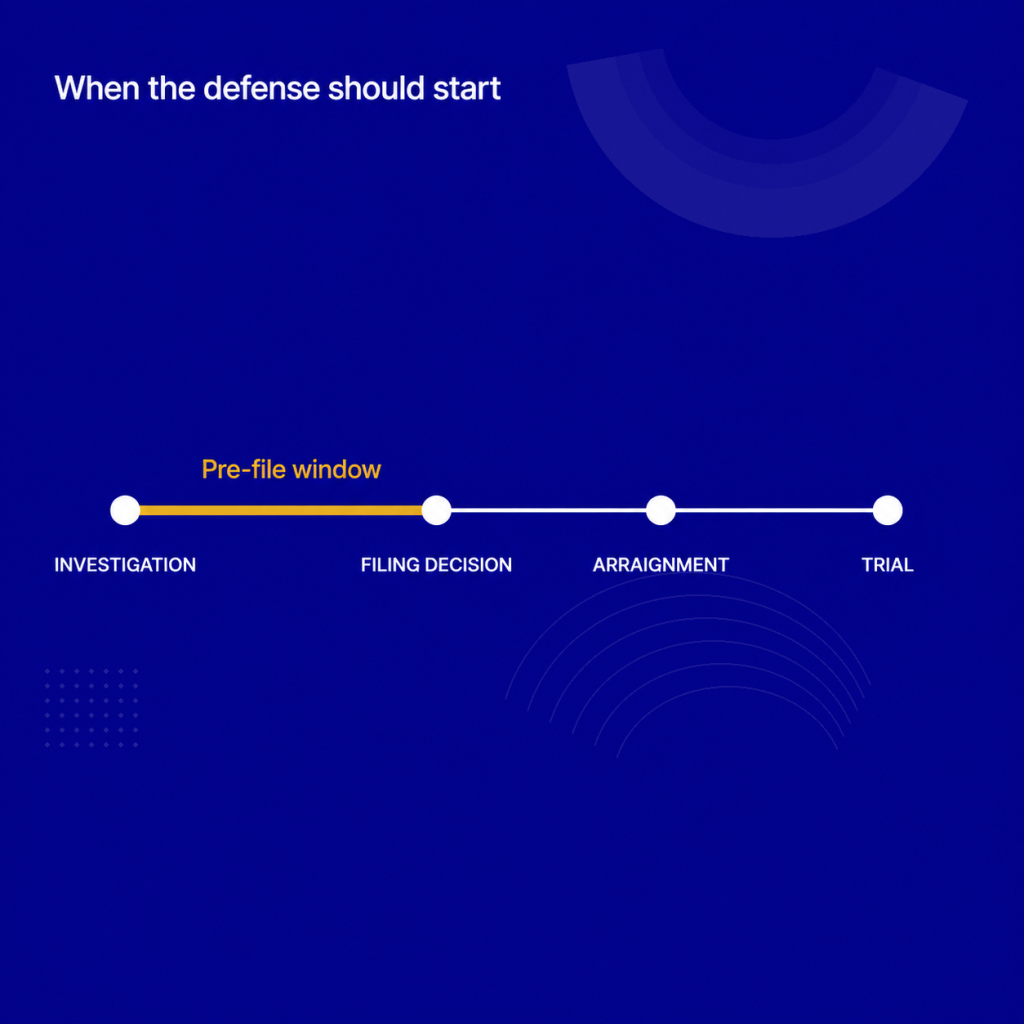
In practice, that work breaks down into several steps:
- Preserve evidence immediately. Surveillance footage gets overwritten. Apps delete messages. Witnesses’ memories fade. Location providers have limited retention windows. The defense team’s first job is identifying and preserving everything that could matter before it disappears.
- Investigate independently. A private investigator builds a timeline and interviews witnesses. A DNA expert examines raw laboratory data. A forensic pathologist reviews medical findings. A digital forensics specialist evaluates actual device artifacts rather than relying on a police summary.
- Make a strategic disclosure. A targeted pre-file submission can demonstrate an impossible timeline, an alibi supported by independent records, consensual communications between the parties, a flawed DNA interpretation, an alternative medical explanation, or a fatal statute-of-limitations problem. The decision about what to disclose is case-specific because pre-file advocacy can also reveal defense strategy prematurely.
- Request a no-file decision. The goal is not always to prove every trial defense in advance. Sometimes it is enough to demonstrate that the available evidence does not support the contemplated charge.
We have prevented charges from being filed in multiple sex crime investigations through this process. (Each case is unique. Past results do not guarantee future outcomes.) Pre-file advocacy is threaded throughout the defenses below because many of them are more effective when the work begins before filing, not after.
Consent as a Defense in Adult Sexual Battery Cases
In many adult sexual battery prosecutions, the central question is whether the sexual act occurred without the victim’s consent. Under Florida Statute 794.011, consent means intelligent, knowing, and voluntary consent. The statute specifically states that a lack of physical resistance does not equal consent. It also defines circumstances where a person’s condition (mental incapacitation, physical helplessness, unconsciousness) makes purported consent legally ineffective.
A consent defense is strongest where the charged offense actually turns on lack of consent and the evidence permits a reasonable inference of voluntary agreement. Building it requires reconstructing what happened before, during, and immediately after the encounter. That means gathering contemporaneous texts, dating-app messages, call records, photographs, location history, witness accounts of the parties’ interactions, and any subsequent communications.
Where an accuser’s account has changed over time, Florida Statute 90.608 expressly permits credibility challenges through prior inconsistent statements, evidence of bias, defects in the ability or opportunity to perceive or remember, and contradictory testimony from other witnesses.
What consent does NOT cover: Consent is expressly unavailable in important categories of cases involving minors. Under Section 800.04, the victim’s consent is not a defense to lewd or lascivious offenses. That statute also eliminates reliance on ignorance of age, the minor’s misrepresentation of age, or a bona fide belief that the victim was older. Consent applies to specific adult sexual battery charges, not to sex offenses generally.
False Allegations and Credibility Challenges
False allegations do occur. Accusations can be driven by custody disputes, divorce proceedings, breakups, financial conflicts, or personal vendettas. But the defense cannot simply assert “the accusation is false” and expect that to carry the day. The question is always whether objective evidence supports the theory.
A credibility defense built on alleged fabrication requires:
- Evidence of the accuser’s motive (custody filings, divorce records, financial disputes, prior threats)
- Objective evidence contradicting the accusation (full message threads, call logs, social media records, location history, witness statements, detailed chronology)
- Prior inconsistent statements or changes in the accuser’s account
- Gaps between the allegation and the physical, forensic, or digital evidence
Section 90.608 makes bias and prior inconsistent statements legitimate impeachment tools. Section 90.614 governs how those prior statements get used at trial. Extrinsic evidence of a prior inconsistent statement is generally inadmissible unless the witness first has an opportunity to explain or deny it. The defense is not limited to arguing the accuser is lying. It can also demonstrate that the accuser’s perception, memory, or account is unreliable.
One important note on the data: credible research estimates that demonstrably false reports of sexual assault fall in the range of roughly 2 to 10 percent, and a 2026 scoping review of child sexual abuse allegations in custody proceedings found that deliberately false allegations appeared rare. An “unsubstantiated” allegation is not the same thing as a “fabricated” allegation. When a defense theory involves fabrication, it must be supported by case-specific evidence, not by statistics.
Our article on false confessions covers a related issue: how interrogation tactics can produce unreliable statements even from innocent people.
Alibi and Mistaken Identity
An alibi defense places the accused somewhere other than the scene of the alleged crime at the time it allegedly occurred. Florida Rule of Criminal Procedure 3.200 creates a formal notice-of-alibi process. After a prosecutorial demand specifying the place, date, and time of the alleged offense, a defendant intending to offer alibi evidence must serve notice at least 10 days before trial, with reciprocal disclosure for alibi witnesses.
An effective alibi is rarely built on a single data point. The strongest presentations reconcile several independent records with a precise timeline: surveillance video, toll or transaction records, employer records, access logs, photographs, phone records, and GPS or location data. Digital records require forensic examination rather than face-value acceptance.
Mistaken identity is related but distinct. Where the accused is identified by an eyewitness, the defense can challenge the witness’s opportunity and ability to observe, the conditions under which the identification was made, the reliability of the identification procedure, and whether contradictory witnesses, surveillance, or DNA exclusion evidence points to someone else.
At the pre-file stage, alibi and identity evidence is especially time-sensitive. Video gets overwritten on fixed schedules. Transaction records have retention limits. Neutral witnesses are easier to locate and interview while their memories are fresh.
Challenging DNA Evidence
A DNA report that says the defendant’s profile “matches” the evidence sample answers a much narrower question than many people assume. According to NIST’s 2024 scientific foundation review of DNA mixture interpretation, modern methods can obtain profiles from very small quantities of biological material, including only a few skin cells. That sensitivity increases the importance of questions about mixtures, contamination, transfer, persistence, low-template effects, and the assumptions behind statistical conclusions.
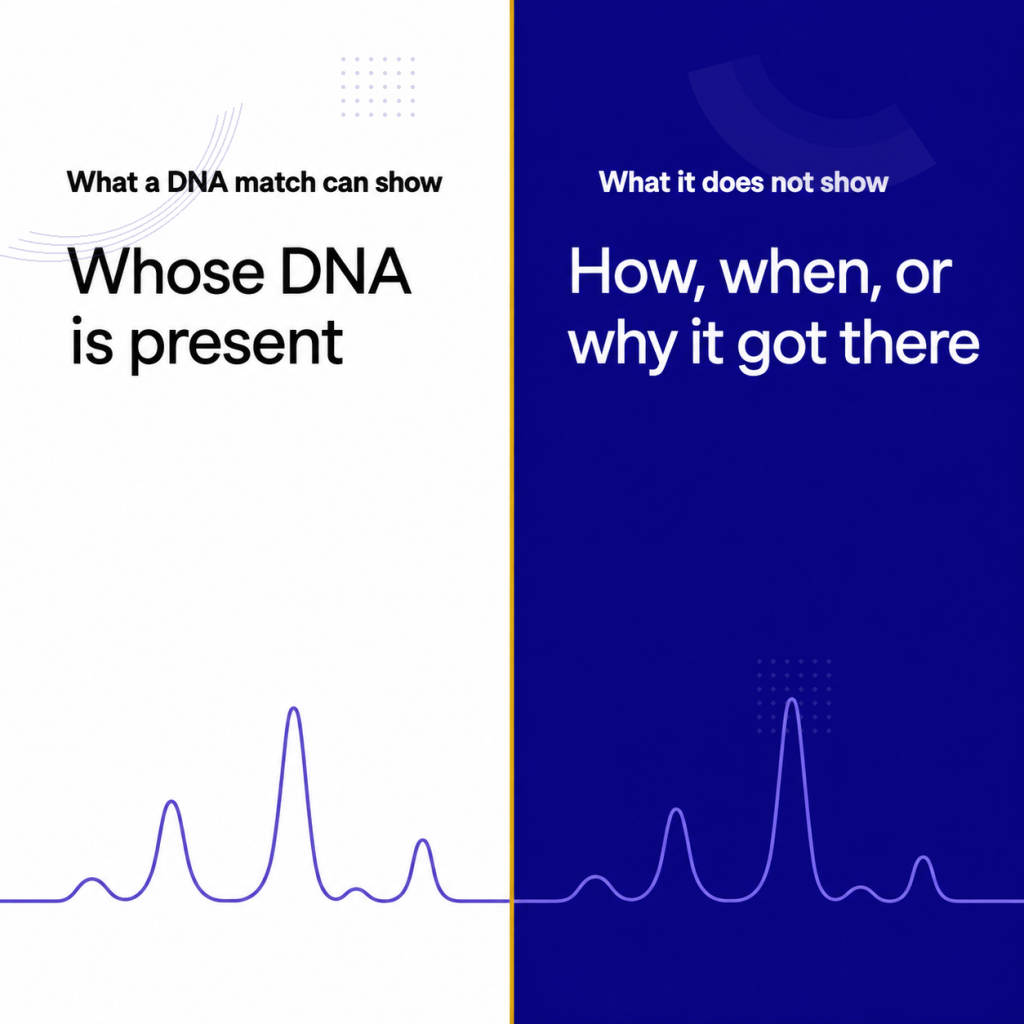
A DNA result may strongly support a proposition about whose DNA is present without resolving how, when, or why it was deposited. That distinction is significant in cases involving consensual prior contact, shared environments, mixed samples, or trace DNA.
A serious forensic DNA challenge involves obtaining and reviewing:
- Electropherograms and underlying electronic data
- Quantitation results and analyst worksheets
- Controls, reagent records, and contamination logs
- Contributor assumptions and analytical thresholds
- Software version and validation materials
- Likelihood-ratio propositions and population assumptions
- Chain of custody documentation
This is where our firm has achieved some of its most significant results. In a cold-hit sexual battery case involving an eight-year-old crime, we subpoenaed the state laboratory’s bench notes, obtained the raw electronic DNA data, and retained an expert geneticist who demonstrated that the state’s analyst had misinterpreted an allele at a critical locus. The DNA did not match at the required threshold. One of the state’s own experts agreed, and the prosecutor dismissed the case entirely. Our client, a combat veteran, was fully exonerated. (Each case is unique. Past results do not guarantee future outcomes.)
Under Florida Statute 90.702, the defense can challenge an expert opinion where the underlying facts are insufficient, the methodology is unreliable, or reliable methodology has been applied unreliably. This framework (often called “Daubert” after the U.S. Supreme Court decision that established it) has been part of Florida law since 2013, when the Legislature rewrote Section 90.702, and was formally adopted as a procedural rule by the Florida Supreme Court in 2019.
For deeper reading, see our forensic science defense page and our DNA evidence defense case study.
Challenging Medical Evidence and SANE Findings
Sexual Assault Nurse Examiner (SANE) findings are frequently treated as definitive evidence of assault. The science tells a different story.
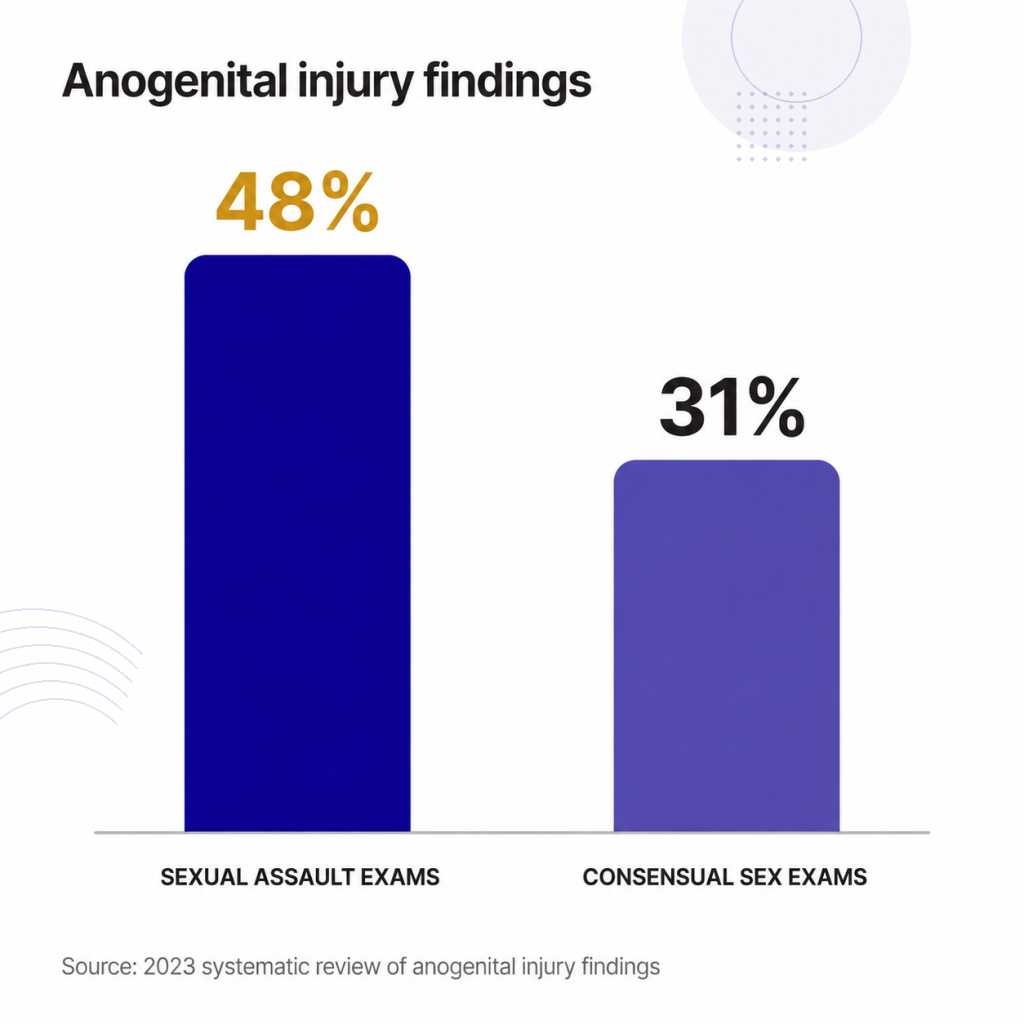
A 2023 systematic review examining over 3,100 participants found that anogenital injury appeared in roughly 48% of sexual assault examinations and in about 31% of consensual sex examinations. More than half of examined sexual assault complainants had no detectable injury. The researchers cautioned that the pooled results could overestimate the distinction, and a higher-quality subgroup showed no statistically significant difference.
The takeaway cuts both ways: injury does not by itself establish non-consent, and the absence of injury does not establish consent or disprove assault.
A defense medical review should examine:
- The timing of the examination relative to the alleged event
- The exact location and nature of each finding
- Whether findings were photographed
- Alternative consensual or non-sexual causes
- Normal anatomical variants
- Whether the examiner moved from observed “findings” to unsupported opinions about mechanism or consent
In a notable April 2026 decision, the Fourth District Court of Appeal held in Henderson v. State that a nurse practitioner who had not examined the complainant could not act as a conduit for another examiner’s report. The substitute witness admitted she had no independent knowledge of the patient or case. The court found her recounting of the clinical injury description was inadmissible hearsay. This is a point we regularly make: a medical defense is not limited to disputing the science. It also asks who performed the examination, who made each observation, what foundation exists, and whether an expert is merely repeating another person’s report.
Read our full guide on SANE nurse evidence in Tampa Bay.
Digital Forensics Defenses
In internet sting cases, child sexual abuse material (CSAM) cases, and any charge built on digital evidence, the defense must separate several propositions that the prosecution often compresses into a single claim.
| What the Prosecution Asserts | What the Defense Investigates |
| “It came from his computer” | Who owned the device? Who else had physical or remote access? |
| “It was downloaded intentionally” | Was the material cached, synchronized, or auto-downloaded? What do file-system artifacts show? |
| “The timestamps prove it” | Were time zones set correctly? Were creation, download, and access times properly interpreted? |
| “The IP address identifies the defendant” | Does network, account, and device evidence connect the relevant conduct to the specific person? |
NIST’s scientific foundation review of digital investigation techniques treats digital forensics as a structured discipline involving preservation, acquisition, examination, analysis, and reporting. The defense team’s job is to evaluate each of those stages rather than taking the prosecution’s summary at face value.
Florida law also imposes special discovery rules for CSAM evidence. Under Section 92.561, the material must remain in government or court custody. The defense and its expert can inspect and examine the evidence at a designated facility, but it cannot simply be copied and sent to the expert’s laboratory. Defense counsel needs to plan expert review logistics early so the examination is not squeezed against trial deadlines.
A 2026 statutory update: Effective July 1, 2026, Florida replaced the statutory term “child pornography” with “child sexual abuse material” (CSAM) in numerous provisions and increased penalties for several offenses under Chapter 2026-20.
For more on internet sting defenses, see our article on vigilante predator catchers in Florida.
Constitutional Challenges: Illegal Searches and Coerced Statements
Search and Seizure
Article I, Section 12 of the Florida Constitution requires that search-and-seizure rights be construed in conformity with the Fourth Amendment as interpreted by the U.S. Supreme Court. In a sex crime case built on a phone, computer, cloud account, or home search, the defense can challenge probable cause, the nexus between the suspected crime and the place searched, the particularity of the warrant, and whether the warrant affidavit contained material falsehoods or omissions.
In State v. Domenech, a Second DCA case arising from a child pornography investigation, the circuit court found false statements in a detective’s warrant affidavit and suppressed the evidence. The Second DCA reversed, holding that even after setting the challenged statements aside, the remaining affidavit content supported probable cause. The case illustrates both the opportunity and the difficulty: a warrant affidavit can contain serious problems and still survive if the remaining content independently supports probable cause. A defense team must map each alleged misstatement, establish the required state of mind (deliberate falsity or reckless disregard, not mere negligence), and reconstruct the affidavit without the tainted material.
Digital cases often present the highest-value suppression opportunities because a single warrant may produce the device, communications, images, search history, and admissions on which the entire prosecution is built.
Statements and Interrogation
In State v. Pastor (Fifth DCA, August 2025), the appellate court addressed post-Miranda statement suppression. It reiterated that once a person in custodial interrogation unequivocally invokes the right to counsel, questioning must stop until counsel is available or the person reinitiates the conversation. The court reversed suppression because it concluded the invocation was not sufficiently unequivocal and, alternatively, that the suspect reinitiated discussion.
A defense review of any interrogation should analyze whether the interaction was custodial, the adequacy of warnings and waiver, whether silence or counsel was invoked, whether reinitiation occurred, and whether the statement was voluntary. Pre-file counsel can also decide whether the client should give any interview at all, which is often the most consequential decision of the entire case.
Entrapment in Internet Sex Sting Operations
“It was a sting” is not the same thing as entrapment. Florida Statute 777.201 uses a subjective framework: entrapment occurs when law enforcement induces or encourages a person to commit a crime through methods that create a substantial risk the crime will be committed by someone not already ready to commit it. The defendant bears the burden of proving entrapment by a preponderance of the evidence.
Merely creating the opportunity to offend is not enough. The defense must show actual inducement: persistent persuasion, fraud, coercive tactics, appeals to sympathy, or escalation after the target expressed reluctance. In State v. Lopez-Garcia (Second DCA, 2022), the court emphasized that giving someone an opportunity to offend does not constitute entrapment and that predisposition is ordinarily a fact question for the jury.
In an internet sex sting case, building an entrapment defense means obtaining the full, unedited communication history and analyzing who first introduced sexual content, how often the accused hesitated or declined, whether law enforcement escalated after reluctance, what inducements were offered, and what the accused did independently.
Read our sex sting defense guide for deeper analysis.
Williams Rule and Prior Bad Acts Evidence
Florida’s rules on prior-act evidence in sex crime cases are broader than many defendants expect. The traditional “Williams Rule” under Section 90.404(2)(a) allows similar-act evidence for purposes like proving motive, intent, identity, or absence of mistake, but not solely to prove bad character.
However, Florida separately enacted much broader provisions for sex offense cases. Section 90.404(2)(b) allows other child-molestation acts to bear on any relevant matter in a qualifying child-molestation prosecution, and Section 90.404(2)(c) does the same with other sexual offenses in qualifying sexual-offense prosecutions.
The defense still has avenues to challenge this evidence:
- Whether the alleged prior act qualifies under the statute
- Whether the State provided adequate 10-day pretrial notice
- Whether dissimilarity or remoteness reduces probative value
- Whether the presentation becomes cumulative or a distracting mini-trial
- Whether Section 90.403 requires exclusion because unfair prejudice substantially outweighs probative value
Defense investigation of a proposed Williams Rule witness should be nearly as intensive as investigation of the charged allegation itself: original reports, identification history, communications, timing, inconsistencies, and whether similarities are genuine or selectively presented.
For our full analysis, see our article on Williams Rule in sex crimes.
Florida’s Rape Shield Law
Section 794.022 prohibits evidence of specific consensual sexual activity between the complainant and persons other than the accused, bars reputation evidence about prior sexual conduct, and makes arguments based on the complainant’s clothing irrelevant.
The statute does contain defense-relevant exceptions. An in-camera hearing can allow evidence of third-party sexual activity where it could establish an alternative source of semen, pregnancy, injury, or disease. When consent is at issue, a separate narrowly worded exception may apply if a highly similar pattern is shown to be relevant.
These exceptions intersect directly with forensic defense work. When the prosecution infers assault from semen or genital injury, a defense expert can provide the factual foundation needed to make a rape-shield exception legally relevant by identifying a scientifically plausible alternative source of DNA or injury.
An important statutory note: Section 794.022 also states that a sexual battery complainant’s testimony does not require corroboration. The State does not need DNA, physical injuries, or an eyewitness before a case can proceed. Defense strategy must account for this.
Our full guide on Florida’s rape shield law covers the procedural requirements and exceptions in detail.
Child Hearsay Challenges
Under Section 90.803(23), an out-of-court statement by a child concerning abuse or an unlawful sexual act can be admitted only after the court holds a hearing outside the jury’s presence and finds sufficient safeguards of reliability. The statute invites consideration of the child’s age and maturity, the nature and duration of the alleged abuse, the relationship to the alleged offender, and the reliability of both the statement and the child.
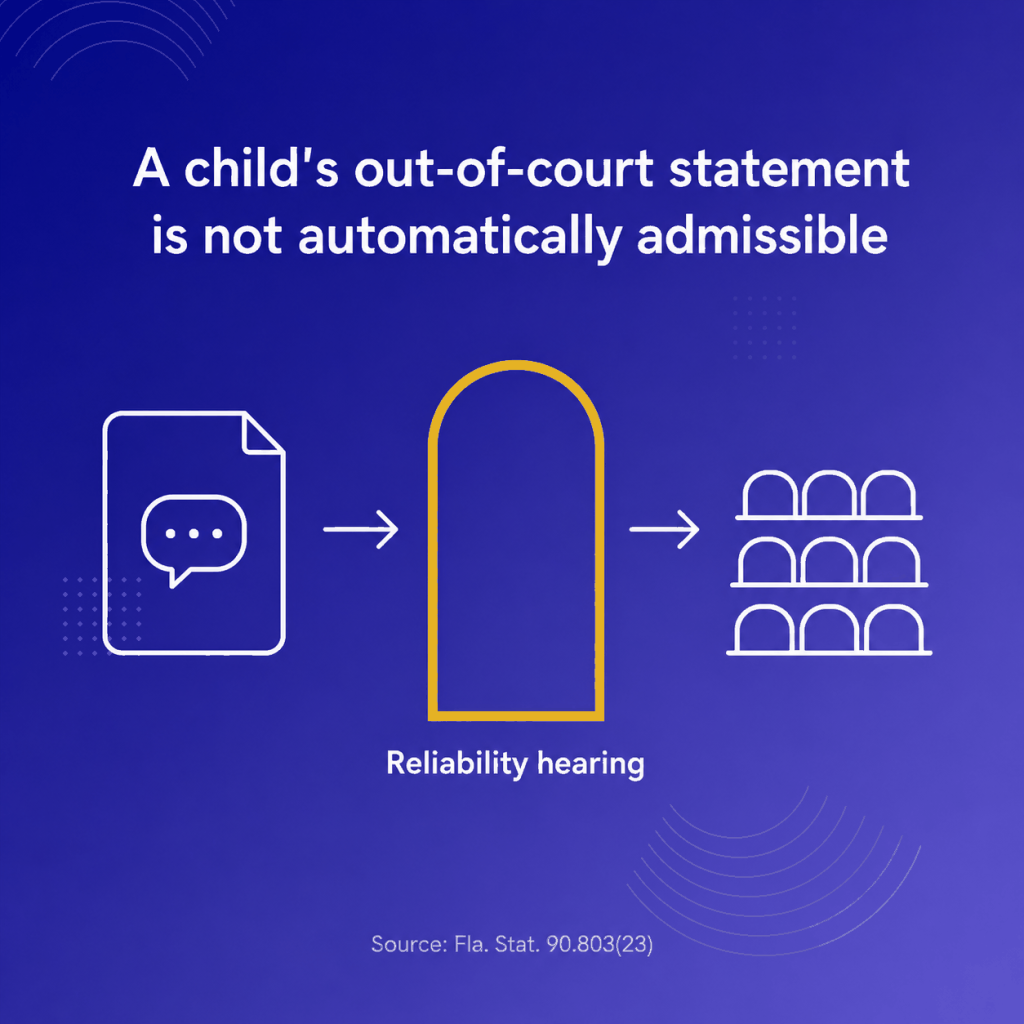
A 2024 amendment expanded this provision to cover a child whose physical, mental, emotional, or developmental age is 17 or less.
Defense litigation can target the reliability hearing itself:
- Was the initial disclosure elicited through repeated or suggestive questioning?
- Who first brought up the allegation?
- Did the child’s account change between versions?
- Was age-appropriate language used?
- Was the child exposed to adult information about the alleged events?
- What was the sequence of family, law enforcement, and forensic interviews?
- Were interviewer techniques consistent with accepted protocols?
- Was statutory notice provided at least 10 days before trial?
- If the child is unavailable, does the required corroborative evidence exist?
Unrecorded interviews are not automatically inadmissible. In Oliver v. State (Second DCA, July 2024), the court affirmed child hearsay from unrecorded law enforcement and child protection interviews where the trial court made sufficient reliability findings. The absence of a recording can support a reliability challenge, but it does not by itself result in exclusion. The defense has to connect the problem to the statutory criteria.
For a deeper analysis, see our child hearsay defense guide.
Statute of Limitations in Florida Sex Crimes
Florida’s sex crime limitation rules under Section 775.15 are far more complex than most people realize. The answer depends on the exact offense, the degree at the relevant time, the victim’s age, the date the offense allegedly occurred, the date it was reported, whether any later statutory amendments extended the deadline, whether DNA identification provisions apply, and whether the case was already time-barred before an extension took effect.
A few examples of the current framework:
| Circumstance | Limitation |
| Capital or life felony | No time limit |
| Sexual battery on a victim under 18 (offense on or after July 1, 2020) | No time limit |
| First- or second-degree sexual battery, victim 16+, reported within 72 hours | No time limit |
| First- or second-degree sexual battery, victim 16+, no 72-hour report | Eight years |
| Lewd or lascivious offenses on a victim under 16 | Generally no time limit (exceptions for close-in-age situations) |
| Identity established through DNA after the original period | Special DNA-identification provisions with conditions |
Section 775.15 repeatedly preserves cases that were already time-barred before a later extension took effect. A limitations defense therefore requires an offense-date-specific analysis, not a glance at the current statute.
Where a historical accusation is facially time-barred, counsel can put the statutory analysis before the prosecutor before an information is filed. This is one of the clearest applications of pre-file advocacy.
What Is NOT a Defense in Florida
Florida Statute 794.021 states plainly: where criminality depends on the victim being below a specified age, ignorance of the victim’s age, misrepresentation by the victim, and a bona fide belief that the victim was older are not defenses. Section 800.04 independently contains the same prohibition for lewd or lascivious offenses.
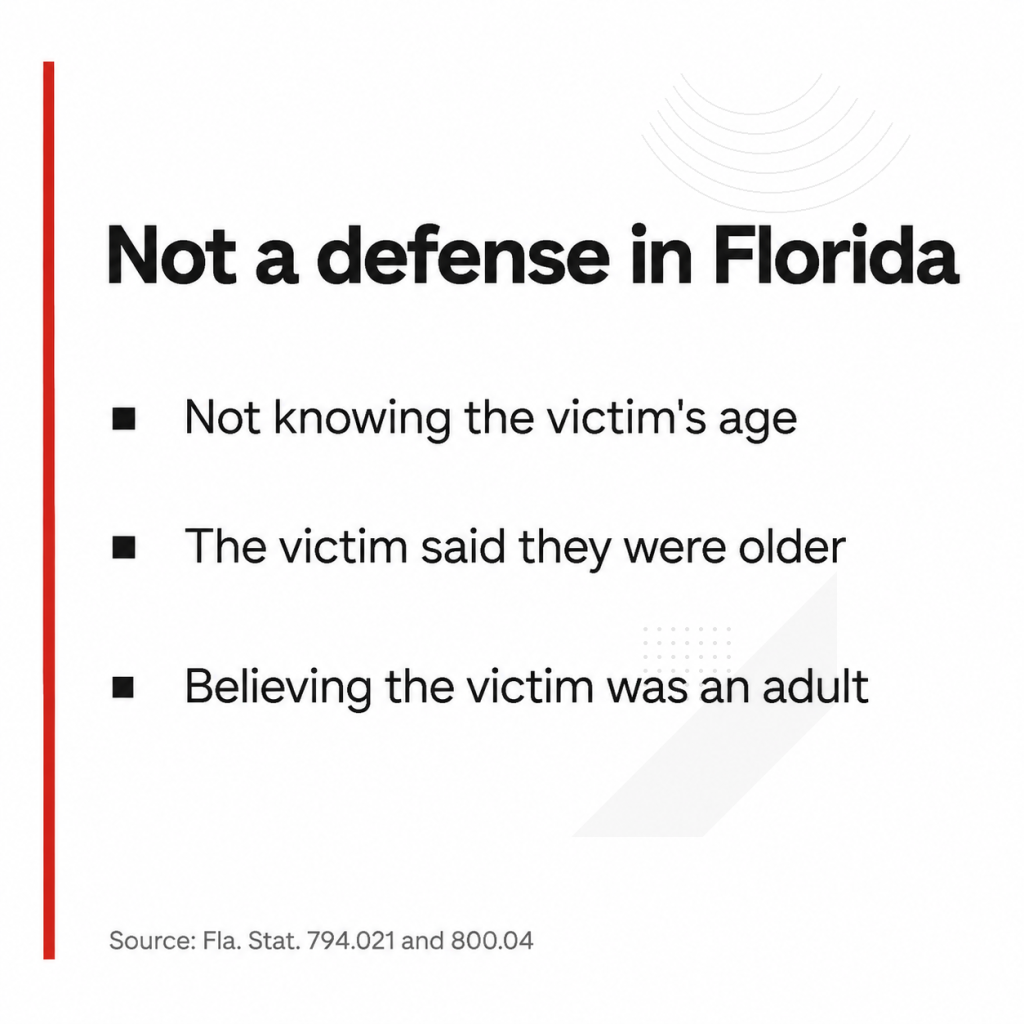
“The profile said 18,” “the minor told me she was 18,” and “I genuinely believed he was of age” cannot simply be presented as defenses where these statutes govern.
This does not mean the communications are irrelevant to every possible issue. In an undercover case involving no actual minor, what the accused was told and what the accused believed can bear on the elements and intent of the particular offense. But counsel must distinguish those element questions from a prohibited age-mistake defense.
Our article on ignorance of the victim’s age covers this in full.
Talk to a Defense Team That Handles These Cases
If you or someone you care about is facing a sex crime charge or investigation in Tampa Bay, the defense needs to start now. Evidence disappears. Witnesses forget. Filing decisions are made. The earlier we get involved, the more we can protect.
The Brancato Law Firm defends clients facing sex crime charges across Hillsborough, Pinellas, and Pasco Counties. We handle sexual battery, lewd or lascivious offenses, internet sex stings, CSAM cases, child abuse allegations, and sex offender registration challenges, with the forensic science capability and trial experience these cases require.
Call (813) 727-7159 for a free, confidential consultation.
Visit Us
Tampa, FL 33602
Contact Us Now
Free Legal Consultation (813) 727-7159