- Free Consultation 24/7: (813) 727-7159 Tap Here To Call Us


From First DUI to Death Penalty



Messaged a Minor Online in Florida? What to Do Right Now (2026)



Fully rewritten and updated October 26, 2026.
If you messaged a minor online in Florida, stop all contact now, do not delete anything, do not talk to police or the other person’s family, and speak with a defense lawyer before anyone knocks on your door. Messages alone can be a crime: using a phone, app, or computer to solicit a child, or a person believed to be a child, for sex is a third-degree felony under section 847.0135(3), Florida Statutes, punishable by up to five years in prison, and a conviction requires sex offender registration. Whether a crime was committed depends on what was said, what was sent, and what you believed about the other person’s age, so the next steps you take matter.
If you just realized the person you were chatting with is underage, or you received a message from someone claiming to be a parent or a detective, the hours that follow can shape whether you are ever charged. As founder of The Brancato Law Firm, P.A., a Tampa criminal defense firm, I handled sex crimes cases in the Major Crimes Unit of the Hillsborough County Public Defender’s Office before going on to serve as its Chief Operations Officer, overseeing a staff of over 100 attorneys. Our attorneys represent people at this stage, before an arrest, and we read the full conversation before giving advice about what happens next.
What Should You Do Right Now If You Messaged a Minor Online?
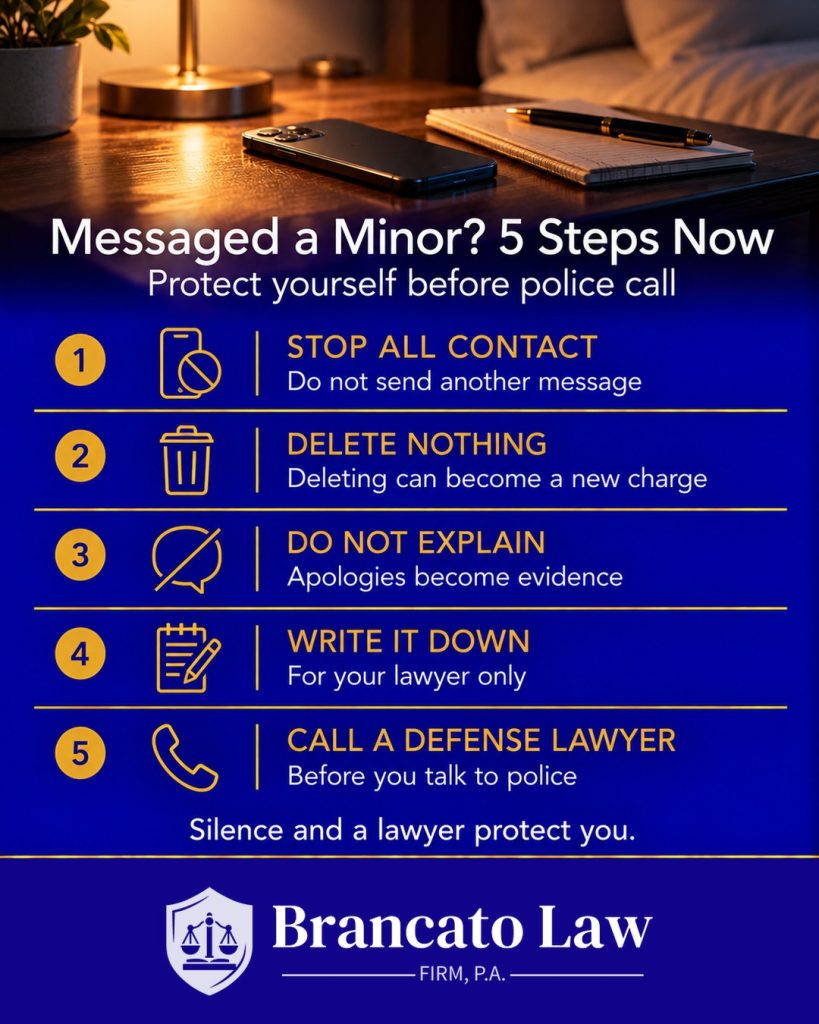
Stop, preserve, stay silent, and call a lawyer. These five steps protect you whether the other person is a real teenager, an adult who lied about age, a detective, or a vigilante group:
| Step | What to do | Why it matters |
|---|---|---|
| 1 | Stop all communication | Every new message is new evidence, and each separate use of a device can be charged as a separate offense |
| 2 | Do not delete messages, apps, or accounts | Deleting can be charged as tampering with evidence and can destroy messages that help your defense |
| 3 | Do not explain, apologize, or confront anyone | Statements to the other person, a parent, or a vigilante can be recorded and used in court |
| 4 | Write down what you remember for your lawyer only | Which app, how the chat started, what the profile said about age, and who raised sex first |
| 5 | Call a defense attorney before speaking with police | Early representation can shape whether, and how, the State files charges |
Can You Be Charged for Messaging a Minor Online in Florida?
Yes. Under section 847.0135(3), Florida Statutes, it is a crime to knowingly use “any other device capable of electronic data storage or transmission” to “seduce, solicit, lure, or entice, or attempt to seduce, solicit, lure, or entice, a child or another person believed by the person to be a child” to engage in unlawful sexual conduct. No meeting is required. In Cashatt v. State, 873 So. 2d 430 (Fla. 1st DCA 2004), a man arranged online to meet a “14-year-old boy” in Jacksonville who was actually a vice detective. The First District upheld his conviction and held that “the Internet communications alone constituted a prima facie case of guilt” under the statute.
Cashatt also matters for anyone who believed the other person was an adult. The court rejected the argument that the statute had no mental state as to age, holding that the statute is presumed to require knowledge “including the age of the child sought to be ‘lured.'” In practice, that means what you knew or believed about the person’s age is central to whether the solicitation statute applies.
Which Florida Charges Can Come From Online Messages to a Minor?
The charge depends on what was said, what was sent, and whether anyone traveled to meet. Our Tampa internet crimes attorney page covers each of these in more depth.
| What happened | Possible charge | Degree and maximum | Sex offender registration? |
|---|---|---|---|
| Messages asking a child, or a person believed to be a child, for sex | Solicitation of a child by computer, s. 847.0135(3) | Third-degree felony, 5 years; second-degree, 15 years, if you misrepresented your age | Yes |
| Driving or traveling to meet after those messages | Traveling to meet a minor, s. 847.0135(4) | Second-degree felony, 15 years | Yes |
| Live video exposure or sexual act seen by a person under 16 | Lewd or lascivious exhibition using a computer, s. 847.0135(5) | Second-degree felony, 15 years, for an offender 18 or older | Yes |
| Sending obscene images or videos to a person under 18 | Transmitting obscene material to a minor, s. 847.0133 | Third-degree felony, 5 years | Yes |
| Using a phone to facilitate a felony | Unlawful use of a two-way communications device, s. 934.215 | Third-degree felony, 5 years | No |
Registration follows from the list of qualifying offenses in section 943.0435, Florida Statutes, which includes section 847.0133 and section 847.0135 (other than subsection 6). Section 847.0133 defines a minor as “any person under the age of 18 years.” Our guide to sex offender registration in Florida explains what registration requires.
What If You Did Not Know the Person Was a Minor?
It depends on the charge. For computer solicitation, your belief about age is part of what the State must prove, so an adult profile, an adult photo, or a stated adult age can be strong evidence. For in-person sexual contact, the rule is the opposite: under section 800.04(3), Florida Statutes, “the perpetrator’s ignorance of the victim’s age, the victim’s misrepresentation of his or her age, or the perpetrator’s bona fide belief of the victim’s age cannot be raised as a defense” to lewd or lascivious offenses involving someone under 16.
That difference is why the conversation should end the moment you learn the person may be underage. Our age of consent in Florida guide explains the age lines in Florida law.
Was It a Real Minor or a Police Sting?
Many of these cases involve no real child at all. In our practice, Hillsborough County Sheriff’s Office online stings follow two patterns: a deputy answers or posts an adult ad and then claims a teenage age once the conversation is under way, or a deputy poses as an adult offering access to a child. If you were talking with a detective, entrapment and charge-stacking defenses may apply; our post on solicitation of a child using a computer covers those defenses and the leading cases in detail.
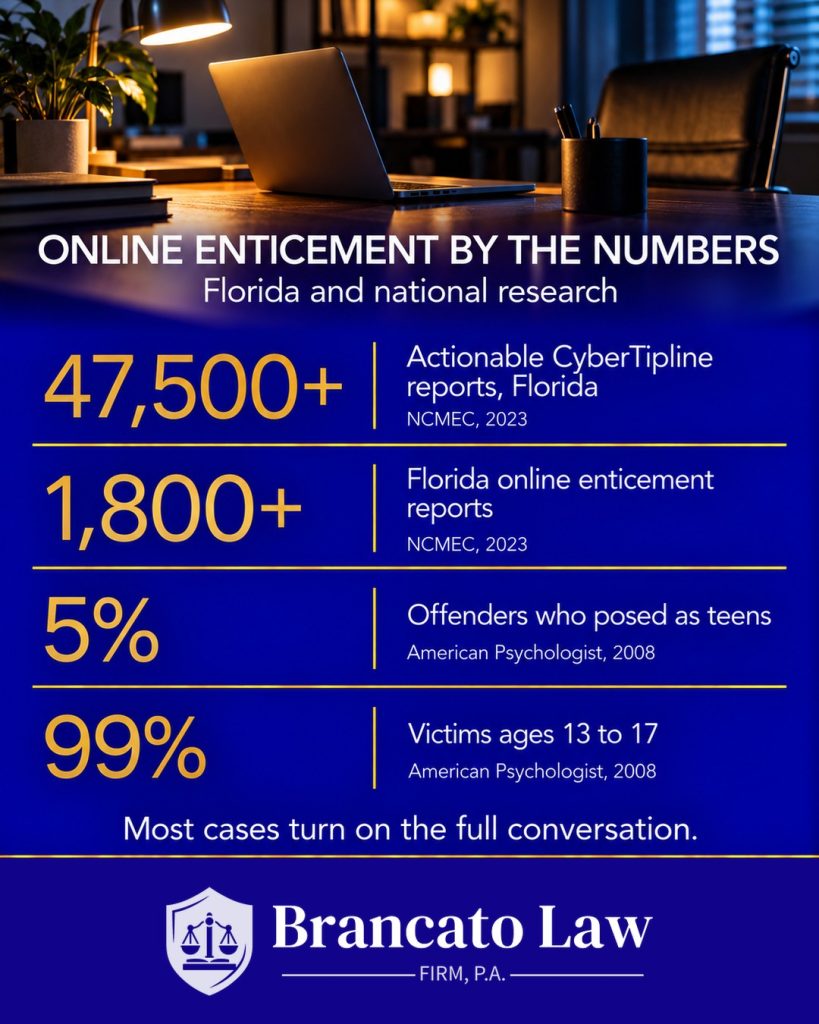
Research on real cases points the other way from popular belief. In “Online ‘Predators’ and Their Victims,” published in American Psychologist in 2008 (vol. 63, pp. 111-128), researchers Janis Wolak, David Finkelhor, Kimberly Mitchell, and Michele Ybarra of the University of New Hampshire’s Crimes Against Children Research Center reported that in their national study of arrests, only 5 percent of offenders pretended to be teens when they met potential victims online, and 99 percent of victims of internet-initiated sex crimes were ages 13 to 17. The cases that reach court are usually about older teenagers and conversations that moved toward sex over time, which is why the full chat history matters.
How Do These Investigations Usually Start?
Most investigations start with a report from a parent, a platform, or a tip to the National Center for Missing and Exploited Children. NCMEC reports that in 2023, Florida law enforcement received more than 47,500 actionable CyberTipline reports, and more than 1,800 of them concerned suspected online enticement, including sextortion.
Signs you may already be under investigation include:
- The other person suddenly reveals an underage age after a sexual turn in the conversation.
- The account blocks you, disappears, or is replaced by a message from someone claiming to be a parent.
- Someone asks you to meet, then sends a location you do not recognize.
- A detective calls, leaves a card, or asks you to “come in and talk.”
- Your service provider notifies you of a legal request for your account records.
Our article on signs you are being investigated for a crime in Florida covers other warning signs.
Should You Talk to Police If a Detective Contacts You?
No, not without a lawyer. A detective who calls or knocks is usually trying to confirm that you were the person typing the messages, and a voluntary interview often supplies the identity proof the State does not yet have. You can politely decline to answer questions, decline consent to search your phone, and ask for your lawyer. If officers have a search warrant, do not resist, but do not discuss the case.
Early representation gives the defense a chance to act before the State’s charging decision. Our page on representation before charges are filed explains how our attorneys communicate with investigators and prosecutors on a client’s behalf. If the first contact came from a self-described predator-catcher group rather than police, see our post on vigilante predator catchers in Florida.
How Can a Defense Attorney Help Before You Are Charged?
A defense attorney can review the conversation, preserve evidence that helps you, and keep you from making the statements that most often prove the State’s case. Our attorneys focus on four questions in every case:
- What did the messages actually say? Sexual talk is not always solicitation; the State must prove an attempt to seduce, solicit, lure, or entice.
- What did you believe about age? The profile, the photos, and when age was first mentioned matter under Cashatt.
- Can the State prove you sent the messages? Shared phones, shared accounts, and incomplete screenshots can leave doubt about identity.
- Was there inducement? If a detective or decoy pushed the conversation toward sex after you pulled back, entrapment may apply.
Frequently Asked Questions About Messaging a Minor Online in Florida
Can I go to jail for texting a 16-year-old in Florida?
You can if the messages solicited sexual conduct, or if you sent obscene material, because Florida treats anyone under 18 as a minor for these offenses. The Brancato Law Firm reviews the actual messages before advising a client, since ordinary conversation is not a crime.
Should I delete the messages if I talked to a minor online?
No, deleting messages can lead to a tampering charge and can destroy proof that the other person claimed to be an adult. Our attorneys at The Brancato Law Firm preserve the full conversation so it can be reviewed for defenses; see our internet crimes defense page.
What if the minor said they were 18?
A stated adult age is strong evidence on the belief element of computer solicitation, but it does not help if the case involves in-person sexual contact with someone under 16. The Brancato Law Firm builds the defense around the exact point where age entered the conversation.
Can a parent press charges for messages to their child?
A parent can report the messages, but the State Attorney’s Office, not the parent, decides whether to file charges. Our attorneys at The Brancato Law Firm can contact the prosecutor before a decision is made; learn more about pre-file advocacy.
How long does an online solicitation investigation take in Florida?
It can take days in a sting case and months when police need records from an app or phone carrier, and an arrest can come without warning. The Brancato Law Firm advises clients during that window so they do not make statements that strengthen the case.
Can charges for messaging a minor be dropped in Florida?
Yes, charges can be declined or dismissed when the messages do not show solicitation, the State cannot prove who sent them, or entrapment applies. The Brancato Law Firm presents those problems to prosecutors early, and when a case is filed we file the motions that test them in court.
Call a Tampa Defense Attorney Before You Talk to Anyone
What you say in the first conversation with a detective can matter more than anything in the chat. Before you answer a call or open the door, talk with The Brancato Law Firm, P.A., founded by Tampa Criminal Defense Attorney Rocky Brancato, at (813) 727-7159. Our attorneys will review the conversation with you and tell you what to expect. You can call us at any hour, and our office is two blocks from the courthouse. Our firm has Spanish-speaking staff, and attorney Jean-Luc Adrien speaks Spanish, Haitian Creole, and French.
For more about our defense strategies, visit our Tampa Internet Crimes Attorney page, or our Tampa sex crimes lawyer page.
The Brancato Law Firm, P.A.
620 E. Twiggs Street, Suite 205, Tampa, FL 33602
(813) 727-7159
Serving Hillsborough, Pinellas, and Pasco Counties
The Brancato Law Firm, P.A. is a Tampa-based criminal defense practice. We are not affiliated with any other Brancato-named law firms.
Visit Us

Tampa, FL 33602

Contact Us Now
Free Legal Consultation (813) 727-7159
