- Free Consultation 24/7: (813) 727-7159 Tap Here To Call Us


From First DUI to Death Penalty



What Is Sexual Battery in Florida? Definition, Penalties, and How to Fight the Charge (2026)


Fully rewritten and updated October 23, 2026.
Sexual battery in Florida is oral, anal, or female genital penetration by, or union with, the sexual organ of another, or anal or female genital penetration by any other object, under section 794.011, Florida Statutes. It is always a felony, ranging from a second-degree felony (up to 15 years) to a capital felony when an adult is accused of sexual battery on a child under 12. For complainants 12 or older, the State must prove the person did not consent, and a conviction requires sex offender registration. Most cases are fought on actual consent, identity and DNA, and the reliability of the accusation.
Sexual battery cases in Hillsborough County are usually decided by one witness’s account and how well it holds up under cross-examination, long before anyone argues to a jury. I learned that in the Major Crimes Unit, where homicide, sex crimes, and child abuse cases were assigned, and I have spent more than 25 years in Hillsborough County courtrooms since. I’m Rocky Brancato, founder of The Brancato Law Firm, P.A., a Tampa criminal defense firm, and our attorneys defend sexual battery charges from second-degree felonies to capital cases across Hillsborough, Pinellas, and Pasco Counties, often starting before a charge is filed.
For an overview of every Florida sex offense, see our guide to sex crime charges in Florida.
What Is Sexual Battery Under Florida Law?
Sexual battery is the Florida crime for nonconsensual oral, anal, or vaginal sex, and for any sexual act of that kind with a child under 12. Section 794.011(1), Florida Statutes, defines it as “oral, anal, or female genital penetration by, or union with, the sexual organ of another or the anal or female genital penetration of another by any other object.” The definition excludes “an act done for a bona fide medical purpose.”
Two parts of that definition surprise people. First, “union with” means contact is enough; penetration is not required when the sexual organ of one person is involved. Second, the definition covers oral and anal acts, so Florida does not need a separate sodomy statute to charge them. Touching without penetration or union is generally charged under other statutes, such as the lewd or lascivious offenses in chapter 800.
Under section 794.022(1), Florida Statutes, the complainant’s testimony “need not be corroborated,” so the State can take a case to trial on one person’s account. Our attorneys at The Brancato Law Firm treat the investigation itself, including how and when the first statement was taken, as evidence to examine; our Tampa sex crimes lawyer page describes that approach.
Is Sexual Battery the Same as Sexual Assault or Rape in Florida?
Yes, in everyday terms. “Sexual assault” and “rape” are the words most people use, but the Florida crime is called sexual battery, and that is the charge that appears on the arrest affidavit and the information. Being “sexually battered” means being the victim of that offense.
The short charge descriptions on booking and court records can be hard to read. “SEX BAT BY ADULT/VCTM LT 12” refers to sexual battery by a person 18 or older on a child under 12, the capital offense in section 794.011(2)(a). “SEX BAT/MINOR,FAM/CUST AUTH” refers to section 794.011(8)(b), sexual battery on a person 12 to 17 by someone in familial or custodial authority. Always confirm the exact statute number on the charging document, because the subsection sets the degree.
How Does Florida Law Define Consent?
Florida defines consent as “intelligent, knowing, and voluntary consent,” and the definition “does not include coerced submission.” Section 794.011(1)(a) adds that consent “shall not be deemed or construed to mean the failure by the alleged victim to offer physical resistance to the offender.”
A person is “physically helpless” if “unconscious, asleep, or for any other reason physically unable to communicate unwillingness to an act.” A person is “mentally incapacitated” when temporarily incapable of appraising or controlling his or her own conduct because of a narcotic, anesthetic, or intoxicating substance “administered without his or her consent” or another act committed without consent. Voluntary drinking does not fit that definition by itself, although the State may still argue the person was physically helpless.
The leading consent case is Statler v. State, 349 So. 3d 873 (Fla. 2022), an Alachua County case in which the Florida Supreme Court upheld subsection (5)(b) against a due process challenge. The Court held that the statute “requires the State to prove, beyond a reasonable doubt, that the complainant in fact did not consent to sexual intercourse, but not that the defendant knew or should have known anything in particular about the complainant’s subjective state of mind.” In practice, a mistaken belief in consent is not a separate defense; what each person actually said and did is. Our attorneys build the consent defense from messages, witnesses, location records, and video.
What Are the Degrees and Penalties for Sexual Battery in Florida?
Sexual battery is always a felony, from second degree to capital, depending on the ages of both people and whether force, a weapon, or an aggravating circumstance was involved. The table reflects section 794.011 as it reads in 2026.
| Circumstance | Subsection | Degree | Maximum sentence |
|---|---|---|---|
| Offender 18 or older, victim under 12 | (2)(a) | Capital felony | Death or life without parole for offenses on or after Oct. 1, 2023; life without parole for earlier offenses |
| Offender under 18, victim under 12 | (2)(b) | Life felony | Life |
| Victim 12 or older, no consent, deadly weapon used or threatened, or force likely to cause serious personal injury | (3) | Life felony | Life |
| Offender 18 or older, victim 12 to 17, no consent, an aggravating circumstance | (4)(a) | First-degree felony | Up to life |
| Offender 18 or older, victim 18 or older, no consent, an aggravating circumstance | (4)(b) | First-degree felony | 30 years |
| Offender 18 or older, victim 12 to 17, no consent, no serious-injury force | (5)(a) | First-degree felony | 30 years |
| Offender 18 or older, victim 18 or older, no consent, no serious-injury force | (5)(b) | Second-degree felony | 15 years |
| Offender under 18, victim 12 or older, no consent, no serious-injury force | (5)(c) | Second-degree felony | 15 years |
| Person in familial or custodial authority, victim 12 to 17 | (8)(b) | First-degree felony | Up to life |
The aggravating circumstances in subsection (4)(e) include a physically helpless victim, coercion by threats of force or retaliation, secretly administering an intoxicating substance, a physically incapacitated victim, and an offender who is a law enforcement or correctional officer or holds similar authority. Maximum terms come from section 775.082, Florida Statutes, and subsection (7) makes anyone convicted of sexual battery ineligible for basic gain-time. Subsection (6) makes the (5) offenses included in the (3) and (4) charges, which gives a jury a lower option when the State overcharges force or an aggravating circumstance.
Can Sexual Battery Be Punished by Death in Florida?
Florida law allows it, although U.S. Supreme Court precedent says the Constitution does not. Since October 1, 2023, sexual battery by an offender 18 or older on a child under 12 has carried a possible death sentence under chapter 2023-25, Laws of Florida, which created section 921.1425, Florida Statutes. A finding that “at least two aggravating factors” exist must be unanimous, and at least eight jurors must vote for death; otherwise the sentence is life without parole.
The law was written to challenge Kennedy v. Louisiana, 554 U.S. 407 (2008), in which the U.S. Supreme Court held that the Eighth Amendment bars the death penalty for the rape of a child when the crime did not result, and was not intended to result, in the child’s death. Section 921.1425 declares that Kennedy “was wrongly decided.” In Bartels v. State, 410 So. 3d 21 (Fla. 4th DCA 2025), a Palm Beach County appeal, the majority did not reach the question because the crimes predated the amendment and “neither party has addressed the Eighth Amendment constitutionality of the 2023 amendment.”
Death notices have been filed. The Death Penalty Information Center reports that Lake County prosecutors announced in December 2023 that they would seek the first death sentence under the law, and that the defendant pleaded guilty in February 2024 and received life without parole. In November 2025, the Attorney General announced the State would seek death in a Hernando County case and asked the U.S. Supreme Court to revisit Kennedy, the Florida Phoenix reported.
Two procedural rules follow from the offense date. For offenses before October 1, 2023, the Fourth District has held a six-person jury is allowed because death was not a possible penalty: Koonce v. State, 425 So. 3d 6 (Fla. 4th DCA 2025), and Oakes v. State, No. 4D2025-2758 (Fla. 4th DCA June 3, 2026), which rejected a preserved request for 12 jurors. And when death is sought, capital defense standards apply: the Florida Supreme Court amended Florida Rule of Criminal Procedure 3.112 in In re Amendments to Florida Rules of Criminal Procedure – 2025 Legislation, 422 So. 3d 123 (Fla. 2025) to cover “any trial in which the defendant is charged with a crime punishable by death unless the death penalty is waived by the state on the record.” Rocky Brancato meets the Florida Rule of Criminal Procedure 3.112 qualifications to defend capital cases, and our firm has tried a capital sexual battery case to a not guilty verdict.
Is There a Statute of Limitations for Sexual Battery in Florida?
Often there is none. Section 775.15, Florida Statutes, replaces the usual felony time limits with special rules for sexual battery, and many cases can be filed at any time.
| Situation | Time limit | Subsection |
|---|---|---|
| Capital or life felony sexual battery | None | (1) |
| First- or second-degree felony, victim 16 or older, reported to law enforcement within 72 hours | None | (14)(a) |
| First- or second-degree felony, victim 16 or older, not reported within 72 hours | 8 years from the offense | (14)(b) |
| Any sexual battery on a victim under 16 | None | (13)(c) |
| First-degree felony sexual battery on a victim under 18 | None | (13)(b) |
| Any sexual battery on a victim under 18, committed on or after July 1, 2020 | None | (20) |
| Identity established through DNA testing | Any time after identification, if preserved evidence is available to the accused | (16) |
Subsection (20) came from chapter 2020-81, Laws of Florida, known as Donna’s Law. The DNA extension applies only “if a sufficient portion of the evidence collected at the time of the original investigation and tested for DNA is preserved and available for testing by the accused.”
Old cases come back when untested sexual assault kits are tested. The National Institute of Justice report Down the Road: Testing Evidence in Sexual Assaults (June 2016) describes four-year projects in Detroit and Houston to inventory backlogged kits, prioritize testing, and follow up on database matches. Our post on DNA cold hits explains how those matches are challenged.
What Does Florida’s Rape Shield Law Allow and Exclude?
Florida’s rape shield law bars evidence of the complainant’s prior consensual sexual activity with anyone other than the accused, with two exceptions decided at a hearing outside the jury’s presence. The evidence may come in if it “may prove that the defendant was not the source of the semen, pregnancy, injury, or disease,” or, when consent is at issue, if it shows a pattern of conduct “so similar to the conduct or behavior in the case that it is relevant to the issue of consent.” Reputation evidence and evidence about how the complainant was dressed are barred.
The law has limits. In Vincent v. State, 368 So. 3d 993 (Fla. 4th DCA 2023), a Broward County child sex case, the trial court used the rape shield statute to stop the defense from arguing that someone else had raped the child. The Fourth District agreed that was error because the statute “concerns only consensual sexual activity with a person other than the accused,” though it found the error harmless on DNA evidence and affirmed.
What Evidence Rules Shape a Sexual Battery Trial?
Four rules decide much of what a jury hears: the collateral sex offense rule, the bar on bad-character evidence, the right to cross-examine on motive to fabricate, and the confession rule. Under section 90.404(2)(c), Florida Statutes, when a person is charged with a sexual offense, evidence of other sexual offenses “is admissible and may be considered for its bearing on any matter to which it is relevant,” with written notice “no fewer than 10 days before trial.” Our post on the Williams rule in sex crimes cases covers how those motions are fought.
Evidence that only suggests bad character is still inadmissible, and two 2026 decisions from the Second District, which hears appeals from Hillsborough, Pinellas, and Pasco, show how it plays out. In Green v. State, No. 2D2024-1803 (Fla. 2d DCA Sept. 4, 2026), a Pinellas County case, the State showed the jury a steak knife and two sealed condoms found in the defendant’s van with no evidence connecting them to the crime. The court held their only relevance was “bad character or propensity” and, together with improper prosecutor comments, found fundamental error and ordered a new trial on the sexual battery and battery counts.
In Johnson v. State, No. 2D2024-0982 (Fla. 2d DCA Sept. 25, 2026), a Sarasota County familial-authority case, the trial court stopped the defense from showing that the complainant, in a 2013 DCF interview, accused another relative of sexual abuse while denying any sexual contact with the defendant. The Second District held that limit was an abuse of discretion and not harmless in a “case of he said, she said,” and ordered a new trial on the two counts of conviction.
Finally, section 92.565, Florida Statutes, lets the State use a confession in a sexual battery case without independent proof of each element only after the judge finds it “trustworthy” and makes “specific findings of fact, on the record.” Our attorneys at The Brancato Law Firm demand that hearing whenever a statement anchors the State’s case.
How Common Are Sexual Battery Arrests in Hillsborough County?
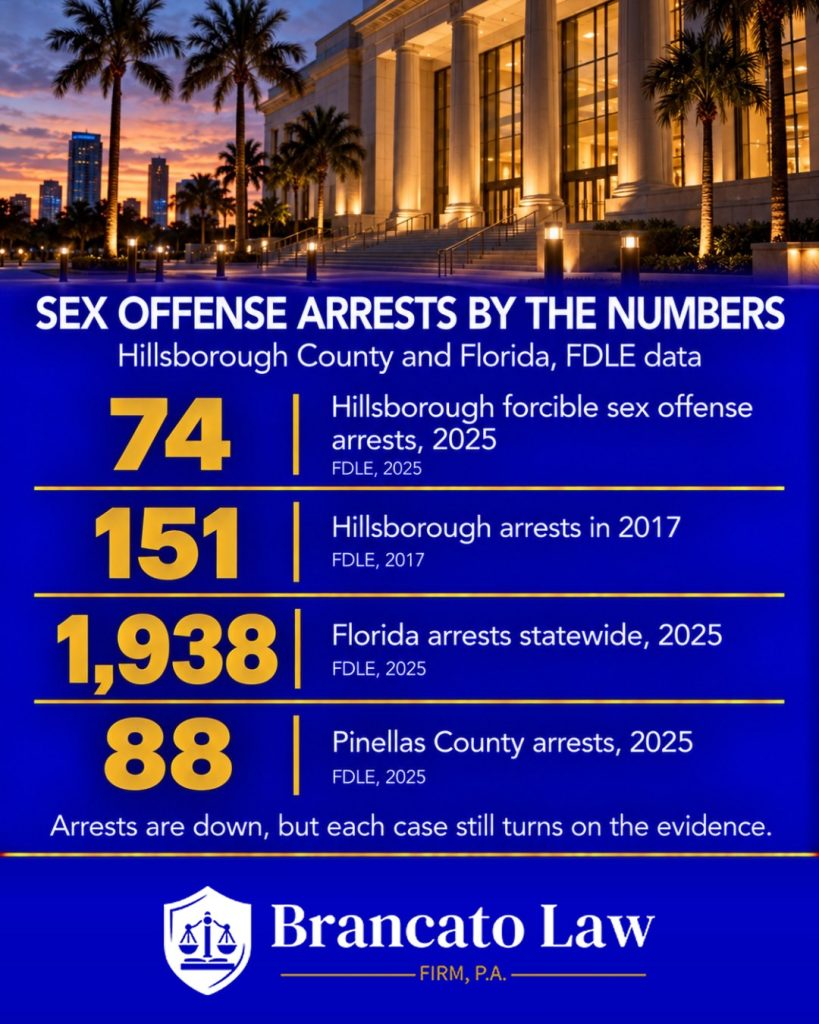
Less common than they were. FDLE arrest data published by Florida Health CHARTS show 74 forcible sex offense arrests in Hillsborough County in 2025, down from 118 in 2024 and 151 in 2017 (Florida Health CHARTS, Forcible Sex Offenses, FDLE data). Statewide, Florida recorded 1,938 forcible sex offense arrests in 2025, compared with 2,486 in 2017.
These are arrest counts, not convictions, and the FDLE category is broader than sexual battery. The same data show 88 such arrests in Pinellas County and 41 in Pasco County in 2025.
What Happens After a Sexual Battery Conviction in Florida?
A sexual battery conviction requires sex offender registration for life, and a first-degree, life, or capital conviction makes the person a sexual predator on a single offense. Under section 943.0435, Florida Statutes, a person convicted under section 794.011 must report in person to the sheriff within 48 hours after establishing a residence, and the 25-year petition to end registration is not available when the requirement is based on an adult conviction under section 794.011.
Under section 775.21, Florida Statutes, one conviction for “[a] capital, life, or first degree felony violation, or any attempt thereof,” of section 794.011 triggers the sexual predator designation. A second-degree conviction under subsection (5)(b) does not, unless the person has a qualifying prior. That difference makes the degree of any plea a central negotiating point. Our post on sex offender registration in Florida explains the reporting duties.
How Do Our Attorneys Fight a Sexual Battery Charge?
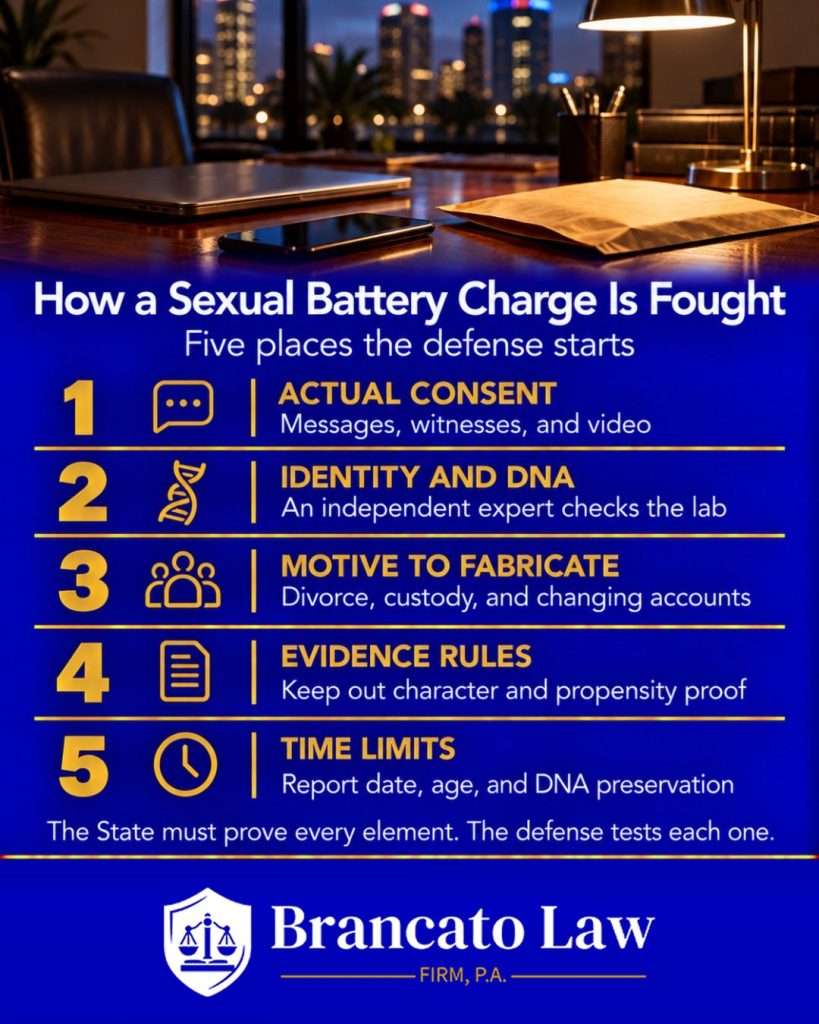
Our attorneys test each element with independent evidence, starting before the State’s case is complete:
- Actual consent. We gather the messages, witnesses, location records, and video that show what each person said and did.
- Identity and DNA. An independent DNA expert reviews the lab’s work and whether a database match is reliable.
- False or unreliable accusation. We look for motive, such as a divorce or custody dispute, and for changes between the first report, the forensic interview, and the deposition.
- The statutory definitions. We challenge proof of “physically helpless,” “mentally incapacitated,” or the force that raises the degree.
- Evidence rules. We move to exclude collateral acts and character evidence, protect cross-examination on motive, and demand a section 92.565 hearing on any confession.
- Time limits. We check the report date, the complainant’s age, and DNA preservation against section 775.15.
Our post on common defenses to sex crime charges in Florida covers more of these strategies.
Real Results in Sexual Battery Cases
| Charge | Result |
|---|---|
| Capital sexual battery: a military veteran accused, during a divorce, of molesting his grandson, who was under 12 | Not guilty; the child had been coached by his mother |
| Sexual battery cold case built on a DNA hit | All charges dismissed after a defense DNA expert showed our client was excluded |
| Sexual battery, Ybor City | Not guilty of attempted sexual battery; cross-examination showed the encounter was consensual |
Past results do not guarantee future outcomes. More results are on our case results page.
What Should You Do If You Are Under Investigation for Sexual Battery?
Stop talking about the allegation and call a defense lawyer before you speak with law enforcement.
- Do not give a statement. Tell the detective you will not answer questions without a lawyer.
- Do not contact the accuser. Detectives often arrange a recorded call or text exchange, and an apology for anything can be played to a jury as an admission.
- Preserve your evidence. Save messages, call logs, photos, and location history, and do not reset your phone.
- Hire counsel before charges are filed. Our representation before charges are filed can include presenting evidence to the State Attorney’s Office for the 13th Judicial Circuit, which decides whether to file the charging information.
After a Hillsborough County arrest, first appearance happens within 24 hours, and the person is held at the Orient Road Jail until release is set. Our Hillsborough County criminal defense attorney page explains the local process.
Frequently Asked Questions About Sexual Battery in Florida
Is sexual battery a felony or a misdemeanor in Florida?
Sexual battery is always a felony in Florida, from a second-degree felony punishable by up to 15 years to a capital felony. The Brancato Law Firm reviews the charged subsection first, because it sets the degree, the predator question, and the plea options.
Can sexual battery charges be dropped in Florida?
Yes, the State can decline to file or can dismiss a sexual battery charge when the evidence shows consent, excludes the accused through DNA, or undermines the complainant’s account. The Brancato Law Firm has had a cold-case sexual battery charge dismissed after a defense DNA expert excluded our client; see our case results.
Is there a time limit to charge sexual battery on an adult in Florida?
Usually eight years, but there is no limit if the offense was reported to law enforcement within 72 hours or the charge is a life felony. Our attorneys at The Brancato Law Firm check the report date and charge level under section 775.15 in every older case.
Is believing the other person consented a defense to sexual battery in Florida?
No, because under Statler v. State the State must prove only that the complainant did not in fact consent, not what the accused knew. The Brancato Law Firm builds consent defenses around the words and conduct each person actually showed, using messages, witnesses, and video; our sex crime defenses guide explains more.
Can someone be convicted of sexual battery in Florida on the accuser’s word alone?
Yes, because section 794.022(1) says the complainant’s testimony “need not be corroborated.” Our attorneys at The Brancato Law Firm investigate the account itself, an approach described on our sex crimes defense page.
Should I talk to a detective who calls about a sexual assault allegation?
No, not before speaking with a lawyer. The Brancato Law Firm can contact the detective for you and pursue pre-file advocacy with the prosecutor before a charging decision is made.
Call Before the Case Is Built Without You
Whether you have a court date, a booking number, or only a voicemail from a detective, call The Brancato Law Firm, P.A., founded by Tampa Criminal Defense Attorney Rocky Brancato, at (813) 727-7159. We will step in with law enforcement, preserve the evidence that supports you, and start building the defense in the first week. Call us at any hour for a free, confidential consultation. Our firm has Spanish-speaking staff, and attorney Jean-Luc Adrien speaks Spanish, Haitian Creole, and French.
For more about our defense strategies, visit our Tampa Sex Crimes Lawyer page.
The Brancato Law Firm, P.A.
620 E. Twiggs Street, Suite 205, Tampa, FL 33602
(813) 727-7159
Serving Hillsborough, Pinellas, and Pasco Counties
The Brancato Law Firm, P.A. is a Tampa-based criminal defense practice. We are not affiliated with any other Brancato-named law firms.
Visit Us

Tampa, FL 33602

Contact Us Now
Free Legal Consultation (813) 727-7159
