

From First DUI to Death Penalty



How to Fight a Cocaine Trafficking Charge in Tampa (2026)


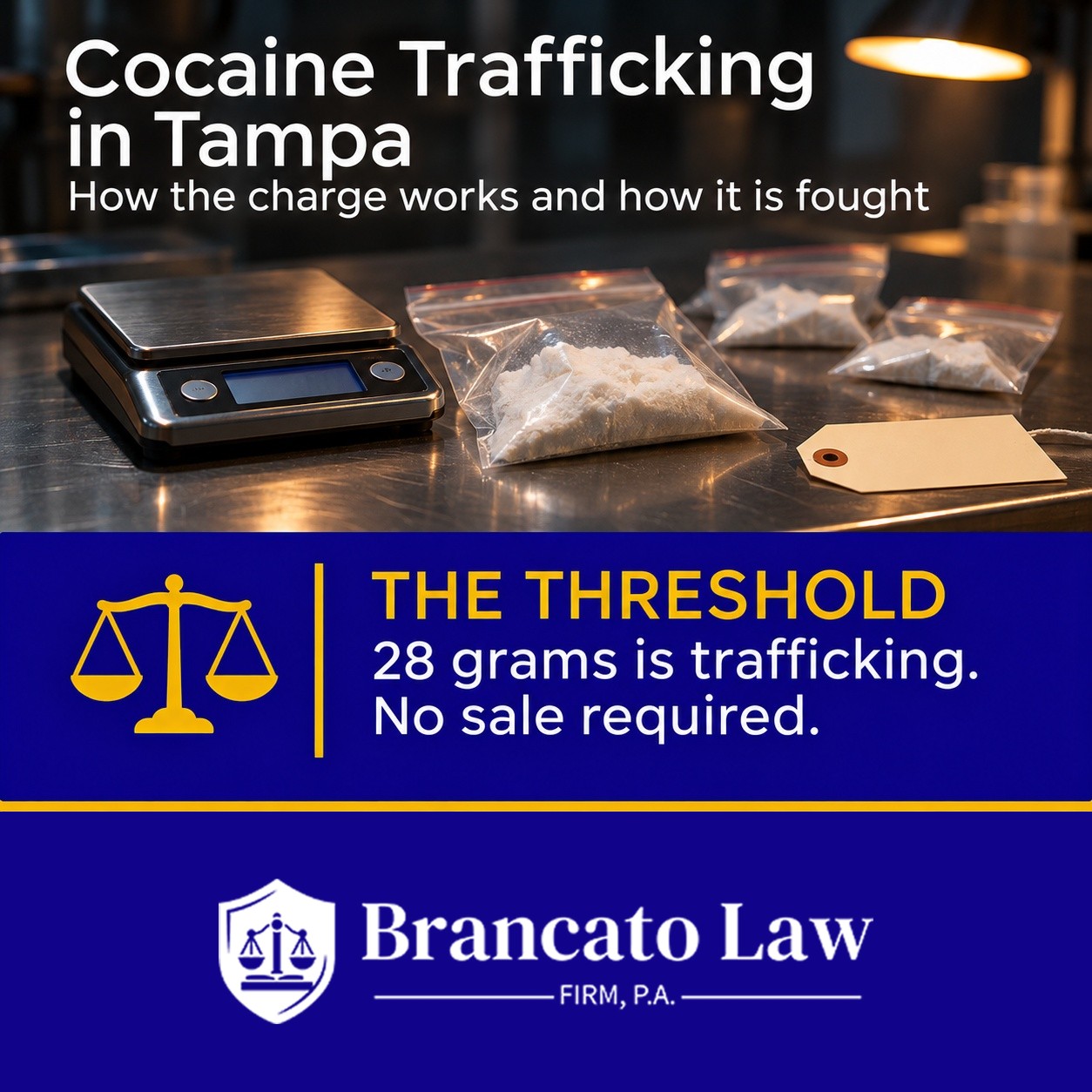
Cocaine trafficking in Florida does not require a sale. Knowingly possessing 28 grams or more of cocaine, or of any mixture containing cocaine, is trafficking under section 893.135(1)(b), Florida Statutes, and it carries a mandatory prison term of 3, 7, or 15 years depending on the weight. The strongest defenses usually attack the stop and search, the proof that the drugs belonged to the accused, and the lab weight. The Brancato Law Firm, P.A. defends cocaine trafficking cases in Hillsborough, Pinellas, and Pasco Counties.
Cocaine trafficking cases are usually decided by the property receipt and the lab report, long before anyone talks about a plea. I’m Rocky Brancato, founder of The Brancato Law Firm, P.A., a Tampa criminal defense firm. I have tried more than 150 jury trials to verdict, including a cocaine trafficking trial involving 200 to 400 grams that ended in a not guilty verdict, and I am a former Chief Operations Officer of the Hillsborough County Public Defender’s Office, where I oversaw a staff of over 100 attorneys. Our attorneys start on a trafficking case at first appearance and take the weight, search, and possession problems to the prosecutor through pre-file advocacy before the State decides what to file.
Do you have to sell cocaine to be charged with trafficking in Florida?
No. Florida’s trafficking statute treats possession of a trafficking amount the same as a sale. Section 893.135(1)(b)1., Florida Statutes, covers anyone who knowingly sells, purchases, manufactures, delivers, or brings into Florida 28 grams or more of cocaine, and anyone who is knowingly in actual or constructive possession of that amount. A person who never sold anything can face the same mandatory minimum as the person who supplied the drugs.
The weight is the weight of the whole mixture. Section 893.135(6) counts the cocaine plus any cutting agent, and it adds together separate mixtures of the same drug, so several small bags can reach a trafficking tier together. Twenty-eight grams is just under one ounce. Our guide to drug trafficking in Florida covers the weight rules for every drug, and our Tampa drug trafficking attorney page explains how our firm handles these cases from arrest to trial.
Knowledge still matters. The State has to prove the person knew the cocaine was there and could control it. Under section 893.101, lack of knowledge of the illicit nature of the substance is an affirmative defense the defense raises, and the jury may infer that knowledge from possession.
What are the mandatory minimums for cocaine trafficking in Florida?
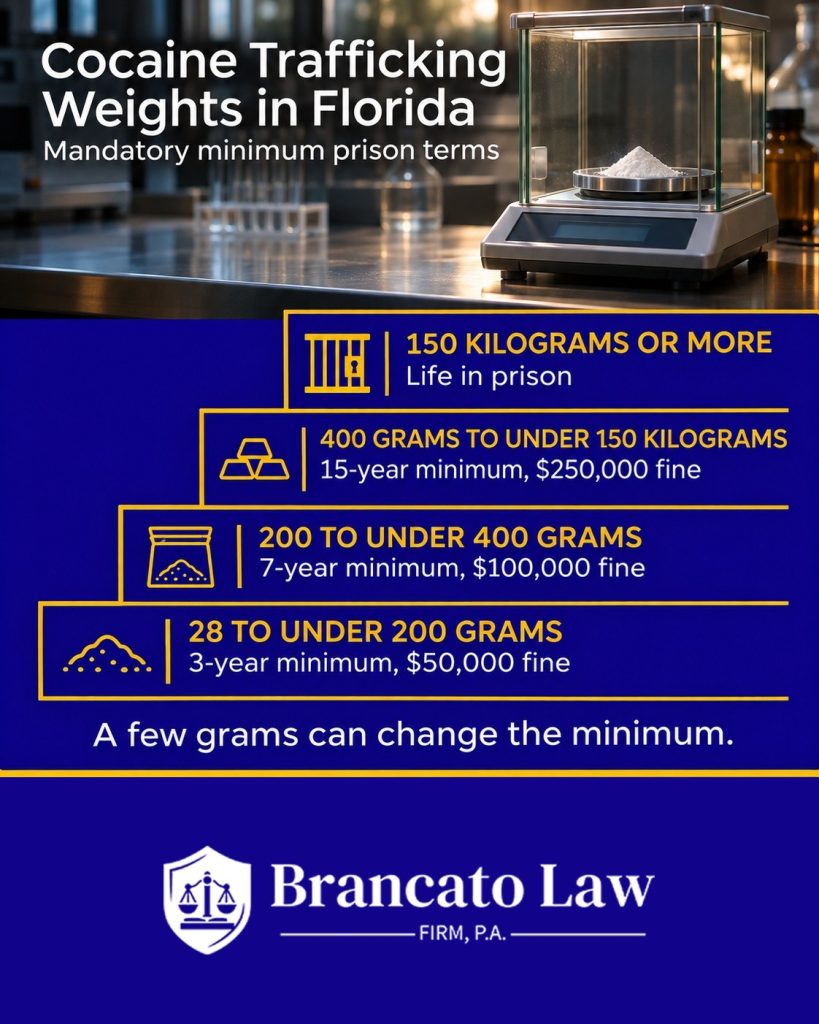
Every cocaine trafficking conviction carries a mandatory prison term and a mandatory fine set by the weight. Trafficking is a first-degree felony, and the judge cannot sentence below the minimum unless the prosecutor files a substantial assistance motion.
| Weight of cocaine or mixture | Mandatory minimum prison | Mandatory fine |
|---|---|---|
| 28 grams to under 200 grams | 3 years | $50,000 |
| 200 grams to under 400 grams | 7 years | $100,000 |
| 400 grams to under 150 kilograms | 15 years | $250,000 |
| 150 kilograms or more | Life, with no discretionary early release | Not stated in the statute for this tier |
| 300 kilograms or more brought into Florida, knowing death is the probable result | Capital importation of cocaine (capital felony) | Maximum fine under the statute |
Section 893.135(3) bars a withhold of adjudication and bars any form of discretionary early release before the minimum is served. A firearm can add its own minimum. Section 775.087(3) lists trafficking in cocaine among the offenses that carry a 15-year minimum when the person possessed a semiautomatic firearm with a high-capacity detachable box magazine during the offense. Our guides to firearm during a felony charges and Florida’s 10-20-Life law cover the gun enhancements.
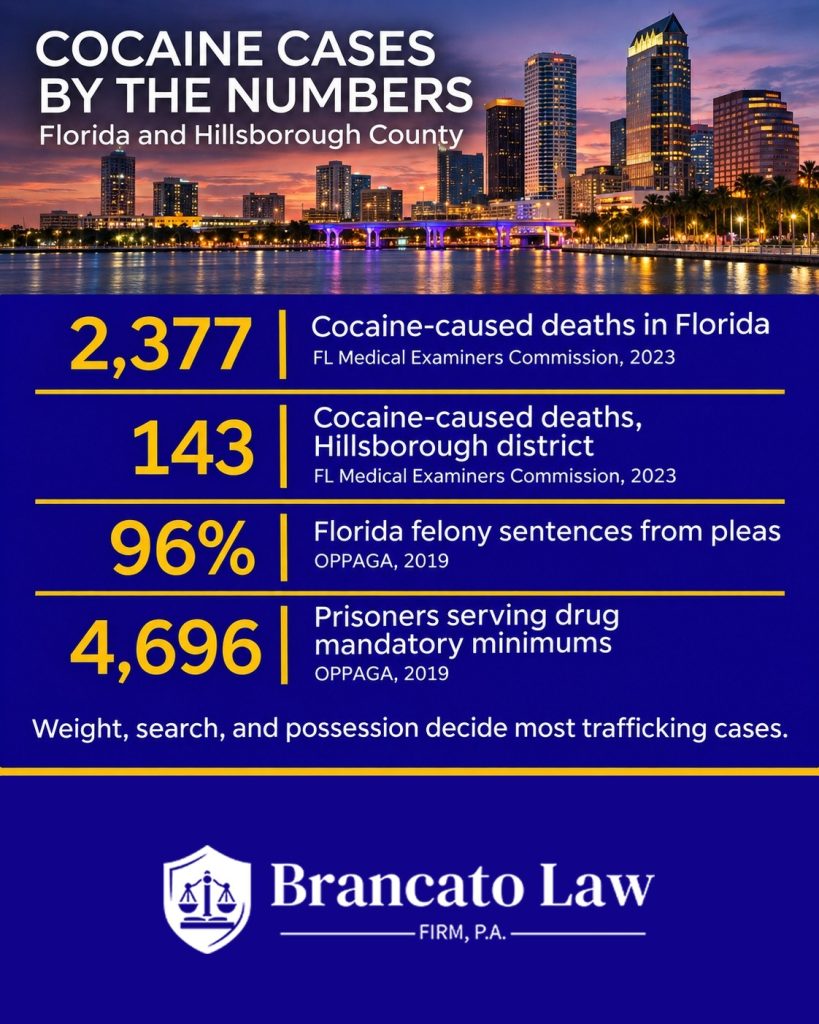
Cocaine was the second leading cause of drug deaths in Florida in 2023. The Florida Medical Examiners Commission’s 2023 annual drug report found cocaine caused 2,377 deaths statewide in 2023, and 143 of those deaths were in the medical examiner district that covers Hillsborough County. Prosecutors raise those numbers when they argue against a reduction. The same agency reported in 2025 that cocaine-caused deaths fell 19% in 2024.
How does the lab weigh and test each packet of cocaine?
The State has to prove trafficking weight with chemical testing, and when the cocaine is in separate packets, the lab has to test each packet before combining them. In Greenwade v. State, 124 So. 3d 215 (Fla. 2013), Jacksonville detectives found nine one-ounce baggies of white powder. The contents were later combined, and the chemist tested only the combined powder, which weighed 234.5 grams. The Florida Supreme Court held that the State “must prove through chemical testing that each individually wrapped packet” contains a controlled substance before the contents are combined and weighed. Because that was not done, the court ordered the trafficking conviction reduced to simple possession.
The same principle reached Hillsborough County in Campbell v. State, 407 So. 3d 558 (Fla. 2d DCA 2025), where the lab tested a sample from only one of fifty packages of suspected cannabis, and the Second District reduced a trafficking conviction to possession. Our attorneys look for these gaps in every lab file:
- Whether every bag or brick was tested before the contents were combined.
- Whether the reported weight includes packaging, wet weight, or a bag that was never opened.
- How close the net weight sits to 28, 200, or 400 grams, since a few grams can move the case to a lower tier or out of trafficking altogether.
- Whether the weight at the lab matches the weight recorded at the scene and in the property receipt.
- Whether a field test is the only proof that a package contained cocaine.
How do our attorneys challenge the stop and the search?
If the stop or the search was illegal, a judge can suppress the cocaine, and without the drugs the State usually has no trafficking case. Most Tampa trafficking arrests begin with a traffic stop, a K-9 sniff, a search warrant, or a confidential informant. In Rodriguez v. United States, 575 U.S. 348 (2015), a Nebraska officer finished a traffic stop, then held the driver another seven or eight minutes while he waited for a backup officer and walked his dog around the car, which led to methamphetamine. The Supreme Court held that a stop “prolonged beyond the time reasonably required” to complete its mission is unlawful without reasonable suspicion. Body camera time stamps often show exactly when the ticket was done and the waiting began.
I taught criminal procedure as a police academy instructor, so I know what officers are trained to write in a report. One of my first suppression motions involved an officer who claimed my client failed to maintain a single lane and drove over a concrete curb. I went to the scene and photographed it. There was no curb, and the judge granted the motion. Our attorneys still visit scenes and compare the report with the body camera video. Our guide to motions to suppress in Florida explains the process, and our guide to confidential informants covers cases built on a controlled buy.
What if the cocaine was found in a shared car or home?
Being near cocaine is not enough to convict. When a car or home is shared, the State must offer independent proof that the accused knew about the drugs and could control them. The Florida Supreme Court set that rule in Brown v. State, 428 So. 2d 250 (Fla. 1983), a case about drugs found throughout a house the defendant owned and lived in: in jointly occupied premises, knowledge and control “must be established by independent proof.” Brown lost because the drugs were in plain view in rooms he controlled. Many of our clients are in a different spot, such as a passenger in someone else’s car or one of several adults in an apartment.
In Melton v. State, 317 So. 3d 292 (Fla. 2d DCA 2021), a Hardee County case, deputies found drugs in a pillowcase on a car’s passenger seat and in an open shed on a property several people used. The Second District reversed two trafficking convictions and ordered the defendant discharged on those counts, holding that “[m]ere proximity to contraband is insufficient to establish constructive possession.” Our firm won a not guilty verdict in a 200 to 400 gram cocaine trafficking trial in Tampa by showing that the co-defendant was the trafficker and our client was only present. Our guide to constructive possession in Florida covers shared spaces in more detail.
Should you cooperate with police after a cocaine trafficking arrest?
Not before you speak with a lawyer. Substantial assistance is the only route the trafficking statute gives below the mandatory minimum, and the law puts that decision in the prosecutor’s hands. Under section 893.135(4), the State Attorney may ask the court to reduce or suspend the sentence of a person who helps identify, arrest, or convict others involved in trafficking. The arresting agency gets to be heard, the motion can be heard in camera for good cause, and the judge decides whether the help was substantial.
A detective at the scene is not the State Attorney, so a promise made in the back of a patrol car is not the motion the statute requires. Anything said in an interview without a written agreement can become evidence, and cooperation can carry real safety risks. Our attorneys weigh cooperation against the defenses in the case, and when a client chooses it, the terms belong in writing first. Our guide to substantial assistance in Florida explains how the agreements work and what happens when cooperation does not produce the motion.
What happens after a cocaine trafficking arrest in Hillsborough County?
A person arrested for cocaine trafficking in Hillsborough County sees a judge at first appearance, usually by video from the jail within 24 hours of arrest. The judge sets bond, and the State can move for pretrial detention under section 907.041 by arguing that no release conditions will assure the person comes back to court. If the State files that motion, the hearing must be held within 5 days. Hillsborough County does not offer pretrial services supervision as a release option, unlike some nearby counties, so the bond argument at first appearance carries real weight. If a family member who will attend speaks Spanish, our attorney Jean-Luc Adrien can speak with them directly.
In the weeks after the arrest, the State Attorney’s Office decides what to file. That window is the best time to put a weight problem, a search problem, or a possession problem in front of the assigned prosecutor. Our guide to the Florida criminal case process walks through each stage, and our Hillsborough County criminal defense page covers the local courts. Our office at 620 E. Twiggs Street is two blocks from the courthouse.
How do cocaine trafficking cases usually end in Florida?
Most end with a negotiated resolution, and the outcome depends on what the defense can prove about the evidence. Florida’s Office of Program Policy Analysis and Government Accountability reported in Report No. 19-01 (2019) that about 96% of felony sentences in Florida result from pleas. The same report found that 4,696 state prisoners, 5% of the prison population, were serving mandatory minimum sentences for drug offenses, and that 45.4% of them had no prior prison term and no violent or sexual conviction.
| Outcome | What usually makes it possible | Mandatory minimum? |
|---|---|---|
| No charges filed or dismissal | An illegal search, or no independent proof of possession | None |
| Reduced to simple possession | The State cannot prove trafficking weight, as in Greenwade | None |
| Reduced to a lower trafficking tier | Lab weight falls under 200 or 400 grams | Lower minimum |
| Reduced to a non-trafficking charge or diversion | Weaknesses exposed by depositions or a suppression motion | None |
| Substantial assistance | State Attorney’s motion under s. 893.135(4) | Judge may reduce or suspend |
| Not guilty at trial | Jury rejects possession, weight, or identity | None |
Our guides to possession with intent to sell and drug possession cover the charges a trafficking case is often reduced to.
What results has our firm gotten in cocaine cases?
| Charge | Result | What made the difference |
|---|---|---|
| Cocaine trafficking, 200 to 400 grams | Not guilty at jury trial | The defense showed the co-defendant was the trafficker and our client was only present |
| Possession of cocaine and possession of a firearm during a felony (January 2025) | Both charges dismissed | At first appearance we argued the facts did not fit the firearm statute and secured low bonds |
| Delivery of cocaine within 1,000 feet of a church, plus possession | Not guilty on both counts | Mistaken identity defense and poor police work exposed at trial |
| Possession of cocaine | Not guilty at trial | The client turned down a plea offer and testified |
Past results do not guarantee future outcomes. Every case turns on its own facts. More results are on our case results page.
Cocaine trafficking FAQs
Can cocaine trafficking charges be dropped in Florida?
Yes. Prosecutors drop or reduce trafficking charges when a search is suppressed, when the State cannot tie the drugs to the accused, or when the lab cannot prove the weight. The Brancato Law Firm puts those problems in front of the prosecutor before the filing decision through representation before charges are filed.
Does 28 grams of cocaine count as trafficking if it is split into small bags?
It can. Section 893.135(6) adds the weights of separate mixtures of the same drug, but under Greenwade v. State, 124 So. 3d 215 (Fla. 2013) each bag of white powder must be chemically tested before the contents can be combined. Our attorneys at The Brancato Law Firm check the lab notes for every bag, because one untested bag can drop the total below 28 grams.
Can you get probation for cocaine trafficking in Florida?
Not on a trafficking conviction, unless the State files a substantial assistance motion, because section 893.135(3) requires the mandatory prison term and bars a withhold of adjudication. The Brancato Law Firm works to get the charge itself reduced or dismissed, which can make probation or diversion possible, and our drug trafficking defense team has done that in trafficking cases.
Can I get a bond on a cocaine trafficking charge in Hillsborough County?
Usually, yes. A judge sets bond at first appearance, and the State must file a motion and win a hearing to hold someone without bond under section 907.041. Our attorneys at The Brancato Law Firm prepare the release argument before the hearing, including family, work, and residence information the judge will ask about.
What if the cocaine belonged to someone else in the car?
The State must prove you knew the cocaine was there and could control it, and in a shared car that requires independent proof beyond being close to it. The Brancato Law Firm won a not guilty verdict in a 200 to 400 gram cocaine trafficking trial by showing the co-defendant was the trafficker.
Is a roadside field test enough to prove cocaine trafficking?
No. A field test is a preliminary screen, and trafficking weight has to be proven by laboratory analysis. In Greenwade v. State, 124 So. 3d 215 (Fla. 2013), officers field-tested all nine bags, and the Florida Supreme Court still required chemical testing of each bag before their contents could be combined; our attorneys at The Brancato Law Firm request the full lab file in discovery to see exactly what was tested.
Talk to a Tampa cocaine trafficking defense attorney
For more about our defense strategies, visit our Tampa drug crimes page.
The State decides what to file in the first weeks after a trafficking arrest, and what reaches the prosecutor in that window shapes the rest of the case. Call The Brancato Law Firm, P.A., founded by Tampa Criminal Defense Attorney Rocky Brancato, at (813) 727-7159. You can call us at any hour. Our firm has Spanish-speaking staff, and attorney Jean-Luc Adrien speaks Spanish, Haitian Creole, and French.
The Brancato Law Firm, P.A.
620 E. Twiggs Street, Suite 205, Tampa, FL 33602
(813) 727-7159
Serving Hillsborough, Pinellas, and Pasco Counties
The Brancato Law Firm, P.A. is a Tampa-based criminal defense practice. We are not affiliated with any other Brancato-named law firms.
Visit Us

Tampa, FL 33602

Contact Us Now
Free Legal Consultation (813) 727-7159
