

From First DUI to Death Penalty



How to Fight a Firearm During a Felony Charge in Florida? (2026)



In Florida, displaying, using, threatening to use, or carrying a concealed firearm while committing or attempting any felony is a separate second-degree felony under section 790.07(2), punishable by up to 15 years in prison. The State must prove two things: that a felony was committed or attempted, and that the gun was displayed, used, threatened, or carried concealed during it. The charge is usually fought by attacking the underlying felony, the link between the gun and the person, the legality of the search that found it, and, after a conviction, double jeopardy when the same gun already enhanced another count.
A gun found near a felony arrest can turn one charge into two, even when nobody fired it or pointed it at anyone. As founder of The Brancato Law Firm, P.A., a Tampa criminal defense firm, I have spent more than 25 years in Hillsborough County courtrooms and tried more than 150 jury trials to verdict, and as a former police academy instructor I taught officers the search rules that decide many of these cases. Our attorneys start every firearm-during-a-felony case with two questions: can the State prove the underlying felony, and was the gun lawfully found?
What Is Possession of a Firearm During a Felony in Florida?
It is a crime under section 790.07, Florida Statutes, to display, use, threaten to use, or attempt to use a firearm, or to carry a concealed firearm, while committing or attempting to commit any felony. The statute’s official title is “Persons engaged in criminal offense, having weapons,” and courts and charging documents often shorten it to “possession of a firearm during the commission of a felony.” The firearm version in subsection (2) is a second-degree felony.
The statute applies to almost any felony, from drug sales to burglary to grand theft. Subsection (3) excludes only a short list of offenses: antitrust violations, unfair trade practices, restraints of trade, nonsupport of dependents, bigamy, “or other similar offenses.” Our Tampa gun crimes attorney page explains how this count fits with the other Florida firearm charges.
What Are the Penalties for Each Part of Section 790.07?
The penalty depends on whether the item was a firearm or another weapon, and on whether the person has a prior conviction under the statute. Maximum prison terms come from section 775.082.
| Subsection | Conduct | Degree | Maximum prison |
|---|---|---|---|
| 790.07(1) | Displaying, using, threatening, or attempting to use a weapon or electric weapon or device, or carrying a concealed weapon, while committing or attempting a felony or while under indictment | Third-degree felony | 5 years |
| 790.07(2) | Displaying, using, threatening, or attempting to use a firearm, or carrying a concealed firearm, while committing or attempting a felony | Second-degree felony | 15 years |
| 790.07(4) | Any of the above after a prior conviction under subsection (1) or (2), while committing or attempting a felony or while under indictment | First-degree felony; sentence cannot be suspended or deferred | 30 years |
On the Criminal Punishment Code scoresheet, subsection (4) is ranked at Level 7. Subsections (1) and (2) are not listed in the ranking chart, so they fall under section 921.0023, which places an unlisted second-degree felony at Level 4 and an unlisted third-degree felony at Level 1. In practice the underlying felony often drives the scoresheet more than the firearm count does. Our Florida criminal case process guide explains how sentencing works after a plea or trial.
What Counts as a Firearm or a Weapon Under Section 790.07?
A firearm under section 790.001 is any weapon, including a starter gun, that will, is designed to, or may readily be converted to expel a projectile by the action of an explosive, plus the frame or receiver of such a weapon, a silencer, a destructive device, or a machine gun. An antique firearm is excluded unless it is used in a crime. A “weapon” is a separate category: a dirk, knife, metallic knuckles, billie, chemical weapon, or other deadly weapon, but not a firearm and not a common pocketknife.
These definitions matter because the degree of the charge turns on them. If the object was not a firearm under the statute, the second-degree charge under subsection (2) does not fit, and the State is limited to the third-degree weapon charge, if any. Our attorneys ask for the lab report on every recovered gun to confirm it was operable or readily convertible, and to confirm it was the item described in the arrest report.
Is a Firearm-During-a-Felony Charge Subject to 10-20-Life?
No. Section 790.07 is not on the list of offenses that trigger Florida’s 10-year, 20-year, and 25-year mandatory minimums under section 775.087(2)(a). That list includes murder, sexual battery, robbery, burglary, aggravated battery, kidnapping, carjacking, home-invasion robbery, drug trafficking, possession of a firearm by a felon, and other listed crimes. The mandatory minimum attaches to the underlying felony when that felony is on the list and the person actually possessed or discharged a gun.
| Rule | What it does | When it applies |
|---|---|---|
| s. 790.07(2) | Creates a separate second-degree felony count | Firearm displayed, used, threatened, or carried concealed during any felony not excluded by subsection (3) |
| s. 775.087(1) | Raises the degree of the underlying felony by one level | Weapon or firearm carried, displayed, used, or threatened during a felony in which the weapon is not an essential element |
| s. 775.087(2) (10-20-Life) | Mandatory minimum of 10, 20, or 25 years to life | Only listed felonies, with actual possession, discharge, or discharge causing death or great bodily harm |
Because section 790.07 already makes the firearm an essential element, the 790.07 count itself is not reclassified under section 775.087(1). Our post on Florida’s 10-20-Life law explains the mandatory minimums in detail.
Can You Be Convicted of Both the Felony and the Firearm Count?
Sometimes not. In Cleveland v. State, 587 So. 2d 1145 (Fla. 1991), a man was convicted of attempted robbery with a firearm and of using a firearm while committing a felony under section 790.07(2), both based on a single act. The Florida Supreme Court held that when a robbery conviction is enhanced because of the use of a firearm, the single act of using the same firearm in the same robbery cannot also support a separate conviction and sentence under section 790.07(2). It quashed the decision that had upheld both convictions.
That protection is narrower than many people think. In Tambriz-Ramirez v. State, 248 So. 3d 1087 (Fla. 2018), a Fourth District case involving a knife used during a home invasion, the Florida Supreme Court described its Cleveland holding as “very narrow” and held that double jeopardy claims are decided by comparing the statutory elements of the offenses under section 775.021(4), not by the facts charged or proven. The lesson for anyone facing both counts is practical: the double jeopardy argument works best when the underlying felony was itself enhanced or reclassified because of the same gun, and our attorneys raise it at sentencing and on appeal when it applies.
How Common Are Gun Recoveries in Tampa Cases?
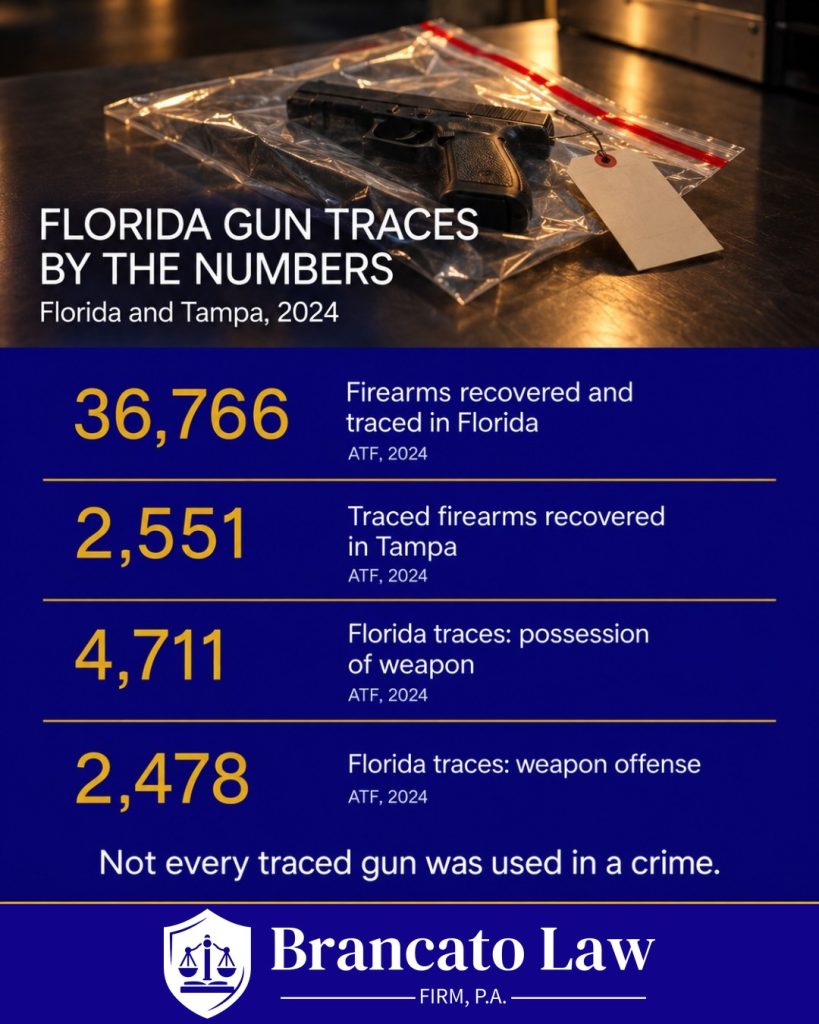
Gun recoveries are common in Tampa criminal cases. In 2024, law enforcement agencies recovered and traced 36,766 firearms in Florida, and 2,551 of them were recovered in Tampa, the fourth-highest city total in the state, according to ATF firearms trace data for Florida. Among the Florida traces, 4,711 were categorized as possession of weapon cases and 2,478 as weapon offenses. ATF notes that not every traced gun was used in a crime, which is the same caution our attorneys raise when a gun is simply found near a person.
Legislatures add firearm counts and enhancements on the theory that extra prison time deters armed crime. Economist David Abrams tested that theory in Estimating the Deterrent Effect of Incarceration Using Sentencing Enhancements, published in the American Economic Journal: Applied Economics in 2012. Using the timing of state add-on gun laws, he found that the average law produced a roughly 5 percent decline in gun robberies within the first three years. That is a measurable but modest effect, and it is part of the context our attorneys give prosecutors when arguing that a stacked firearm count adds punishment without adding much public safety in a particular case.
What Are the Defenses to a Firearm-During-a-Felony Charge?
The defenses to a section 790.07 charge target each element the State must prove. Our attorneys test these points in every case:
- No underlying felony. The charge requires a felony committed or attempted. If the main charge is dismissed, reduced to a misdemeanor, or ends in an acquittal, the firearm count loses its foundation.
- No display, use, threat, or concealed carry. A gun in a closed bag or a vehicle compartment may not have been “on or about” the person as the statute requires for concealed carry, and a gun nobody saw may not have been displayed or used.
- Not this person’s gun. When a gun is found in a shared car or home, the State must connect it to the accused. Our attorneys examine who owned it and whether fingerprint or DNA testing was done.
- Illegal search. A gun found during an unlawful stop, frisk, or search can be suppressed with a motion to suppress, which often ends the firearm count entirely.
- Not a firearm under the statute. An inoperable item, an antique, or a replica may not meet the definition in section 790.001.
- Double jeopardy. When the same gun already enhanced or reclassified the underlying felony, Cleveland may bar a separate conviction.
Our post on whether police can stop or frisk you for carrying a gun in Florida covers the search issues, and our guide to Florida gun crime laws covers the related charges.
Does Permitless Carry or a Concealed Weapons License Protect You?
No. Florida now allows eligible adults to carry a concealed firearm without a license under section 790.01, but neither permitless carry nor a concealed weapons license authorizes carrying a gun while committing a felony. The charge under section 790.07(2) turns on what the person was doing while armed, not on whether the person could otherwise carry legally. Lawful carry can still help the defense in a different way: it explains why a person had a gun for reasons unrelated to the alleged felony, which matters to prosecutors deciding whether to keep the add-on count.
What Happens After a Gun-and-Felony Arrest in Hillsborough County?
In Hillsborough County, a person arrested on a felony with a firearm count is booked at the Orient Road Jail and sees a judge at first appearance, usually within 24 hours, where bond is set on each count. In our experience in the 13th Judicial Circuit, the State Attorney’s Office often adds a section 790.07 count to drug, burglary, and theft cases when officers find a gun nearby, and that count is frequently part of plea negotiations. Our Hillsborough County criminal defense page explains how felony cases move through the local courts.
If police are still investigating and no charge has been filed, representation before charges are filed can give our attorneys a chance to explain lawful gun ownership or a weak felony theory to the prosecutor before the charging decision is made.
Frequently Asked Questions About Firearm-During-a-Felony Charges in Florida
Is possession of a firearm during a felony a mandatory minimum offense in Florida?
No. Section 790.07 is not listed in the 10-20-Life statute, so the firearm count itself carries no mandatory minimum. The Brancato Law Firm checks whether the underlying felony is on that list, because the mandatory minimum may attach to that count instead; our 10-20-Life guide explains the list.
Can I be convicted of armed robbery and use of a firearm during a felony for the same act?
Generally not when the robbery was enhanced because of the same gun. Under Cleveland v. State, the single use of one firearm in one robbery cannot support both an enhanced robbery conviction and a separate section 790.07(2) conviction, and our attorneys at The Brancato Law Firm raise that argument before sentencing.
Can a possession of a firearm during a felony charge be dropped in Florida?
Yes. Prosecutors drop or reduce the count when the underlying felony is weak, the gun cannot be tied to the accused, or the gun is suppressed. The Brancato Law Firm files suppression motions and presents ownership and lawful-carry evidence to prosecutors to get the add-on count dismissed; learn more on our firearm charge defense page.
What if police found a gun in my car during a drug arrest?
The State must still prove the gun was displayed, used, threatened, or carried concealed on or about you during the drug felony. Our attorneys at The Brancato Law Firm look at where the gun was, who else used the car, and whether the search was lawful, as explained in our criminal case process guide.
Is having a knife during a felony a crime in Florida?
Yes. Under section 790.07(1), displaying, using, or threatening with a weapon such as a knife, or carrying it concealed, during a felony is a third-degree felony, though a common pocketknife is excluded from the definition of weapon. The Brancato Law Firm examines whether the item meets the statutory definition before anything else.
Does carrying a gun legally protect me from a section 790.07 charge?
No. Lawful carry does not authorize carrying a gun while committing a felony. The Brancato Law Firm uses lawful ownership and carry to show why a person had the gun, which can persuade prosecutors to drop the firearm count; if you are being investigated, our pre-file advocacy page explains how we intervene early.
Talk to a Tampa Gun Crimes Lawyer About a Firearm-During-a-Felony Charge
A firearm count can add up to 15 years to a felony case, and the suppression and bond issues are decided in the first weeks after arrest. Our attorneys will review the search, the gun evidence, and the underlying felony and tell you where the State’s case is weakest. Call The Brancato Law Firm, P.A., founded by Tampa Criminal Defense Attorney Rocky Brancato, at (813) 727-7159, any hour of the day. Our firm has Spanish-speaking staff, and attorney Jean-Luc Adrien speaks Spanish, Haitian Creole, and French. Learn more about our Spanish and Haitian Creole criminal defense services.
For more about our defense strategies, visit our Tampa Gun Crimes Defense page.
The Brancato Law Firm, P.A.
620 E. Twiggs Street, Suite 205, Tampa, FL 33602
(813) 727-7159
Serving Hillsborough, Pinellas, and Pasco Counties
The Brancato Law Firm, P.A. is a Tampa-based criminal defense practice. We are not affiliated with any other Brancato-named law firms.
Visit Us

Tampa, FL 33602

Contact Us Now
Free Legal Consultation (813) 727-7159
