- Free Consultation 24/7: (813) 727-7159 Tap Here To Call Us


From First DUI to Death Penalty



Hillsborough First Appearance: What Happens and When? (2026)


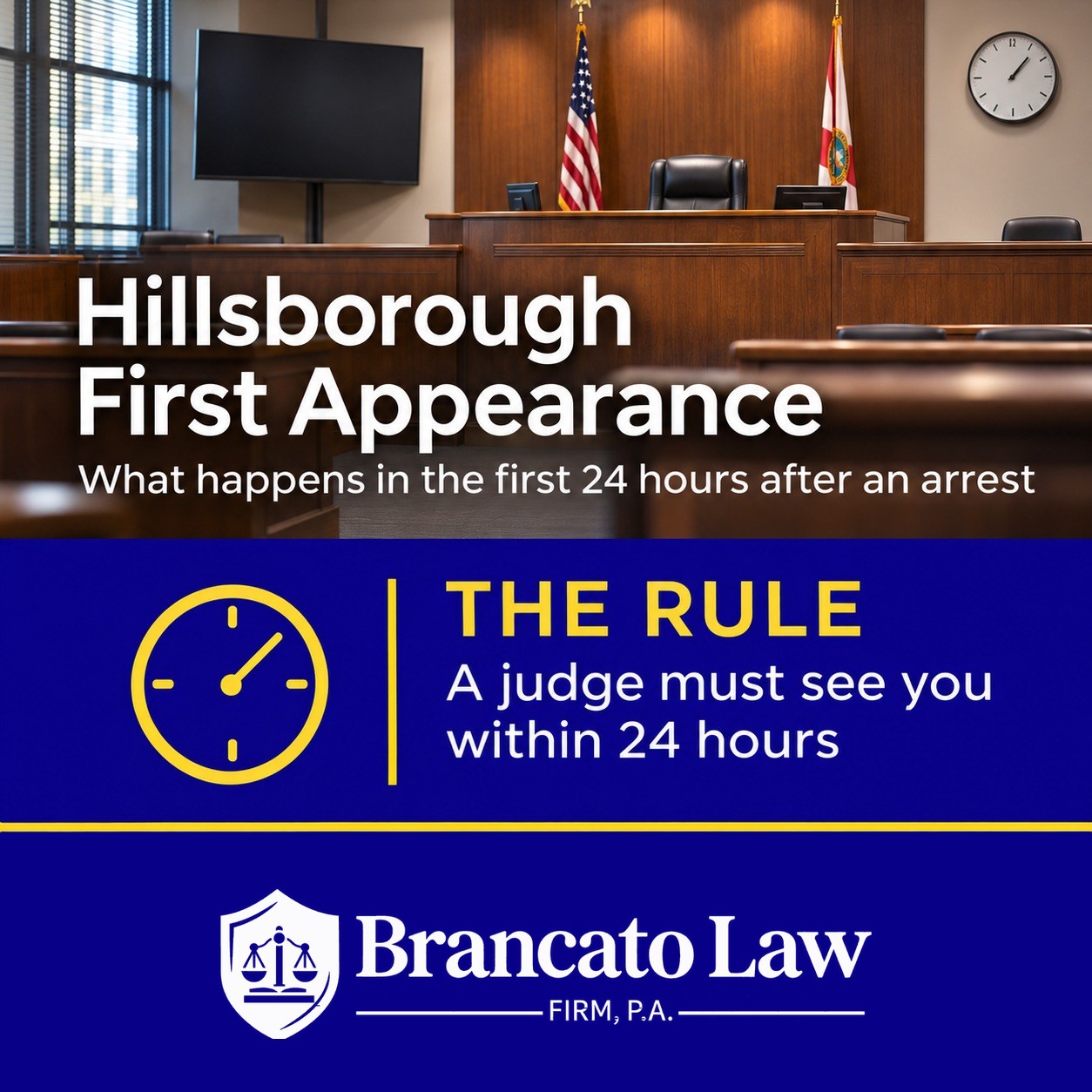
A Hillsborough County first appearance is the court hearing where a judge first sees a person who was arrested and not released. Under Florida Rule of Criminal Procedure 3.130 it must happen within 24 hours of arrest. In Hillsborough the judge sits downtown and the arrested person appears by video from the jail, at 1:30 p.m. on weekdays and 10:00 a.m. on weekends and holidays. At that hearing the judge advises the person of the charges and rights, addresses counsel, and decides bond, release conditions, or detention.
In Hillsborough County, the first judge an arrested person sees is usually on a video screen, the day after the arrest, in a hearing that lasts a few minutes. Those few minutes decide whether the person goes home to work and family or waits in the Orient Road or Falkenburg Road Jail while the case moves forward. I’m Rocky Brancato, founder of The Brancato Law Firm, P.A., a Tampa criminal defense firm, and a former Chief Operations Officer of the Hillsborough County Public Defender’s Office, where I oversaw a staff of over 100 attorneys. After more than 25 years in Hillsborough County courtrooms, our attorneys know what the first appearance judge needs to hear, and we prepare families to give us that information before the hearing starts.
What is a first appearance in Hillsborough County?
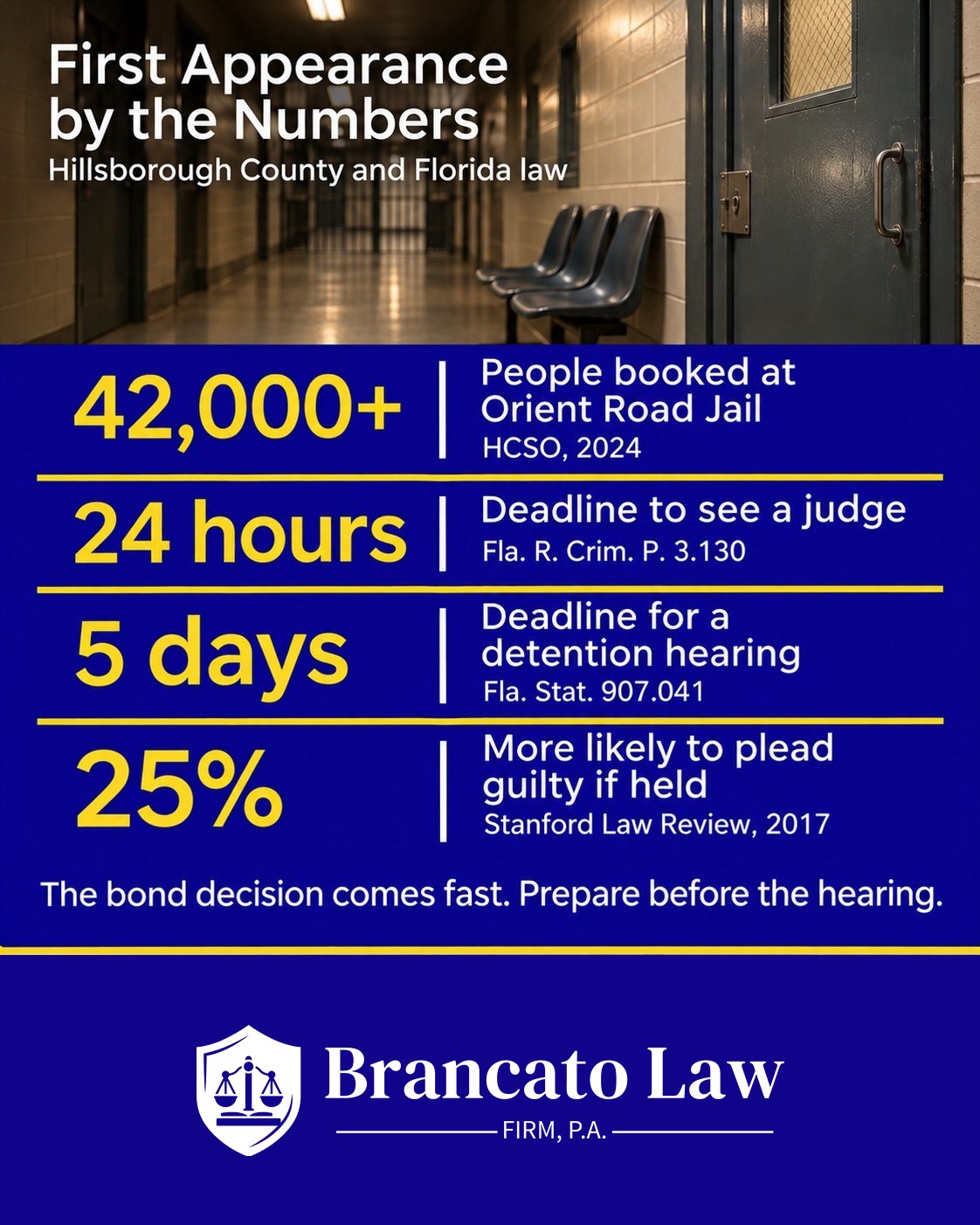
A first appearance is the first court hearing after an arrest for anyone who has not already been released on bond. Florida Rule of Criminal Procedure 3.130 requires that every arrested person who was not lawfully released be taken before a judge within 24 hours of arrest, either in person or by audio-video technology. It is the second step in the Florida criminal case process, right after booking.
First appearance is not a trial and not the place where guilt is decided. The judge has a short list of jobs: tell the person what the charges are, advise of the right to remain silent and the right to a lawyer, make sure counsel is addressed, review whether the arrest is supported by probable cause, and decide pretrial release. In the Thirteenth Judicial Circuit, those hearings are handled by Criminal Division “O,” and Administrative Order S-2024-022 requires that all Division O proceedings be conducted by audiovisual devices and electronically recorded. The Brancato Law Firm appears at these hearings for clients who hire us before the hearing starts.
When and where is first appearance held in Hillsborough County?
First appearance in Hillsborough County is held every day of the year, with the judge downtown and the arrested person on video from the jail. According to the Hillsborough State Attorney’s Office, the hearings are held at the Hillsborough County Courthouse Annex in Courtroom 17, starting at 1:30 p.m. on non-holiday weekdays and at 10:00 a.m. on Saturdays, Sundays, and holidays. People attending in person go through courthouse security at 800 E. Twiggs Street, two blocks from our office.
Volume is the reason the hearing moves fast. The Orient Road Jail booked more than 42,000 people in 2024, according to the Hillsborough County Sheriff’s Office 2024 Annual Report (page 21). Everyone booked who does not bond out on the schedule goes through the same daily first appearance calendar, so each case usually gets only a few minutes. Our attorneys at The Brancato Law Firm prepare the bond argument in advance so those minutes count.
| Question | Answer | Source |
|---|---|---|
| Deadline | Within 24 hours of arrest | Fla. R. Crim. P. 3.130(a) |
| Weekday start time | 1:30 p.m. | Hillsborough SAO |
| Weekend and holiday start time | 10:00 a.m. | Hillsborough SAO |
| Courtroom | Courtroom 17, Courthouse Annex (security entrance at 800 E. Twiggs St.) | Hillsborough SAO |
| Where the arrested person is | At the jail, appearing by video | Admin. Order S-2024-022 |
| Who else is there | Judge, assistant state attorney, assistant public defender, and any private lawyer who was hired | Fla. R. Crim. P. 3.130(a) |
| Daily docket | Posted by the Sheriff’s Office by 5 a.m. | Hillsborough SAO |
What happens during a first appearance hearing?
A first appearance hearing follows the same five steps in nearly every case. Rule 3.130 sets the order, and the judge works through the calendar one person at a time.
- Charges. The judge tells the person what he or she was arrested for, including any alleged probation violation, and provides a copy of the complaint.
- Rights. The judge advises that the person does not have to say anything, that anything said can be used against him or her, and that he or she has a right to a lawyer, appointed if the person cannot afford one.
- Counsel. If the person has hired a lawyer, Rule 3.130(c)(2) says the judge “must allow the defendant a reasonable time to send for counsel.” Otherwise the Public Defender’s Office is appointed for the hearing if the person qualifies.
- Probable cause. For an arrest without a warrant, the judge reviews the arrest affidavit to decide whether it shows probable cause.
- Release decision. Under Rule 3.130(d), the judge “must proceed to determine pretrial detention or conditions of release.” That means setting a bond amount, releasing on conditions, or holding the person for a pretrial detention hearing.
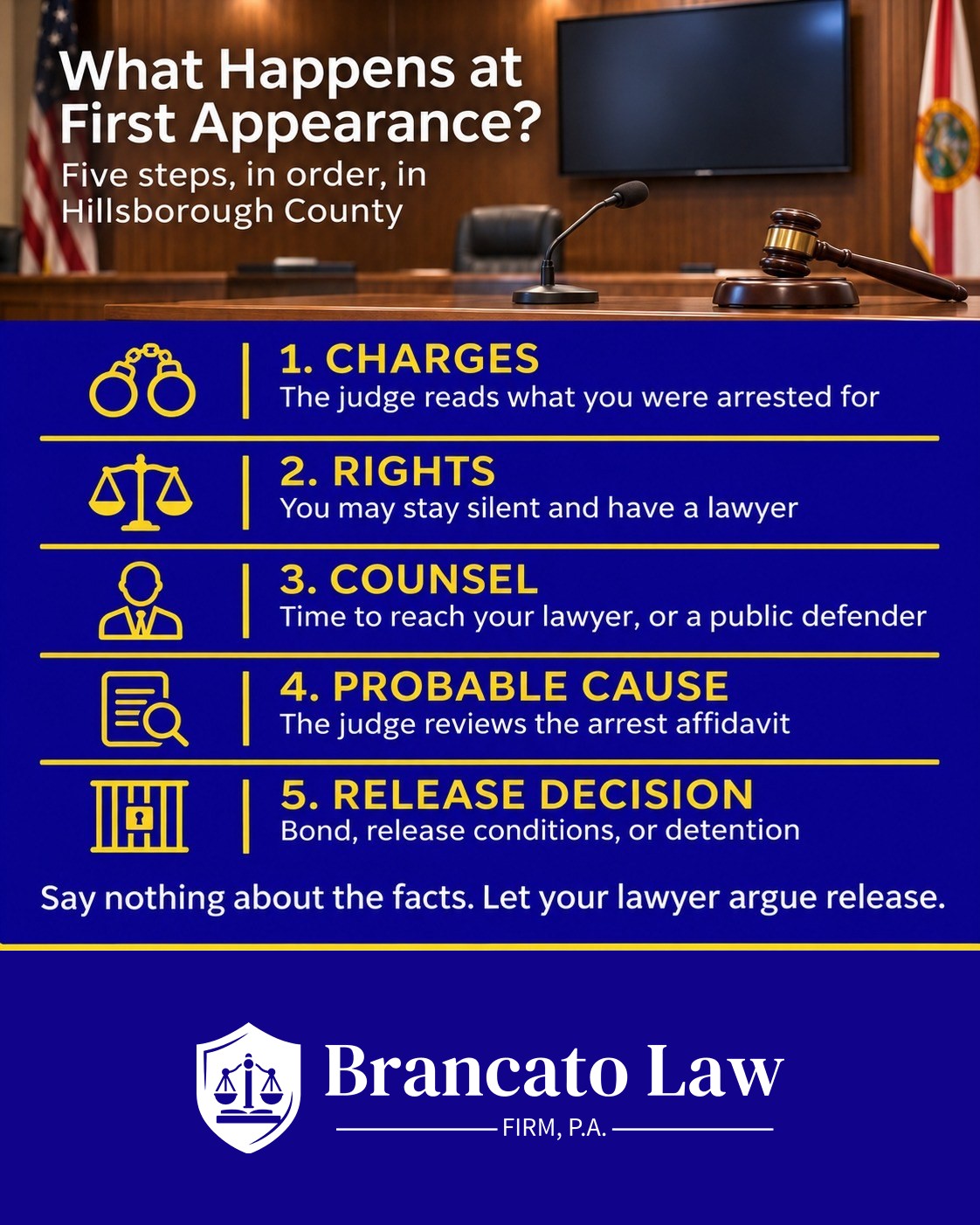
The arrested person should not talk about the facts of the case at first appearance. The hearing is recorded, the prosecutor is listening, and a statement made to explain things to the judge can become evidence later. Our attorneys at The Brancato Law Firm speak for our clients at the hearing so they do not have to.
How does the judge set bond at first appearance?
The judge sets bond by weighing the factors listed in section 903.046, Florida Statutes. The statute says the purpose of bail is to ensure the person comes back to court and to protect the community from unreasonable danger. The factors include the nature of the charge, the weight of the evidence, family ties, length of residence in the community, employment history, financial resources, mental condition, prior record and any past failures to appear, danger to the community, and whether the person was already on release or probation.
The bond schedule sets a default amount, and the first appearance judge can depart from it. Under section 903.011, Florida Statutes, the Florida Supreme Court adopts a uniform statewide bond schedule each year, and the statute states that the schedule “shall not bind a judge in an individual case who is conducting a first appearance hearing.” That is why the facts a lawyer puts in front of the judge matter. The Brancato Law Firm builds the bond argument around the 903.046 factors: where the client works, how long the client has lived here, who depends on the client, and what conditions would make release safe.
One local fact changes how bond is argued here. Hillsborough County does not offer pretrial services supervision as a release option, though some nearby counties do, so a Hillsborough judge cannot release someone to a county supervision program as a middle ground. That puts more weight on a money bond amount the family can actually post and on specific conditions such as no contact with an alleged victim, GPS monitoring, or staying away from a location. For a longer look at bond after first appearance, see our guide to how a bond hearing works in Tampa.
Who has to wait for first appearance instead of bonding out?
Some people cannot bond out on the schedule and must wait to see the first appearance judge. Section 903.011(6) says a person who meets any listed criterion “may not be released before his or her first appearance hearing or bail determination,” and the judge must set bail, if any, after an individualized look at the 903.046 factors. Everyone else can usually post the scheduled bond at the jail and skip first appearance entirely.
| Category | Examples from the statute |
|---|---|
| Status at the time of arrest | On pretrial release, probation, or community control when arrested for a felony; designated a sexual offender or sexual predator; on certain post-prison supervision |
| Prior record | Previously sentenced as a prison releasee reoffender, habitual violent felony offender, three-time violent felony offender, or violent career criminal |
| Recent arrests | Three or more arrests in the 6 months before the current arrest |
| Injunctions | Arrested for violating a protective injunction |
| Charge level | Any capital, life, first-degree, or second-degree felony |
| Listed offenses | Homicide, felony battery, domestic violence, stalking, robbery, burglary, kidnapping, felon in possession of a firearm, sexual battery, child abuse, and other listed crimes |
Domestic violence arrests are a common example. Because domestic violence is on the 903.011(6) list, a person arrested on a domestic battery charge in Hillsborough County waits for the first appearance judge, who will usually add a no-contact condition if bond is set. Our Tampa domestic violence attorney page covers what that no-contact order means for a household.
What happens if the State asks the judge to hold someone with no bond?
If the State seeks pretrial detention, the person can be held without bond until a separate detention hearing. Under section 907.041, Florida Statutes, when a person is arrested for a dangerous crime that is a capital, life, or first-degree felony and the court finds probable cause, the State or the court must move for pretrial detention, and that hearing must be held within 5 days after first appearance. When the State files a discretionary detention motion, the hearing must be held within 5 days after the motion is filed.
The detention hearing is where a defense lawyer can test the State’s evidence and present witnesses, which first appearance does not allow. The Brancato Law Firm treats the days between first appearance and the detention hearing as a deadline: we gather the documents and witnesses that answer the State’s danger and flight arguments before the judge rules.
Can family watch or speak at first appearance?
Yes, family can attend first appearance in person in the downtown courtroom, but they should expect to watch rather than speak. The arrested person appears on a screen from the jail, so family will see and hear the hearing but will not be in the same room as their loved one. Before driving downtown, check the Sheriff’s Office first appearance docket, which the State Attorney’s Office says is posted by 5 a.m., and confirm through the HCSO Arrest Inquiry that the person has not already bonded out.
Family support is most useful when it reaches the judge through the lawyer. A judge weighing family ties and length of residence under section 903.046 responds to specifics: a family member present in the courtroom, a spouse who will drive the person to court, an employer who will hold the job. Victims also have a voice. The State Attorney’s Office collects victim input on bail and asks that it arrive before 7 a.m. on the day of the hearing, so the prosecutor may argue for conditions the family has not heard about. Our attorneys at The Brancato Law Firm tell families before the hearing which of them should be in the courtroom and what we will say on their behalf.
Language should not be a barrier for families. Our firm has Spanish-speaking staff, and attorney Jean-Luc Adrien speaks Spanish, Haitian Creole, and French, so we can explain the hearing to relatives before and after it in their own language.
Why does a lawyer at first appearance matter?
A lawyer at first appearance matters because the release decision made there shapes the rest of the case. A 2017 study of Harris County, Texas misdemeanor cases published in the Stanford Law Review found that detained defendants were 25% more likely than similarly situated released defendants to plead guilty and 43% more likely to be sentenced to jail (Paul Heaton, Sandra Mayson and Megan Stevenson, The Downstream Consequences of Misdemeanor Pretrial Detention, 69 Stan. L. Rev. 711 (2017)). A person sitting in jail has less leverage, less time with a lawyer, and more pressure to take the first offer.
The assistant public defender at first appearance is handling the whole calendar that day, often dozens of people, usually with only the arrest affidavit in hand. A private lawyer hired the night before can walk in with the client’s employment, residence, family, and medical information already organized around the 903.046 factors, plus a release plan the judge can accept. I spent years inside the Public Defender’s Office and have deep respect for the lawyers who staff that calendar; the difference is time and preparation, and a family that calls us before the hearing gives us both.
| Before the hearing | At the hearing |
|---|---|
| Confirm the charges, booking number, and whether the person is on the day’s docket | Announce as counsel so the judge allows time under Rule 3.130(c)(2) |
| Gather proof of employment, residence, and family ties | Argue the 903.046 factors with specifics, not generalities |
| Review the arrest affidavit for gaps in probable cause | Point out probable cause problems on the record |
| Propose release conditions the judge can accept | Ask for a bond the family can post, or conditions instead of money |
| Tell the client not to discuss the case on recorded jail calls | Speak for the client so the client says nothing about the facts |
What if first appearance does not happen within 24 hours?
A missed 24-hour deadline is a rule violation, and the constitutional backstop is 48 hours for a probable cause decision. In County of Riverside v. McLaughlin, 500 U.S. 44 (1991), a class of people arrested without warrants in Riverside County, California challenged how long they were held before a judge reviewed their arrests. The U.S. Supreme Court held that a probable cause determination within 48 hours of a warrantless arrest generally satisfies the Fourth Amendment, and that after 48 hours the government must show a bona fide emergency or other extraordinary circumstance. The Court added that intervening weekends do not qualify.
Because Hillsborough holds first appearance every day, including weekends and holidays, long delays are rare here. When one does happen, The Brancato Law Firm raises it with the court immediately and asks for the person to be brought before a judge or released.
What should family do in the hours before first appearance?
Family should move quickly, because on a weekday the hearing starts at 1:30 p.m. and on weekends at 10:00 a.m., often less than a day after the arrest. These steps give a lawyer what the judge needs:
- Look the person up on the Hillsborough County jail inmate search and write down the booking number and every charge.
- Check whether a scheduled bond is listed. If it is and the person is not on the 903.011(6) list, posting it may avoid first appearance.
- Call a criminal defense lawyer before the hearing, not after. Bond set at first appearance can be revisited later, but it is easier to get it right the first time.
- Gather proof of ties: employer name and phone, length of residence, lease or mortgage, children or relatives the person supports, and any medical needs.
- Do not discuss the facts of the case on jail calls, which are recorded, and do not send money to anyone who calls claiming to be a bondsman or a jail official. Read about the Hillsborough County jail bond scam before paying anyone.
For what comes after the hearing, our guide to what to do after being arrested in Tampa covers the first 30 days, and our Hillsborough County criminal case timeline walks through each later court date. For more about how our attorneys defend cases in this county, visit our Hillsborough County criminal defense attorney page.
Frequently asked questions about Hillsborough first appearance
Can you bond out before first appearance in Hillsborough County?
Yes, most people charged with offenses on the bond schedule can post the scheduled bond at the jail and never attend first appearance. The Brancato Law Firm checks the charges against section 903.011(6) first, because anyone on that list, including people arrested for domestic violence or any second-degree or higher felony, must wait for the judge.
Can a private lawyer handle first appearance instead of the public defender?
Yes, and Rule 3.130(c)(2) requires the judge to give a person who has hired a lawyer a reasonable time to reach that lawyer. Families who call The Brancato Law Firm before the hearing let us appear for the client and argue bond with the client’s information already in hand; see our Hillsborough criminal defense page for how we handle cases from arrest forward.
How do I find out if my loved one is on today’s first appearance docket?
The Hillsborough County Sheriff’s Office posts the first appearance docket each morning, and the State Attorney’s Office says it is up by 5 a.m. Our staff at The Brancato Law Firm checks the docket and the HCSO Arrest Inquiry for families who call us, and our inmate search guide shows how to do it yourself.
Can the bond set at first appearance be lowered later?
Yes, a defense lawyer can file a motion asking the assigned judge to reduce bond or change release conditions after first appearance. The Brancato Law Firm files those motions when the first appearance bond was set without the full picture, and our bond hearing guide explains how that hearing works.
Can charges be dropped at a Hillsborough first appearance?
No, the first appearance judge decides probable cause and release, but the decision to file or drop charges belongs to the State Attorney’s Office. That decision usually comes weeks later, and The Brancato Law Firm uses that window for representation before charges are filed, presenting the prosecutor with reasons not to file.
Does the person have to speak at first appearance in Hillsborough County?
No, the judge must advise the person of the right to remain silent, and the person should not discuss the facts of the case on the recorded video hearing. When our attorneys at The Brancato Law Firm appear, we answer the judge’s questions about release so the client does not have to.
Talk to a Hillsborough first appearance lawyer today
The window to shape bond closes when the first appearance judge rules, often within hours of the arrest. Call The Brancato Law Firm, P.A., founded by Tampa Criminal Defense Attorney Rocky Brancato, at (813) 727-7159; you can call us at any hour, and our attorneys will start on the bond argument before the next calendar. Our firm has Spanish-speaking staff, and attorney Jean-Luc Adrien speaks Spanish, Haitian Creole, and French.
The Brancato Law Firm, P.A.
620 E. Twiggs Street, Suite 205, Tampa, FL 33602
(813) 727-7159
Serving Hillsborough, Pinellas, and Pasco Counties
The Brancato Law Firm, P.A. is a Tampa-based criminal defense practice. We are not affiliated with any other Brancato-named law firms.
Visit Us

Tampa, FL 33602

Contact Us Now
Free Legal Consultation (813) 727-7159
