

From First DUI to Death Penalty



How to Fight a Drug Possession Charge in Florida? (2026)


To fight a drug possession charge in Florida, the defense attacks what the State must prove: that the substance really is a controlled substance, confirmed by a crime lab rather than a roadside kit, and that the accused knew it was there and could control it. Possession of a controlled substance without a valid prescription is a third-degree felony under section 893.13(6)(a), Florida Statutes, punishable by up to 5 years in prison, while possession of 20 grams or less of cannabis is a first-degree misdemeanor. The issues that most often win these cases are illegal searches, weak constructive possession proof, lab problems, and a valid prescription, and many first-time cases can end in dismissal through pretrial intervention or drug court.
Most drug possession cases in Tampa turn on two documents: the arrest report that explains how officers found the drugs, and the crime lab report that says what the drugs were. As founder of The Brancato Law Firm, P.A., a Tampa criminal defense firm, I have spent more than 25 years in Hillsborough County courtrooms, including as former Chief Operations Officer of the Hillsborough County Public Defender’s Office, where I oversaw a staff of over 100 attorneys, and I have tried more than 150 jury trials to verdict. Our attorneys start every possession case by testing the search, the possession proof, and the lab work, and when the case is still under review we push for a resolution through representation before charges are filed.
What counts as drug possession under Florida law?
Drug possession in Florida means having a controlled substance in your actual or constructive possession without a valid prescription or other legal authorization. Section 893.13(6)(a), Florida Statutes, makes that a third-degree felony for most controlled substances. A controlled substance is any drug listed in the schedules of section 893.03, which covers street drugs such as cocaine, heroin, fentanyl, and methamphetamine, and also prescription medications such as oxycodone and alprazolam when the person has no valid prescription.
Possession takes two forms. Actual possession means the drug is in your hand, in your pocket, or within ready reach and under your control. Constructive possession means the drug was somewhere else, such as a car console or a dresser drawer, and the State claims you knew it was there and could control it. Our Tampa drug crimes attorney page explains how our firm defends the full range of drug charges, and our post on constructive possession in Florida covers that doctrine in depth.
What are the penalties for drug possession in Florida?
The penalty depends on the drug and the amount. Most possession charges are third-degree felonies with a maximum of 5 years in prison under section 775.082, but small amounts of cannabis and Schedule V drugs are misdemeanors, and more than 10 grams of certain drugs is a first-degree felony.
| Charge | Statute | Degree | Maximum jail or prison |
|---|---|---|---|
| Possession of a controlled substance, such as cocaine, fentanyl, methamphetamine, or prescription pills without a prescription | 893.13(6)(a) | Third-degree felony | 5 years |
| Possession of 20 grams or less of cannabis (resin and concentrates excluded) | 893.13(6)(b) | First-degree misdemeanor | 1 year |
| Possession of a Schedule V substance | 893.13(6)(d) | Second-degree misdemeanor | 60 days |
| Possession of more than 10 grams of a substance listed in 893.03(1)(a), (1)(b), or (2)(b), or a mixture containing it | 893.13(6)(c) | First-degree felony | 30 years |
The 10-gram rule in section 893.13(6)(c) catches people off guard because it counts any mixture containing the listed drug, so the weight of the whole mixture can push a possession case into first-degree felony territory. Larger amounts can also trigger the separate trafficking statute, which our post on drug trafficking in Florida explains. A pipe, scale, or baggie found with the drugs often brings a separate charge, which our guide on how to fight a drug paraphernalia charge in Florida covers.
Sentencing follows Florida’s Criminal Punishment Code. Simple possession under section 893.13(6)(a) is a Level 3 offense on the ranking chart in section 921.0022. For a third-degree felony that is not a forcible felony, section 775.082(10) requires a nonstate prison sanction, such as probation or county jail, when total sentence points are 22 or fewer, unless the judge makes written findings that this could present a danger to the public. Prior convictions and added charges raise the points quickly, which is why our attorneys score the case at the start rather than after a plea offer arrives.
What does the State have to prove in a Florida drug possession case?
The State must prove that the substance is a specific controlled substance, that the accused knew it was present, and that the accused had the ability to control it. The State does not have to prove the person knew the substance was illegal.
That last point comes from section 893.101, which the Legislature passed in 2002 to reverse Florida Supreme Court decisions that had required proof that the defendant knew the illicit nature of the drug. In State v. Adkins, 96 So. 3d 412 (Fla. 2012), a circuit judge had dismissed drug charges after ruling the statute unconstitutional, and the Florida Supreme Court reversed and upheld it. The Court also said the statute “does not eliminate the element of knowledge of the presence of the substance.” So the State still has to prove the person knew the drug was there, and lack of knowledge of what the substance was remains an affirmative defense. When that defense is raised, the jury is told it may presume that a person in possession knew what the substance was, but it is not required to.
| Element | What the State usually relies on | How our attorneys test it |
|---|---|---|
| The substance is a controlled substance | Field test, then a crime lab report | Demand the lab analysis, the analyst, and the chain of custody |
| Knowledge of presence | Location of the drug, statements, plain view | Show the drug was hidden, in a shared space, or belonged to someone else |
| Ability to control | Ownership of the car or home, personal items nearby | Show joint access and the lack of independent proof |
| No valid prescription | No prescription found with the person | Produce pharmacy and prescriber records |
How do Tampa defense attorneys fight a drug possession charge?
The strongest defenses challenge how police found the drugs, whether the State can tie the drugs to the client, and whether the lab can prove what the substance is. Our attorneys at The Brancato Law Firm work through these issues in order, because a win on the search can end the case before the other issues matter.
- Suppress an illegal search. A traffic stop without a lawful reason, a search that went beyond what the person consented to, or a warrantless entry into a home can support a motion to suppress, which asks the judge to exclude the drugs. Without the drugs, the State usually has no case.
- Challenge constructive possession. When drugs turn up in a shared car or home, the State needs independent proof that the client knew about the drugs and could control them.
- Demand the lab report. A roadside field test is a presumptive screen, and the State needs a confirmed lab analysis to prove what the substance is.
- Prove a valid prescription. Section 893.13(6)(a) does not reach a drug lawfully obtained from a practitioner or under a valid prescription.
- Raise lack of knowledge. A person who did not know what the substance was, such as someone handed a pill described as something else, can raise the affirmative defense in section 893.101.
- Check the weight. Charges that depend on weight, such as cannabis over 20 grams or the 10-gram line in section 893.13(6)(c), turn on what the lab actually weighed.
- Pursue diversion. Pretrial intervention or drug court can end with the charge dismissed.
When is being near drugs not enough for a possession conviction?
Being near drugs is not enough when other people shared the space and the State has no independent proof that the accused knew about the drugs and could control them. In Brown v. State, 428 So. 2d 250 (Fla. 1983), officers searching a house found marijuana, hashish, and PCP in the living room, kitchen, family room, garage, and a bedroom, much of it in plain view, while the owner was present. The Florida Supreme Court explained that when premises are jointly occupied, knowledge of the drugs and the ability to control them “will not be inferred from the ownership but must be established by independent proof.” Brown’s conviction stood because the drugs were in plain view in common areas he controlled.
The lesson for a shared car or apartment is that presence and ownership alone are not proof. Our attorneys look for what is missing: no fingerprints or DNA on the bag, no statements, no personal items next to the drugs, and nothing in plain view. Those gaps support a motion to dismiss or a judgment of acquittal at trial.
Why does the crime lab report matter so much in a drug case?
The crime lab report matters because it is usually the only reliable proof of what the substance is. A roadside field test is a color-change kit that tells an officer a substance might be a drug, and it can react to legal substances.
A 2024 report by the Quattrone Center for the Fair Administration of Justice at the University of Pennsylvania Carey Law School estimated that about 773,000 drug arrests in the United States each year involve presumptive field tests, and that around 30,000 arrests each year involve people who did not possess any illegal substance. The report noted that the true error rate of these tests remains unknown. The Brancato Law Firm treats a positive field test as the start of the State’s proof, not the end of it, and our attorneys ask for the lab analysis, the analyst’s notes, and the chain of custody in every case.
How common are drug arrests in Hillsborough County?
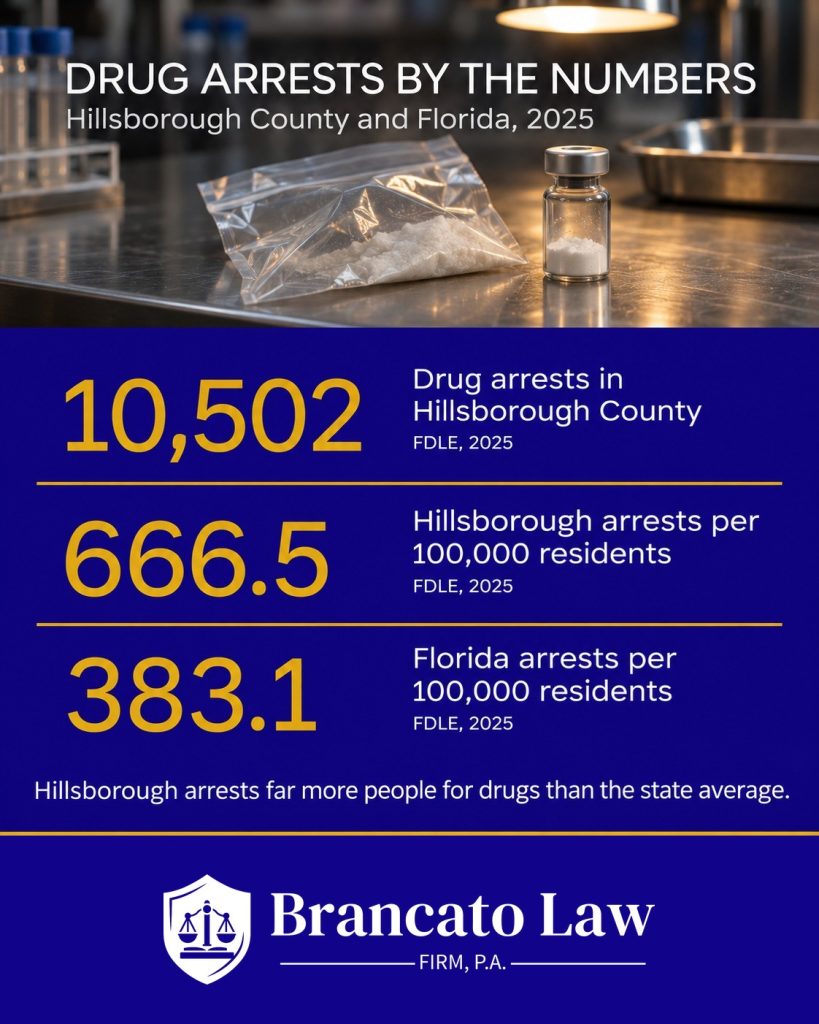
Drug arrests are far more common in Hillsborough County than in Florida as a whole. In 2025, Hillsborough County recorded 10,502 drug arrests, a rate of 666.5 per 100,000 residents, compared with 383.1 per 100,000 statewide, according to Florida Department of Law Enforcement arrest data published on the Florida Department of Health’s FLHealthCHARTS site. Pinellas County recorded 5,269 drug arrests in 2025 and Pasco County recorded 1,817.
That volume shapes how cases move through the 13th Judicial Circuit. Prosecutors in high-volume courtrooms resolve many possession cases through diversion or reduced charges, and our attorneys at The Brancato Law Firm use that reality to push for dismissal when the evidence has weak points.
Can a drug possession charge be dismissed through diversion in Hillsborough County?
Yes. Florida’s pretrial intervention statute, section 948.08(6), lets a person charged with a nonviolent felony who has a substance abuse problem and two or fewer prior nonviolent felony convictions enter a pretrial substance abuse program, and the court must dismiss the charges when the person successfully completes it. If the State Attorney believes the facts suggest dealing, the court holds a preadmission hearing and denies admission if the State proves involvement in dealing by a preponderance of the evidence.
In Hillsborough County, drug court is a single treatment court, Division W of the 13th Judicial Circuit, with two tracks. In our experience in that courthouse, the pretrial track is the better outcome for most first-time clients because it requires no plea and the felony is dismissed at graduation. Our post on how drug court works in Hillsborough County explains the requirements in detail.
Many first-time possession cases in Hillsborough County never reach drug court. The State Attorney’s Office runs DETRR (Drug Education and Treatment Reducing Recidivism), a diversion program for low-risk, nonviolent drug possession cases: the person waives speedy trial in writing, completes any drug education or treatment the program requires, stays arrest-free for six months, and the possession charge is dismissed. DETRR is not available for sale, distribution, trafficking, or violent offenses, so our attorneys push to keep a case framed as simple possession from the first conversation with the prosecutor.
| Option | Plea required? | Result if completed |
|---|---|---|
| DETRR (State Attorney diversion) | No | Possession charge dismissed |
| Pretrial intervention (section 948.08(6)) | No | Charges dismissed |
| Drug court, pretrial track (Division W) | No | Felony dismissed at graduation |
| Drug court, post-adjudication track | Yes, guilty or no contest, with probation | Can keep a nonviolent felony scoring up to 60 points out of prison |
What should you do after a drug possession arrest in Tampa?
Stay silent about the drugs, refuse consent to search your phone, collect your prescription records, and talk to a defense lawyer before the State Attorney makes its filing decision. An arrested person sees a judge at first appearance within 24 hours, and the formal charging decision often comes weeks later. Our guide to the Florida criminal case process walks through each stage, and our post on first appearance in Hillsborough County explains the first hearing.
- Do not explain or discuss the drugs with officers, cellmates, or anyone on a recorded jail call.
- Gather pharmacy printouts, prescription bottles, and prescriber contact information if the substance was a medication.
- Write down who else drove the car or lived in the home, and who had access to the room where the drugs were found.
- Keep the property receipt and any paperwork from the arrest.
- Call a defense attorney before the State files formal charges, while there is still time to influence that decision. Our post on fighting a drug charge before it is filed explains what can happen in that window.
Frequently asked questions about drug possession charges in Florida
Can drug possession charges be dropped in Florida?
Yes. Prosecutors drop or decline possession charges when the search was illegal, the possession proof is weak, the lab cannot confirm the drug, or the person completes pretrial intervention. The Brancato Law Firm presents those problems to the State Attorney’s Office early, often through pre-file advocacy before formal charges are filed.
Is having pills without a prescription a felony in Florida?
Usually, yes. Possessing a controlled prescription drug such as oxycodone or alprazolam without a valid prescription is a third-degree felony under section 893.13(6)(a), unless the drug is a Schedule V substance, which is a second-degree misdemeanor. Our attorneys at The Brancato Law Firm often resolve these cases by producing pharmacy records, and our Tampa drug possession defense page describes that work.
Can I be charged if the drugs were found in someone else’s car?
Yes, under constructive possession, but the State must prove you knew the drugs were there and could control them. When a car or home is shared, Florida courts require independent proof of both, and The Brancato Law Firm builds the defense around what that proof lacks. Our post on constructive possession in a Florida drug case explains the rule.
Will I go to prison for a first drug possession charge in Florida?
Usually not. For a nonviolent third-degree felony with 22 or fewer sentence points, section 775.082(10) requires a nonstate prison sanction unless the judge makes written findings of danger to the public. Our attorneys at The Brancato Law Firm also pursue pretrial intervention and drug court, which can end in dismissal instead of a conviction.
What if I did not know the pill was a controlled substance?
Lack of knowledge of the illicit nature of a substance is an affirmative defense under section 893.101. The jury may presume a person in possession knew what the substance was, so the defense needs evidence, such as messages or witnesses showing what the person was told. The Brancato Law Firm gathers that evidence before trial and uses it in negotiations.
Is possessing a small amount of marijuana still a crime in Florida?
Yes. Possession of 20 grams or less of cannabis is a first-degree misdemeanor, and resin and concentrates such as wax are excluded from that misdemeanor category. Our attorneys at The Brancato Law Firm handle these cases regularly, and our post on Florida marijuana possession laws explains where the felony line falls.
Talk to a Tampa drug possession defense attorney
The weeks between an arrest and the State Attorney’s filing decision are when a possession case is easiest to win. Our attorneys will review the search, request the lab report, and look for a path to dismissal from the first call. Call The Brancato Law Firm, P.A., founded by Tampa Criminal Defense Attorney Rocky Brancato, at (813) 727-7159. You can call us at any hour, and our office is two blocks from the courthouse. Our firm has Spanish-speaking staff, and attorney Jean-Luc Adrien speaks Spanish, Haitian Creole, and French. For more about our defense strategies, visit our Drug Crimes page.
The Brancato Law Firm, P.A.
620 E. Twiggs Street, Suite 205, Tampa, FL 33602
(813) 727-7159
Serving Hillsborough, Pinellas, and Pasco Counties
The Brancato Law Firm, P.A. is a Tampa-based criminal defense practice. We are not affiliated with any other Brancato-named law firms.
Visit Us

Tampa, FL 33602

Contact Us Now
Free Legal Consultation (813) 727-7159
