

From First DUI to Death Penalty



How to Fight an Intent to Sell Charge in Florida? (2026)


To fight a possession with intent to sell charge in Florida, the defense attacks the “intent” the State infers from quantity, packaging, cash, and an officer’s opinion. Under section 893.13(1)(a), selling or possessing a controlled substance with intent to sell is a second-degree felony for drugs like cocaine, heroin, fentanyl, and oxycodone, punishable by up to 15 years, and a third-degree felony for marijuana and most Schedule III and IV drugs. Florida courts have reduced convictions to simple possession when the amount and circumstances were as consistent with personal use as with sales.
Most intent to sell cases are decided by one word in the charge. The drugs are often not in dispute, but whether they were for sale is an inference the State has to build from circumstances, and those circumstances can usually be explained. As founder of The Brancato Law Firm, P.A., a Tampa criminal defense firm, and a former police academy instructor, I have spent more than 25 years in Hillsborough County courtrooms cross-examining officers about exactly what they saw, and I have tried more than 150 jury trials to verdict. Our attorneys push to turn intent to sell charges into possession cases, or to end them entirely, starting before the first hearing.
What is possession with intent to sell in Florida?
Possession with intent to sell is having a controlled substance while intending to sell, manufacture, or deliver it to someone else. Section 893.13(1)(a), Florida Statutes, puts it in the same offense as an actual sale, manufacture, or delivery, so a person can be charged with “sale” without any sale happening. “Deliver” includes handing drugs to a friend for free. Our firm defends these cases as part of the work described on our Tampa drug crimes attorney page.
Three charges sit close together, and the difference matters:
| Charge | What the State must prove | Typical sentence exposure |
|---|---|---|
| Simple possession, s. 893.13(6)(a) | You knowingly possessed the drug | Third-degree felony, up to 5 years (20 grams or less of marijuana is a misdemeanor) |
| Sale or possession with intent to sell, s. 893.13(1)(a) | You possessed the drug and intended to sell or deliver it, or did sell it | Second- or third-degree felony depending on the drug |
| Trafficking, s. 893.135 | You possessed, sold, or delivered at least a threshold weight | Mandatory minimum prison and fines tied to weight |
When the weight crosses a trafficking threshold, intent does not matter; our guide to drug trafficking in Florida covers those cases. Below the threshold, the intent element is the fight.
What are the penalties for sale or intent to sell in Florida?
The degree depends on which schedule the drug falls in under section 893.13(1)(a). The maximum prison terms come from section 775.082.
| Drug type | Degree | Maximum prison | Maximum fine |
|---|---|---|---|
| Cocaine, heroin, fentanyl, oxycodone, methamphetamine, and other drugs listed in s. 893.13(1)(a)1. | Second-degree felony | 15 years | $10,000 |
| Marijuana and most Schedule III and IV drugs, such as alprazolam (Xanax) | Third-degree felony | 5 years | $5,000 |
| Schedule V drugs | First-degree misdemeanor | 1 year in jail | $1,000 |
| Giving away 20 grams or less of marijuana, with no payment, s. 893.13(3) | First-degree misdemeanor | 1 year in jail | $1,000 |
| Sale or intent to sell within 1,000 feet of a school, park, church, or other listed place, s. 893.13(1)(c) | Usually first-degree felony for the most serious drugs | 30 years | $10,000 |
Location can raise the charge sharply. Our guide to selling drugs near a school in Florida explains how drug-free zone enhancements work and how the distance is challenged.
How does the State try to prove intent to sell?
The State proves intent to sell with circumstantial evidence, because people rarely announce that they plan to sell. The usual signs prosecutors point to are:
- A quantity larger than one person would use.
- Many small baggies or individually wrapped portions.
- Digital scales, empty baggies, or cutting agents.
- Cash in small bills, especially in amounts that match drug prices.
- Text messages that read like orders or price quotes.
- An officer’s opinion, based on training and experience, that the drugs were “packaged for sale.”
Each of these has an innocent explanation in many cases. Users buy in bulk to save money and to avoid repeated trips. Cash comes from paychecks and tips. Scales are sold everywhere. The question for the jury is whether the whole picture proves intent to sell beyond a reasonable doubt.
When have Florida courts thrown out intent to sell convictions?
Florida appellate courts have reversed intent to sell convictions when the evidence showed only a small amount with no real sign of a sales business. In McFarlane v. State, 239 So. 3d 1272 (Fla. 2d DCA 2018), an officer found eight cocaine rocks of different sizes and $42 on a man stopped for a suspended license. Three officers testified that the way the cocaine was cut pointed to sales, but each admitted it could have been for personal use, and there were no scales, baggies, gun, or large amount of cash. The Second District reversed the intent to sell conviction and sent the case back for a judgment of simple possession.
The legal standard has shifted since then. In Bush v. State, 295 So. 3d 179 (Fla. 2020), the Florida Supreme Court abolished the special appellate rule for wholly circumstantial cases and held that courts now ask whether competent, substantial evidence supports the verdict. That makes it harder to win on appeal, so the intent fight has to be won earlier: in the motion for judgment of acquittal, in cross-examination of the officer’s “packaged for sale” opinion, and in negotiations before trial. The facts that mattered in McFarlane still matter to juries and prosecutors.
What role does drug use play in an intent to sell defense?
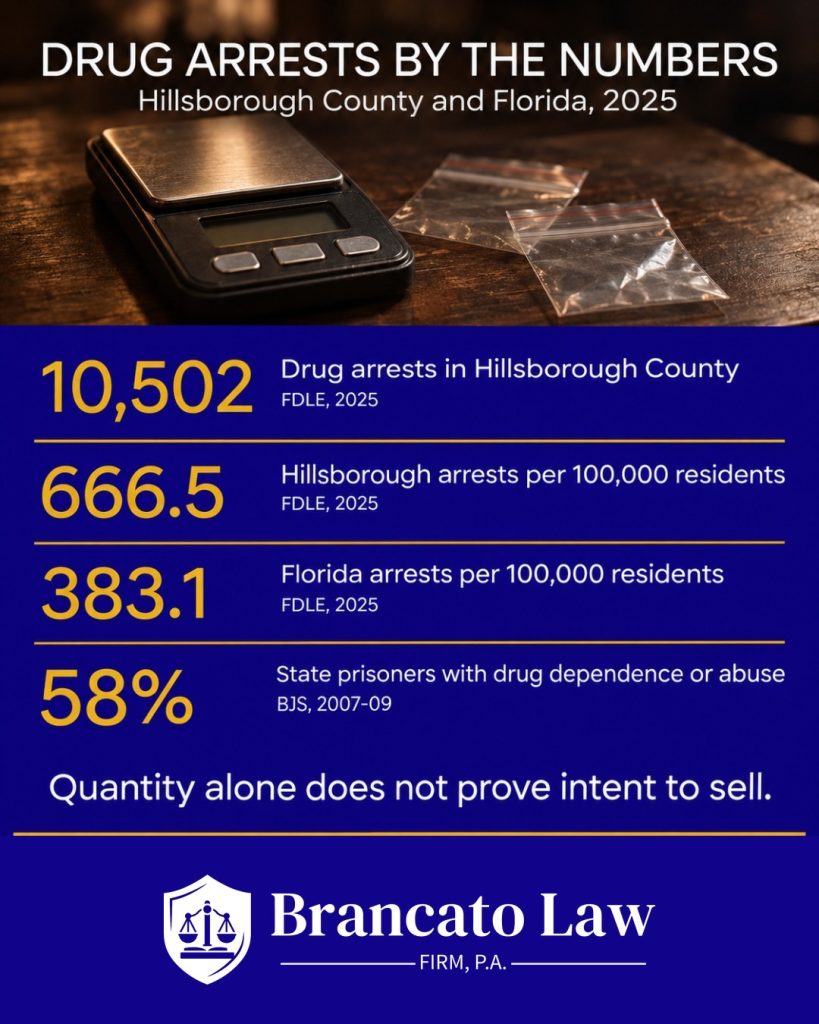
Evidence that the accused is a heavy user is often the core of the defense, because it explains quantity, packaging, and paraphernalia without any sale. Drug dependence is common among people in the justice system: during 2007-2009, an estimated 58% of state prisoners and 63% of sentenced jail inmates met clinical criteria for drug dependence or abuse, according to the U.S. Bureau of Justice Statistics report Drug Use, Dependence, and Abuse Among State Prisoners and Jail Inmates, 2007-2009. A person with a dependence often buys larger amounts and splits them up for later use.
That evidence has to be used carefully, because it also admits possession. Our attorneys decide early whether the defense is “not mine,” “not for sale,” or a suppression challenge, since the three can pull in different directions.
How do our attorneys fight an intent to sell charge?
Our attorneys fight intent to sell charges at three levels: the search, possession itself, and intent. The approach usually follows this order:
- Challenge the stop and search. Many cases begin with a traffic stop or a home search. If the stop lacked legal grounds, the search exceeded consent, or the warrant was defective, a motion to suppress can remove the drugs from evidence.
- Challenge possession. Drugs in a shared car, room, or house require proof that you knew about them and could control them. Our guide to constructive possession in Florida explains that standard.
- Challenge the lab result and weight. The State must prove what the substance is. We review the lab report and, where the weight is near a threshold, how it was measured. Our guide to being charged with the wrong drug shows how lab errors change cases.
- Attack intent. We examine quantity against personal-use patterns, the packaging, the source of any cash, and the officer’s basis for calling it “packaged for sale.”
- Negotiate the charge down. Reducing intent to sell to simple possession can open diversion and drop the maximum sentence from 15 years to 5.
Can intent to sell charges be reduced to possession in Hillsborough County?
Yes, and that reduction is often the most important goal, because it changes what programs are available. In Hillsborough County, the State Attorney’s Office offers DETRR, a drug diversion program for possession cases, but it is not available for sale, distribution, trafficking, or violent offenses. Our guide to fighting a drug possession charge in Florida explains how those programs work once a case is framed as possession.
Volume shapes how these cases move. In 2025, Hillsborough County recorded 10,502 drug arrests, a rate of 666.5 per 100,000 residents compared with 383.1 statewide, according to Florida Department of Law Enforcement data published on the Florida Department of Health’s FLHealthCHARTS drug arrest dashboard. In our experience, prosecutors handling that many cases will look closely at a weak intent theory when the defense lays out the problems early, often before the arraignment. Our guide to the Florida criminal case process shows where that negotiation fits.
What should you do after an intent to sell arrest?
Say nothing about the drugs, your phone, or where the money came from, and call a defense attorney before first appearance if you can. Then:
- Do not consent to a search of your phone. Text messages are often the State’s best intent evidence.
- Write down every detail of the stop or search while you remember it: times, what officers said, and who else was present.
- Keep pay stubs, bank records, or anything that shows a lawful source for cash that was seized.
- Do not discuss the case on jail phones, which are recorded.
If you learn that police are investigating you but you have not been arrested, our representation before charges are filed can address the case before a warrant issues.
Frequently asked questions about intent to sell charges in Florida
How much drugs do you need to be charged with intent to sell in Florida?
There is no minimum amount. The State can charge intent to sell based on packaging, cash, scales, or messages even with a small quantity, while amounts above the trafficking thresholds in section 893.135 are charged as trafficking instead. Our attorneys at The Brancato Law Firm compare the amount with personal-use patterns to show when the quantity proves nothing about sales.
Can a possession with intent to sell charge be dropped in Florida?
Yes. Charges can be dropped or reduced when a search was illegal, when the State cannot prove you knew about the drugs, or when the intent evidence is weak, and reduction to simple possession is common. The Brancato Law Firm raises those issues with the prosecutor early, and our Tampa drug defense lawyers file suppression motions where the facts support them.
Is giving drugs to a friend for free a sale in Florida?
It can be charged the same way, because section 893.13(1)(a) covers delivery, not just sales for money. The exception is giving away 20 grams or less of marijuana for no payment, which is a first-degree misdemeanor under section 893.13(3), and The Brancato Law Firm makes sure that lower charge is applied when the facts fit.
Does having cash and drugs together prove intent to sell?
No. Cash is common and has many lawful sources, and courts look at the whole picture, including whether there were scales, baggies, or sales conduct. Our attorneys at The Brancato Law Firm document where the money came from to take that inference away from the State.
Can police search my phone for evidence of drug sales?
Generally not without a warrant or your consent, and the scope of any warrant can be challenged. The Brancato Law Firm reviews phone search warrants line by line, because text messages are often the State’s strongest intent evidence.
Is selling marijuana still a felony in Florida in 2026?
Yes, for most sales. Selling marijuana, or possessing it with intent to sell, is a third-degree felony under section 893.13(1)(a)2. even though medical marijuana is legal for registered patients. The Brancato Law Firm examines whether a medical marijuana card or hemp product changes the analysis in a particular case.
For more about our defense strategies, visit our Drug Crimes page.
What our attorneys do first is lock down the facts of the stop and the search, before memories fade and before video evidence is lost. Call The Brancato Law Firm, P.A., founded by Tampa Criminal Defense Attorney Rocky Brancato, at (813) 727-7159; call us at any hour, including the night of an arrest. Our office is two blocks from the courthouse. Our firm has Spanish-speaking staff, and attorney Jean-Luc Adrien speaks Spanish, Haitian Creole, and French.
The Brancato Law Firm, P.A.
620 E. Twiggs Street, Suite 205, Tampa, FL 33602
(813) 727-7159
Serving Hillsborough, Pinellas, and Pasco Counties
The Brancato Law Firm, P.A. is a Tampa-based criminal defense practice. We are not affiliated with any other Brancato-named law firms.
Visit Us

Tampa, FL 33602

Contact Us Now
Free Legal Consultation (813) 727-7159
