

From First DUI to Death Penalty



What Happens at a Hillsborough County School Expulsion Hearing? (2026)


Short answer: A Hillsborough County Public Schools expulsion case usually starts as a change of placement hearing run by the district’s Office of Student Conduct and Support, where hearing officers decide whether a student goes back to school, moves to an alternative school, or is referred to the Expulsion Committee. Families can bring a representative, including a lawyer, and can appeal a change of placement in writing within 5 days. If the district recommends expulsion, the School Board decides, and Florida law gives the student a hearing under Chapter 120, which includes the right to cross-examine witnesses when the facts are disputed.
A school discipline case is decided on paper unless someone makes the school prove it. Principals send referral packets full of witness summaries and incident reports, and most families walk into the hearing without knowing they can challenge any of it. I’m Rocky Brancato, founder of The Brancato Law Firm, P.A., a Tampa criminal defense firm, and I chaired the 13th Judicial Circuit Juvenile Justice Advisory Board and spent years on Hillsborough’s juvenile civil citation committee. As a former Chief Operations Officer of the Hillsborough County Public Defender’s Office, where I oversaw a staff of over 100 attorneys, I have spent more than 25 years in Hillsborough County courtrooms. Our attorneys prepare students and parents for these hearings, test the school’s evidence, and coordinate the school case with any juvenile or criminal case that comes from the same incident.
What is a change of placement hearing in Hillsborough County schools?
A change of placement hearing is the district-level hearing Hillsborough County Public Schools (HCPS) holds when a principal believes a student’s conduct is too serious for a school-level suspension. Under the HCPS Student Code of Conduct, the principal must get approval from the Region Superintendent, and the Office of Student Conduct and Support then schedules the hearing and notifies the parent of the date, time, and location.
The hearing decides “the appropriate educational environment for the student,” in the code’s words. The hearing officers review the incident, the school’s documentation of earlier interventions, and anything else they consider relevant. The student and parent get a chance to explain their side, and they may bring a representative. The result is announced at the end of the hearing, and families who do not attend receive it by mail.
Three outcomes are realistic: the student returns to a regular school, the student is assigned to an alternative school for a set term, or the case is referred to the Expulsion Committee. The code says the committee decides within 3 school days whether to recommend expulsion to the superintendent and the School Board.
How often does Hillsborough County actually expel students?
Expulsion is rare in Hillsborough County; alternative placement is the common outcome. In the 2024-25 school year, the Florida Department of Education’s discipline data shows that Hillsborough County schools gave 8,698 students out-of-school suspensions and placed 597 students in an alternative educational setting. The number of Hillsborough students expelled was below 10, so the state suppressed the exact figure for privacy.
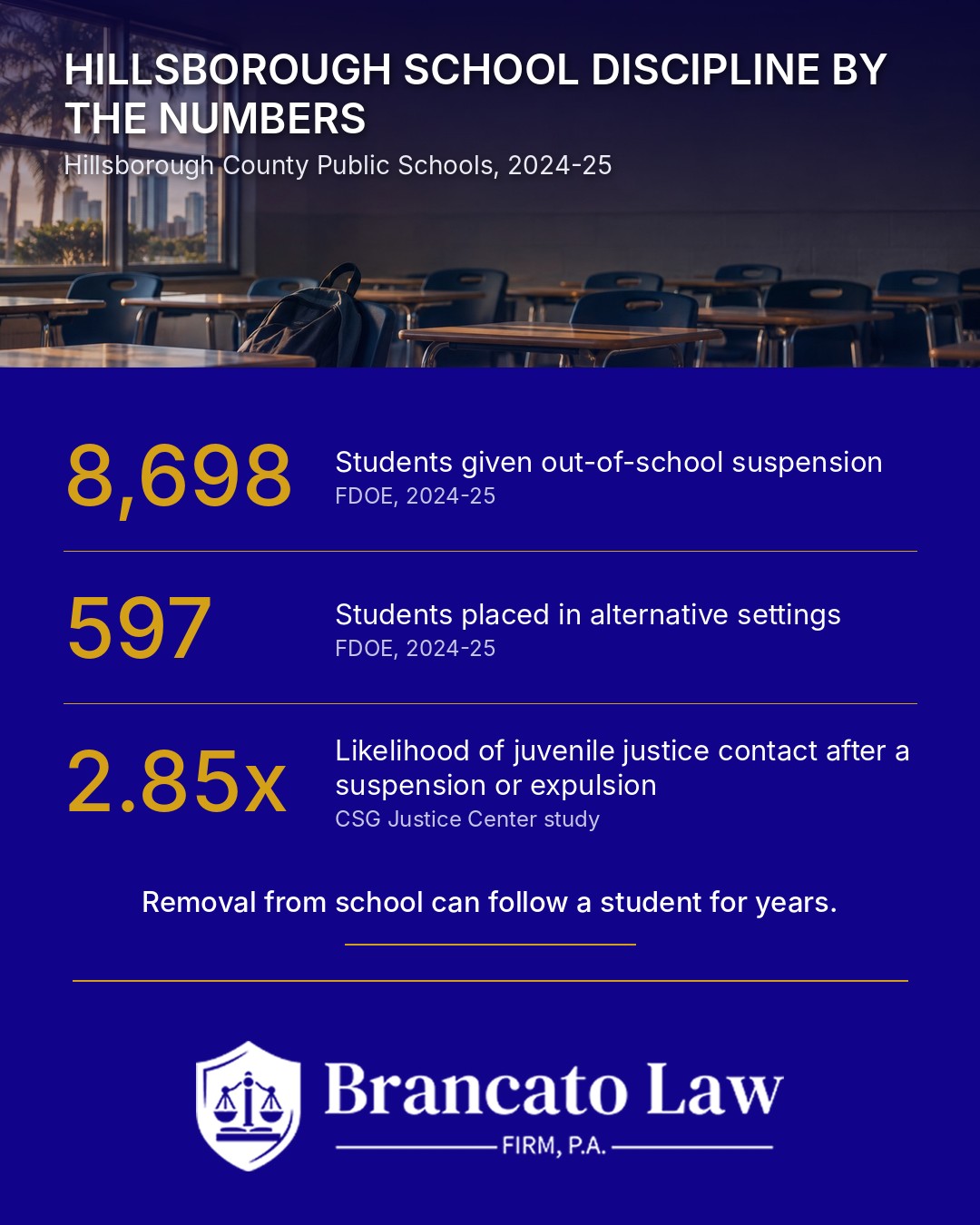
For most Hillsborough students, then, the change of placement hearing is the decision that matters, because it decides whether the student finishes the year at the home school or at an alternative site. Statewide, by comparison, the same 2024-25 FDOE data shows 997 students expelled with continuing educational services and 547 expelled without them.
What is the difference between a suspension, a change of placement, and an expulsion?
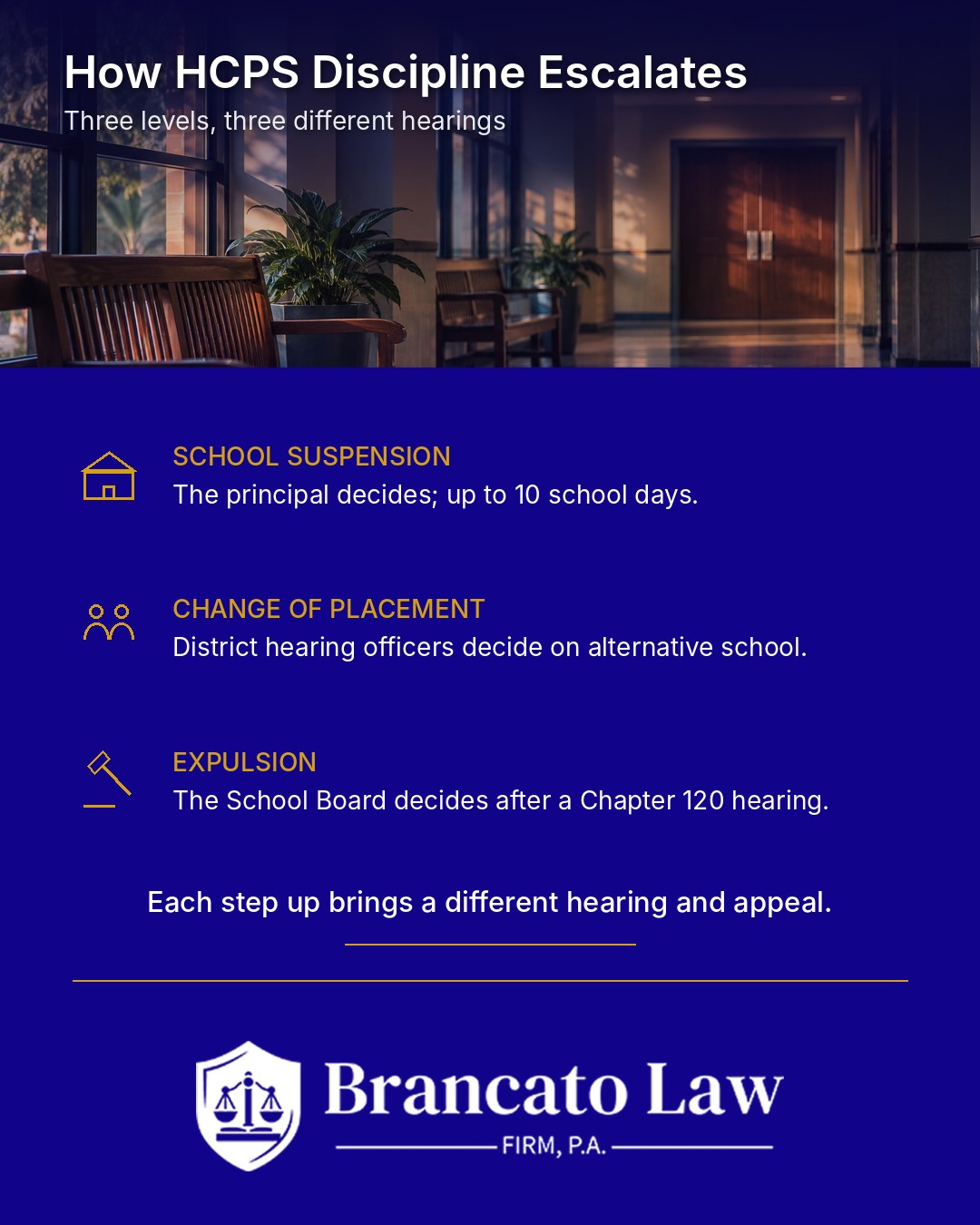
Each level of HCPS discipline has a different decision-maker, a different hearing, and a different appeal. Knowing which one your child is facing tells you what rights apply.
| Level | Who decides | Type of hearing | How long it can last | Appeal |
|---|---|---|---|---|
| School-level suspension (in-school or out-of-school) | Principal or designee | Informal: notice of the charges, an explanation of the evidence, and a chance to respond (s. 1006.09(1)(b)) | Out-of-school suspension may not exceed 10 school days | Meet with the principal, then the Region Superintendent |
| Change of placement (alternative school) | Hearing officers, Office of Student Conduct and Support | District hearing; the family may bring a representative | Set at the hearing; may be extended a semester if return criteria are not met | Written appeal to the Office of Chief of Schools within 5 days; decision within 3 school days |
| Expulsion | School Board, after an Expulsion Committee recommendation | Chapter 120 hearing (ss. 120.569 and 120.57); formal hearing with cross-examination when facts are disputed | At least 1 full year for zero-tolerance offenses, unless modified | Judicial review in the District Court of Appeal |
Suspension hearings are exempt from Chapter 120 under section 1006.07(1)(a), Florida Statutes. Before a suspension, section 1006.09(1)(b) requires oral and written notice of the charges, an explanation of the evidence, and a chance for the student to tell their side of the story. That mirrors the constitutional minimum the U.S. Supreme Court set in Goss v. Lopez, 419 U.S. 565 (1975), where Ohio high school students suspended without any hearing won a ruling that a suspension of 10 days or less still requires notice and an informal chance to respond.
What rights does a student have if HCPS recommends expulsion?
A student recommended for expulsion has the right to a hearing governed by Florida’s Administrative Procedure Act. Section 1006.07(1)(a) says expulsion hearings “shall be governed by ss. 120.569 and 120.57(2),” and section 1006.08(1) requires the superintendent to give the student and parent written notice of the charges and of the student’s due process rights. The School Board, not the principal, decides every expulsion.
The hearing type changes when the facts are disputed. Under section 120.569(1), a formal hearing under section 120.57(1) applies whenever a proceeding involves a disputed issue of material fact, unless all parties waive it. In a formal hearing, section 120.57(1)(b) gives every party the right to present evidence and argument, conduct cross-examination, submit rebuttal evidence, and be represented by counsel.
Expulsion hearings are closed by default. The statute exempts them from Florida’s open-meetings law, but the parent must be told of that right and may choose to have the hearing held in the open.
- Written notice of the charges and of the student’s due process rights.
- A hearing before the School Board or its hearing officer.
- When the facts are disputed: the right to cross-examine the school’s witnesses, present evidence, and have a lawyer.
- A decision based on the evidence presented, which can be reviewed by the District Court of Appeal.
Can a school expel a student based only on hearsay?
No, not when the hearsay is the only evidence. Section 120.57(1)(c) allows hearsay to supplement or explain other evidence, but hearsay cannot support a finding by itself unless it would be admissible over objection in a civil trial.
Florida’s Second District Court of Appeal, which hears appeals from Hillsborough County, applied that rule to a student in Franklin v. District School Board of Hendry County, 356 So. 2d 931 (Fla. 2d DCA 1978). The board expelled a student based only on the alleged victim’s affidavits and the principal’s and vice principal’s account of what that student told them. No eyewitness testified, and the student admitted nothing. The court held that hearsay “standing alone was insufficient” and reversed the expulsion.
The Fifth District reached a similar result for three of five high school students in Adams v. School Board of Brevard County, 470 So. 2d 760 (Fla. 5th DCA 1985). The students were expelled for buying or selling pills on campus that a lab later found were pure caffeine. The court upheld two expulsions where the record showed the pills were represented as “speed,” reversed three where it did not, and ordered the board to expunge those three students’ expulsion records.
The Second District repeated the principle against the Hillsborough County School Board itself in 2025. In Smith v. School Board of Hillsborough County, No. 2D2023-2315 (Fla. 2d DCA May 21, 2025), a teacher was fired over a child abuse allegation after a hearing built almost entirely on written reports. The court reversed, holding the superintendent had to prove the allegations were true, not just that they were made, and that relying on the reports denied the right to confront the witnesses. That case involved a teacher, but the same Chapter 120 rule governs a student’s expulsion hearing.
What happens at the hearing, and what can a lawyer do there?
A lawyer’s job at an HCPS hearing is to make the district prove what the referral packet only alleges. I have represented a student at a Hillsborough County Public Schools hearing where I cross-examined the school’s witnesses and argued the case to the hearing officers. Some college conduct systems in Tampa Bay limit a lawyer to a silent advisor role, so families should not assume a K-12 hearing works the same way. Our student conduct and Title IX defense guide compares the rules at USF, Hillsborough College, the University of Tampa, and Tampa Bay law schools.
Our attorneys typically do the following before and during the hearing:
- Request the full discipline packet, incident reports, witness statements, and any video before the hearing date.
- Identify which facts are disputed and say so on the record, because disputed facts trigger the formal-hearing protections if the case moves toward expulsion.
- Question the administrator who investigated about who saw what, when statements were taken, and what the video does and does not show.
- Present the student’s record, teacher letters, counseling or treatment, and a concrete safety plan that makes a return to the home school realistic.
- Keep the student from making statements at the hearing that a prosecutor could later use.
- Raise disability protections when the student has an IEP or 504 plan.
Can an off-campus arrest get my child removed from school?
Yes. The HCPS Student Code of Conduct has a separate procedure for an off-campus arrest, coded as a “Code 81” hearing, which follows the same change of placement process. The principal must get the Region Superintendent’s approval first.
Florida law sets a higher bar for off-campus felony charges. Under section 1006.09(2), suspension proceedings can begin only when a prosecutor has formally charged the student with a felony, or a delinquent act that would be a felony for an adult, and an administrative hearing shows the incident had an adverse impact on the school’s educational program, discipline, or welfare. The student is placed in an alternative education program during that suspension, and under that subsection the School Board may expel only if the court later determines the student committed the offense.
The outcome of the criminal case therefore drives what the school can do. A juvenile case resolved through a civil citation, diversion, or a no-file decision is a different starting point for the school than a felony petition. Our firm’s representation before charges are filed is often the fastest way to protect both the court case and the school placement.
How can a plea in juvenile court affect which school my child attends?
A plea can bar a student from the victim’s school. Under section 1006.13(6), when a student is adjudicated delinquent, is found to have committed the offense even with adjudication withheld, or pleads guilty or no contest to a felony in listed categories such as battery, robbery, sexual battery, or child abuse, and the student was attending a school the victim or the victim’s sibling attends, the student may not attend that school or ride the same school bus.
The statute’s exception is a written disposition order under section 985.455(2). That is why the plea and the disposition order should be negotiated with the school consequences in mind. A plea that looks favorable in juvenile court can still force a school transfer if no one addresses section 1006.13(6) before the judge signs the order.
What zero-tolerance offenses require a one-year expulsion?
Florida’s zero-tolerance law requires at least a one-year expulsion, plus referral to the criminal or juvenile justice system, for two categories of conduct. Under section 1006.13(3)(a), they are (1) bringing a firearm or weapon to school, a school function, or school transportation, or possessing a firearm at school, and (2) making a threat or false report involving school property, transportation, or a school-sponsored activity.
Even these cases are not automatic. The superintendent may consider the one-year requirement case by case and ask the School Board in writing to assign the student to a disciplinary program or second chance school instead. The statute also says zero-tolerance policies “may not be rigorously applied to petty acts of misconduct” and that any action “must be based on the particular circumstances of the student’s misconduct.” Our posts on weapons on school property and school shooting and bomb threats cover the criminal side of those charges.
How is a Title IX complaint handled in Hillsborough County schools?
A Title IX sexual harassment complaint in a K-12 school follows a separate federal grievance process with no required live hearing. Under 34 C.F.R. § 106.45(b)(6)(ii), as recodified by the U.S. Department of Education on September 29, 2026, elementary and secondary schools may hold a hearing but do not have to. With or without one, each party must be allowed to submit written questions for the other party and witnesses, receive the answers, and ask limited follow-up questions.
| Question | K-12 schools (including HCPS) | Colleges and universities |
|---|---|---|
| Is a live hearing required? | No. The school may hold one but does not have to (§ 106.45(b)(6)(ii)) | Yes (§ 106.45(b)(6)(i)) |
| How are witnesses questioned? | Each party submits written questions, receives the answers, and may ask limited follow-up questions | Each party’s advisor cross-examines the other party and witnesses directly, orally, and in real time |
| Can a lawyer act as the advisor? | Yes, the party may choose an advisor, who may be a lawyer | Yes, and the advisor conducts the cross-examination |
For a high school student, that means the defense is built on paper: the investigative report, the written questions, and the written response. The questions have to be drafted with the same care as a live cross-examination, because there may be no second chance to ask them.
Does a student with an IEP or 504 plan have extra protection?
Yes. Under the Individuals with Disabilities Education Act, 20 U.S.C. § 1415(k), a school must hold a manifestation determination review before a disciplinary change of placement for a student with a disability. The HCPS code says that review must take place within 10 school days of any significant change in placement and asks whether the conduct was caused by, or had a direct and substantial relationship to, the student’s disability, or resulted from the school’s failure to implement the IEP or 504 plan. If the answer is yes, the student generally returns to the original placement. The exception covers weapons, illegal drugs, and serious bodily injury at school, where the school may move the student to an interim alternative setting for up to 45 school days regardless of the disability.
Why does a school case matter so much for a teenager’s future?
Exclusion from school predicts later contact with the justice system. In the Council of State Governments Justice Center’s Breaking Schools’ Rules study, which followed nearly 1 million Texas seventh graders over six years, a discretionary suspension or expulsion nearly tripled (2.85 times) a student’s likelihood of juvenile justice contact in the following school year.
Hillsborough County saw the reverse side of that research when it expanded civil citations. In my years on the juvenile civil citation committee, the county’s juvenile caseload fell from roughly 12,000 cases around 2004 to about 2,000 after civil citations took hold. The free book Before It Becomes a Case walks parents through how one incident can create a school case, a juvenile case, and an injunction at the same time, in its chapter on one incident and several proceedings.
What should parents do before an HCPS hearing?
Act in the days between the referral and the hearing date, because the hearing is usually decided by the record in front of the hearing officers. Use this checklist:
- Read the notice and write down the date, the code violations listed, and who to contact at the Office of Student Conduct and Support.
- Do not let your child write a new statement or talk to the school resource officer about the incident without a lawyer.
- Ask for the discipline packet and any video, and save texts, photos, and social media posts that support your child’s account.
- Collect report cards, attendance records, teacher letters, and any counseling or medical records you are comfortable sharing.
- If police were involved, learn whether the State Attorney’s Office has filed anything, and whether a civil citation through JAAP was issued or is still possible.
- Calendar the 5-day deadline to appeal a change of placement in writing to the Office of Chief of Schools.
For the larger picture of how the criminal side moves, see our guide to the Florida criminal case process, and our page on Hillsborough County courts for local court procedure.
Frequently asked questions
Can I bring a lawyer to a Hillsborough County change of placement hearing?
Yes. The HCPS Student Code of Conduct says the student and parent may bring a representative to the change of placement or expulsion hearing. The Brancato Law Firm prepares families for these hearings and appears with them to question the school’s evidence and present the student’s case.
How long does an alternative school placement last in Hillsborough County?
The length is set at the hearing, and the HCPS code says a student who does not meet the return criteria may have the term extended by a semester and reviewed again. Our attorneys at The Brancato Law Firm focus on the exit criteria early, so the student knows exactly what must be done to return to a traditional school.
How do I appeal a change of placement decision in HCPS?
File a written appeal with the Office of Chief of Schools within 5 days of the hearing, according to the HCPS code, which says the office decides within 3 school days. The Brancato Law Firm drafts the appeal around the specific errors in the hearing record rather than a general request for leniency, and our Hillsborough County defense attorneys coordinate it with any court date.
Should my child talk at the school hearing if there is also a criminal charge?
Not without legal advice first, because statements made to school officials can reach police and prosecutors. The Brancato Law Firm decides with the family what the student will and will not say, and whether a written statement or a lawyer’s presentation is safer. Our guide to arrests of students in Tampa explains how the two cases interact.
Does a withhold of adjudication in juvenile court still count for school purposes?
For the school-transfer rule in section 1006.13(6), yes: the statute applies “regardless of whether adjudication is withheld.” That is why The Brancato Law Firm reviews the school consequences of any plea and asks for a written disposition order under section 985.455(2) when it protects the student’s placement.
Can a school discipline my child for something that happened off campus?
Yes, in limited situations, including an off-campus arrest under the HCPS Code 81 procedure and formal felony charges under section 1006.09(2). The Brancato Law Firm works to resolve the criminal case early, often through pre-file advocacy, because the school’s options depend on what prosecutors file.
Talk to our attorneys before the hearing date
The hearing date on the district’s letter is the deadline that matters, so call before it arrives. The Brancato Law Firm, P.A., founded by Tampa Criminal Defense Attorney Rocky Brancato, prepares students and parents for Hillsborough County school discipline hearings and handles the juvenile or criminal case that often comes with them. Call (813) 727-7159; you can call us at any hour. Our firm has Spanish-speaking staff, and attorney Jean-Luc Adrien speaks Spanish, Haitian Creole, and French.
For more about our defense strategies, visit our Hillsborough County criminal defense page.
The Brancato Law Firm, P.A.
620 E. Twiggs Street, Suite 205, Tampa, FL 33602
(813) 727-7159
Serving Hillsborough, Pinellas, and Pasco Counties
The Brancato Law Firm, P.A. is a Tampa-based criminal defense practice. We are not affiliated with any other Brancato-named law firms.
Visit Us

Tampa, FL 33602

Contact Us Now
Free Legal Consultation (813) 727-7159
