

From First DUI to Death Penalty



What Happens at a USF Student Conduct Hearing? (2026)


Short answer: A USF student conduct case starts with an emailed notice and an Informational Meeting with a hearing officer from Student Conduct and Ethical Development. The student then chooses a Resolution Agreement or a Formal Hearing, which is either an Administrative Hearing before one hearing officer or a University Conduct Board of two students and one faculty or staff member. Because USF is a state university, section 1006.60, Florida Statutes, guarantees written notice at least 7 business days ahead, a presumption that no violation occurred, the right to remain silent, and an advisor or lawyer who may directly participate. A written appeal to the Dean of Students is due within 5 days of the outcome letter.
If your son or daughter just got an email from USF Student Conduct and Ethical Development asking for an Informational Meeting, the record in the case starts with that first conversation. I’m Rocky Brancato, founder of The Brancato Law Firm, P.A., a Tampa criminal defense firm, and a former Chief Operations Officer of the Hillsborough County Public Defender’s Office, where I oversaw a staff of over 100 attorneys. I was also a training director at that office and have trained hundreds of Tampa Bay attorneys over more than 25 years in Hillsborough County courtrooms. Our attorneys prepare USF students for conduct and Title IX hearings, put their rights in writing before the hearing, and defend the criminal case that often grows out of the same incident.
What rights does a USF student have in a conduct case?
A USF student has every protection in section 1006.60(3), Florida Statutes, because the statute sets minimum due process rules for every state university and Florida College System institution. USF’s own rule, Regulation USF6.0021, the Student Code of Conduct, has to meet those minimums, and the Board of Governors’ Regulation 6.0105 sets the system-wide floor for state universities.
The Legislature added these rights in 2021. The House staff final bill analysis of CS/CS/HB 233 (June 24, 2021) describes the change as mandating codes of conduct with minimum protections, including the right to hire “an advisor, advocate, or legal representative to be present and who can fully participate in the disciplinary proceeding.” The table below lines up each statutory right with how USF applies it.
| Right | What the statute requires | How it works at USF |
|---|---|---|
| Notice | Written notice at least 7 business days before the proceeding (s. 1006.60(3)(a)) | Notice goes to the student’s USF email; the Informational Meeting explains the charges |
| Evidence before the hearing | A list of known witnesses and all known information, inculpatory and exculpatory, at least 5 business days before | The student may review all available information supporting the charges before resolution |
| Burden of proof | Presumption that no violation occurred; the university must prove a violation by a preponderance of the evidence (s. 1006.60(3)(b)) | Preponderance of the evidence, decided by the hearing officer or Conduct Board |
| Impartial decision-maker | An impartial hearing officer (s. 1006.60(3)(c)) | Bias or conflict of interest is an appeal ground in Title IX cases |
| Silence | The right to remain silent; silence may not be used against the student (s. 1006.60(3)(d)) | Invoking the right “will not be considered as a negative factor” |
| Witnesses | The right to present relevant information and question witnesses (s. 1006.60(3)(e)) | Present and question witnesses under the Formal Hearing procedure |
| Advisor or lawyer | An advisor, advocate, or legal representative, at the student’s expense, who “may directly participate in all aspects of the proceeding” (s. 1006.60(3)(g)) | An Advisor “may participate in all aspects of the proceeding but shall not testify for the student” |
| Record | An accurate and complete record of every proceeding and appeal, available for copying on request (s. 1006.60(3)(i)) | Request the record early if an appeal is possible |
| Appeal | Appeal to the vice president of student affairs or a designated senior administrator (s. 1006.60(3)(h)) | Written appeal to the Dean of Students, or designee, within 5 days of the outcome letter |
Our attorneys at The Brancato Law Firm use this list as a checklist. A missed deadline or a withheld witness statement is a due process problem that can be raised at the hearing and on appeal.
How does a USF student conduct case move from notice to hearing?
A USF case moves through four stages: notice, an Informational Meeting, a choice of resolution, and an appeal. USF’s Student Conduct Process applies to conduct on or off campus, and the university says it will act “independently of any criminal or civil court process.”
- Notice. The student receives an email from Student Conduct and Ethical Development (SCED) with a link to the charge letter.
- Informational Meeting. A hearing officer explains the process, the charges, and the information supporting them. The hearing officer may gather more information afterward, and the student gets notice and a chance to review it. USF’s Informational Meeting page says a student who skips the meeting waives it, and SCED schedules a Formal Hearing.
- Choice of resolution. The student has up to 3 days after the meeting to choose a Resolution Agreement or a Formal Hearing. A Resolution Agreement waives the hearing and the appeal and is not available when the case could end in separation from the university.
- Formal Hearing and outcome. The student receives written notice of the outcome within 5 days of the hearing.
- Appeal. A written appeal goes to the Dean of Students, or designee, within 5 days of the outcome letter.
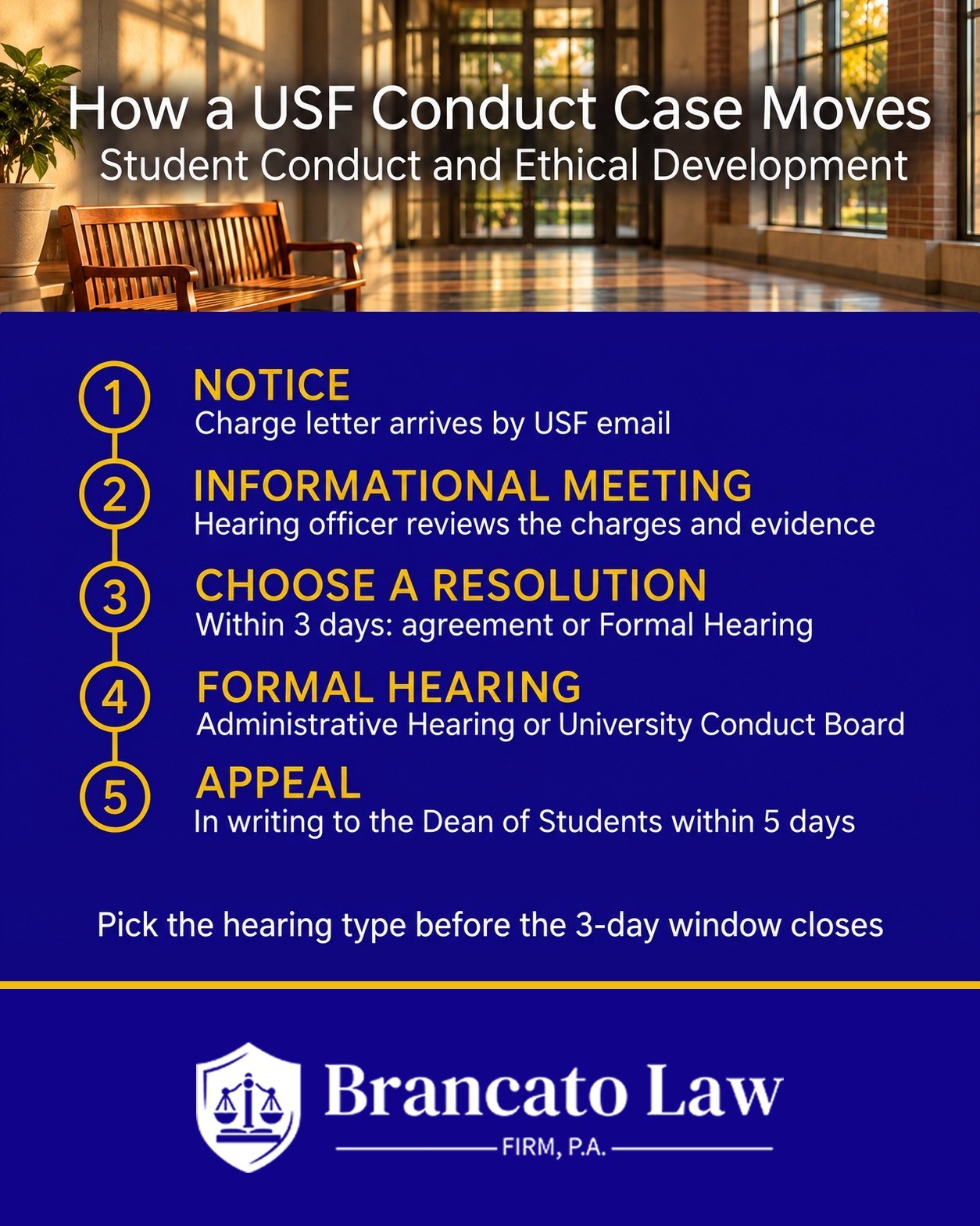
The 3-day window after the Informational Meeting is the decision our attorneys most want to be part of, because the choice made there decides whether the student keeps a hearing and an appeal.
What is the difference between an Administrative Hearing and the University Conduct Board?
An Administrative Hearing is decided by one hearing officer, and the University Conduct Board is decided by a panel of two students and one faculty or staff member. USF’s resolution options page says choosing one forum waives the other, and cases involving sexual harassment, stalking, and violence must go to a Formal Hearing.
| Question | Administrative Hearing | University Conduct Board |
|---|---|---|
| Who decides | A single hearing officer | Two students and one faculty or staff member |
| Who runs the hearing | The hearing officer | A non-voting hearing officer moderates and stays out of deliberations |
| What the student waives | The right to a Conduct Board | The right to an Administrative Hearing |
| When it tends to fit | Technical or document-heavy cases where a trained decision-maker helps | Cases where peers may weigh context and credibility differently |
| Appeal | Written appeal to the Dean of Students within 5 days | Written appeal to the Dean of Students within 5 days |
The Brancato Law Firm looks at the evidence, the witnesses, and the sanction at stake before advising a student which forum to choose.
Can a lawyer speak at a USF conduct hearing?
Yes. Under current Florida law and USF’s current regulation, a lawyer who serves as the student’s advisor may participate in the hearing. Section 1006.60(3)(g) gives the student the right to an advisor, advocate, or legal representative who “may directly participate in all aspects of the proceeding, including the presentation of relevant information and questioning of witnesses.” Board of Governors Regulation 6.0105 says the advisor “may participate in all aspects of the proceeding but shall not testify for the student.”
USF’s regulation now says the same thing. Regulation USF6.0021, last amended January 31, 2025, says the Advisor “may be present to advise the student and may participate in all aspects of the proceeding but shall not testify for the student,” and that an Advisor who is “an advocate or legal representative” must follow “the same guidelines as any other Advisor.” There is no separate, lesser rule for attorneys. The same regulation lets the hearing officer “provide advice regarding the scope, direction, or tone of questioning,” and an Advisor “may be dismissed from the Student Conduct Process for failure to adhere to the parameters of their role.”
USF’s public FAQ page has not caught up. The Student Conduct and Ethical Development FAQ still says the advisor “may not speak for the charged student, act as attorney, nor otherwise participate.” That is the older rule, from before the 2021 statute, and hearings have been run that way. In 2025, months after that January amendment, our firm’s attorney was limited to the role of a silent advisor at a USF hearing.
Our attorneys handle that gap in four steps:
- Before the hearing, we write to SCED and state the student’s rights under section 1006.60(3)(g) and Regulation USF6.0021, including the right to present information and question witnesses through the advisor.
- At the start of the hearing, we raise those rights again so the hearing officer’s ruling is on the record.
- If the hearing officer limits the advisor’s role, we preserve that ruling as an appeal issue under section 1006.60(3)(h) and USF’s appeal ground for “a violation of due process rights or failure of the University to follow the Student Conduct Process” that substantially affected the outcome.
- We still prepare the student to carry the presentation, because the hearing officer controls the scope, direction, and tone of questioning.
The statute and the regulation are public, and a clear written request before the hearing gives SCED the chance to apply them.
What is an interim suspension at USF?
An interim suspension is an immediate, temporary separation from the university while the case is pending. Under USF’s interim suspension procedure, the Vice President for Student Success, or designee, may impose it to protect the safety of the USF community or university property, or when the student’s continued presence is likely to pose an ongoing threat or disruption. Conditions can include a ban from campus, classes, and university activities.
The student receives notice of an Informational Meeting, where the hearing officer decides whether the interim suspension stays, changes, or ends, and the student receives written notice of that decision 2 days after the meeting. If the student is later found not responsible, USF must correct the enrollment record and refund a pro rata share of tuition and out-of-state fees when the suspension from classes lasted more than 10 days. The Brancato Law Firm treats the interim suspension meeting as a hearing in its own right, because it decides whether the student can attend class for the rest of the term.
How are Title IX cases handled at USF?
Title IX sexual harassment cases at USF go to a live Formal Hearing where each party’s advisor conducts cross-examination. Federal law requires it. Under 34 C.F.R. § 106.45(b)(6)(i), as recodified by the U.S. Department of Education effective September 29, 2026, a college must hold a live hearing, and cross-examination “must be conducted directly, orally, and in real time by the party’s advisor of choice and never by a party personally.” If a party has no advisor, the school must provide one, who “may be, but is not required to be, an attorney.”
USF’s regulation follows the same rule: all cross-examination in these cases is conducted by the Advisor, and USF appoints an Advisor for that purpose if a party has none. USF’s due process rights page adds that a student in these cases may ask to take part by audio or live video from another location, may submit a written impact statement, and is protected from questions about prior sexual history except shared history the panel finds relevant. Because a sexual misconduct complaint can also bring a police investigation, our attorneys build the Title IX cross-examination together with the criminal defense; see our Tampa sex crimes lawyer page for that side of the case.
Does the same process apply at USF St. Petersburg and Sarasota-Manatee?
Yes. One Student Code of Conduct, Regulation USF6.0021, covers USF students on every campus, and one office, Student Conduct and Ethical Development, handles cases at the Tampa campus, the St. Petersburg campus, and the Sarasota-Manatee teach-out site, according to SCED’s contact page. The St. Petersburg office sits in the Student Life Center on 6th Avenue South.
The criminal side differs by campus. An arrest on or near the Tampa campus is prosecuted in Hillsborough County, and an arrest at USF St. Petersburg goes to Pinellas County court. Our attorneys handle both; see our Pinellas County criminal defense page for how cases move there.
What happens in USF housing and fraternity or sorority cases?
Housing and Greek-life cases run through the same Student Code of Conduct, and a student organization has the same section 1006.60(3) rights as an individual student. Alcohol cases are the most common example. USF’s Parental Notification Policy, described in its FAQ, allows the university to notify parents when a dependent student under 21 is found in violation of the alcohol and substance abuse policy.
Hazing is both a code violation and a crime. Under section 1006.63, Florida Statutes, hazing that results in serious bodily injury or death is a third-degree felony, and hazing that creates a substantial risk of physical injury or death is a first-degree misdemeanor. The statute also lets state universities fine students, withhold diplomas or transcripts, and suspend or dismiss students, and it lets a university remove an organization’s permission to operate. When a chapter and individual members are charged together, our attorneys look at how each member’s statements could be used against the others before anyone speaks to SCED or to police.
How often do arrests and conduct referrals happen on the USF Tampa campus?
In calendar year 2025, the USF Police Department reported 129 drug law arrests, 51 liquor law referrals for disciplinary action, and 21 weapons law arrests within the Tampa campus’s Clery Act reporting area, which covers on-campus property, non-campus buildings, and adjacent public property. Those figures come from page 8 of the 2025 USF Tampa Campus Annual Security and Fire Safety Report. Liquor law disciplinary referrals rose from 7 in 2024 to 51 in 2025.
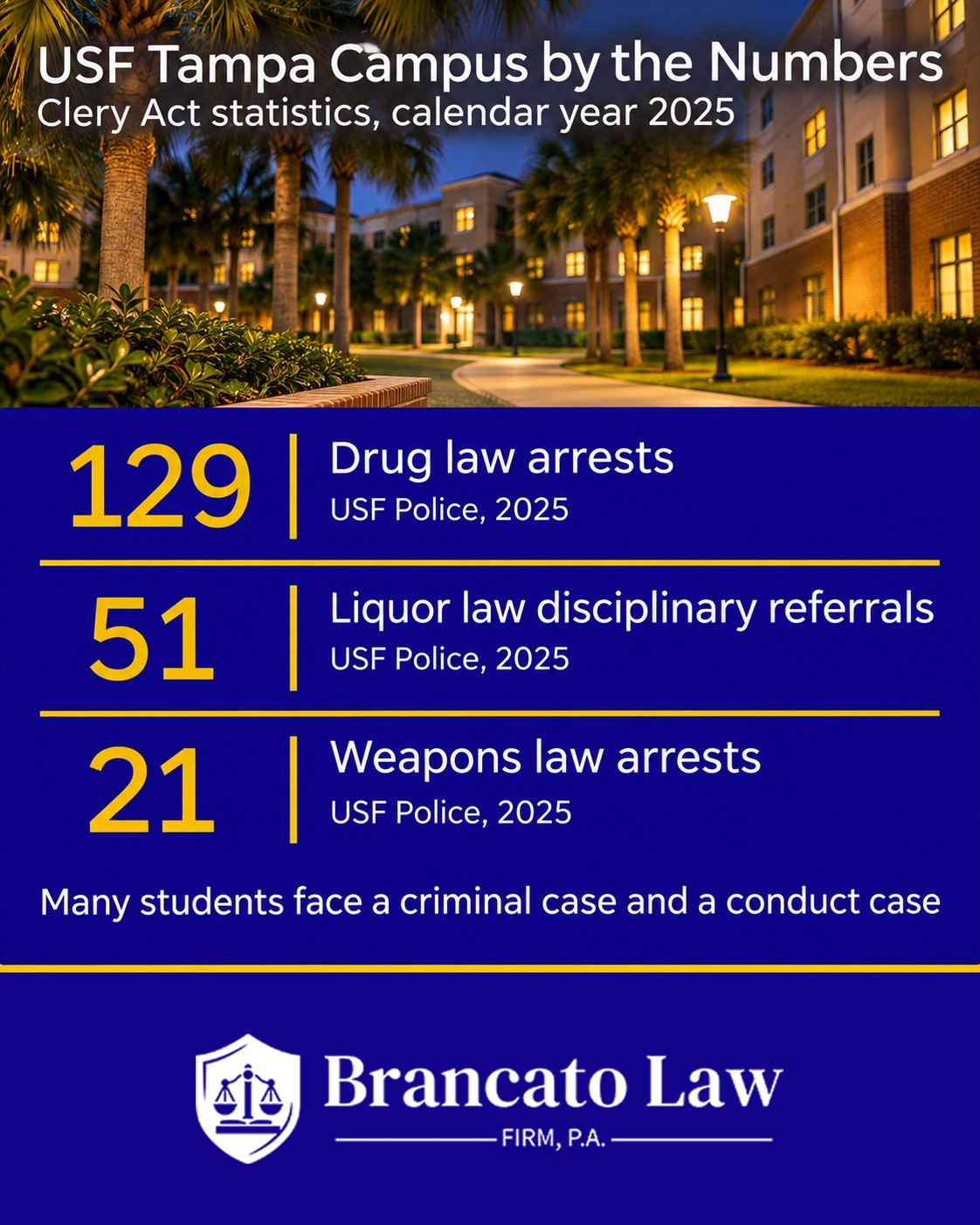
Many of those students face two cases at once: a criminal charge in Hillsborough County court and a conduct charge at SCED. The Brancato Law Firm handles both, starting with what the student should and should not say in the first SCED meeting.
Can what a student says at a USF hearing be used in the criminal case?
Yes. Statements a student makes to SCED can reach police and prosecutors, and USF says it may run the conduct case “prior to, concurrently with, or following” a criminal case and will not change its decision because criminal charges are dismissed or reduced. That is why the right to remain silent in section 1006.60(3)(d) matters, and why USF’s rule that invoking it “will not be considered as a negative factor” should be used with a plan.
The leading federal case on this problem is Gabrilowitz v. Newman, 582 F.2d 100 (1st Cir. 1978). A University of Rhode Island senior charged by police with assault with intent to commit rape was ordered to defend the same allegations before the university’s student conduct board, which barred lawyers. The First Circuit held that, because of the pending criminal case, denying him a lawyer of his choice to “consult with and advise him” during the hearing would deprive him of due process. Florida students now have a broader right by statute, and the risk the court described still applies: what a student says at the conduct hearing can end up in the prosecution’s file.
Our attorneys decide with the student what to say, what to put in writing, and when to say nothing. When police are still investigating, our representation before charges are filed can address the State Attorney’s Office before a charging decision is made. The free book chapter on one incident and several proceedings walks families through how one night can create a criminal case, a conduct case, and a housing case at once.
What happens when a USF student is arrested in Hillsborough County?
A USF student arrested in Tampa goes through the same criminal process as any adult. The student is booked at the Orient Road Jail, sees a judge at first appearance within 24 hours, and the State Attorney’s Office then decides whether to file formal charges. Our guide to the Florida criminal case process explains each stage, and our Hillsborough County criminal defense page covers local court procedure.
For parents, our guide My College Student Was Arrested in Tampa: What Should Parents Do? covers the first 48 hours, diversion options, and how to keep a first arrest from becoming a permanent record. For a side-by-side look at how USF, Hillsborough College, the University of Tampa, and Hillsborough County Public Schools handle discipline, see our student conduct and Title IX defense guide. Students at other local schools can read our guides to Hillsborough College student conduct hearings and University of Tampa conduct hearings, and families with a high school student facing discipline can read what happens at a Hillsborough County school expulsion hearing.
What should a USF student do before the Informational Meeting?
Act before the meeting, because the hearing officer starts building the record there. Use this checklist:
- Read the charge letter in the USF portal and write down every code section listed and the meeting deadline.
- Do not write a statement, post about the incident, or talk to witnesses about what they will say.
- If police were involved, find out whether there is a pending charge before saying anything to SCED.
- Ask for the information supporting the charges and the list of witnesses, and note the date you receive them.
- Save texts, photos, ride-share receipts, and card-swipe records that show where you were and when.
- Calendar the 3-day deadline to choose a resolution option and the 5-day appeal deadline.
- Call a lawyer before the meeting, not after the outcome letter.
Frequently asked questions
Can my lawyer speak at a USF conduct hearing?
Yes, under current law: section 1006.60(3)(g) and Regulation USF6.0021 both let an advisor, including a lawyer, participate in all aspects of the proceeding, though USF’s FAQ page still describes the older silent-advisor rule. The Brancato Law Firm puts those rights in writing to SCED before the hearing, raises them again on the record, and prepares the student to present the case if the hearing officer limits the advisor. Our Tampa student conduct defense guide compares the rules at other local schools.
How long do I have to appeal a USF conduct decision?
Five days from the date of the Formal Hearing outcome letter, in writing to the Dean of Students or designee, according to USF’s appeals page. Our attorneys at The Brancato Law Firm write appeals around the three grounds USF accepts: a due process or procedural error that substantially affected the outcome, new information that was not available at the hearing, and a sanction disproportionate to the violation.
Can USF discipline me if the criminal charges were dropped?
Yes. USF says its conduct decisions will not change because criminal charges were dismissed, reduced, or resolved in the student’s favor, and the outcome of a criminal case is not new information for an appeal. The Brancato Law Firm plans the conduct defense on its own evidence and timeline instead of waiting for the criminal case to end.
Should I stay silent at my USF Informational Meeting if police are investigating?
Often, yes, at least until you have legal advice, because section 1006.60(3)(d) protects your silence and USF says invoking it is not a negative factor. The Brancato Law Firm decides with each student whether a written statement, a limited statement, or silence is safer, and coordinates that choice with our pre-file advocacy on the criminal side.
Does a USF conduct suspension show up on my transcript?
A notation appears on the transcript only while a suspension is in effect, according to USF’s FAQ, and it is removed when the suspension ends. The Brancato Law Firm still treats suspension cases as serious, because the Florida Bar application and many graduate and professional school applications ask about school discipline.
Can my parents attend my USF conduct hearing?
Usually only if the student chooses that parent as the advisor, because USF’s Informational Meeting is a private meeting closed to spectators other than the advisor. Our attorneys at The Brancato Law Firm usually recommend that the advisor be the lawyer, with parents kept informed through a FERPA release the student signs with SCED.
Call before the Informational Meeting
The deadline that matters is the meeting date in the SCED email, so call before it arrives. The Brancato Law Firm, P.A., founded by Tampa Criminal Defense Attorney Rocky Brancato, prepares USF students for conduct and Title IX hearings and defends the criminal case that often comes with them. Call (813) 727-7159; you can call us at any hour. Our firm has Spanish-speaking staff, and attorney Jean-Luc Adrien speaks Spanish, Haitian Creole, and French.
For more about how our attorneys handle school discipline, visit our student conduct and Title IX defense page.
The Brancato Law Firm, P.A.
620 E. Twiggs Street, Suite 205, Tampa, FL 33602
(813) 727-7159
Serving Hillsborough, Pinellas, and Pasco Counties
The Brancato Law Firm, P.A. is a Tampa-based criminal defense practice. We are not affiliated with any other Brancato-named law firms.
Visit Us

Tampa, FL 33602

Contact Us Now
Free Legal Consultation (813) 727-7159
