

From First DUI to Death Penalty



How to Fight a Weapon on School Property Charge in Florida? (2026)


In Florida, knowingly possessing a firearm or other weapon on school property, at a school-sponsored event, on a school bus, or at a school bus stop is a third-degree felony under section 790.115, punishable by up to 5 years in prison. It drops to a second-degree misdemeanor for an adult who is otherwise authorized to carry a concealed firearm. Exhibiting a weapon in a threatening way within 1,000 feet of a school during school hours is also a third-degree felony, and firing one there is a second-degree felony. Common defenses include the vehicle exception, the common pocketknife exception, lack of knowledge, and an illegal search.
A weapon-on-campus case usually turns on three facts a prosecutor checks first: what the item was, exactly where it was, and how it was found. As founder of The Brancato Law Firm, P.A., a Tampa criminal defense firm, and a former Chief Operations Officer of the Hillsborough County Public Defender’s Office, where I oversaw a staff of over 100 attorneys, I have spent more than 25 years in Hillsborough County courtrooms, including juvenile court. Our attorneys defend students, parents, and visitors charged under this law, and we look at the school’s discipline case and the criminal case together, because one affects the other.
What Is the Florida Law on Weapons and Firearms on School Property?
Section 790.115, Florida Statutes, makes it a crime to possess a firearm, electric weapon, destructive device, or other weapon, including a razor blade or box cutter, at a school-sponsored event or on the property of any school, school bus, or school bus stop. “School” is defined broadly: any preschool, elementary, middle, junior high, secondary, career center, or postsecondary school, public or private. The statute also punishes exhibiting a weapon in a rude, careless, angry, or threatening manner within 1,000 feet of a K-12 school during school hours, and discharging a weapon on school property or within 1,000 feet of a school.
The State must prove the person possessed the item “willfully and knowingly.” Our Tampa gun crimes attorney page explains how this charge fits with the other Florida firearm laws.
What Are the Penalties for a Weapon on School Property in Florida?
The penalty depends on the conduct, the item, and whether the person is authorized to carry a concealed firearm. The table summarizes each part of the statute, with the Criminal Punishment Code offense level for felonies.
| Conduct | Subsection | Degree | Maximum | Scoresheet level |
|---|---|---|---|---|
| Exhibiting a weapon (including a pocketknife or box cutter) in a rude, careless, angry, or threatening manner at school, a school event, a school bus or stop, or within 1,000 feet of a K-12 school during school hours | (1) | Third-degree felony | 5 years | Level 4 |
| Knowingly possessing a firearm on school property, a school bus or stop, or at a school event | (2)(c)1. | Third-degree felony | 5 years | Level 4 |
| Knowingly possessing another weapon (knife other than a common pocketknife, electric weapon, razor blade, box cutter) | (2)(b) | Third-degree felony | 5 years | Level 4 |
| Same possession by a person authorized to carry concealed under s. 790.01(1) | (2)(e) | Second-degree misdemeanor | 60 days | Not scored |
| Leaving a loaded firearm within easy reach of a minor who then takes it to school | (2)(c)2. | Second-degree misdemeanor | 60 days | Not scored |
| Discharging a weapon or firearm on school property, or within 1,000 feet of a school during school hours, without a lawful purpose | (2)(d) | Second-degree felony | 15 years | Level 6 |
A person arrested for discharging a weapon under subsection (2)(d) must be held in custody until brought before a judge for bail. Our Florida criminal case process guide explains what happens at that first appearance.
What Are the Exceptions to Florida’s School Weapons Law?
The statute allows a firearm on school property in three situations: in a case going to a firearms program or class approved in advance by the principal, in a case going to a career center with a firearms training range, and in a vehicle as allowed by section 790.25(4). That vehicle provision lets an adult 18 or older keep a lawfully possessed handgun inside a private vehicle if it is securely encased or otherwise not readily accessible for immediate use, and it lets a person authorized to carry concealed keep the gun on their person in the vehicle. School districts may adopt written policies that waive the vehicle exception for student and campus parking privileges.
Law enforcement officers are excluded under subsection (3), and the statute does not apply to items used “as authorized in support of school-sanctioned activities.” For parents, the vehicle exception is often the whole case: a lawfully owned handgun locked in the glove box during school drop-off is generally covered, while a gun carried onto the walkway or into the front office is not.
Is a Pocketknife a Weapon on School Property in Florida?
A common pocketknife is not a “weapon” under section 790.001, so simply possessing one on school property does not violate the possession part of section 790.115. In L.B. v. State, 700 So. 2d 370 (Fla. 1997), a middle school student was convicted for carrying a folding knife with a 3 3/4-inch blade. The Florida Supreme Court defined a common pocketknife as “a type of knife occurring frequently in the community which has a blade that folds into the handle and that can be carried in one’s pocket,” held that her knife fit that definition, and vacated the conviction. The court did not set a bright-line blade length.
Two limits matter. First, exhibiting even a common pocketknife or box cutter in a threatening way at school is a felony under subsection (1). Second, razor blades and box cutters are listed by name in the possession section, so the pocketknife exception does not cover them. School discipline codes can also be stricter than the criminal statute.
Is a BB Gun or Airsoft Gun a Weapon at School?
Not automatically. A BB gun is not a “firearm” because it does not fire by explosive force, so the State must prove it was a “deadly weapon.” In A.H. v. State, 71 So. 3d 249 (Fla. 4th DCA 2011), a student was seen with an unloaded BB gun at a school bus stop. The Fourth District held the evidence was insufficient because there was no proof he used or threatened to use it as a bludgeon, and it ordered the charge dismissed. Our attorneys ask whether a replica, toy, or air gun meets the statute before anything else, and our post on how to fight a bomb or shooting threat charge covers the related threat charges students often face.
Can a School Search Lead to a Suppressed Weapon?
Yes. School officials may search a student based on reasonable suspicion, a lower standard than probable cause, but the search still has to be justified. In A.S.P. v. State, 964 So. 2d 211 (Fla. 2d DCA 2007), a security officer at Hillsborough High School in Tampa searched a young man who said he was not a student, before asking whether he had business on campus, and found a knife. He was there to pick up GED test scores. The Second District held the search was illegal because the officer had no particularized suspicion that he was armed, and it reversed the juvenile adjudication for possession of a weapon on school property.
A.S.P. is a Tampa case from our own appellate district, and it shows why our attorneys ask who searched, what they knew beforehand, and whether the person was a student. Our post on whether police can stop or frisk you for carrying a gun explains the broader search rules.
How Often Are Weapons Found in Hillsborough County Schools?
Weapons cases at school are a small but steady share of school discipline. In the 2024-25 school year, Florida schools reported 1,363 weapons possession incidents, 130 of them involving firearms, and 304 of those incidents were reported to law enforcement and resulted in an arrest, according to the Florida Department of Education’s School Environmental Safety Incident Reporting (SESIR) data. Hillsborough County schools reported 104 weapons possession incidents that year, 13 involving firearms, with 34 resulting in an arrest.
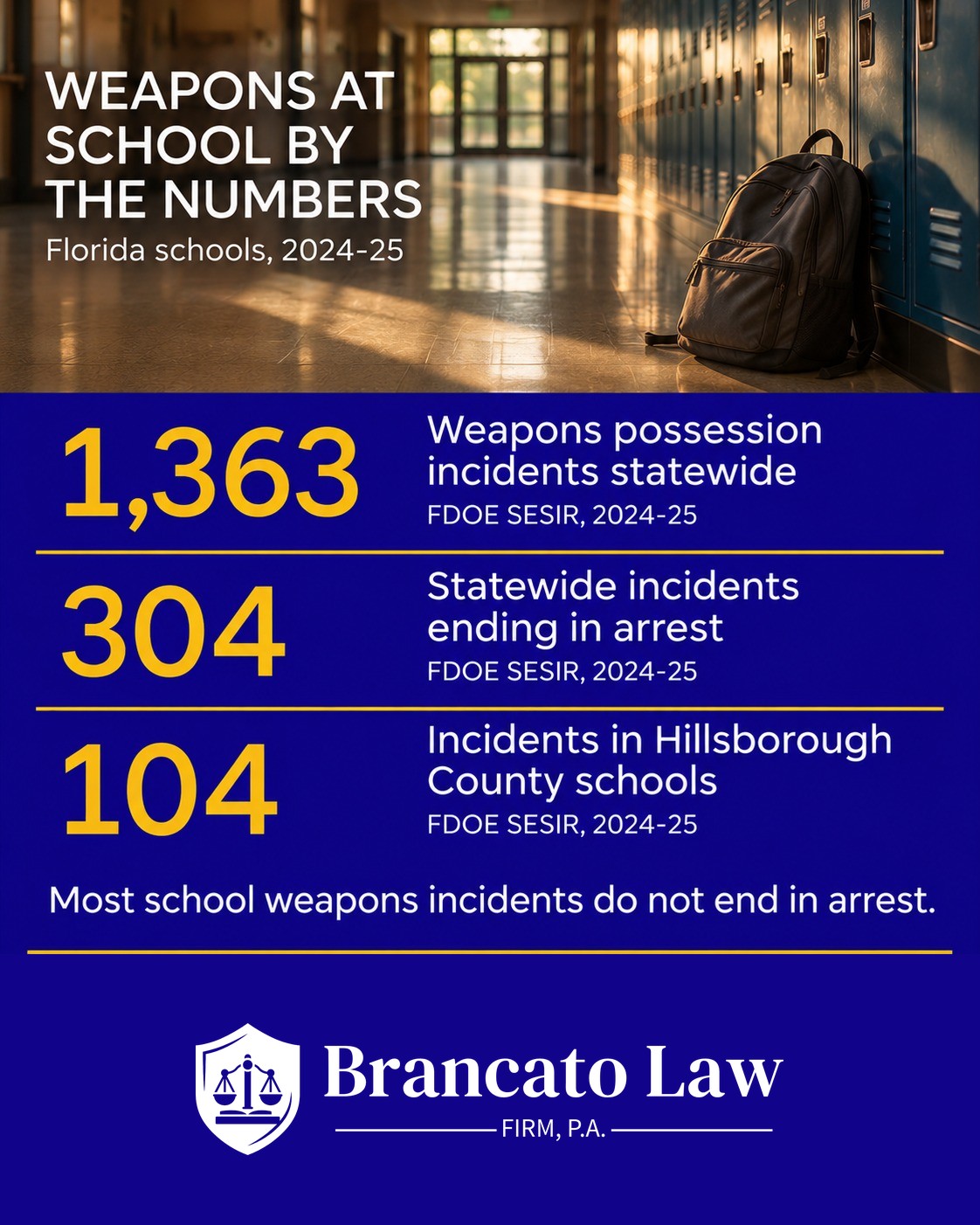
Those numbers mean most weapons incidents at school do not end in arrest, which gives the defense room to argue for school-based or diversion outcomes. The American Psychological Association’s Zero Tolerance Task Force reached a related conclusion in its 2008 report, Are Zero Tolerance Policies Effective in the Schools?: after reviewing a decade of research, it found surprisingly few data supporting the assumptions behind zero tolerance discipline and noted that the data available tend to contradict them. Our attorneys use that research, and the student’s own record, when asking prosecutors and school boards for a measured response.
What Happens to a Student Charged Under Section 790.115?
A student faces two cases at once: a school discipline case and a juvenile or adult criminal case. Under section 1006.13, Florida schools must expel a student who brings a firearm or weapon to school, or possesses a firearm at school, for at least one full year and refer the student to the criminal or juvenile justice system, although the superintendent may ask the school board in writing to modify the expulsion case by case.
The 2024 juvenile justice law tightened the criminal side. According to the Florida Senate summary of the 2024 juvenile justice law (CS/CS/HB 1181), firearm-related offenses can no longer be handled through prearrest delinquency citation programs, and a child committed for any offense involving a firearm must be placed on conditional release for at least one year after release, with electronic monitoring for the first six months. In our experience in Hillsborough County, the expulsion hearing and the juvenile case move on different calendars, and statements a student makes in the school process can surface in the criminal case, so our attorneys coordinate both from the start. Our post for students arrested in Tampa covers college and university cases.
What Are the Defenses to a Weapon on School Property Charge?
Our attorneys test each element of a section 790.115 charge:
- Vehicle exception. A handgun securely encased or not readily accessible inside a private vehicle, or carried in the vehicle by a person authorized to carry concealed, is covered by section 790.25(4), unless a district parking policy for students waives it.
- Not a weapon. A common pocketknife, plastic knife, blunt-bladed table knife, or a toy or air gun that was not used as a deadly weapon may fall outside the statute.
- No knowledge. The State must prove willful and knowing possession. A gun left in a borrowed car or a parent’s bag raises real doubt.
- Not school property. Possession must occur on school property, a school bus or stop, or at a school event. The 1,000-foot zone applies only to exhibiting and discharging, and only during school hours or a sanctioned activity.
- Authorized carrier. A person authorized to carry concealed under section 790.01(1) faces a misdemeanor, not a felony, for possession.
- Illegal search. A search without the required suspicion can lead to suppression, as in A.S.P.
Florida’s open carry changes do not change the school rule; our post on the Florida open carry ruling explains what changed and what did not, and our guide to firearm-during-a-felony charges covers cases where a gun is found during another crime.
Frequently Asked Questions About Weapons on School Property in Florida
Can a parent with a gun in the car drop a child off at school in Florida?
Generally yes, if the parent is 18 or older, the handgun is lawfully possessed, and it is securely encased or not readily accessible inside the vehicle, or the parent is authorized to carry concealed and keeps it on their person in the car. The Brancato Law Firm reviews exactly where the gun was and whether it left the vehicle, which usually decides these cases.
Is bringing a pocketknife to school a crime in Florida?
Possessing a common pocketknife is not a crime under the possession part of section 790.115, though displaying it in a threatening way is a felony and the school may still discipline the student. Our attorneys at The Brancato Law Firm check the knife’s design against the definition in L.B. v. State; see our weapons charge defense page for related charges.
Will a student be expelled for bringing a weapon to school in Florida?
Usually, because section 1006.13 requires at least a one-year expulsion and a referral to the justice system, though the superintendent can request a modification to a disciplinary program or second chance school. The Brancato Law Firm prepares the written case for modification alongside the defense of the criminal charge.
Can a weapon on school property charge be dropped in Florida?
Yes. Charges are dropped or reduced when the item is not a weapon under the statute, the vehicle exception applies, knowledge is doubtful, or the search was illegal. The Brancato Law Firm raises those points with the State Attorney’s Office early; our case process guide explains when that review happens.
Does the 1,000-foot school zone apply to carrying a gun?
No. Under section 790.115, the 1,000-foot zone applies to exhibiting a weapon in a threatening way or discharging it during school hours or a sanctioned activity, not to simply carrying near a school. Our attorneys at The Brancato Law Firm map the location against the school’s property line when the zone is at issue.
What if my child is being questioned by school officials about a weapon?
Ask that questioning stop until you can be present and speak with a lawyer, because statements in the school process can be used in the criminal case. The Brancato Law Firm can step in before charges are filed through our pre-file advocacy work.
Talk to a Tampa Lawyer About a Weapon on School Property Charge
Expulsion hearings and juvenile detention decisions come quickly, often within days of the incident. Our attorneys will review the search, the item, and the school’s paperwork, and we will coordinate the school case with the criminal case. Reach The Brancato Law Firm, P.A., founded by Tampa Criminal Defense Attorney Rocky Brancato, at (813) 727-7159; we are available 24/7. Our firm has Spanish-speaking staff, and attorney Jean-Luc Adrien speaks Spanish, Haitian Creole, and French. Learn more about our Spanish and Haitian Creole criminal defense services.
For more about our defense strategies, visit our Tampa Gun Crimes Defense page.
The Brancato Law Firm, P.A.
620 E. Twiggs Street, Suite 205, Tampa, FL 33602
(813) 727-7159
Serving Hillsborough, Pinellas, and Pasco Counties
The Brancato Law Firm, P.A. is a Tampa-based criminal defense practice. We are not affiliated with any other Brancato-named law firms.
Visit Us

Tampa, FL 33602

Contact Us Now
Free Legal Consultation (813) 727-7159
