

From First DUI to Death Penalty



What Happens at a Hillsborough College Student Conduct Hearing? (2026)


Short answer: A Hillsborough College (formerly HCC) conduct case starts with a written allegation to the campus Dean of Student Services, who investigates and meets with the student. Many cases end at that meeting with a written decision. If the Dean finds that suspension or expulsion is warranted, the student has 5 days to request a hearing before the College Code of Conduct Committee. Because Hillsborough College is a Florida College System institution, section 1006.60, Florida Statutes, gives the student written notice, a presumption that no violation occurred, the right to remain silent, and an advisor or lawyer who may take part in every stage, including questioning witnesses.
If you just opened a Hawkmail message from the Dean of Student Services, the meeting date in that letter is the first deadline in your case, and what you say at that meeting can follow you into court. As founder of The Brancato Law Firm, P.A., a Tampa criminal defense firm, I chaired the 13th Judicial Circuit Juvenile Justice Advisory Board from 2022 to 2024 and served for years on Hillsborough County’s juvenile civil citation committee. I have also spent more than 25 years in Hillsborough County courtrooms, including as former Chief Operations Officer of the Hillsborough County Public Defender’s Office, where I oversaw a staff of over 100 attorneys. Our attorneys prepare Hillsborough College students for the Dean meeting and the committee hearing, and we defend the criminal case when the same incident brings police into it.
Do Florida’s student due process rights apply at Hillsborough College?
Yes. Hillsborough Community College became Hillsborough College in July 2025, and it remains part of the Florida College System, so section 1006.60, Florida Statutes governs its code of conduct. That statute requires every Florida College System institution and state university to give students minimum due process protections, and Hillsborough College’s own 2026-2027 Student Handbook repeats those rights almost word for word.
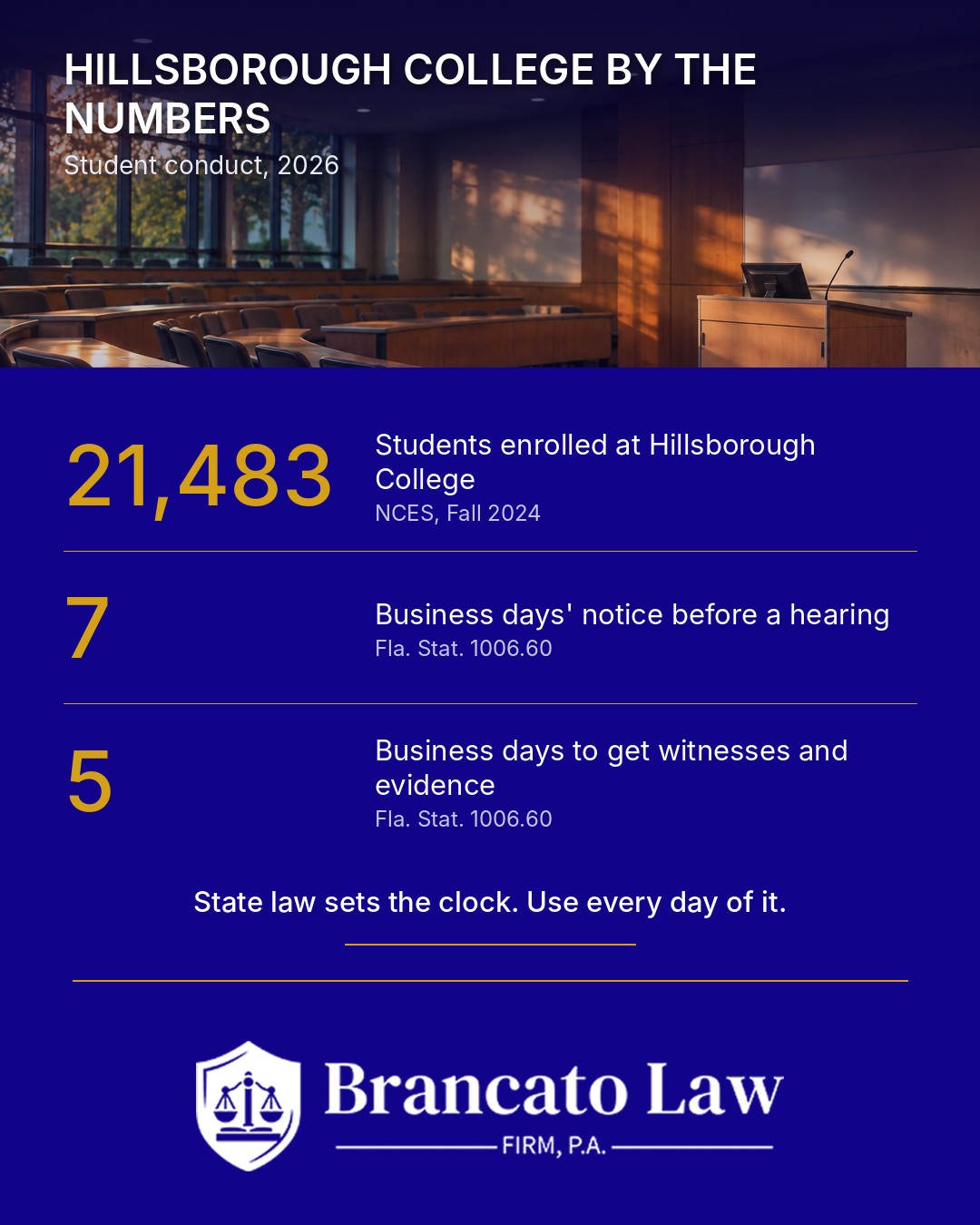
Hillsborough College enrolled 21,483 students in fall 2024, all of them undergraduates, according to the U.S. Department of Education’s NCES College Navigator. Each of those students has the same timing rights under section 1006.60(3)(a): written notice of the charges at least 7 business days before the disciplinary proceeding, and, at least 5 business days before it, a list of every known witness against the student plus all known information about the allegation, including information that helps the student. If the student is under 18, the statute lets the school send that notice to a parent as well.
The college’s Code of Student Conduct is administrative rule 6HX-10-5.17. The rule itself is short. It says the code and procedure “shall be published in the HC Student Handbook,” so the handbook is where the working procedure lives, and it is the document our attorneys read line by line when a student calls. For an overview of how public colleges, state universities, private universities, and public school districts in Tampa Bay compare, see our student conduct and Title IX defense page. Students at the private University of Tampa do not have these statutory rights, as our guide Can a Lawyer Help With a University of Tampa Conduct Hearing? explains.
How does a Hillsborough College conduct case start?
A conduct case starts with a written allegation filed with the Dean of Student Services at the campus where the incident happened. Under the handbook, anyone in the college community can make the allegation, it must be put in writing within 10 days of the report, and the college has up to one calendar year after the alleged violation to charge a student, a limit the Campus President can extend or waive.
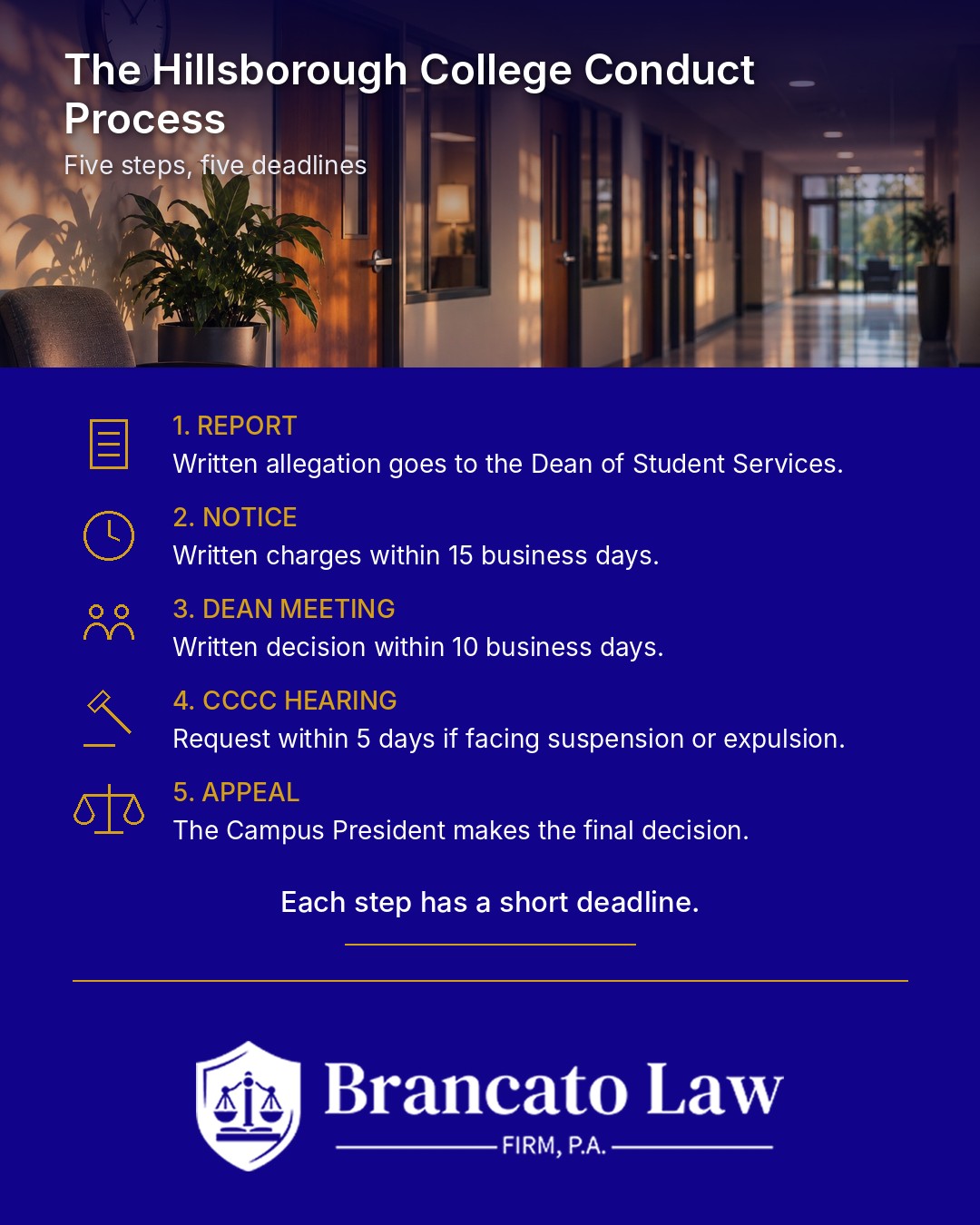
The Dean investigates. If the facts do not support a charge, the matter is dropped and the student is told in writing. If the Dean finds a probable violation, the student must get the allegations in writing within 15 business days of the Dean’s receipt of the documentation, by hand, by Hawkmail with a confirmation receipt, or by certified mail. Sexual assault, sexual violence, and sexual harassment complaints go instead to the Department of Equity, Diversity and Special Programs, which runs the Title IX process covered below.
The written notice is the most useful document in the case. The handbook says it must list the allegations, the code sections charged, the process the college will use, the witnesses against the student with copies of their statements, and “all known information” about the allegation, both inculpatory and exculpatory. When a notice arrives missing any of those items, our attorneys ask for them in writing before the meeting.
| Step | Who handles it | Deadline or timing |
|---|---|---|
| Written allegation | Any member or guest of the college community, filed with the campus Dean of Student Services | Within 10 days of the report; charge within one calendar year of the alleged violation |
| Investigation and written notice | Dean of Student Services | Notice within 15 business days of the Dean’s receipt of the documentation; under section 1006.60, at least 7 business days before the proceeding |
| Witness list and evidence | Dean of Student Services | At least 5 business days before the proceeding (section 1006.60(3)(a)) |
| Informal meeting with the Dean | Dean or designee; the student’s advisor or lawyer may attend | Student has 5 business days to reschedule for a documented conflict |
| Dean’s decision | Dean or designee | In writing within 10 business days |
| Request for committee hearing (suspension or expulsion only) | Student | Within 5 days of the notification |
| College Code of Conduct Committee hearing | Committee; Vice President for Student Services and Enrollment Management sets the date | Not less than 10 days from the date of notification |
| Appeal | Campus President (procedural appeals: Vice President for Student Services and Enrollment Management) | Decision within 10 business days of the appeal request |
What happens at the meeting with the Dean?
The informal meeting with the Dean of Student Services, or a designee, is the first point where a Hillsborough College case can be decided. The Dean reviews the evidence with the student and asks whether the student accepts responsibility. The student may bring an advisor, advocate, or lawyer at the student’s own expense. Witnesses attend only with the Dean’s permission, and if they do attend, the handbook says the advisor or legal representative “will be permitted to question the witness(es).”
Missing the meeting does not stop the case. If a student refuses to meet or misses the meeting, the handbook says the violations “will be considered and decision made without the alleged violator’s input.” A student with a documented conflict has 5 business days from the notice to ask for a new date.
After the meeting, the Dean decides whether a violation occurred and imposes any sanction, then notifies the student in writing within 10 business days. A student who accepts responsibility at the meeting gets the sanction decision the same way. That choice deserves a conversation with a lawyer first, especially when the same conduct is a crime, because an admission to the Dean is a statement a prosecutor can try to use.
When does a case go to the College Code of Conduct Committee?
A case goes to the College Code of Conduct Committee (CCCC) when the Dean decides the violation warrants suspension or expulsion and the student asks for a hearing. The student has 5 days from the notification to make that request. If the student does not ask in time, the Dean recommends the suspension or expulsion to the Campus President and tells the student in writing. The Dean or the Campus President can also send a case to the committee on their own.
The Vice President for Student Services and Enrollment Management sets the hearing date, which must be at least 10 days after notification. The committee decides by “a simple majority vote of the members present,” and it can hold the hearing without the student if the student had proper notice and no valid excuse for missing it. The committee then files findings and recommendations, and the Campus President and the Dean of Student Services impose the sanction.
This is the hearing where an advisor’s role matters most. Section 1006.60(3)(g) says the advisor, advocate, or legal representative “may directly participate in all aspects of the proceeding,” and the handbook adds that this includes “the presentation of relevant information and questioning of witnesses.” That is a broader role than many families expect. I represented a student at a Hillsborough County Public Schools hearing where I cross-examined the school’s witnesses and argued the case; at the University of South Florida, by contrast, my role has been to advise and to prepare the student, and I could not cross-examine or argue there. Because Hillsborough College’s handbook puts the advisor’s right to question witnesses in writing, our attorneys confirm that role in writing before the committee meets.
What rights does a student have in a Hillsborough College conduct case?
A Hillsborough College student has the rights listed in section 1006.60(3) and repeated in the handbook’s notice requirements. Those rights apply at the informal Dean meeting and at the committee hearing:
- A presumption that no violation occurred, with the college bearing the burden to prove a violation by a preponderance of the evidence, meaning “more likely than not.”
- An impartial hearing officer.
- The right against self-incrimination and the right to remain silent. The handbook says silence “may not be used against the student.”
- The right to present relevant information and to question witnesses.
- An advisor or advocate who may not also serve as investigator, fact-finder, hearing officer, or committee member.
- An advisor, advocate, or legal representative, at the student’s own expense, who may take part in all aspects of the proceeding.
- An appeal, and an accurate record of every disciplinary proceeding in the case, including the appeal, available for copying.
The right to remain silent is easy to give up without meaning to. A student facing a related criminal charge can decline to answer, and the college cannot treat that silence as proof. Our attorneys decide with the student, question by question, what can safely be said, and we make sure the student’s side still reaches the decision-maker through documents and witnesses when the student stays quiet.
What sanctions can Hillsborough College impose?
Hillsborough College can impose sanctions ranging from a written warning to permanent expulsion. The handbook lists eight disciplinary measures, and the Dean may impose one or more of them:
| Measure | What it means under the handbook |
|---|---|
| Expulsion | Permanent dismissal from the college |
| Interim suspension | Suspension for up to 10 days when the Dean finds the student presents a continuing threat to the college community or the academic process; the student may refute the charges with the Dean during that period |
| Suspension | Separation from the college for a specified period |
| Disciplinary probation | Limits on extracurricular activities, athletics, and student organizations for a set time |
| Restitution | Paying for or replacing damaged property or other losses |
| Loss of privileges | For example, driving on campus, library borrowing, parking, or housing and visitation at the Hawks Landing residence complex |
| Disciplinary censure | A written warning |
| Conciliatory act | A disposition that avoids a formal sanction in exchange for an agreed act, such as counseling or service to the college |
Suspension and expulsion are the sanctions that trigger the committee hearing, and they are the ones that follow a student into transfer applications and financial aid questions. A conciliatory act, by contrast, requires the agreement of both the student and the college, so it is worth raising early when the facts support it.
How do appeals work at Hillsborough College?
Appeals at Hillsborough College move fast. A student who disagrees with the Dean’s decision can appeal to the Campus President within 5 business days, and the Campus President decides within 10 business days. After a committee hearing, the student may appeal to the Campus President, “who has the final decision in these cases,” and appeals based only on procedure go to the Vice President of Student Services and Enrollment Management, who also decides within 10 business days.
The handbook describes the suspension and expulsion appeal in two places, and the two do not match. Its one-page summary tells students to notify the Dean within five business days that they want to appeal to the College Code of Conduct Committee, while the full procedure routes the student first to the committee hearing and then to the Campus President. When two parts of the same handbook differ, our attorneys file within the shortest deadline that could apply and send the request to every office the handbook names.
How are Title IX sexual harassment cases handled at Hillsborough College?
Title IX sexual harassment complaints at Hillsborough College go to a live grievance hearing, not to the Dean’s ordinary conduct process. On September 29, 2026, the U.S. Department of Education formally restored the 2020 Title IX regulations, and 34 C.F.R. § 106.45(b)(6)(i) requires every college to hold a live hearing where each party’s advisor cross-examines the other party and witnesses “directly, orally, and in real time.” If a party has no advisor, the college must provide one for the cross-examination.
Hillsborough College publishes Rules of Decorum for the Sexual Harassment Live Grievance Hearing. They confirm that “an Advisor may be an attorney,” but they also say no duty of zealous advocacy “should be inferred or enforced within this forum.” Questions must be asked in a neutral tone, may not repeat questions already asked, and may not contain accusations. The decision-maker can remove an advisor after a second violation, and the party then picks a new advisor or accepts one the college provides for cross-examination.
Those rules shape how our attorneys prepare. A cross-examination in a Title IX hearing has to be short, relevant, and calm, and it has to be built around the same facts the criminal case will turn on. When a sexual misconduct accusation also brings a police investigation, we coordinate the Title IX hearing with our sex crimes defense work so that nothing said in one forum undercuts the other.
Can a Hillsborough College conduct case hurt a criminal case?
Yes. The college will not wait for the court. The handbook says HC may pursue discipline “at the same time the student is facing criminal charges for the same offense, even if criminal prosecution is pending, has been dismissed or the charges have been reduced.” Statements the student makes to the Dean or the committee can reach police and prosecutors.
The college’s own officers do not make arrests. According to Hillsborough College’s 2025 Annual Security and Fire Safety Report, its Department of Public Safety uses non-sworn, unarmed public safety officers “who do not possess powers of arrest” and refers criminal incidents to the local agency: the Tampa Police Department inside the City of Tampa, the Hillsborough County Sheriff’s Office in the unincorporated county, and the Plant City Police Department at the Plant City campus. A fight at the Dale Mabry campus or a theft report at the Brandon campus can therefore produce a police report and a conduct referral from the same incident, which brings the case into our Hillsborough County criminal defense practice.
Federal courts have recognized the problem for decades. In Gabrilowitz v. Newman, 582 F.2d 100 (1st Cir. 1978), a University of Rhode Island senior charged with assault with intent to commit rape faced a campus hearing on the same accusation, and the First Circuit held that, with the criminal case pending, denying him a lawyer to advise him during the hearing would violate due process. The court described the student’s choice plainly: if he testifies, “his statements may be used against him in the criminal case.” A 2012 article in the University of Pennsylvania Law Review, “Navigating a Legal Dilemma: A Student’s Right To Legal Counsel In Disciplinary Hearings for Criminal Misbehavior”, by Ellen L. Mossman, argues that students facing this overlap are ill-equipped to handle it without counsel. Florida went further than Gabrilowitz: section 1006.60(3)(g) lets the lawyer participate, not just sit beside the student.
When police are involved, our firm works the conduct case and the criminal case together, often starting with representation before charges are filed. Our overview of the Florida criminal case process explains what happens after an arrest, and parents can start with our guide My College Student Was Arrested in Tampa: What Should Parents Do?
Do St. Petersburg College and Pasco-Hernando State College students have the same rights?
Yes. St. Petersburg College and Pasco-Hernando State College are also Florida College System institutions, so section 1006.60 sets the same minimum protections there: 7 business days’ written notice, the witness list and evidence 5 business days ahead, the presumption of no violation, the right to remain silent, and an advisor or lawyer who may participate in every stage. Each college writes its own procedure on top of those rights, so the deadlines and hearing bodies differ from Hillsborough College’s. Our attorneys represent students at those colleges through our Pinellas County criminal defense and Pasco County criminal defense practices.
What should a student do after receiving a Hillsborough College conduct notice?
Act within the first few days, because the handbook’s deadlines run in business days and some run in plain days. These are the steps our attorneys walk students through:
- Save the Hawkmail notice and every attachment, and write down the date and time it arrived.
- Check whether the notice lists the witnesses, their statements, and all known information, including anything that helps you. Ask in writing for anything missing.
- Do not contact the complaining student or witnesses, and do not post about the incident.
- Call a lawyer before the Dean meeting, especially if police took a report or you were arrested.
- Decide with your lawyer whether to speak, what to say, and which documents and witnesses will tell your side.
- Calendar the 5-day deadline to request a committee hearing and the 5-business-day appeal deadline before the meeting happens.
Families of younger students should also read our free book Before It Becomes a Case, which explains how one incident can start a school case, a police case, and a court case at the same time. For more about how our firm handles student discipline across Tampa Bay, visit our Student Conduct and Title IX Defense page.
Frequently asked questions
Can I bring a lawyer to my HCC meeting with the Dean of Student Services?
Yes. The Hillsborough College handbook lets a student bring an advisor, advocate, or legal representative, at the student’s own expense, to the informal Dean meeting as well as the committee hearing. The Brancato Law Firm prepares students for that meeting and, when we attend, makes sure the student’s right to remain silent is respected under section 1006.60(3)(d).
Is a conduct record from HCC the same as one from Hillsborough College?
Yes. Hillsborough Community College changed its name to Hillsborough College in July 2025, and the same Code of Student Conduct, rule 6HX-10-5.17, applies to cases that began under either name. Our attorneys at The Brancato Law Firm review the full record of an older HCC case when a student needs to explain it on a transfer or professional application.
Can Hillsborough College suspend me before my hearing?
Yes, for a limited time. The Dean of Student Services can impose an interim suspension of up to 10 days when the Dean finds a student presents a continuing threat, and the student must be given a chance to refute the charges during that period. The Brancato Law Firm uses that window to present the student’s side quickly and in writing.
Should I answer questions at an HCC conduct hearing if I was also arrested?
Not without advice from a lawyer. Your statements at the hearing can be used in the criminal case, although section 1006.60 says your silence may not be used against you in the conduct case. Our attorneys at The Brancato Law Firm plan the conduct defense and the criminal defense together, often through pre-file advocacy before charges are decided.
How long do I have to appeal a Hillsborough College conduct decision?
Five business days from the Dean’s decision to notify the Campus President in writing. Committee decisions also go to the Campus President, and procedural appeals go to the Vice President of Student Services and Enrollment Management. The Brancato Law Firm files appeals within the shortest deadline the handbook could apply, because the handbook’s summary and its full procedure describe the suspension and expulsion appeal differently.
Can Hillsborough College discipline me for something that happened off campus?
Sometimes. The code covers conduct on college premises, at college-sponsored activities, and at the Hawks Landing housing complex, and it reaches off-campus behavior that the college finds “impairs, obstructs, interferes with or adversely affects” its mission or operations. The Brancato Law Firm challenges that jurisdiction in writing when an off-campus incident has no real connection to the college.
Call before the Dean meeting
The meeting date on your Hawkmail notice is the deadline that matters most, and the first statement you make will be in the record from that day forward. Call The Brancato Law Firm, P.A., founded by Tampa Criminal Defense Attorney Rocky Brancato, at (813) 727-7159 before that meeting; you can call us at any hour, and our office is two blocks from the courthouse. We prepare Hillsborough College students and families in Hillsborough, Pinellas, and Pasco Counties for conduct and Title IX hearings and defend the criminal case that often comes with them. Our firm has Spanish-speaking staff, and attorney Jean-Luc Adrien speaks Spanish, Haitian Creole, and French.
The Brancato Law Firm, P.A.
620 E. Twiggs Street, Suite 205, Tampa, FL 33602
(813) 727-7159
Serving Hillsborough, Pinellas, and Pasco Counties
The Brancato Law Firm, P.A. is a Tampa-based criminal defense practice. We are not affiliated with any other Brancato-named law firms.
Visit Us

Tampa, FL 33602

Contact Us Now
Free Legal Consultation (813) 727-7159
