

From First DUI to Death Penalty



How to Fight a Written Threat Charge in Florida? (2026)


To fight a written or electronic threat charge in Florida, the defense attacks whether the message was a true threat and what the sender understood about how it would be read. Section 836.10, Florida Statutes, makes it a second-degree felony, punishable by up to 15 years in prison, to send, post, or transmit a writing or electronic record that threatens to kill or do bodily harm to another person or to conduct a mass shooting or act of terrorism. The strongest defenses are context showing a joke, lyric, or venting rather than a threat, a lack of the required mental state under Counterman v. Colorado, proof that someone else wrote or sent the message, and the statute’s exclusion of telephone calls.
A prosecutor reading a screenshot sees a threat, but a jury has to decide what the sender meant and understood, and that question is where most of these cases are won. I am Rocky Brancato, founder of The Brancato Law Firm, P.A., a Tampa criminal defense firm, and I have spent more than 25 years in Hillsborough County courtrooms, including as a former Chief Operations Officer of the Hillsborough County Public Defender’s Office, where I oversaw a staff of over 100 attorneys. Our attorneys defend threat cases by collecting the full message thread and the context around it, preserving the phone and account data, and challenging the State’s proof of intent before a charge is filed whenever we can.
What is a written or electronic threat to kill in Florida?
A written or electronic threat to kill is a message, post, or other record that threatens to kill or injure someone, or threatens a mass shooting or act of terrorism, sent or posted where another person may see it. Section 836.10(2), Florida Statutes, makes it unlawful to “send, post, or transmit, or procure the sending, posting, or transmission of, a writing or other record, including an electronic record, in any manner in which it may be viewed by another person,” when the writing threatens to:
- Kill or do bodily harm to another person; or
- Conduct a mass shooting or an act of terrorism.
The statute defines an electronic record as anything “created, modified, archived, received, or distributed electronically,” including text, graphics, video, audio, or pictures, “but does not include a telephone call.” Texts, direct messages, emails, social media posts, Snapchat stories, videos, and group chats all qualify. Our Tampa violent crime lawyer page explains how our attorneys defend the threat, assault, and battery charges that often travel together.
What does the State have to prove for a section 836.10 charge?
The State must prove that the accused sent, posted, or transmitted a writing or record, that it contained a threat to kill, injure, or commit a mass shooting or terrorism, and that it was sent or posted in a way another person could view it. The State does not have to prove the accused meant to carry out the threat or could have done so. In Smith v. State, 532 So. 2d 50 (Fla. 2d DCA 1988), a Pinellas County case in which a man mailed letters to judges’ and lawyers’ wives claiming the paper was coated with a “rare, lethal toxin,” the Second District held that “neither the actual intent to do harm nor the ability to carry out the threats is an essential element.”
The threat does not have to be sent to the person threatened. In Puy v. State, 294 So. 3d 930 (Fla. 4th DCA 2020), a Palm Beach County man posted a Snapchat photo of himself captioned “On my way! School shooter.” The Fourth District held that the amended statute “is invoked by the mere act of posting the threat on social media, regardless of whether it is directed to an individual,” and it left the question of whether the post was a threat for the jury.
What mental state does Florida require for a written threat after Counterman?
The State must prove more than the words on the screen: under the First Amendment, it must prove the sender had some subjective understanding that the message was threatening. In Counterman v. Colorado, 600 U.S. 66 (2023), a stalking case built on Facebook messages, the U.S. Supreme Court held that the government must prove “the defendant had some subjective understanding of the threatening nature of his statements,” and that “a mental state of recklessness is sufficient.”
Florida’s appeals courts have not settled exactly how that rule fits section 836.10. In T.R.W. v. State, 363 So. 3d 1081 (Fla. 4th DCA 2023), a juvenile case involving messages to a classmate that said “at this point I might just start killing people” followed by “let me stop its just a prank,” the Fourth District held that the State must prove the accused “transmitted a communication for the purpose of issuing a threat, or with knowledge that the communication will be viewed as a threat.” The court reversed because the trial judge treated the youth’s intent as irrelevant, and it certified conflict with Smith.
The question is still open in 2026. In Dominguez v. State, 432 So. 3d 1192 (Fla. 1st DCA 2026), an Alachua County man posted a video titled “Suicide Note #1” in which he displayed a rifle and described attacking the middle school down the street. The First District affirmed his conviction because the evidence let the jury infer he intended a true threat, but it declined to decide the required mental state because the issue was not preserved. That lesson matters for every Florida threat case: our attorneys raise the Counterman mental-state issue in writing, early, so it is preserved for trial and appeal.
What are the penalties for a written threat to kill in Florida?
A section 836.10 violation is a second-degree felony punishable by up to 15 years in prison under section 775.082, Florida Statutes, and a fine of up to $10,000. The offense is ranked at level 6 on the Criminal Punishment Code’s offense severity chart in section 921.0022, Florida Statutes.
A level 6 offense alone, for a person with no prior record, scores below the 44-point line at which prison becomes the lowest permissible sentence. That leaves room for probation, a withhold of adjudication, or a diversion outcome in the right case, which is why the first weeks of a threat case matter so much. For a juvenile, the case usually stays in juvenile court, where the focus is on treatment and supervision rather than prison.
| Item | What the law provides |
|---|---|
| Degree | Second-degree felony (§ 836.10(2)) |
| Maximum prison term | 15 years (§ 775.082(3)(d)) |
| Maximum fine | $10,000 (§ 775.083) |
| Offense severity level | Level 6 (§ 921.0022) |
| Proof of intent to carry out the threat | Not required (Smith v. State) |
| Proof of the sender’s mental state about the threat | Required in some form; the standard is still being settled after Counterman v. Colorado |
How is a written threat charge different from other Florida threat crimes?
Section 836.10 covers threats made in writing or electronically, while other statutes cover spoken threats, phone calls, false reports, and threats used to get something. The charge the State chooses changes the penalty and the defense, as the table below shows.
| Offense | Statute | What it covers | Degree |
|---|---|---|---|
| Written or electronic threat | § 836.10 | A writing or electronic record threatening to kill, injure, or commit a mass shooting or terrorism | Second-degree felony |
| False report of a bomb or shooting | § 790.163 | A knowingly false report that a bomb was planted or a shooting is happening | Second-degree felony |
| Extortion | § 836.05 | A threat used to get money, an advantage, or to make someone act against their will | Second-degree felony |
| Aggravated stalking with a credible threat | § 784.048(3) | Repeated following, harassment, or cyberstalking plus a credible threat | Third-degree felony |
| Harassing phone calls | § 365.16 | Threatening or harassing telephone calls | Misdemeanor |
| Assault | § 784.011 | A spoken or physical threat of violence that creates a well-founded fear of imminent harm | Second-degree misdemeanor |
The State Attorney’s Office sometimes files two of these charges for one message. Our posts on fighting a bomb or shooting threat charge, fighting a harassing phone call charge, and fighting a stalking charge cover those related offenses.
How do defense attorneys fight a written threat charge in Florida?
Written threat charges are fought by putting the message back in its full context, because a screenshot of one line rarely tells the whole story. At The Brancato Law Firm, our attorneys build the defense around these issues:
- No true threat. Song lyrics, dark humor, gaming talk, exaggeration, and venting are not threats when the context shows no one could reasonably read them as a serious statement of intent to harm.
- No culpable mental state. Under Counterman, recklessness means the speaker “is aware that others could regard his statements as threatening violence and delivers them anyway.” A message sent with no awareness of how it would be read does not meet that standard.
- Identity and authorship. Shared phones, hacked or spoofed accounts, and group chats make authorship a real question. Account logs, device forensics, and IP data can show someone else sent the message.
- Wrong statute. Section 836.10 excludes telephone calls, and a threat with no writing or record behind it may not fit the statute at all.
- Free speech limits. Political, religious, or artistic speech that does not threaten a person or group is protected, and a charge built on it can be challenged in a motion to dismiss.
- Mitigation. When the facts are hard, a mental health evaluation, counseling, and a safety plan can support a reduced charge, diversion, or a withhold of adjudication.
| State evidence | What the defense examines |
|---|---|
| Screenshot of a message or post | The full thread, replies, emojis, edits, and what came before and after |
| Account ownership | Login records, shared devices, IP data, and whether the account was hacked or spoofed |
| Statements to police or school staff | Miranda warnings, whether a parent was present for a minor, and the exact words used |
| Search of the home or phone | The warrant, its scope, and whether any weapon was actually found |
| Witness fear | Whether the reader took it seriously at the time or only after police became involved |
Digital evidence decides most of these cases. Our post on social media evidence in Tampa criminal cases explains how screenshots, account records, and metadata are challenged in court.
What does research say about threats and school violence?
Research by the U.S. Secret Service explains why police act fast on online threats. Its National Threat Assessment Center studied 67 averted plots against K-12 schools from 2006 through 2018 in Averting Targeted School Violence (2021). It found that most of the students who plotted attacks “elicited concern from others, and most communicated their intent to attack,” and that those communications were most often seen by friends, classmates, and peers.
That research has a second lesson for the defense. The study looked at real plots, many involving planning, weapons, and repeated warning signs, and those facts are absent from most cases our attorneys see, where a single message was sent in anger or as a joke. When the evidence shows no plan, no weapon, no target, and no follow-up, we use that gap to argue against a felony conviction.
How often do threat incidents lead to arrest in Hillsborough, Pinellas, and Pasco schools?
Most school threat incidents in Tampa Bay do not end in arrest. In the 2024-25 school year, the Florida Department of Education’s School Environmental Safety Incident Reporting data recorded 890 threat or intimidation incidents in Hillsborough County public schools, 30 of which led to arrest. Pinellas County schools reported 705 incidents and 49 arrests, and Pasco County schools reported 250 incidents and 7 arrests. Statewide, Florida schools reported 13,454 threat or intimidation incidents and 435 arrests that year.
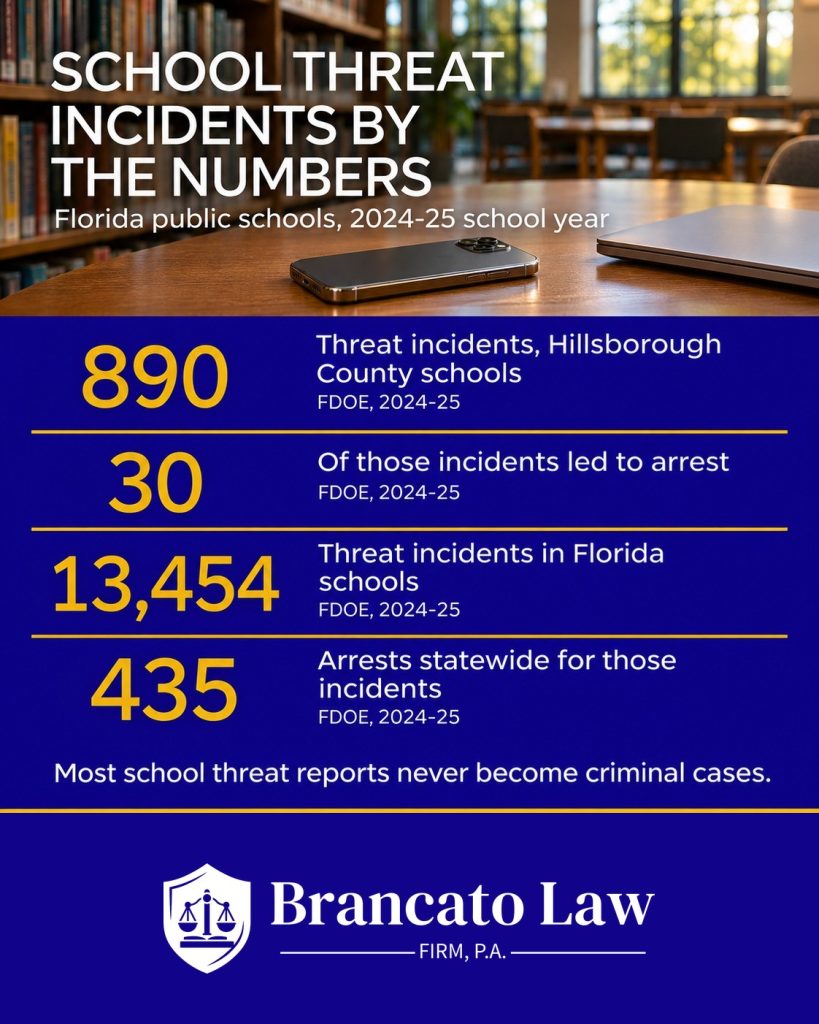
Those numbers cover every kind of threat or intimidation reported at school, not only section 836.10 cases, and they do not count threats made outside school. They do show that most incidents are handled through school discipline, diversion, or other law enforcement action rather than a felony arrest. Our attorneys at The Brancato Law Firm work to keep a client’s case in that larger group by reaching the school, the investigating officer, and the State Attorney’s Office early.
What happens after a written threat arrest in Hillsborough County?
An adult arrested in Hillsborough County for a written threat is booked into the Orient Road Jail and sees a judge at first appearance within 24 hours, where bond and no-contact conditions are set. Pretrial services supervision is not available in Hillsborough County, though some nearby counties offer it, so release conditions often depend on what the defense proposes, such as a no-contact order, surrendering firearms, or staying off social media. Our Hillsborough County criminal defense attorney page explains the local courts, and our Florida criminal case process guide walks through each stage from arrest to trial.
| Stage | What happens | What our attorneys do |
|---|---|---|
| Investigation | Police or a school resource officer interviews the sender and seizes devices | Advise silence and preserve the full message history |
| Arrest and booking | An adult is taken to the Orient Road Jail | Prepare a release plan with no-contact and social media conditions |
| First appearance (within 24 hours) | A judge reviews probable cause and sets bond and conditions | Argue for release on conditions the defense proposes |
| Filing decision | The State Attorney’s Office decides the charge | Present context, authorship evidence, and mitigation before the charge is set |
If an officer or school resource officer wants to talk about a post or message and no one has been arrested, call a lawyer before answering questions. Our representation before charges are filed can put the full context in front of the State before it decides what to file.
Frequently asked questions about written threat charges in Florida
Can a written threat charge be dropped in Florida?
Yes. The State Attorney’s Office can drop or reduce a section 836.10 charge when the full context shows a joke, lyric, or venting, when authorship is in doubt, or when the evidence of a culpable mental state is weak. The Brancato Law Firm pushes for that result by presenting the complete message thread and supporting evidence before the filing decision, often through our pre-file advocacy.
Is a threatening text message a felony in Florida?
Yes. A text that threatens to kill or injure someone, or threatens a mass shooting, can be charged as a second-degree felony under section 836.10 because a text is an electronic record. Our attorneys at The Brancato Law Firm review the full conversation, because a single text pulled from a longer exchange often reads differently in context.
Is it a crime to post a threat on social media if it was a joke?
It can be, because the statute covers posts that others may view, and a court may let a jury decide whether a “joke” was a threat, as in Puy v. State. The defense focuses on whether the poster understood the post would be taken as a threat, and The Brancato Law Firm gathers the replies, follow-up messages, and history that show how the post was meant and received.
Does section 836.10 apply to a threat made in a phone call?
No. The statute’s definition of an electronic record “does not include a telephone call,” so a spoken threat over the phone must be charged under a different law if at all. Lawyers from The Brancato Law Firm check the charging document carefully, because a phone threat charged under section 836.10 can be challenged in a motion to dismiss, a step our violent crime defense team takes early.
What happens if a student is charged with a written threat in Tampa?
A student under 18 usually goes through juvenile court, and the school may also open its own discipline and threat assessment process. The Brancato Law Firm coordinates the criminal case with the school process so that a statement made in a school meeting does not become evidence against the student.
Talk to a Tampa threat defense attorney
Message threads disappear, accounts get locked, and schools act within days, so the first step after a threat accusation is to preserve the full context. Call The Brancato Law Firm, P.A., founded by Tampa Criminal Defense Attorney Rocky Brancato, at (813) 727-7159, and our attorneys will begin securing the messages and building the defense right away. You can call us at any hour, and our office is two blocks from the courthouse. Our firm has Spanish-speaking staff, and attorney Jean-Luc Adrien speaks Spanish, Haitian Creole, and French. For more about our defense strategies, visit our Violent Crimes page.
The Brancato Law Firm, P.A.
620 E. Twiggs Street, Suite 205, Tampa, FL 33602
(813) 727-7159
Serving Hillsborough, Pinellas, and Pasco Counties
The Brancato Law Firm, P.A. is a Tampa-based criminal defense practice. We are not affiliated with any other Brancato-named law firms.
Visit Us

Tampa, FL 33602

Contact Us Now
Free Legal Consultation (813) 727-7159
