

From First DUI to Death Penalty



How to Fight a Shooting Into a Dwelling or Vehicle Charge in Florida? (2026)


To fight a shooting into a dwelling or vehicle charge in Florida, the defense attacks the element prosecutors most often take for granted: that the shot or throw was wanton or malicious. The Florida Supreme Court has held that proof a person fired into a building is not enough by itself, so the State must prove the person knew the act was likely to hurt someone or damage another person’s property. The charge under section 790.19 is a second-degree felony punishable by up to 15 years in prison, and a vehicle case also requires proof that the vehicle was being used or occupied by a person.
As founder of The Brancato Law Firm, P.A., a Tampa criminal defense firm, and a former Major Crimes Unit attorney who has tried more than 150 jury trials to verdict, I have seen how quickly a report of “shots fired” becomes a second-degree felony charge. I also spent more than 25 years in Hillsborough County courtrooms, including as former Chief Operations Officer of the Hillsborough County Public Defender’s Office, where I oversaw a staff of over 100 attorneys. In these cases our attorneys focus first on intent, the type of target, and whether the forensic evidence actually ties our client to the shot.
What Is Shooting or Throwing a Deadly Missile Under Florida Law?
Shooting or throwing a deadly missile is the Florida crime of wantonly or maliciously shooting, throwing, or hurling an object that could cause death or great bodily harm at, within, or into a building, an occupied vehicle, a boat, or an aircraft. The offense is defined in section 790.19, Florida Statutes, and police reports and court dockets often shorten it to “shooting into an occupied dwelling,” “shooting into a building,” or “shooting into an occupied vehicle.” It is one of the charges our Tampa gun crimes attorney team defends most often after a neighborhood shooting call.
The statute reaches more than guns. It also covers a person who “throws any missile or hurls or projects a stone or other hard substance which would produce death or great bodily harm,” so a rock thrown through a car window or a brick thrown at a house can be charged under the same section. The statute treats buildings and vehicles differently. A public or private building is covered whether it is “occupied or unoccupied,” while a car, bus, or train is covered only when it “is being used or occupied by any person.”
What Must Prosecutors Prove for a Section 790.19 Charge?
Prosecutors must prove three things beyond a reasonable doubt: the object, the target, and the mental state. The Florida standard jury instruction for section 790.19 (Instruction 10.13) breaks the crime into those elements, and the third one is where most of these cases are won or lost.
| Element | What the State must prove | Where the defense often pushes back |
|---|---|---|
| 1. The object | The person shot a firearm, or threw a missile, stone, or other hard substance, that would produce death or great bodily harm. | Was the object capable of serious harm? A thrown bottle, BB, or small rock may not qualify on the facts. |
| 2. The target | The shot or object went at, within, or into a building (occupied or not), a vehicle being used or occupied by a person, a boat or vessel in Florida waters, or an aircraft in flight. | Was anyone in or using the vehicle? Did the shot actually go at or into the structure? |
| 3. The mental state | The act was done wantonly or maliciously. | Did the person know the act was likely to hurt someone or damage another person’s property? |
The jury instruction defines both mental states. “Wantonly” means consciously and intentionally, with reckless indifference to consequences and with the knowledge that damage is likely to be done to some person. “Maliciously” means wrongfully, intentionally, without legal justification or excuse, and with the knowledge that injury or damage will or may be caused to another person or the property of another person.
What Are the Penalties for Shooting Into an Occupied Dwelling or Vehicle in Florida?
Shooting or throwing a deadly missile is a second-degree felony, punishable by up to 15 years in prison and a fine of up to $10,000 under section 775.082 and section 775.083. The offense severity chart in section 921.0022 ranks section 790.19 as a Level 6 offense, which drives the Criminal Punishment Code scoresheet that sets the lowest sentence a judge may impose without a legal reason to go lower.
| Item | Rule | Source |
|---|---|---|
| Degree and maximum | Second-degree felony: up to 15 years in prison and a $10,000 fine | § 790.19; § 775.082; § 775.083 |
| Offense level | Level 6 on the offense severity ranking chart | § 921.0022 |
| Primary offense points | 36 points for a Level 6 offense | § 921.0024 |
| Firearm points | 18 additional points when the felony is committed while possessing a firearm (the offense is not on the 10-20-Life list) | § 921.0024 |
| 44 points or fewer | Lowest permissible sentence is any non-state-prison sanction, unless the judge chooses prison up to the maximum | § 921.0024 |
| More than 44 points | Lowest permissible prison sentence = (total points minus 28) x 0.75, in months | § 921.0024 |
| Prison releasee reoffender | Shooting into an occupied vehicle qualifies as a forcible felony for PRR sentencing; shooting into a building does not | Paul v. State (Fla. 2013) |
Here is how those rules play out. Under section 921.0024, a stand-alone section 790.19 charge with no prior record and no injury scores 36 points, which falls under the 44-point line where the lowest permissible sentence is a non-prison sanction such as probation. If the State also scores the 18 firearm points, the total reaches 54, and the lowest permissible sentence becomes 19.5 months in state prison. That 18-point difference is why our attorneys check every line of the scoresheet, including whether a firearm was actually possessed and whether victim-injury points are supported.
The prison releasee reoffender question matters for anyone released from prison within the past three years. In Paul v. State, 112 So. 3d 1188 (Fla. 2013), the Florida Supreme Court reviewed a man convicted of shooting into an occupied vehicle and held that the offense “necessarily involves the use or threat of physical force or violence against an individual,” so it qualifies for PRR sentencing. The court also acknowledged that shooting into a building is not a forcible felony under that provision because the statute “does not require the building to be occupied.”
How Do Our Attorneys Fight a Shooting Into a Dwelling or Vehicle Charge?
Our attorneys fight these charges by testing each element and the evidence behind it, starting with intent. The defenses below come up most often in Hillsborough, Pinellas, and Pasco County cases, and more than one usually applies.
- No wanton or malicious intent. In State v. Kettell, 980 So. 2d 1061 (Fla. 2008), neighbors called 911 after hearing shots from a man’s apartment, and officers found bullet holes in the floor molding. The trial judge told the jury that shooting into a building “per se” satisfied the intent element. The Florida Supreme Court approved the Second District’s reversal, holding that “proof that the defendant shot at or into a building is simply insufficient to prove that the act was wanton or malicious.” An accidental discharge, a shot fired while cleaning a gun, or a shot into one’s own empty property may not meet the definition.
- The vehicle was not being used or occupied. Under Paul, the vehicle part of the statute requires the presence of a person. A shot into an empty parked car does not fit that part of section 790.19, though it may still be charged as a different offense such as criminal mischief.
- The object could not cause death or great bodily harm. In H.H. v. State, 773 So. 2d 122 (Fla. 4th DCA 2000), a teenager threw a bottle that struck a tree 20 to 25 feet above a police officer on a motorcycle. The Fourth District reversed because the bottle “did not come close to hitting the officer” and there was no other evidence of intent to hit him. Thrown-object cases turn on size, distance, and what the object actually did.
- The State cannot prove who fired. Many shooting cases rest on shell casings, a matching gun, and a firearms examiner’s opinion. In its January 2017 addendum on forensic feature-comparison methods, the President’s Council of Advisors on Science and Technology reported that only one appropriately designed black-box study of firearms identification existed and that its upper confidence bound on the false-positive rate was equivalent to 1 in 46. Our attorneys use that research, independent experts, and Daubert challenges to limit or test a toolmark “match.”
- Self-defense or defense of others. Florida law allows deadly force when a person reasonably believes it is necessary to prevent imminent death or great bodily harm, under section 776.012. A person who meets that standard is immune from prosecution under section 776.032, and the immunity question is decided at a pretrial Stand Your Ground hearing where the State carries the burden by clear and convincing evidence once the defense raises a prima facie claim.
- Suppression of statements and searches. Shooting investigations often involve a gun found in a car or home and a statement given at the scene. If the search lacked a warrant or a valid exception, or the statement followed custodial questioning without Miranda warnings, our attorneys move to suppress it.
- Negotiating a lesser charge. When the evidence of intent or occupancy is thin, our attorneys may negotiate a reduction to a charge such as discharging a firearm in public under section 790.15(1), a first-degree misdemeanor, or to criminal mischief for property damage.
Can You Be Convicted of Shooting Into a Vehicle and Another Gun Charge for the Same Shots?
Yes. Florida courts allow separate convictions for shooting into an occupied vehicle and discharging a firearm from a vehicle for the same shots. In Valdes v. State, 3 So. 3d 1067 (Fla. 2009), a driver pulled up beside another car, argued with a passenger, and fired four or five shots, striking her in the arm and foot. The Florida Supreme Court held that convictions under both section 790.15(2) and section 790.19 do not violate double jeopardy because the offenses sit in separate statutes and are not degree variants of the same offense.
That stacking risk is why our attorneys look at the whole charging document, not only the lead count. A single incident can produce a section 790.19 count, a discharge count, and an aggravated assault or aggravated battery count, each with its own scoresheet and mandatory minimum issues. Our posts on fighting aggravated assault charges and fighting aggravated battery charges explain those companion counts.
Does 10-20-Life Apply to a Shooting Into a Building Charge?
No, not to the section 790.19 count itself. The 10-20-Life mandatory minimums in section 775.087(2) apply only to the felonies listed there, such as murder, robbery, burglary, aggravated battery, and kidnapping, and shooting into a building or vehicle is not on that list. The minimums can still apply when the same shots are also charged as attempted murder or aggravated battery, which is a common prosecution strategy in Tampa Bay.
| Charge | Statute | Degree | 10-20-Life listed? |
|---|---|---|---|
| Shooting or throwing a deadly missile into a building or occupied vehicle | § 790.19 | Second-degree felony | No |
| Discharging a firearm in public or recklessly on residential property | § 790.15(1) | First-degree misdemeanor | No |
| Discharging a firearm from a vehicle within 1,000 feet of a person | § 790.15(2) | Second-degree felony | No |
| Aggravated battery with a firearm | § 784.045 | Second-degree felony | Yes |
| Attempted murder with a firearm | § 782.04; § 777.04 | Depends on the degree of murder attempted | Yes |
Our overview of Florida gun crime laws covers the wider list of weapon offenses, and our post on bomb and shooting threat charges covers threats that never involve a fired shot.
How Are Shooting Cases Handled in Hillsborough County?
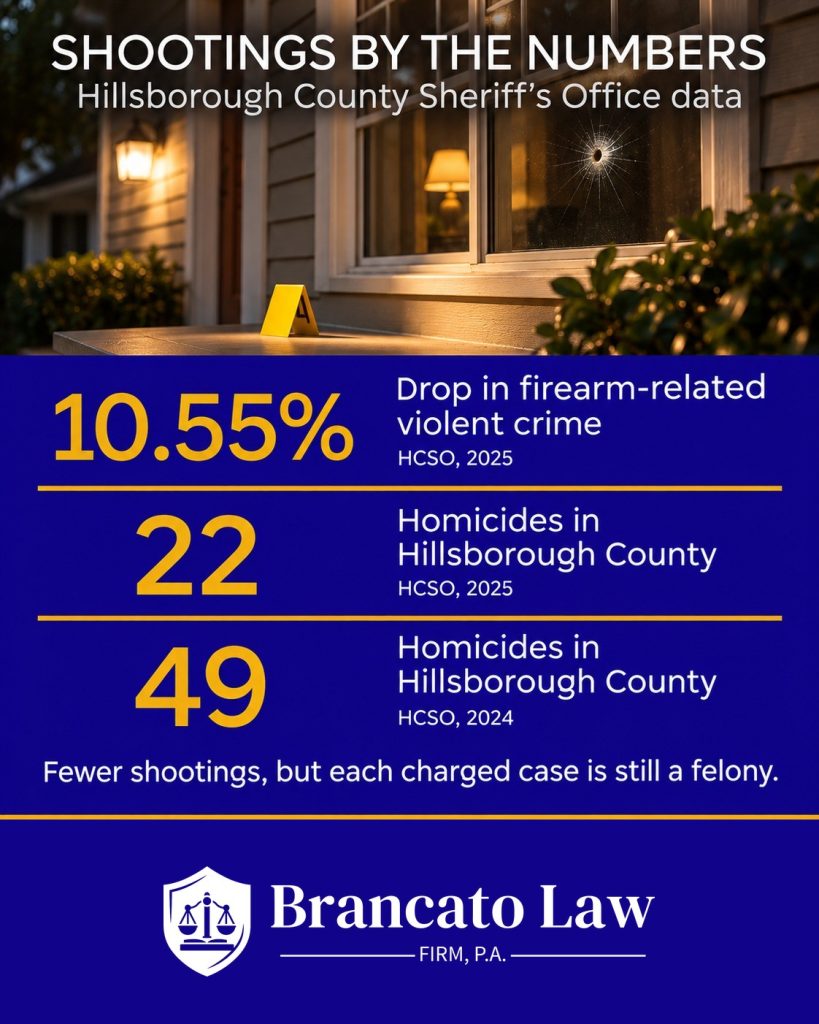
Shooting cases in Hillsborough County are charged as felonies in the 13th Judicial Circuit and start with a first appearance hearing. Firearm-related violent crime declined 10.55% in 2025, and homicides fell from 49 in 2024 to 22 in 2025, according to the Hillsborough County Sheriff’s Office’s 2025 NIBRS crime data. Fewer shootings has not meant gentler treatment of the ones that are charged; in our experience, a shots-fired case still draws a felony charge and a contested bond hearing.
First appearance in Hillsborough County is held every day of the year, with the judge downtown and the arrested person appearing by video from the jail, as our guide to Hillsborough first appearance explains. In our practice, one local detail shapes bond arguments in gun cases: pretrial services supervision is not available in Hillsborough County, though nearby counties offer it, so release conditions here often come down to the bond amount and no-contact orders. Our Hillsborough County criminal defense attorneys prepare release plans for that hearing before it happens.
What Should You Do If Detectives Want to Talk About a Shooting?
You should decline to answer questions and call a defense attorney before any interview. Statements made to detectives in the first days after a shooting, including “I only fired into the air” or “I was aiming at the tires,” often become the State’s proof of the wanton or malicious element. Our attorneys provide representation before charges are filed, which can include preserving doorbell and surveillance video, locating witnesses, and presenting a self-defense account to the State Attorney’s Office before a charging decision.
Timing matters at every stage of the Florida criminal case process. Surveillance systems in many homes and businesses overwrite footage within days, and 911 audio and cell phone records need prompt preservation requests.
Frequently Asked Questions About Shooting Into a Dwelling or Vehicle in Florida
Can a shooting into a dwelling charge be dropped in Florida?
Yes. Prosecutors can drop or reduce a section 790.19 charge when the evidence of wanton or malicious intent, occupancy, or identity is weak, or when self-defense is supported. Our attorneys at The Brancato Law Firm build that case for the prosecutor early, often before the filing decision, through pre-file advocacy.
Is it a crime to shoot into an empty house in Florida?
It can be, because section 790.19 covers buildings that are “occupied or unoccupied.” The State still has to prove the shot was wanton or malicious under State v. Kettell, and The Brancato Law Firm looks closely at who owned the property and whether anyone could have been hurt.
Is shooting at an empty parked car a felony under section 790.19?
Usually not under section 790.19, because the vehicle part of the statute requires a vehicle “being used or occupied by any person,” as the Florida Supreme Court explained in Paul v. State. The Brancato Law Firm checks whether the State can prove anyone was inside or using the car, since the same act may only support a lesser property charge.
Is throwing a rock at a moving car a felony in Florida?
Throwing a rock or other hard object at an occupied car can be charged as a second-degree felony under section 790.19 if the object could cause death or great bodily harm. Our team at The Brancato Law Firm examines the object’s size, the distance, and the damage, because cases like H.H. v. State show that a thrown object that never came close to a person may not support the charge.
Does a shooting into a building charge carry a mandatory minimum in Florida?
Not by itself, because section 790.19 is not one of the felonies listed in the 10-20-Life statute. The Brancato Law Firm watches for companion counts like aggravated battery or attempted murder, which can carry 10, 20, or 25-year minimums for the same shots, and our gun crimes defense team in Tampa works to keep those counts out of the case.
Can I claim self-defense if I fired at a car that was trying to run me over?
Yes, if you reasonably believed deadly force was necessary to prevent imminent death or great bodily harm, Florida law can justify the shot and give you immunity from prosecution. The Brancato Law Firm prepares Stand Your Ground immunity motions with scene measurements, video, and witness statements so the judge can decide the issue before trial.
Will a shooting into an occupied vehicle conviction count against me if I was recently released from prison?
Yes. Shooting into an occupied vehicle qualifies for prison releasee reoffender sentencing, which can require the statutory maximum for a person who committed the offense within three years of release from prison. Our attorneys at The Brancato Law Firm review release dates and the exact charging language, because a building charge does not qualify for PRR the same way.
For more about our defense strategies, visit our Gun Crimes page.
Video, 911 audio, and witness memories from a shooting scene start disappearing within days, so the first week often decides what evidence is left to work with. Call The Brancato Law Firm, P.A., founded by Tampa Criminal Defense Attorney Rocky Brancato, at (813) 727-7159 for a free consultation; you can call us at any hour, and our office is two blocks from the courthouse. Our firm has Spanish-speaking staff, and attorney Jean-Luc Adrien speaks Spanish, Haitian Creole, and French.
The Brancato Law Firm, P.A.
620 E. Twiggs Street, Suite 205, Tampa, FL 33602
(813) 727-7159
Serving Hillsborough, Pinellas, and Pasco Counties
The Brancato Law Firm, P.A. is a Tampa-based criminal defense practice. We are not affiliated with any other Brancato-named law firms.
Visit Us

Tampa, FL 33602

Contact Us Now
Free Legal Consultation (813) 727-7159
