

From First DUI to Death Penalty



How to Fight Aggravated Assault in Florida? (2026)


To fight aggravated assault in Florida, the defense attacks the fact that turns a 60-day misdemeanor into a 5-year felony: whether the object was really a deadly weapon, or whether the accused really intended to commit a separate felony. The State must also prove the basic assault elements, including a well-founded fear that violence was about to happen right then. Aggravated assault is a third-degree felony under section 784.021, ranked Level 6, so a first offense with no prior record often scores below a mandatory prison sentence. Self-defense applies to threatened force, and a Stand Your Ground motion can end the case before trial.
If you were arrested for aggravated assault in Hillsborough, Pinellas, or Pasco County, the case probably turns on a few seconds and one object: a gun, a knife, a bat, a car, or something an officer decided to call a weapon. As founder of The Brancato Law Firm, P.A., a Tampa criminal defense firm, I have tried more than 150 jury trials to verdict over more than 25 years in Hillsborough County courtrooms, and I learned how threat cases are built in the Major Crimes Unit. Our attorneys handle aggravated assault cases by getting the video, the 911 call, and the object itself early, then holding the State to proof of each element before the filing decision is made.
What is aggravated assault in Florida?
Aggravated assault is an assault committed with a deadly weapon without intent to kill, or with an intent to commit a felony. Those are the only two routes under section 784.021, Florida Statutes, and the statute makes either one a third-degree felony. No touching is required. A threat that never lands is still aggravated assault if the State proves every element.
The underlying assault comes from section 784.011: an intentional, unlawful threat by word or act, an apparent ability to carry it out, and an act that creates a well-founded fear that violence is imminent. Our post on how to fight an assault charge in Florida covers those three elements, the words-alone rule, and the fear requirement in depth. This post covers what the State must add to make the charge a felony, and how our attorneys attack it. Our Tampa violent crime lawyer page describes the rest of our violent felony practice.
| Element | What it means | Where the defense looks |
|---|---|---|
| 1. Intentional, unlawful threat | A threat of violence by word or act, made on purpose and without legal justification | Self-defense, a misread gesture, an accidental display |
| 2. Apparent ability | The accused appeared able to carry out the threat at that moment | Distance, barriers, whether the object was ever visible |
| 3. Well-founded fear of imminent violence | The act would make a reasonable person fear violence right then, not later | Conditional or future threats, timing on the video |
| 4a. Deadly weapon | An object likely to cause death or great bodily harm as designed, or as actually used or threatened | How the object was held and used; whether it was a weapon at all |
| 4b. Intent to commit a felony | The assault was made with intent to commit a separate, identified felony | Whether the intended act was a felony at all, and what proves the intent |
What is the penalty for aggravated assault in Florida?
Aggravated assault is a third-degree felony punishable by up to 5 years in prison and a $5,000 fine, and section 784.021 also allows habitual offender sentencing under section 775.084. The charge climbs when the alleged victim is a protected person. Under section 784.07, aggravated assault on a law enforcement officer is reclassified to a second-degree felony, and anyone convicted of it “shall be sentenced to a minimum term of imprisonment of 3 years.”
| Situation | Degree | Maximum | Floor |
|---|---|---|---|
| Aggravated assault, first offense, no prior record | Third-degree felony, Level 6 | 5 years, $5,000 | 36 points; any nonstate prison sanction is permissible |
| Aggravated assault with a deadly weapon within 3 years of prison release | Third-degree felony, PRR-eligible | 5 years | Mandatory 5 years if the State seeks and proves PRR |
| Aggravated assault on a law enforcement officer | Second-degree felony, Level 6 | 15 years | 3-year mandatory minimum |
| Aggravated assault in furtherance of a riot | Third-degree felony, ranked one level higher | 5 years | Scored at Level 7 |
| Improper exhibition of a weapon (a common alternative charge) | First-degree misdemeanor | 1 year in county jail | No felony scoresheet |
Maximum terms come from section 775.082, and improper exhibition is defined in section 790.10 as exhibiting a weapon “in a rude, careless, angry, or threatening manner, not in necessary self-defense.” Since July 1, 2016, Florida’s 10-20-Life firearm minimums no longer apply to aggravated assault; our assault post explains that change, and our guide to Florida’s 10-20-Life law covers the charges it still reaches.
Does aggravated assault mean prison in Florida?
Not automatically. Aggravated assault is ranked at Level 6 on the offense severity ranking chart in section 921.0022, and under section 921.0024 a Level 6 primary offense scores 36 points. When the total is 44 points or fewer, the lowest permissible sentence is any nonstate prison sanction, which can mean probation, county jail, or a diversion-based resolution. A judge may still impose up to the 5-year maximum.
Three things change that picture. Prior record points, additional counts, and legal status points (such as being on probation at the time) can push the total above 44, and then a prison sentence becomes the floor: subtract 28 and reduce the remainder by 25 percent. The prison releasee reoffender statute is the second. Section 775.082(9) lists “aggravated assault with a deadly weapon” as a qualifying offense, and a defendant who commits it within 3 years of release from prison faces a mandatory 5 years if the State proves PRR status. In Wheeler v. State, 898 So. 2d 1052 (Fla. 2d DCA 2005), a Hillsborough County case in which the defendant held a BB gun to a ten-year-old boy’s head, the Second District upheld a PRR sentence for aggravated assault under the statute’s catch-all for felonies involving a threat of violence. Our post on prison releasee reoffender sentencing explains how that designation is fought. The third is an officer victim, which carries its own 3-year minimum.
Our attorneys score every aggravated assault case at the first meeting, because the number tells the client what each argument is worth. For a client with no record, keeping the case at a single Level 6 count is often what keeps prison off the table.
How do our attorneys fight an aggravated assault charge?
Our attorneys fight aggravated assault by attacking the element that makes it a felony, while preserving self-defense as a complete defense. These are the approaches The Brancato Law Firm uses most often in the 13th Judicial Circuit and the neighboring Pinellas and Pasco courts.
1. Prove the object was not a deadly weapon
An object is a deadly weapon only if it is likely to cause death or great bodily harm, either by its design or by the way it was actually used or threatened. That is a factual question, and it is where many aggravated assault cases are won. In Wallace v. State, 240 So. 3d 872 (Fla. 1st DCA 2018), a man lunged at another man with his cane during a shouting match, pushing it toward him rather than swinging it, and both men stepped back. The First District held that “a cane could certainly constitute a deadly weapon in certain circumstances,” but this use was not likely to cause death or great bodily harm, and it ordered the conviction reduced to simple assault, a second-degree misdemeanor.
The same rule cuts the other way for objects that look dangerous. In Dale v. State, 703 So. 2d 1045 (Fla. 1997), a robber flashed a BB pistol that resembled a 9 mm Beretta and was later found with no BBs or gas cartridge. The Florida Supreme Court held that whether a BB or pellet gun is a deadly weapon “is a factual question to be answered by the jury in each case,” and that an unloaded condition is not dispositive. Arrest reports call bottles, phones, flashlights, tools, and cars deadly weapons. Our attorneys make the State prove how the object was held, how close it came, and what it could actually do, and we read the charging document to confirm it alleges the weapon the evidence shows.
2. Make the State prove the “intent to commit a felony”
The second route to aggravated assault requires proof that the threat was made with intent to commit a separate felony, and the State has to identify that felony. If the evidence shows an angry threat with no plan to rob, kidnap, or seriously injure anyone, the felony-intent route fails and the case falls back to simple assault. Intent is rarely proven by a confession. It is argued from words, timing, and conduct, which means the defense can often answer it with the same video and witness accounts the State relies on.
3. Raise self-defense and Stand Your Ground immunity for threatened force
Florida’s self-defense statute protects threats of force, not only force itself. Under section 776.012, “A person is justified in using or threatening to use force, except deadly force,” when the person reasonably believes it is necessary to defend against another’s imminent use of unlawful force, and may threaten deadly force to prevent imminent death, great bodily harm, or a forcible felony. Showing a holstered gun to stop someone advancing on you can be justified. Our attorneys raise immunity by a pretrial motion under section 776.032; once the defense makes a prima facie claim, the State must overcome it by clear and convincing evidence. Our guide to how a Stand Your Ground immunity hearing works walks through that hearing.
Holding a weapon does not automatically mean deadly force was used. In Claudio-Martinez v. State, 324 So. 3d 45 (Fla. 2d DCA 2021), a Hillsborough County jury convicted a man of aggravated battery after a neighborhood fight in which the other man had armed himself with a broomstick. The Second District reversed for a new trial because trial counsel never asked for the instruction on justifiable nondeadly force, explaining that “the use of a deadly weapon in self-defense does not summarily equate to the use of deadly force.” Nondeadly force is justified in a broader set of circumstances than deadly force. In a threatened-force case, our attorneys ask for both instructions whenever the evidence supports them.
4. Challenge the identification when a weapon was involved
Witnesses who see a weapon remember the people around it less accurately. A meta-analysis by Fawcett, Russell, Peace, and Christie, “Of guns and geese: a meta-analytic review of the ‘weapon focus’ literature,” Psychology, Crime & Law (2013), found an overall effect of weapon presence on memory (g = 0.53), and found that the effect held whether the event was staged in a laboratory, simulated, or real. In a parking-lot or road-rage case where the only identification comes from a frightened witness, our attorneys use that research to challenge show-up identifications and photo lineups, and we look for the video that settles who was holding what.
5. Test imminence, distance, and the alleged victim’s account
Every aggravated assault still requires a fear that violence was about to happen right then. A threat about tomorrow, a weapon that never came out of a car, or a person separated by a closed door or a long distance may not create that fear. These are the facts body camera and phone video capture best, and they are often different from the arrest report. Our attorneys measure the scene, time the video, and depose the alleged victim before any plea discussion.
6. Work the case before the State files
The best time to stop an aggravated assault charge is before the information is filed. In Hillsborough County, an intake prosecutor at the State Attorney’s Office reviews the arrest report and decides what to file. Through representation before charges are filed, our attorneys put witness statements, video, the alleged victim’s own sworn account, and our client’s background in front of that prosecutor while the decision is still open. That is how our firm obtained a no-file decision in an aggravated assault case within 24 days of the arrest.
How common are aggravated assault arrests in the Tampa Bay area?
Hillsborough County records more aggravated assault arrests per resident than Florida as a whole, while Pinellas and Pasco record fewer. Florida Department of Law Enforcement arrest data published by Florida Health CHARTS show 1,772 aggravated assault arrest events in Hillsborough County in 2025, a rate of 112.5 per 100,000 residents, compared with 97.8 for Florida as a whole. The same 2025 data show 899 arrest events in Pinellas County (93.0 per 100,000) and 542 in Pasco County (83.6 per 100,000). These figures count arrest events, not convictions, and an arrest is where our work begins.
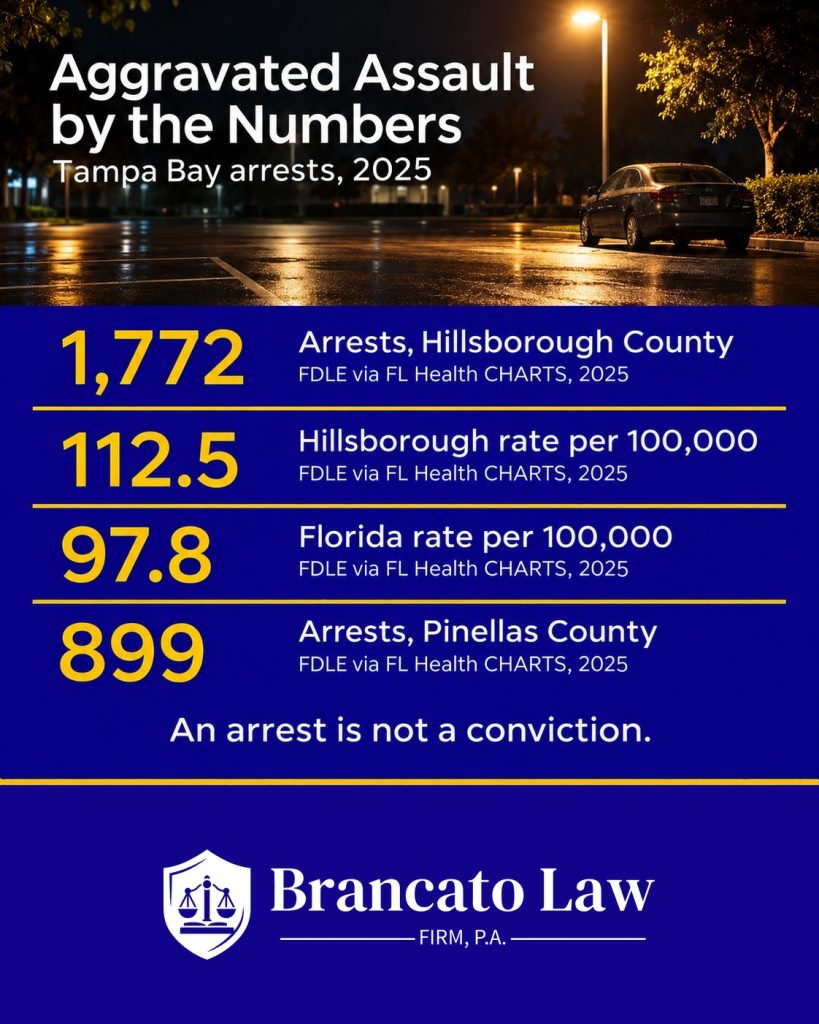
| Area | Arrest events | Rate per 100,000 |
|---|---|---|
| Hillsborough County | 1,772 | 112.5 |
| Pinellas County | 899 | 93.0 |
| Pasco County | 542 | 83.6 |
| Florida | 22,868 | 97.8 |
What happens after an aggravated assault arrest in Hillsborough County?
An aggravated assault arrest in Hillsborough County goes to first appearance within 24 hours, then to the State Attorney’s filing decision. The arrested person appears by video from the Orient Road Jail while a judge reviews probable cause and sets release conditions, usually including no contact with the alleged victim and, in a firearm case, no weapons. In our experience, Hillsborough County does not offer pretrial services supervision as a release option, though some neighboring counties do, so the choice is usually a monetary bond, release on recognizance, or continued detention. Our post on Hillsborough first appearance explains that hearing, and our Hillsborough County criminal defense page covers local procedure.
After first appearance, the State decides whether to file an information and at what level. For a first-time client, diversion may be possible; our firm resolved an aggravated assault with a deadly weapon case through Pretrial Intervention, with the charge to be dismissed on completion. Our post on Pretrial Intervention in Hillsborough County explains eligibility. Each stage is mapped in our guide to the Florida criminal case process, from arrest through trial.
What should you do, and avoid, after an aggravated assault arrest?
Say nothing about the incident to anyone but your lawyer, and start preserving your side right away. Our attorneys give every new aggravated assault client these instructions:
- Do not explain the incident to police, the alleged victim, friends, or on social media. Jail calls are recorded.
- Obey every release condition, including no contact and no weapons. A violation can mean a new charge and revoked bond.
- List every camera and witness: businesses, doorbells, dash cams, and passersby. Many systems overwrite footage within days or weeks.
- Save your own evidence: texts, call logs, photos of injuries or damage, and anything showing the other person approached you.
- Do not try to get the alleged victim to drop the case. Contact can be charged separately, and the State Attorney, not the alleged victim, decides whether to prosecute.
What results have our attorneys obtained in aggravated assault cases?
Our attorneys have obtained no-file decisions, dismissals, and diversion in aggravated assault cases by working the evidence early. These results are published on our case results page.
| Charge | Result |
|---|---|
| Aggravated assault (February 2026) | Hired the day of the arrest; the alleged victim’s affidavit led the State to decline charges within 24 days |
| Aggravated assault with a deadly weapon (May 2026) | All charges dismissed |
| Aggravated assault with a deadly weapon (October 2026) | A veteran facing five years in prison; a Stand Your Ground motion and the firm’s mitigation report led to Pretrial Intervention, with the charge to be dismissed |
Past results do not guarantee future outcomes. Every case depends on its own facts.
Frequently asked questions about aggravated assault in Florida
Can aggravated assault charges be dropped in Florida?
Yes, aggravated assault charges can be dropped or reduced, most often when the evidence does not support a deadly weapon, felony intent, or imminent fear, or when self-defense applies. The Brancato Law Firm presents that evidence to the intake prosecutor before the filing decision, which is the earliest chance to end the case through pre-file advocacy. Only the State Attorney can drop the charge, though the alleged victim’s sworn account carries real weight.
Is pointing an unloaded gun at someone aggravated assault in Florida?
It can be, because the question is whether the person reasonably feared imminent violence and whether the object qualifies as a deadly weapon, not whether it was loaded. In a firearm case, our attorneys at The Brancato Law Firm look first at whether the display was justified threatened force under section 776.012. Our guide to Florida gun crime laws covers the related firearm charges.
Can a car be a deadly weapon in a Florida aggravated assault case?
Yes, a vehicle can be a deadly weapon if it is driven or threatened to be used in a way likely to cause death or great bodily harm. The Brancato Law Firm tests those cases with dash camera, traffic camera, and scene measurements, because speed, distance, and direction decide whether a car was used as a weapon or simply driven away from an argument.
What is the difference between aggravated assault and improper exhibition of a weapon?
Aggravated assault requires a threat that creates a well-founded fear of imminent violence, while improper exhibition under section 790.10 requires only showing a weapon “in a rude, careless, angry, or threatening manner.” Improper exhibition is a first-degree misdemeanor, and our attorneys at The Brancato Law Firm often argue that the facts fit it better than a felony. Our violent crimes defense work includes negotiating that kind of reduction.
Will I go to prison for a first aggravated assault offense in Florida?
Not necessarily, because a single Level 6 aggravated assault with no prior record scores 36 points, below the 44 points that make prison the minimum. Lawyers at The Brancato Law Firm work to keep the case at one count with no enhancements, and to pursue a reduction, diversion, or dismissal. The judge can still impose up to 5 years, so preparation for sentencing starts on day one.
Does Stand Your Ground apply if I only threatened force?
Yes, Florida’s self-defense and immunity statutes cover threatening to use force as well as using it. Our team at The Brancato Law Firm files the immunity motion when the facts support it, and our guide on how to claim self-defense in a Florida criminal case explains the rules.
For more about our defense strategies, visit our Violent Crimes page.
The intake prosecutor’s decision usually comes within weeks of the arrest, and video can disappear sooner. Our attorneys will move first on the evidence, find the witnesses, and put your side in front of the State while the charge is still open. Call The Brancato Law Firm, P.A., founded by Tampa Criminal Defense Attorney Rocky Brancato, at (813) 727-7159 for a free consultation; you can call us at any hour. Our firm has Spanish-speaking staff, and attorney Jean-Luc Adrien speaks Spanish, Haitian Creole, and French. Our office is two blocks from the courthouse, and we defend aggravated assault cases in Hillsborough, Pinellas, and Pasco counties.
The Brancato Law Firm, P.A.
620 E. Twiggs Street, Suite 205, Tampa, FL 33602
(813) 727-7159
Serving Hillsborough, Pinellas, and Pasco Counties
The Brancato Law Firm, P.A. is a Tampa-based criminal defense practice. We are not affiliated with any other Brancato-named law firms.
Visit Us

Tampa, FL 33602

Contact Us Now
Free Legal Consultation (813) 727-7159
