

From First DUI to Death Penalty



How to Fight an Aggravated Battery Charge in Florida? (2026)


To fight an aggravated battery charge in Florida, the defense attacks the one fact that turns a misdemeanor battery into a 15-year felony: proof of great bodily harm that the accused intended or knew would happen, use of a deadly weapon, or a victim the accused knew or should have known was pregnant. If that fact fails, the charge drops to felony battery or simple battery. Self-defense can end the case before trial at a Stand Your Ground immunity hearing, where the State must overcome immunity by clear and convincing evidence. Aggravated battery is a second-degree felony, and a first conviction with no prior record scores at least 21 months in state prison.
A Hillsborough County prosecutor deciding whether to file aggravated battery usually reads three things first: the emergency room chart, the description of the weapon, and any video. Those same three things decide most of these cases, and they are where our defense starts. I am Rocky Brancato, founder of The Brancato Law Firm, P.A., a Tampa criminal defense firm, who worked in the Major Crimes Unit and has tried more than 150 jury trials to verdict. Our attorneys collect the medical records, the 911 calls, and every camera angle in the first days of the case, then test each one against the element the State has to prove.
What is aggravated battery in Florida?
Aggravated battery is a battery that causes intentional serious injury, involves a deadly weapon, or targets a pregnant victim. Under section 784.045, Florida Statutes, a person commits aggravated battery who, in committing a battery, intentionally or knowingly causes great bodily harm, permanent disability, or permanent disfigurement, or uses a deadly weapon. The statute adds a third path: the person struck was pregnant, and the accused knew or should have known it.
Every version starts with an ordinary battery under section 784.03: an intentional, unwanted touch or strike, or intentionally causing bodily harm. Our post on how to fight a battery charge in Florida covers simple and felony battery. This post covers the felony that sits above them. More about our violent felony work is on our Tampa violent crime lawyer page.
| Path to aggravated battery | What the State must prove | What our attorneys test first |
|---|---|---|
| Great bodily harm | A battery plus great bodily harm, permanent disability, or permanent disfigurement, caused intentionally or knowingly | The medical chart, healing time, and whether the injury was intended or a reflex |
| Deadly weapon | A battery during which the accused used a deadly weapon | What the object was, how it was used, and whether video shows it at all |
| Pregnant victim | A battery on a pregnant person when the accused knew or should have known of the pregnancy | Whether the pregnancy was visible, disclosed, or known to the accused |
Aggravated battery is a second-degree felony. The maximum penalty is 15 years in prison under section 775.082 and a $10,000 fine under section 775.083. One detail most summaries miss: under section 784.045(3), an aggravated battery committed in furtherance of a riot or aggravated riot is ranked one level higher on the sentencing scoresheet.
What is the difference between felony battery and aggravated battery?
The difference is intent. Felony battery under section 784.041 requires only that a battery caused great bodily harm, permanent disability, or permanent disfigurement. Aggravated battery by great bodily harm requires proof that the accused intentionally or knowingly caused that harm. Felony battery is a third-degree felony with a 5-year maximum, so that one element is worth up to 10 years of exposure.
T.S. v. State, 965 So. 2d 1288 (Fla. 2d DCA 2007) shows how the gap works. A juvenile dishwasher punched a co-worker once after she threw iced tea in his face, and the punch fractured her eye socket. The Second District held that a quick, almost reflexive punch did not prove the intent aggravated battery requires and ordered the charge reduced to felony battery. Appeals from Hillsborough, Pinellas, and Pasco courts go to the Second District, so its rulings carry weight in local courtrooms. Our attorneys build this argument from the first interview, because witnesses forget the seconds before a punch quickly.
When is an ordinary object a “deadly weapon” in Florida?
An ordinary object is a deadly weapon only when it is used in a way likely to cause death or great bodily harm. In C.A.C. v. State, 771 So. 2d 1261 (Fla. 2d DCA 2000), a 10-year-old stabbed another child two or three times in the back with a fork. The child had scratches, swelling, and puncture marks and needed no medical treatment. The Second District held that the fork was not shown to be a deadly weapon and reduced the charge to simple battery.
Two other rules surprise people. First, the weapon does not always have to touch the victim. In Severance v. State, 972 So. 2d 931 (Fla. 4th DCA 2007), a man hit and choked his girlfriend, then put a knife to her throat while she tried to grab it. The Fourth District, sitting en banc, held that “uses a deadly weapon” includes holding a deadly weapon during the battery without touching the victim with it, and affirmed the conviction.
Second, a car can carry a battery to the person inside another car. In Clark v. State, 783 So. 2d 967 (Fla. 2001), a man rammed his truck into a truck that was blocking his exit, and the impact spun the driver. The Florida Supreme Court held that whether a vehicle is closely enough connected to its occupant is generally a question for the jury, and that evidence the impact spun the occupant can supply the touching a battery requires. In vehicle cases, our attorneys focus on the speed, the angle, and what the occupant actually felt, because Clark leaves those facts to the jury.
What counts as great bodily harm in a Florida aggravated battery case?
Great bodily harm means serious injury, more than the bruises and cuts that come with an ordinary fight. In Owens v. State, 289 So. 2d 472 (Fla. 2d DCA 1974), the Second District quoted the definition Florida courts still use: great bodily harm is “great as distinguished from slight, trivial, minor, or moderate harm,” and said it does not include mere bruises. The victim there had a broken nose and an eye swollen shut, and the court held that whether those injuries qualified was a question for the jury.
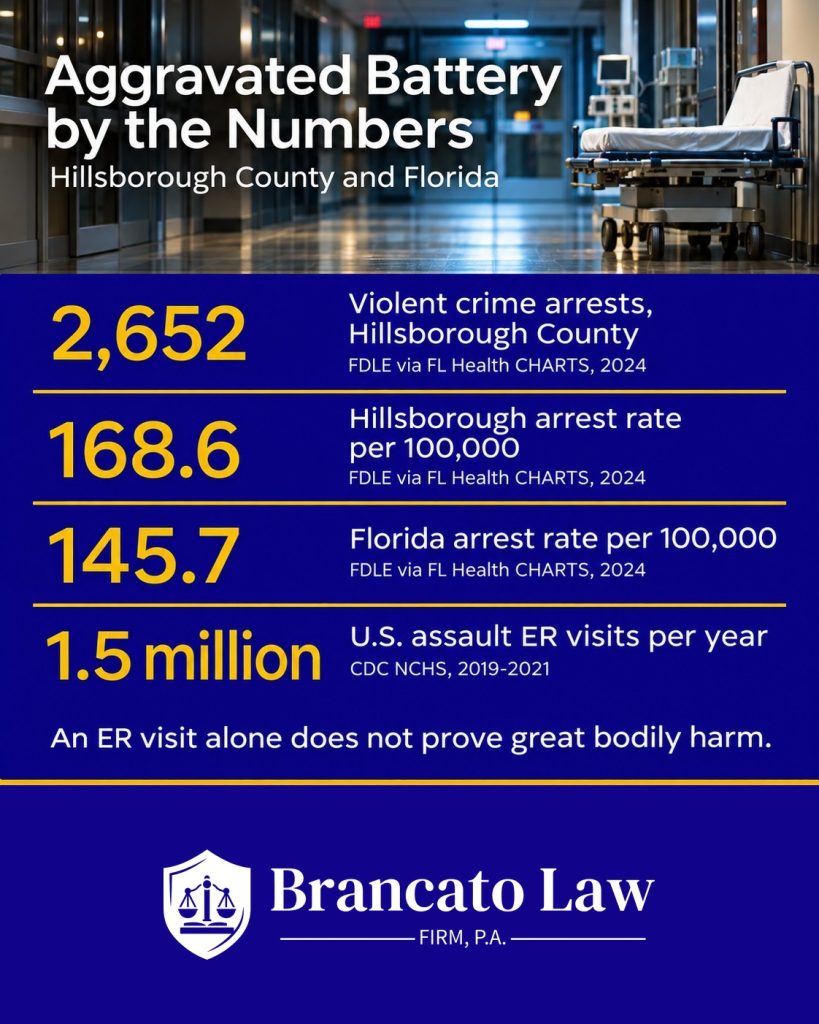
Because it is a jury question, the medical records usually decide it. Assault injuries are a common reason people go to the emergency room: the CDC’s National Center for Health Statistics found in its 2023 data brief on assault-related emergency department visits that, during 2019 to 2021, there were about 1.5 million emergency department visits for assault each year, a rate of 4.5 visits per 1,000 people. An emergency room visit alone does not prove great bodily harm. Our attorneys subpoena the full chart, imaging, discharge papers, and follow-up records, and when the medicine is disputed we consult independent physicians through our forensic expert network.
What if the alleged victim was pregnant?
A battery on a pregnant person is aggravated battery only if the accused knew or should have known about the pregnancy. No injury to the pregnant person or the pregnancy is required. The defense question is knowledge: how far along the pregnancy was, whether it was visible, and whether the accused had been told. Our attorneys look for texts, social media, and witness accounts that show what the accused actually knew on the day of the incident.
How does a firearm change an aggravated battery charge?
A firearm can raise the charge and set a mandatory minimum prison term. Under section 775.087, aggravated battery is a 10-20-Life offense: 10 years if the accused actually possessed a firearm, 20 years if it was discharged, and 25 years to life if the discharge caused death or great bodily harm. The same statute generally reclassifies a felony one degree higher when a weapon or firearm was used, unless use of a weapon is an essential element of the charge. Our post on Florida’s 10-20-Life law explains how “actual possession” is litigated.
The alleged victim’s job also matters. Under section 784.07, aggravated battery on a law enforcement officer performing official duties becomes a first-degree felony with a 5-year mandatory minimum prison sentence. Body camera footage usually answers whether the accused knew the person was an officer.
How much prison does an aggravated battery conviction score in Florida?
A first aggravated battery conviction with no prior record scores at least 21 months in state prison, and injury points push that number higher. The offense severity ranking chart in section 921.0022 places aggravated battery at Level 7. Under section 921.0024, a Level 7 primary offense scores 56 points, and victim injury adds 4 points for slight injury, 18 for moderate injury, and 40 for severe injury. When total points exceed 44, the lowest permissible sentence is the total minus 28, multiplied by 75 percent, in months.
| Scenario (no prior record, one count) | Total points | Lowest permissible sentence |
|---|---|---|
| Aggravated battery with a deadly weapon, no injury scored | 56 | 21 months in state prison |
| Aggravated battery, slight injury | 60 | 24 months in state prison |
| Aggravated battery, moderate injury | 74 | 34.5 months in state prison |
| Aggravated battery, severe injury | 96 | 51 months in state prison |
| Reduced to felony battery (Level 6, 36 points), severe injury | 76 | 36 months in state prison |
| Reduced to misdemeanor battery | None | No felony scoresheet; up to 1 year in county jail |
This math is why the injury dispute matters even when the charge stays the same. A sentence below the lowest permissible sentence requires a downward departure, which needs a legal reason proved with evidence. Our attorneys run the scoresheet early so a client knows what each argument is worth before deciding on a plea or a trial.
How do our attorneys fight an aggravated battery charge?
Our attorneys fight aggravated battery by attacking the element that makes the case a felony while keeping self-defense available as a complete defense. These are the approaches we use most in Hillsborough, Pinellas, and Pasco County courtrooms.
1. Seek Stand Your Ground immunity before trial
Justified force is a complete defense, and Florida makes it a bar to prosecution. Under section 776.032, a person who uses force permitted by section 776.012 is immune from arrest, charging, and prosecution. Once the defense raises a prima facie claim at a pretrial immunity hearing, the State must overcome the immunity by clear and convincing evidence. If the judge grants immunity, the case is dismissed. The immunity does not apply when the person struck was a law enforcement officer performing official duties whom the accused knew or should have known was an officer. Our post on Stand Your Ground vs. self-defense in Florida explains the hearing.
2. Make the State prove the weapon
Arrest reports often call a bottle, a phone, a shoe, or a car a “deadly weapon.” C.A.C. shows that label must be proved by how the object was actually used and what it actually did. When no one recovered the object, or video does not show it, we press that gap in negotiations and at trial.
3. Put the medical chart in front of the prosecutor
A chart that shows a patient treated and released, with no fracture, no surgery, and no lasting effect, is evidence against great bodily harm. Our attorneys obtain the records early and, where the injury is disputed, an independent medical opinion. That evidence often moves a prosecutor from aggravated battery to felony battery or misdemeanor battery.
4. Separate intent from accident
Aggravated battery by great bodily harm requires intent or knowledge as to the injury. A single reflexive punch, a fall, or a struggle that ends with someone hurt is not the same as a planned attack, as T.S. shows. We reconstruct the seconds before contact with video, witness interviews, and the layout of the scene.
5. Challenge identification in chaotic scenes
Bar fights and parking-lot brawls produce unreliable identifications. The National Research Council’s 2014 report, Identifying the Culprit: Assessing Eyewitness Identification, found that stress, brief viewing, and the presence of a weapon all reduce an eyewitness’s ability to perceive a face accurately. Our attorneys use that research to challenge show-ups and photo lineups, and we look for the video that settles the question.
6. Work the case before charges are filed
The State Attorney’s Office decides what to file after the arrest, and that window is the best time to keep aggravated battery from becoming a formal felony charge. Through representation before charges are filed, our attorneys put witness statements, video, and medical records in front of the intake prosecutor while the decision is still open.
What happens after an aggravated battery arrest in Hillsborough County?
An aggravated battery arrest in Hillsborough County goes to first appearance within 24 hours, then to the State’s filing decision. The arrested person appears by video from the jail while a judge reviews probable cause and sets release conditions. Hillsborough County does not offer pretrial services supervision as a release option, though some neighboring counties do, so the judge usually chooses among a monetary bond, release on recognizance, or detention, often with a no-contact condition. Our guide to the stages of a Florida criminal case walks through each step after first appearance.
Hillsborough County arrests people for violent crimes at a higher rate than Florida as a whole. Florida Health CHARTS reports, from Florida Department of Law Enforcement arrest records, 2,652 violent crime arrest events in Hillsborough County in 2024, a rate of 168.6 per 100,000 residents compared with 145.7 statewide. That category includes aggravated assault, the arrest category in which aggravated battery is counted.
If the accused stays in jail and no charge is filed within 21 days, Florida’s rules let the defense demand an adversary preliminary hearing, where the State must establish probable cause with live testimony. Our office at 620 E. Twiggs Street is two blocks from the courthouse, and our attorneys practice daily in the 13th Judicial Circuit. More about local procedure is on our Hillsborough County criminal defense page.
What results have our attorneys obtained in aggravated battery cases?
Our attorneys have had aggravated battery charges reduced by attacking the injury evidence, the weapon, and our client’s role in the incident. These results are published on our case results page.
| Charge | Result |
|---|---|
| Kidnapping and aggravated battery (gang beating) | Reduced to misdemeanor battery; probation |
| Robbery and aggravated battery | Robbery dismissed; aggravated battery reduced to a misdemeanor; probation |
| Robbery with a firearm and aggravated battery with a firearm | Reduced to grand theft and misdemeanor battery; adjudication withheld; 180 days in jail |
Past results do not guarantee future outcomes. Every case depends on its own facts.
Frequently asked questions about aggravated battery in Florida
Can aggravated battery charges be dropped in Florida?
Yes, aggravated battery charges can be dropped or reduced, usually when the evidence does not support great bodily harm, a deadly weapon, or the required intent. The Brancato Law Firm has had aggravated battery charges reduced to misdemeanor battery after challenging the injury evidence and our client’s role. Only the State Attorney’s Office can drop the charge, and the earliest chance is before formal charges are filed, through pre-file advocacy.
Does a deadly weapon have to touch the victim for aggravated battery in Florida?
Not always. In Severance v. State, the Fourth District held that holding a deadly weapon during a battery can be enough even if the weapon never touches the victim. Our attorneys at The Brancato Law Firm still examine whether the weapon was actually present and used during the battery, because a weapon shown before or after the contact raises a different question.
Can hitting someone’s car be aggravated battery in Florida?
Yes, ramming an occupied vehicle can be a battery on the person inside if the impact reaches that person. Under Clark v. State, 783 So. 2d 967 (Fla. 2001), whether the car counts as an extension of the occupant is usually a jury question. In these cases The Brancato Law Firm looks closely at crash photos, vehicle data, and what the occupant reported feeling.
What is the minimum sentence for aggravated battery with a firearm in Florida?
The minimum is 10 years in prison when the accused actually possessed a firearm, 20 years if it was discharged, and 25 years to life if the discharge caused death or great bodily harm. Lawyers at The Brancato Law Firm attack actual possession and discharge first, because those facts set the floor. Our violent crime defense team in Tampa handles 10-20-Life cases.
Can I get probation for aggravated battery in Florida?
Probation is possible but usually requires a reduced charge or a downward departure, because a first aggravated battery scores at least 21 months in prison. Our team at The Brancato Law Firm runs the scoresheet at the start and builds the mitigation evidence a departure requires. Reducing the charge to misdemeanor battery removes the felony scoresheet entirely.
What if the alleged victim does not want to press charges for aggravated battery?
The alleged victim cannot drop the case, because the State Attorney’s Office decides whether to prosecute. The Brancato Law Firm can present a victim’s sworn statement and wishes to the prosecutor, which often affects the filing decision. Contact with the alleged victim while a no-contact order is in place can lead to a new charge, so all communication should go through counsel. Our post on how to fight aggravated assault in Florida covers the related threat-only charge.
For more about our defense strategies, visit our Violent Crimes page.
Surveillance systems record over footage within days, so the first week after an aggravated battery arrest is when the evidence is easiest to save. Call The Brancato Law Firm, P.A., founded by Tampa Criminal Defense Attorney Rocky Brancato, at (813) 727-7159 for a free consultation, and call us at any hour. Our firm has Spanish-speaking staff, and attorney Jean-Luc Adrien speaks Spanish, Haitian Creole, and French.
The Brancato Law Firm, P.A.
620 E. Twiggs Street, Suite 205, Tampa, FL 33602
(813) 727-7159
Serving Hillsborough, Pinellas, and Pasco Counties
The Brancato Law Firm, P.A. is a Tampa-based criminal defense practice. We are not affiliated with any other Brancato-named law firms.
Visit Us

Tampa, FL 33602

Contact Us Now
Free Legal Consultation (813) 727-7159
