

From First DUI to Death Penalty



How to Fight an Attempted Murder Charge in Florida? (2026)


To fight an attempted murder charge in Florida, the defense attacks the element that separates attempted murder from every lesser charge: the State’s proof of what the accused intended. Attempted first-degree murder requires a premeditated intent to kill and is a first-degree felony punishable by up to 30 years, or life when a firearm or other weapon was used, under sections 777.04 and 775.087, Florida Statutes. The most common defenses are self-defense and Stand Your Ground immunity, mistaken identity, a lack of premeditation that reduces the charge to attempted second-degree murder, and challenges to the firearm facts that trigger 10-20-Life minimums.
Attempted murder cases are usually decided by one question the jury cannot see on a video or in a photograph: what was in the accused person’s mind when the shot was fired or the blow was struck. I have argued that question to juries across more than 150 jury trials to verdict. I am Rocky Brancato, founder of The Brancato Law Firm, P.A., a Tampa criminal defense firm, a former Chief Operations Officer of the Hillsborough County Public Defender’s Office, where I oversaw a staff of over 100 attorneys, and an attorney who meets the Florida Rule of Criminal Procedure 3.112 qualifications for capital cases. Our attorneys defend attempted murder cases by building the intent and self-defense record early, testing the identification, and attacking every fact the State needs for a mandatory minimum.
What is attempted murder in Florida?
Attempted murder is an attempt to commit murder that fails, either because the person survives or because the act is interrupted. Florida has no single “attempted murder” statute. Prosecutors combine the general attempt law, section 777.04, Florida Statutes, with the murder statute, section 782.04, Florida Statutes. Under section 777.04(1), a person commits criminal attempt when he or she attempts an offense, “does any act toward the commission of such offense,” and fails or is “intercepted or prevented” in carrying it out.
In practice, the State must prove two things beyond a reasonable doubt:
- The accused had the mental state required for the type of murder charged, such as a premeditated design to kill for attempted first-degree murder.
- The accused did an act toward committing that murder that went beyond planning or talk, and the murder was not completed.
The form of the charge matters because each version carries a different penalty and a different mental state. Our Tampa homicide attorney page explains how our attorneys defend the completed homicide charges these cases are built on.
What are the types of attempted murder charges in Florida?
Florida recognizes four main attempted homicide charges, and the difference between them is the accused person’s state of mind. The table below shows how each version is defined.
| Charge | Statutes | Mental state the State must prove |
|---|---|---|
| Attempted first-degree (premeditated) murder | § 782.04(1)(a); § 777.04 | A premeditated design to kill: a fully formed, conscious purpose to kill that existed long enough to allow reflection |
| Attempted second-degree murder | § 782.04(2); § 777.04 | An act imminently dangerous to another and evincing a depraved mind regardless of human life, with no premeditation required |
| Attempted felony murder | § 782.051 | An intentional act, separate from the essential elements of the underlying felony, that could have caused a death |
| Attempted manslaughter by act | § 782.07; § 777.04 | An intentional unlawful act; no intent to kill is required |
Attempted first-degree murder is the charge most often filed after a shooting, and attempted second-degree murder is the most common reduction. Our post on the difference between second-degree murder and manslaughter in Florida explains the depraved-mind standard in more detail.
What is the sentence for attempted murder in Florida?
Attempted first-degree murder is a first-degree felony punishable by up to 30 years in prison, and it becomes a life felony when the accused carried, displayed, or used a weapon or firearm. Section 777.04(4)(b) makes an attempt to commit a capital felony, such as premeditated murder, a first-degree felony. Section 775.082, Florida Statutes, caps a first-degree felony at 30 years and a second-degree felony at 15 years.
The weapon reclassification law, section 775.087(1), Florida Statutes, moves a felony up one degree when the accused “carries, displays, uses, threatens to use, or attempts to use any weapon or firearm.” That rule turns attempted first-degree murder into a life felony and attempted second-degree murder into a first-degree felony.
| Charge | Degree without a weapon | Degree with a weapon or firearm (§ 775.087(1)) | Maximum prison term |
|---|---|---|---|
| Attempted first-degree murder | First-degree felony (§ 777.04(4)(b)) | Life felony | 30 years; life when reclassified |
| Attempted second-degree murder | Second-degree felony (§ 777.04(4)(c)) | First-degree felony | 15 years; 30 years when reclassified |
| Attempted felony murder, listed felony (§ 782.051(1)) | First-degree felony, level 9 | Depends on the facts charged | Up to life |
| Attempted felony murder, other felony (§ 782.051(2)) | First-degree felony, level 8 | Depends on the facts charged | 30 years before any reclassification |
| Attempted manslaughter by act | Third-degree felony (§ 777.04(4)(d)) | Second-degree felony | 5 years; 15 years when reclassified |
On the Criminal Punishment Code scoresheet, attempted premeditated murder and attempted felony murder during an enumerated felony are both ranked at level 9 under section 921.0022, Florida Statutes. A level 9 primary offense alone scores enough points to make prison the lowest permissible sentence, before any firearm minimum is added.
Does 10-20-Life apply to attempted murder in Florida?
Yes. Florida’s 10-20-Life law applies to attempted murder because section 775.087(2) covers any person “convicted of a felony or an attempt to commit a felony” when the listed offense is murder. The minimums depend on what the State proves about the gun:
- A 10-year minimum when the accused actually possessed a firearm during the attempt.
- A 20-year minimum when the accused discharged the firearm.
- A minimum of 25 years, up to life in prison, when the discharge caused death or great bodily harm to any person.
These minimums often matter more than the statutory maximum. The difference between “possessed,” “discharged,” and “discharged causing great bodily harm” is a factual question the jury must answer on the verdict form, so our attorneys treat each word as a separate fight. Our post on fighting a shooting into a dwelling or vehicle charge covers a related charge that is often filed alongside attempted murder.
How do defense attorneys fight an attempted murder charge in Florida?
Attempted murder charges are fought by attacking intent first, because a jury that doubts the intent to kill can reject the charge even when it believes the accused caused the injury. At The Brancato Law Firm, our attorneys build the defense around these issues:
- No premeditation. Premeditation requires a fully formed purpose to kill that existed long enough to reflect on it. When the State’s evidence shows a sudden reaction, the charge should fall to attempted second-degree murder or lower.
- Self-defense and Stand Your Ground immunity. A person who used force permitted under section 776.012, Florida Statutes, can seek pretrial immunity, and the State must overcome a properly raised claim by clear and convincing evidence.
- Mistaken identity. Shootings happen fast, often at night, and witnesses identify strangers under stress. Phone location data, video timestamps, and gunshot residue testing can show the accused was not the shooter.
- No act beyond preparation. Section 777.04(1) requires an act toward committing the murder. Words, threats, or buying a weapon alone may support a different charge, but not an attempt.
- Abandonment. Section 777.04(5) makes it a defense when the accused, under circumstances “manifesting a complete and voluntary renunciation,” abandoned the attempt or prevented the crime.
- The firearm facts. Each 10-20-Life minimum needs specific proof of actual possession, discharge, or great bodily harm. A minimum that the evidence does not support can be removed even when a conviction stands.
Self-defense deserves early attention in these cases. Our guide on how to claim self-defense in a Florida criminal case walks through the immunity hearing under section 776.032, Florida Statutes, which protects a qualifying person from arrest, detention, charging, and prosecution.
| State evidence | What the defense examines |
|---|---|
| Number of shots or wounds | Whether the shots came in one burst, the distance, and whether any shot was aimed, as in White v. State |
| Eyewitness identification | Lighting, distance, stress, cross-racial identification, and how the photo lineup was run |
| Statements to police | Miranda warnings, whether the statement was voluntary, and whether it was recorded in full |
| Firearm or shell casings | Chain of custody, firearm examiner methods, and whether the gun is tied to the accused at all |
| Phone and location data | Whether cell-site or GPS data places the accused at the scene or somewhere else |
| Injuries to the alleged victim | Medical records and expert review of what the wounds show about intent and the first aggressor |
How do courts decide whether an attempted murder was premeditated?
Courts decide premeditation from the circumstances, because the State almost never has a confession to a plan. In White v. State, No. 4D2025-1360 (Fla. 4th DCA Aug. 19, 2026), a St. Lucie County case, the defendant fired six shots from a fleeing car at an unmarked vehicle that was following it from about 50 to 60 feet away. The vehicle held four detectives, and no one was hurt.
The Fourth District reversed both attempted first-degree murder convictions and ordered them reduced to attempted second-degree murder. The court repeated that “[p]remeditation is more than a mere intent to kill; it is a fully formed conscious purpose to kill.” It looked at the weapon, any provocation, prior trouble between the parties, the manner of the attack, and the wounds, and found no plan, threats, prior hostility, or injuries. The court held that “an intent to kill cannot be inferred solely from the act of shooting at a moving vehicle.”
The lesson from White applies in Hillsborough County courtrooms too. Six shots and a dangerous act can support attempted second-degree murder, but premeditation needs more, and our attorneys make the State show that “more” with evidence rather than inference.
Can attempted murder be reduced to a lesser charge in Florida?
Yes. Attempted first-degree murder can be reduced to attempted second-degree murder, attempted manslaughter, aggravated battery, or aggravated assault, depending on the evidence of intent and injury. Each step down lowers the maximum sentence and the scoresheet points.
Attempted manslaughter is an important lesser offense because it does not require an intent to kill. In Williams v. State, 123 So. 3d 23 (Fla. 2013), the defendant was charged with attempted first-degree murder after stabbing his ex-girlfriend and was convicted of attempted second-degree murder. The Florida Supreme Court held that “[t]he crime of attempted manslaughter by act does not require the State to prove, or the jury to find, that the defendant intended to kill the victim,” and it reversed because the jury instruction wrongly added that element. When the facts show an intentional act but no intent to kill, attempted manslaughter, a third-degree felony, is often the fair result.
Our attorneys use these lesser offenses in two places: in negotiations with the State Attorney’s Office, and in the jury instructions at trial, where the jury must be told about every lesser crime the evidence supports. Our Florida criminal case process guide explains where plea negotiations and trial fit in the life of a felony case.
Is attempted felony murder a crime in Florida?
Yes, but only because the Legislature created it by statute. In State v. Gray, 654 So. 2d 552 (Fla. 1995), a robbery case, the Florida Supreme Court held that attempted felony murder was not a crime because “[t]he legal fictions required to support the intent for felony murder are simply too great.” The Legislature then enacted section 782.051, Florida Statutes.
Under section 782.051(1), a person who commits or attempts a listed felony, such as robbery or burglary, and “commits, aids, or abets an intentional act that is not an essential element of the felony and that could, but does not, cause the death of another” commits a first-degree felony punishable by up to life. The defense focus is different here: the State must prove a separate intentional act beyond the robbery or burglary itself, and that the act could have caused a death. Our first-degree murder defense guide covers the completed felony murder rule.
How does self-defense work when the charge is attempted murder?
Self-defense is a complete defense to attempted murder, and the jury instructions must not take it away. Florida law bars self-defense for a person who was “attempting to commit, committing, or escaping after the commission of a forcible felony,” but that exception cannot be built from the attempted murder charge itself.
In Martinez v. State, 981 So. 2d 449 (Fla. 2008), the defendant was charged with attempted premeditated murder and aggravated battery for stabbing his girlfriend and claimed self-defense. The Florida Supreme Court held that “there must be an independent forcible felony other than the one which the defendant claims he or she committed in self-defense.” Giving that instruction told jurors that self-defense was unavailable if they found the same crime the defendant said was justified, which the court called “circular logic” that “would most probably confuse jurors.” Our attorneys object to that instruction whenever the State requests it without an independent felony.
Why does medicine affect who gets charged with murder or attempted murder?
The difference between a murder charge and an attempted murder charge is often the speed of medical care, not the intent of the person charged. A study by Anthony R. Harris and colleagues published in Homicide Studies in 2002 found that advances in emergency medical care have sharply reduced the lethality of violent assaults in the United States. The authors estimated that without those advances the country would have 45,000 to 70,000 homicides a year instead of 15,000 to 20,000.
That research cuts both ways for the defense. A survivor’s recovery does not lower the charge, because the State charges intent, not outcome. It also means the injuries a prosecutor calls proof of a “murderous” attack may say little about what the accused intended, and our attorneys often work with medical experts to show what the wounds do and do not prove.
How common are aggravated assault and attempted murder arrests in Hillsborough County?
Florida’s arrest data does not report attempted murder as its own category, so the closest published measure is aggravated assault. In 2025, Hillsborough County recorded 1,772 aggravated assault arrest events, down from 1,861 in 2024, according to Florida Department of Law Enforcement arrest data published by the Florida Department of Health on FLHealthCHARTS. Florida recorded 22,868 aggravated assault arrest events statewide in 2025.
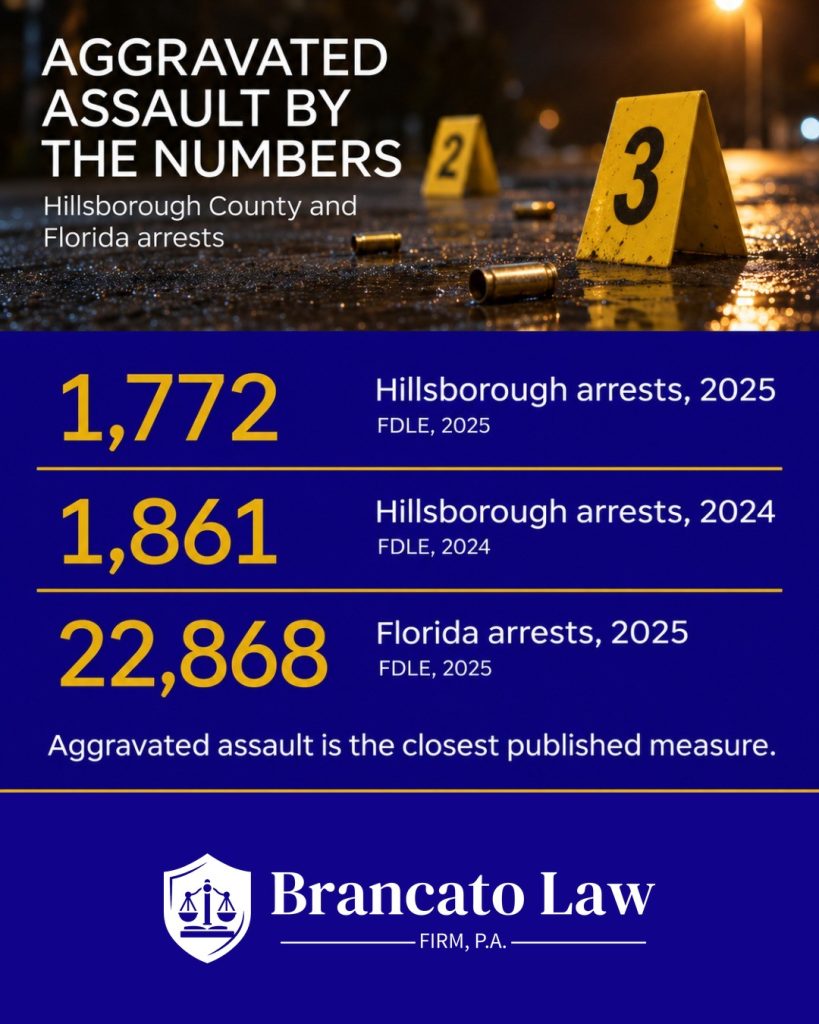
Attempted murder filings are far rarer than aggravated assault arrests, but they carry much higher stakes. In our experience at The Brancato Law Firm, the charging decision in a 13th Judicial Circuit shooting case often turns on what the accused said to police in the first hours, which is why early silence and early counsel matter.
What happens after an attempted murder arrest in Hillsborough County?
After an arrest in Hillsborough County, the accused person is held at the Orient Road Jail and sees a judge at first appearance within 24 hours. Bond is often the first fight. Under Article I, Section 14 of the Florida Constitution, a person charged with a capital offense or an offense punishable by life can be held without bond when “the proof of guilt is evident or the presumption is great.”
Because a firearm usually turns attempted first-degree murder into a life felony, many people charged in Hillsborough County face a no-bond hold. The defense can request a bond hearing where, under State v. Arthur, 390 So. 2d 717 (Fla. 1980), the State carries the burden of showing that the proof is evident or the presumption great. Our attorneys use that hearing both to seek release and to see the State’s evidence early. Pretrial services supervision is not available in Hillsborough County, though some nearby counties offer it, so a release plan usually depends on family support, electronic monitoring, and conditions the defense proposes. Our Hillsborough County criminal defense attorney page explains the local process.
| Stage | What happens | What our attorneys do |
|---|---|---|
| Arrest and booking | The accused is taken to the Orient Road Jail | Advise silence and stop any interview |
| First appearance (within 24 hours) | A judge reviews probable cause and bond | Present a release plan or ask for an Arthur hearing |
| Filing decision | The State Attorney’s Office decides the charge and degree | Present intent, identity, and self-defense evidence before the charge is set |
| Arraignment and discovery | The formal charge is entered and evidence is exchanged | Depose witnesses, test forensics, and prepare any immunity motion |
If police want to talk to you about a shooting or a fight and you have not been arrested, that is the moment to call a lawyer. Our representation before charges are filed can keep a statement from becoming the State’s proof of intent.
Frequently asked questions about attempted murder charges in Florida
Can attempted murder charges be dropped in Florida?
Yes. The State Attorney’s Office can drop or reduce an attempted murder charge when the evidence of identity, intent, or self-defense is weak, and a judge can dismiss it after a successful Stand Your Ground immunity hearing. Our attorneys at The Brancato Law Firm press for those outcomes by presenting the defense evidence before the State locks in its theory, often through our pre-file advocacy.
Can you be charged with attempted murder in Florida if no one was hurt?
Yes. Section 777.04 requires only an act toward the murder that failed, so a missed shot can support the charge. The Brancato Law Firm often uses the lack of injury as evidence against premeditation, as the court did in White v. State when it reduced two counts to attempted second-degree murder.
What is the difference between attempted murder and aggravated battery in Florida?
Attempted murder requires proof of the mental state for murder, while aggravated battery requires only an intentional touching or striking that causes great bodily harm or involves a deadly weapon. Because aggravated battery is a second-degree felony under section 784.045, Florida Statutes, our team at The Brancato Law Firm often argues that the facts fit aggravated battery rather than an attempt to kill.
Can you get bond on an attempted murder charge in Hillsborough County?
Sometimes. A person charged with a life felony, such as attempted first-degree murder with a firearm, can be held without bond if the State meets the Arthur standard, while other attempted murder charges must receive reasonable bond conditions. Lawyers from The Brancato Law Firm prepare the release plan and witnesses before the hearing, because a weak first presentation is hard to undo; our homicide defense team handles these hearings regularly.
Does Stand Your Ground apply to attempted murder charges in Florida?
Yes. Section 776.032 gives immunity from prosecution to a person who used force permitted by Florida’s self-defense laws, including in cases charged as attempted murder. Before an immunity hearing, The Brancato Law Firm gathers the 911 calls, video, and scene evidence that show who was the aggressor.
Is attempted murder a life sentence in Florida?
It can be. Attempted first-degree murder becomes a life felony when a weapon or firearm was used, and attempted felony murder during a listed felony such as robbery is punishable by up to life under section 782.051(1); without a weapon, attempted first-degree murder carries up to 30 years. The Brancato Law Firm challenges the weapon facts and the felony murder theory first, because those facts decide whether life is on the table.
Talk to a Tampa attempted murder defense attorney
Statements, video, and phone data in a shooting case are freshest in the first days after the event, and the bond hearing comes fast. Our attorneys will start building the intent and self-defense record right away, so call The Brancato Law Firm, P.A., founded by Tampa Criminal Defense Attorney Rocky Brancato, at (813) 727-7159. You can call us at any hour, and our office is two blocks from the courthouse. Our firm has Spanish-speaking staff, and attorney Jean-Luc Adrien speaks Spanish, Haitian Creole, and French. For more about our defense strategies, visit our Homicide Defense page, and see our complete guide to homicide charges in Florida.
The Brancato Law Firm, P.A.
620 E. Twiggs Street, Suite 205, Tampa, FL 33602
(813) 727-7159
Serving Hillsborough, Pinellas, and Pasco Counties
The Brancato Law Firm, P.A. is a Tampa-based criminal defense practice. We are not affiliated with any other Brancato-named law firms.
Visit Us

Tampa, FL 33602

Contact Us Now
Free Legal Consultation (813) 727-7159
