- Free Consultation 24/7: (813) 727-7159 Tap Here To Call Us


From First DUI to Death Penalty



What Are the Gun Crime Laws in Florida?



Completely rewritten and updated September 1, 2026. Originally published February 22, 2026
| Key Takeaway: Florida gun law has transformed: concealed carry no longer requires a permit (2023), and a 2025 appellate ruling declared the open-carry ban unconstitutional. But the gun crimes that remain are punished harder than almost anything else in Florida law — carrying while ineligible is a felony, improper exhibition is a jailable misdemeanor, felon in possession carries a 3-year mandatory minimum for actual possession, and 10-20-Life adds decades when a gun appears in a listed felony. Knowing which rules survived the changes is the difference between a right and a charge. |
I’m Rocky Brancato, founder of The Brancato Law Firm, P.A., a Tampa criminal defense firm. I taught search and seizure at the police academy, and most of the gun cases our attorneys defend begin exactly there — with a stop, a frisk, or a car search that has to survive the Fourth Amendment before any gun charge can.
Can You Carry a Concealed Gun Without a Permit in Florida?
Yes — since July 1, 2023, Florida is a permitless-carry state. Under section 790.01, Florida Statutes, a person may carry a concealed weapon or firearm if they are either licensed or unlicensed but otherwise satisfy the criteria for receiving and keeping a concealed-carry license — essentially, an adult who could lawfully get the license may carry without ever applying for it.
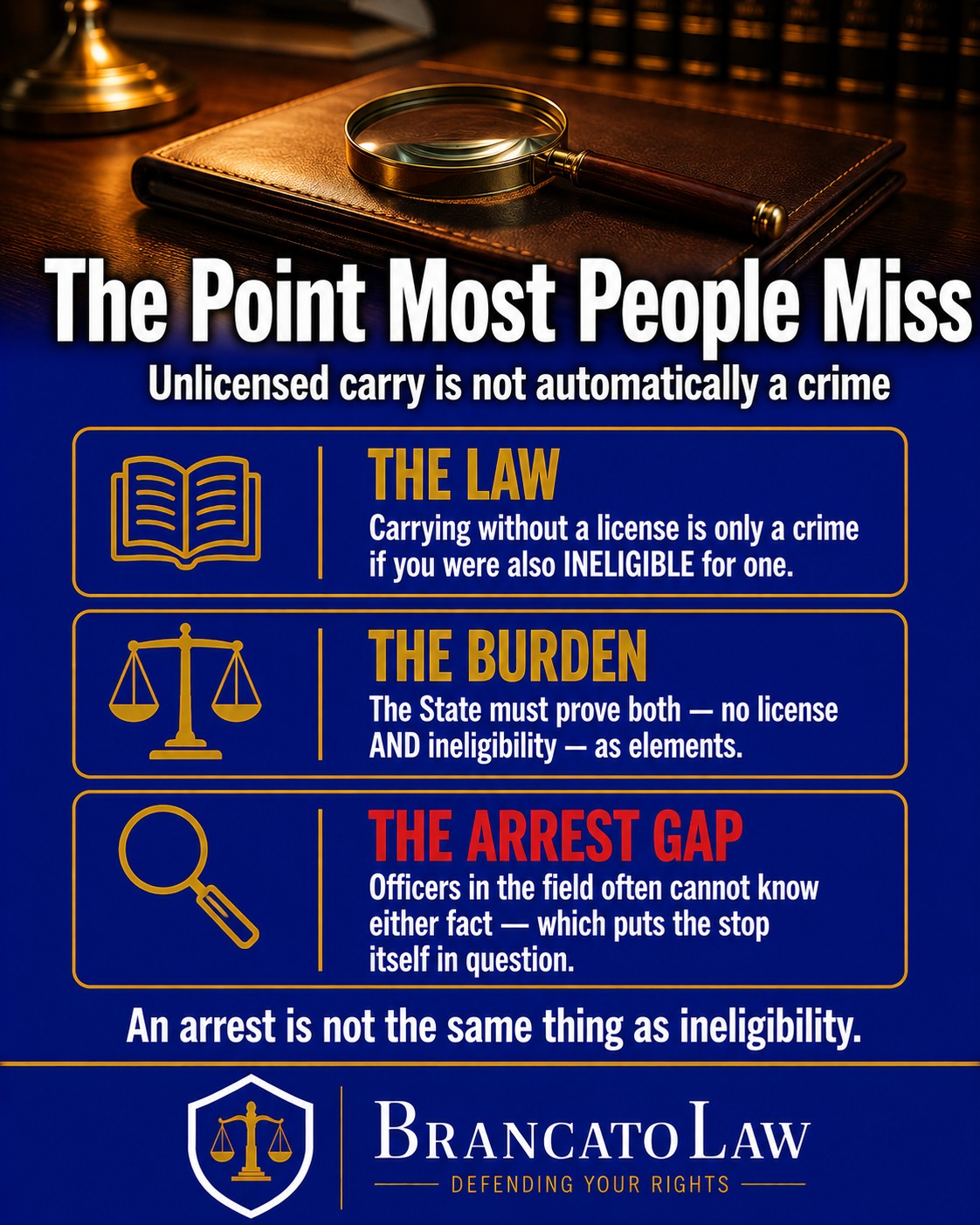
The crimes that remain: a person who is unlicensed and ineligible for a license commits a first-degree misdemeanor for carrying a concealed weapon, and a third-degree felony — up to five years — for carrying a concealed firearm. And here is what the arrest reports rarely mention:
| The defense point most people miss: carrying without a license is only a crime if you were also INELIGIBLE for a license — and the State must prove both, as elements of the offense. An arrest is not the same thing as ineligibility. |
Section 790.01(4) puts that burden expressly on the State: it must prove, as elements, both that you were unlicensed and that you were ineligible under the license criteria. Officers in the field often cannot know either fact — which affects not just the charge but the legality of the stop itself. The statute even contains a hurricane-state exception: lawful gun owners may carry concealed while evacuating during the first 48 hours of a mandatory evacuation order.
Is Open Carry Legal in Florida Now?
As of late 2025, yes — for people who may lawfully possess firearms. In McDaniels v. State, No. 1D2023-0533 (Fla. 1st DCA Sept. 10, 2025), Florida’s First District held the state’s decades-old open-carry ban, section 790.053, unconstitutional under the Second Amendment: applying the U.S. Supreme Court’s Bruen test, the court found no historical tradition supporting a categorical ban, declaring that “[t]he Constitution protects the right to carry arms openly for self-defense.” The Attorney General directed that the ruling be honored statewide, and other districts have since acknowledged it. We broke the decision down in detail — including what it does not change — in our guide to Florida’s 2025 open-carry ruling.
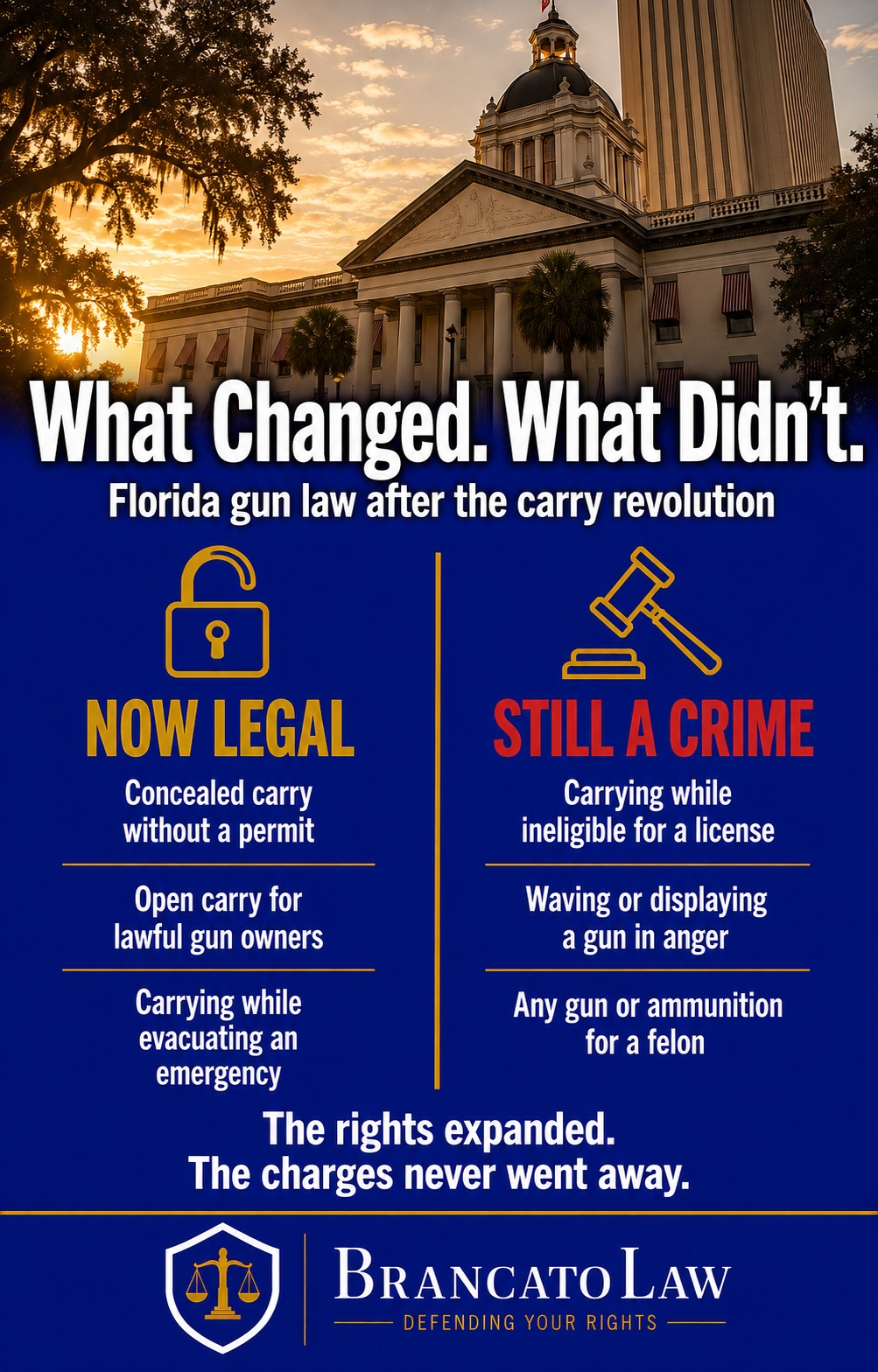
The critical caveats: McDaniels protects ordinary, law-abiding adults. It does not restore gun rights to convicted felons or others prohibited from possession, it does not eliminate location restrictions, and it does not license waving a gun around — which brings us to the charge that has quietly become the workhorse of Tampa Bay gun prosecutions.
What Is Improper Exhibition of a Firearm?
Under section 790.10, Florida Statutes, exhibiting a firearm or other weapon “in a rude, careless, angry, or threatening manner,” in the presence of one or more persons and not in necessary self-defense, is a first-degree misdemeanor — up to a year in jail. In the permitless-carry era, this is the charge that turns a traffic dispute, a neighbor feud, or an argument in a parking lot into a criminal case: carrying the gun was legal; how it was displayed is what gets charged.
The defense terrain is favorable. “Rude, careless, angry, or threatening” is in the eye of an alarmed complainant; the statute itself excludes displays in necessary self-defense; and the line between lawful open carry, a defensive display, and improper exhibition is now genuinely unsettled after McDaniels. Where the display escalates into a charge of aggravated assault, remember what our assault guide explains: aggravated assault was removed from 10-20-Life in 2016, so the automatic firearm minimums people fear do not apply to that charge.
What Is Felon in Possession of a Firearm?
The most unforgiving gun crime in Florida. Under section 790.23, Florida Statutes, a convicted felon may not own or have in his or her “care, custody, possession, or control” any firearm, ammunition, or electric weapon — and the same ban reaches people found delinquent of felony-level acts who are under 24. It is a second-degree felony punishable by up to 15 years, and under the 10-20-Life statute, actual possession carries a 3-year mandatory minimum.
Three battlegrounds decide these cases. First, actual versus constructive possession: a gun in a shared car or house is not automatically “possessed” by the felon in the room — constructive possession requires proof of knowledge and dominion, it is hotly litigable, and the 3-year minimum attaches only to actual possession. Second, the search: these charges almost always begin with a stop or search that can be challenged. Third, the predicate: the ban does not apply if civil rights and firearm authority have been restored or the record was expunged — and whether an out-of-state disposition even qualifies as a “conviction” is a legal question worth litigating. Courts are also actively wrestling with Second Amendment challenges to felon-possession bans after Bruen; that litigation is moving, and preserving the issue can matter.
What Is Florida’s 10-20-Life Law?
Section 775.087(2), Florida Statutes imposes escalating mandatory minimums when a firearm is involved in one of its enumerated felonies:
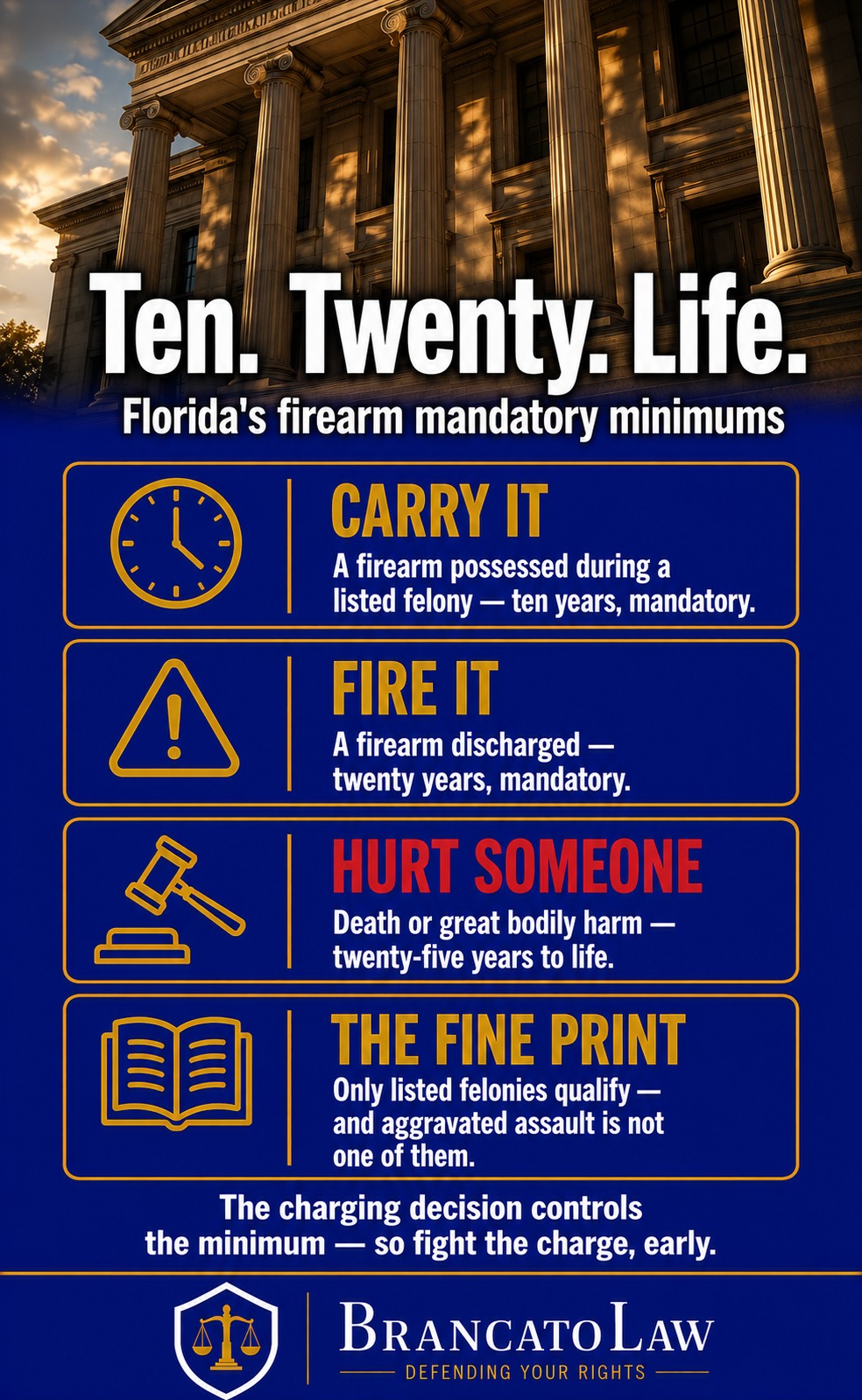
| Firearm conduct during a listed felony | Mandatory minimum |
|---|---|
| Actual possession of a firearm | 10 years |
| Discharge of a firearm | 20 years |
| Discharge causing death or great bodily harm | 25 years to life |
| Felon in actual possession of a firearm (any context) | 3 years |
The enumerated felonies include murder, robbery, burglary, kidnapping, aggravated battery, carjacking, home-invasion robbery, drug trafficking, and others — but not aggravated assault, which the Legislature removed in 2016. These minimums strip judges of discretion, which transfers all the power to the charging decision — and that is precisely where early defense work pays: whether the felony charged is actually a listed one, whether possession was “actual,” and whether the discharge caused the harm are all questions that decide decades.
Where Are Guns Still Prohibited?
Permitless carry and McDaniels changed who may carry and how — not where. The license statute’s list of prohibited places (schools and school events, courthouses, polling places, bars’ alcohol-service areas, and more) still applies to carriers, licensed or not, and separate statutes cover school zones and other sensitive locations. Location-based gun charges are technical, and signage, boundaries, and knowledge requirements all matter — do not assume a place restriction was valid just because a citation says so.
How Do We Defend Gun Charges?
We start with the stop. Most Tampa Bay gun cases begin with a traffic stop, a street encounter, or an anonymous tip — and after permitless carry, the sight of a firearm, without more, is a weak foundation for a detention. I taught officers this area of law at the police academy; our attorneys use that training to find the constitutional defects in how the gun was found. From there: the State’s burden to prove license ineligibility as an element; actual-versus-constructive possession in every multi-occupant case; the necessary-self-defense exclusion in exhibition cases; predicate and restoration issues in felon-possession cases; and the charging-precision fights that keep 10-20-Life minimums out of the case. Gun charges carry the harshest math in Florida sentencing — the defense has to start before the math does.
What Should You Do If You Are Arrested on a Gun Charge?
Say nothing about the gun — not whose it is, not why it was there, not that you “didn’t know it was still in the bag.” Possession cases are built on statements more often than fingerprints. Then move fast: the stop and search that produced the firearm are the foundation of the case, and the video, witnesses, and dispatch records that test them are freshest in the first weeks. If you are a prior felon, bring your complete history — including any rights restoration — to counsel immediately, because the difference between a defensible case and a 3-year minimum can be one document. Our attorneys evaluate the search first, the possession theory second, and the plea posture last.
Frequently Asked Questions About Florida Gun Crimes
Do I need a permit to carry a gun in Florida?
Not for concealed carry, since July 1, 2023 — anyone who meets the criteria to get a concealed-carry license may carry without one. Carrying while ineligible remains a crime (a third-degree felony for a concealed firearm), and the license itself still has benefits, including reciprocity in other states. Our attorneys still see arrests of eligible carriers; eligibility is an element the State must prove, and we hold it to that.
Is open carry legal in Florida?
Yes, as of the First District’s September 2025 decision in McDaniels v. State declaring the open-carry ban unconstitutional — a ruling honored statewide. It applies to people who may lawfully possess firearms, it leaves location restrictions intact, and it does not protect angry or threatening displays, which remain chargeable as improper exhibition. Our detailed guide to the ruling covers what changed and what did not.
Can a convicted felon ever have a gun again in Florida?
Only after civil rights and firearm authority are restored through clemency, or if the record was expunged under the specific statute — otherwise possession of a firearm or even ammunition is a second-degree felony. Whether a particular old disposition actually qualifies as a predicate conviction is a genuine legal question, and The Brancato Law Firm, P.A. examines it in every felon-possession case.
What is the penalty for carrying a concealed firearm without being eligible?
A third-degree felony — up to five years in prison. But the State must prove both that you were unlicensed and that you were ineligible for a license, as elements of the crime. Many arrests are made without officers knowing either fact, which creates both trial defenses and suppression issues.
Does pulling a gun trigger 10-20-Life?
Displaying a gun, without firing it, is typically charged as improper exhibition (a misdemeanor) or aggravated assault (a felony) — and aggravated assault is not on the 10-20-Life list. The 10-, 20-, and 25-to-life minimums attach when a firearm is possessed or discharged during one of the statute’s enumerated felonies, like robbery or burglary. Which charge gets filed is a decision our attorneys work to influence early.
Can gun charges be dismissed?
Regularly — gun cases rise and fall on the stop and search, and a suppressed firearm usually ends the prosecution. Possession theories fail in shared spaces, eligibility elements go unproven, and self-defense excludes exhibition charges. The Brancato Law Firm, P.A. defends firearm cases throughout Tampa Bay — call (813) 727-7159 for a free, confidential review before you talk to anyone about the gun.
For more about our defense strategies, visit our Hillsborough County Criminal Defense Attorney page.
Related reading: Florida’s 2025 Open-Carry Ruling: What You Need to Know · What Is Assault in Florida? · What Is Robbery in Florida? · What Is Burglary in Florida? · What to Do After Being Arrested in Tampa, Florida
Florida Gave You More Gun Rights — and Kept Every Gun Charge
If you have been arrested on a firearm charge in Hillsborough, Pinellas, or Pasco County, you are caught in the gap between a state that just expanded carry rights and prosecutors still charging every gun they find. Call the attorneys of The Brancato Law Firm, P.A. — founded by Tampa Criminal Defense Attorney Rocky Brancato — at (813) 727-7159 before you give a statement. The search that found the gun is the case; let us test it while the evidence is fresh.
The Brancato Law Firm, P.A.
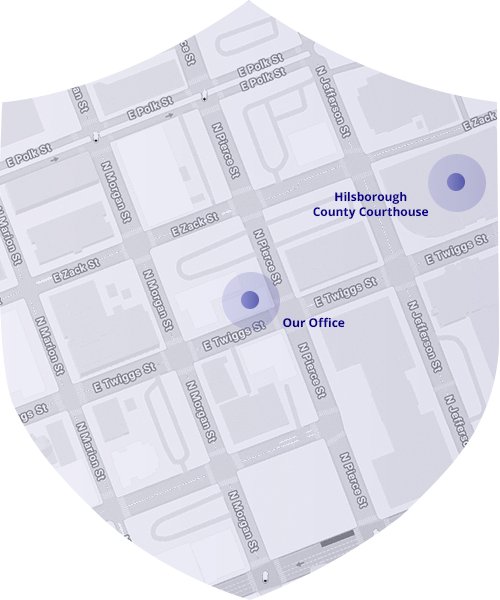
620 E. Twiggs Street, Suite 205, Tampa, FL 33602
(813) 727-7159
Serving Hillsborough, Pinellas, and Pasco Counties
The Brancato Law Firm, P.A. is a Tampa-based criminal defense practice. We are not affiliated with any other Brancato-named law firms.
Visit Us
Tampa, FL 33602
Contact Us Now
Free Legal Consultation (813) 727-7159