

From First DUI to Death Penalty



How to Fight a Discharging a Firearm in Public Charge in Florida? (2026)


To fight a discharging a firearm in public charge in Florida, the defense holds the State to the exact location and mental state that section 790.15 requires: a knowing discharge in a public place, on or over a paved public road, or over occupied premises, or a reckless or negligent discharge outdoors on residential property. Firing from a backyard into an empty field, or a shot fired in lawful defense of life or property, may not be a crime under the statute at all. The basic offense is a first-degree misdemeanor punishable by up to one year in jail, but knowingly firing from a vehicle within 1,000 feet of a person is a second-degree felony punishable by up to 15 years in prison.
If a neighbor called in “shots fired” from your yard on New Year’s Eve, or police found shell casings near your car after an argument, the charge you face depends on where the bullet went and where you were standing. I’m Rocky Brancato, founder of The Brancato Law Firm, P.A., a Tampa criminal defense firm, and a former police academy instructor who has spent more than 25 years in Hillsborough County courtrooms and tried more than 150 jury trials to verdict. Our attorneys start every discharge case by pinning down the location of each shot, because section 790.15 punishes some places and not others.
What Is Discharging a Firearm in Public in Florida?
Discharging a firearm in public is the Florida crime of knowingly firing a gun in a public place, on or over a paved public road, or over occupied premises, defined in section 790.15, Florida Statutes. The same section also makes it a crime to recklessly or negligently fire a gun outdoors on property used primarily as a dwelling or zoned exclusively for residential use, to fire from a vehicle within 1,000 feet of a person, to direct someone else to fire from a vehicle, and to recreationally shoot in a densely residential area. Our Tampa gun crimes attorney team sees these charges after holiday celebrations, neighborhood disputes, and road-rage incidents.
Section 790.15 is aimed at the shot itself, not at a target. If the State claims the bullet went at or into a building or an occupied car, prosecutors usually add a separate second-degree felony charge, which our post on fighting a shooting into a dwelling or vehicle charge explains.
What Are the Penalties for Discharging a Firearm in Florida?
The penalty for discharging a firearm in Florida ranges from a first-degree misdemeanor to a second-degree felony, depending on which subsection applies. Under section 775.082 and section 775.083, a first-degree misdemeanor carries up to one year in jail and a $1,000 fine, a third-degree felony up to five years in prison and a $5,000 fine, and a second-degree felony up to 15 years in prison and a $10,000 fine.
| Subsection | Conduct | Mental state | Degree and maximum |
|---|---|---|---|
| 790.15(1) | Firing in a public place, on the right-of-way of a paved public road, or over a paved public road or occupied premises | Knowingly | First-degree misdemeanor: up to 1 year in jail and a $1,000 fine |
| 790.15(1) | Firing outdoors on property used primarily as the site of a dwelling or zoned exclusively for residential use | Recklessly or negligently | First-degree misdemeanor: up to 1 year in jail and a $1,000 fine |
| 790.15(2) | An occupant of a vehicle firing from the vehicle within 1,000 feet of any person | Knowingly and willfully | Second-degree felony: up to 15 years in prison and a $10,000 fine |
| 790.15(3) | A driver or owner of a vehicle directing another person to fire from the vehicle | Knowingly | Third-degree felony: up to 5 years in prison and a $5,000 fine |
| 790.15(4) | Recreational shooting outdoors, including target shooting, in a primarily residential area with one or more dwelling units per acre | Knows or reasonably should know the area is residential | First-degree misdemeanor: up to 1 year in jail and a $1,000 fine |
A felony conviction under subsection (2) or (3) carries consequences beyond the sentence. Under section 790.23, a person convicted of a felony in Florida may not possess a firearm or ammunition, so a plea to the felony count ends lawful gun ownership. A misdemeanor conviction under subsection (1) or (4) does not trigger that ban by itself, which is one reason the subsection charged matters so much in negotiations.
What Must Prosecutors Prove for a Discharging a Firearm Charge?
Prosecutors must prove the exact place and the exact mental state written into the subsection they charged. The statute lists several separate ways to commit the misdemeanor, and evidence that fits one does not prove another.
| Charged theory | What the State must prove | Common defense question |
|---|---|---|
| Public place | A knowing discharge in a place open to the public | Was the spot private property, such as a fenced yard or a closed work site? |
| Paved public road | The road was both paved and open to the public, and the shot was on or over its right-of-way | Is there proof the road is public, or only that it is paved? |
| Occupied premises | The shot went over occupied premises | Which way was the gun pointed, and was anyone in the buildings? |
| Residential property | A reckless or negligent discharge outdoors on property used as a dwelling or zoned residential | Was the conduct careless, or was it a lawful act or a pure accident? |
| From a vehicle | The person was an occupant, fired knowingly and willfully, and someone was within 1,000 feet | Who fired, from where, and how far away was the nearest person? |
How Do Our Attorneys Fight a Discharging a Firearm Charge?
Our attorneys fight discharge charges by matching the evidence against the precise words of the statute, then testing identity, intent, and any lawful reason for the shot. These are the defenses that come up most often.
- The shot was not in a place the statute covers. In L.A.T. v. State, No. 5D19-1357 (Fla. 5th DCA June 19, 2020), a teenager fired a gun at a wastewater treatment plant that had buildings, a pond, a wooded area, and a paved road. The Fifth District reversed because the State proved the road was paved but offered no evidence it was “accessible to the public,” and because “All of the evidence indicated that L.A.T. fired away from the occupied buildings and into an empty wooded area.” The court ordered the count dismissed.
- The State charged the wrong subsection. In McClan v. State, No. 4D2024-2954 (Fla. 4th DCA Dec. 3, 2025), a woman’s holstered gun went off during a shoving match in an apartment-complex parking lot in Palm Beach County and struck her daughter. The State charged recreational discharge under subsection (4) but tried the case as a reckless or negligent discharge under subsection (1). The Fourth District held she “was convicted of an uncharged crime” and reversed. Our attorneys read the charging document against the State’s theory from the first day.
- Lawful defense of life or property. Section 790.15 states that it “does not apply to a person lawfully defending life or property.” When a shot was fired to stop an attack, our attorneys build the self-defense record under section 776.012 with 911 audio, video, and witness statements, and raise it before trial.
- Accident is not the same as recklessness. The residential-property part of subsection (1) requires reckless or negligent conduct, and the recreational-shooting subsection expressly does not apply “To a person who accidentally discharges a firearm.” A malfunction or an unintended discharge while the gun was being handled safely is a factual defense our attorneys develop with a firearms expert.
- Distance and identity in vehicle cases. Subsection (2) requires proof that the person was an occupant who fired knowingly and willfully with someone within 1,000 feet. Our attorneys check who was in the car, where each person sat, gunshot residue results and their limits, and actual measured distances rather than an officer’s estimate.
- Suppression and statements. Many discharge cases rest on a gun found in a car or a statement like “I just fired into the air.” If the search lacked a warrant or a valid exception, or the statement followed custodial questioning without Miranda warnings, our attorneys move to suppress it.
- Negotiation. When the facts are mixed, our attorneys negotiate to keep a felony vehicle charge from going forward, or to resolve a misdemeanor with a withhold of adjudication or a dismissal after conditions are met.
Is Celebratory Gunfire Illegal in Florida?
Yes. Firing a gun into the air to celebrate is usually a first-degree misdemeanor under section 790.15(1) when it happens in a public place or over occupied premises, or under the residential-property provisions when it happens in a yard. The danger is documented. A CDC investigation of New Year’s Eve celebratory gunfire in Puerto Rico, published in the Morbidity and Mortality Weekly Report in 2004, found that bullets from probable celebratory gunfire caused 19 injuries, including one death from a head injury, in a single 48-hour period from December 31, 2003, to January 1, 2004.
Tampa police treat holiday gunfire as an enforcement priority. In its December 27, 2023 announcement of Operation Countdown to Safety, the Tampa Police Department said officers would focus on “holding those who shoot celebratory gunfire into the air accountable.” In our experience, holiday discharge arrests in Tampa are often built on a neighbor’s 911 call and casings found in a yard, so the first questions are who fired, from where, and in what direction.
Can You Be Convicted Under Two Parts of Section 790.15 for One Shot?
Generally no for subsections (1), (2), and (3), but yes when the second charge comes from a different statute. In Valdes v. State, 3 So. 3d 1067 (Fla. 2009), a driver fired four or five shots at an occupied car after an argument. The Florida Supreme Court described subsections 790.15(1), (2), and (3) as “explicitly degree variants of the same offense,” which under section 775.021(4)(b)2. bars stacking convictions under more than one of them for the same act. The court upheld separate convictions for discharging from a vehicle under section 790.15(2) and shooting into an occupied vehicle under section 790.19, because those offenses sit in separate statutes.
How Are Discharge Cases Handled in Hillsborough County?
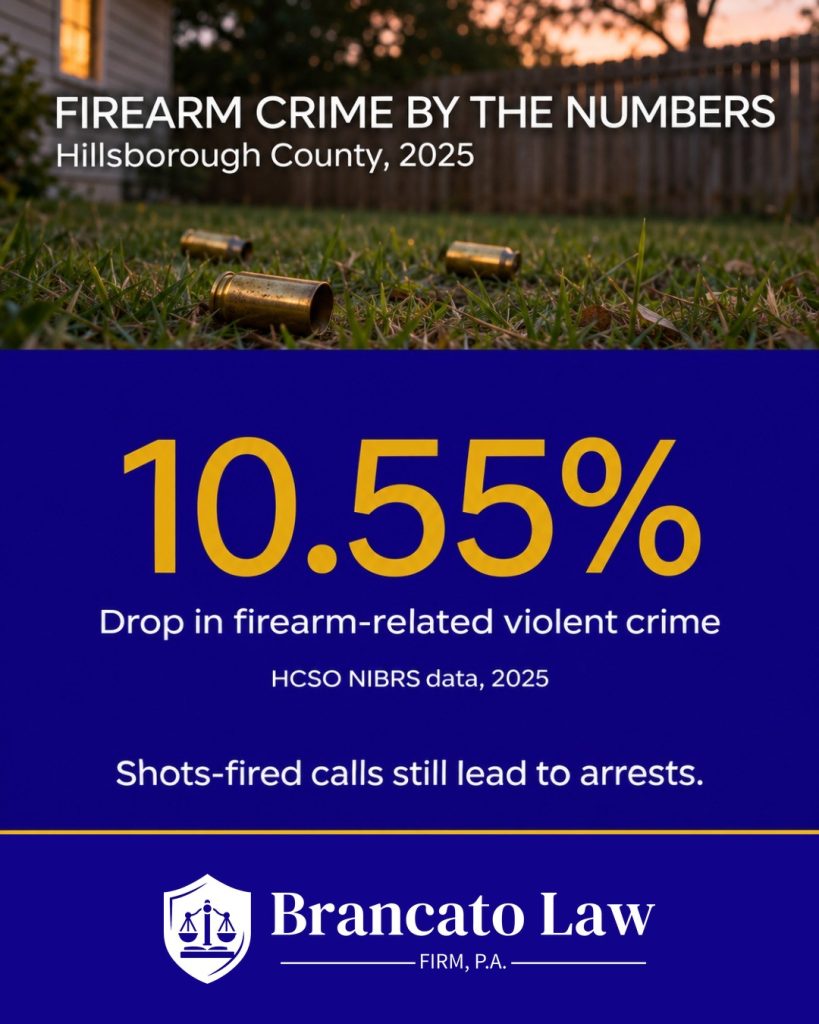
In Hillsborough County, a misdemeanor discharge charge under subsection (1) or (4) is prosecuted in county court, while a felony charge under subsection (2) or (3) is prosecuted in the circuit court of the 13th Judicial Circuit. Firearm-related violent crime declined 10.55% in 2025, according to the Hillsborough County Sheriff’s Office’s 2025 NIBRS crime data, but in our practice a shots-fired call still draws an arrest whenever a deputy can tie the casings to a person.
A person arrested on a discharge charge who does not post bond on the schedule sees a judge at first appearance, which in Hillsborough County is held every day of the year by video from the jail, as our guide to Hillsborough first appearance explains. Our Hillsborough County criminal defense attorneys use that hearing to argue for release on reasonable conditions and to begin preserving evidence.
What Should You Do If Police Want to Talk About Shots Fired?
You should not explain the shot to police without a lawyer. Statements such as “I fired into the air” or “I was only scaring them off” can supply the knowing or willful element the State otherwise could not prove, and can turn a misdemeanor investigation into a felony. Our attorneys offer representation before charges are filed and can present a lawful-defense account to the State Attorney’s Office before a charging decision.
Each step of the Florida criminal case process after arrest has deadlines, and doorbell and business video is often overwritten within days, so early preservation requests matter.
Frequently Asked Questions About Discharging a Firearm in Florida
Can a discharging a firearm in public charge be dropped in Florida?
Yes. Prosecutors can drop the charge when they cannot prove the shot happened in a place the statute covers, cannot prove who fired, or when the shot was fired in lawful defense of life or property. The Brancato Law Firm gathers that evidence early and presents it to the prosecutor through pre-file advocacy when the timing allows.
Is it illegal to shoot a gun in your own backyard in Florida?
It can be. Section 790.15(1) makes it a first-degree misdemeanor to recklessly or negligently fire a gun outdoors on property used primarily as a dwelling or zoned exclusively for residential use, and subsection (4) separately bans recreational target shooting in dense residential areas. Our attorneys at The Brancato Law Firm look at the property’s zoning, density, and the direction of fire, because a safe, lawful discharge is not a crime under either provision.
Is firing a warning shot illegal in Florida?
A warning shot can be lawful if the person was justified in using or threatening deadly force, because section 790.15 does not apply to a person lawfully defending life or property. The Brancato Law Firm documents the threat the person faced, since a warning shot fired without a real threat can lead to discharge, improper exhibition, or aggravated assault charges.
Is discharging a firearm from a car a felony in Florida?
Yes. An occupant who knowingly and willfully fires from a vehicle within 1,000 feet of any person commits a second-degree felony under section 790.15(2), and a driver or owner who directs someone else to fire from the vehicle commits a third-degree felony. Our gun crimes defense lawyers in Tampa at The Brancato Law Firm test who fired, who directed it, and the measured distance to the nearest person.
Will a discharging a firearm conviction take away my gun rights in Florida?
A felony conviction under section 790.15(2) or (3) bars firearm and ammunition possession under section 790.23, while a misdemeanor conviction under subsection (1) or (4) does not trigger that ban by itself. The Brancato Law Firm weighs that consequence in every plea discussion, and our post on Florida gun crime laws explains the related weapon offenses.
Can I be charged with discharging a firearm if the gun went off by accident?
You can be charged, but an accident is a defense to the recreational-shooting subsection and can defeat the reckless or negligent element of the residential-property provision. Our attorneys at The Brancato Law Firm often retain a firearms examiner to test the gun for defects, and our post on culpable negligence charges covers the separate charge prosecutors sometimes add when someone is hurt.
For more about our defense strategies, visit our Gun Crimes page.
Before you explain what happened to anyone, call The Brancato Law Firm, P.A., founded by Tampa Criminal Defense Attorney Rocky Brancato, at (813) 727-7159. Our attorneys can start preserving video and 911 records the same day, and you can call us at any hour. Our firm has Spanish-speaking staff, and attorney Jean-Luc Adrien speaks Spanish, Haitian Creole, and French.
The Brancato Law Firm, P.A.
620 E. Twiggs Street, Suite 205, Tampa, FL 33602
(813) 727-7159
Serving Hillsborough, Pinellas, and Pasco Counties
The Brancato Law Firm, P.A. is a Tampa-based criminal defense practice. We are not affiliated with any other Brancato-named law firms.
Visit Us

Tampa, FL 33602

Contact Us Now
Free Legal Consultation (813) 727-7159
