

From First DUI to Death Penalty



How to Fight a Felon in Possession Charge in Florida (2026)


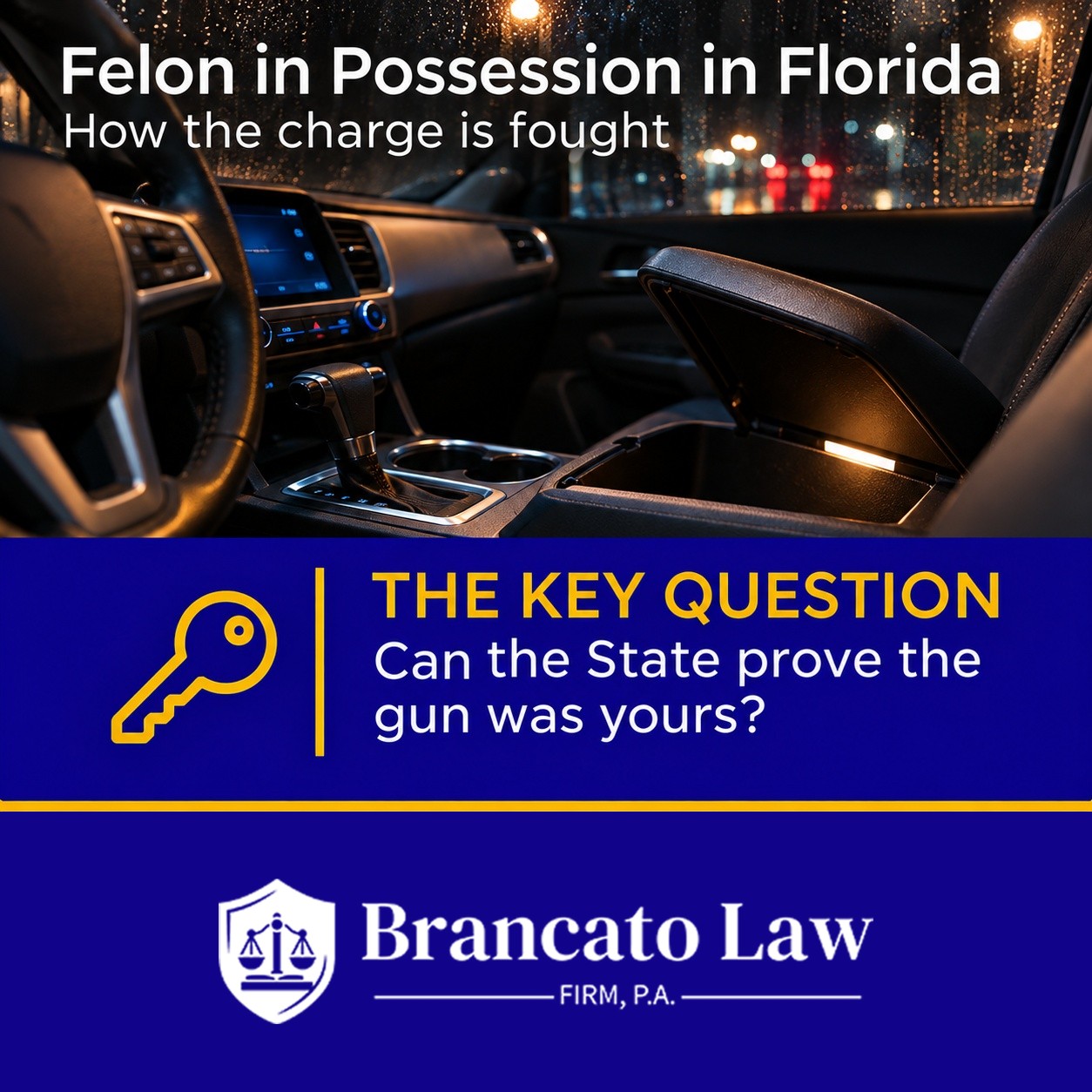
To fight a felon in possession charge in Florida, the defense attacks the two things the State must prove: a qualifying prior felony conviction, and knowing possession of a firearm, ammunition, or electric weapon. The most common defenses are suppressing an illegal stop or search, showing the gun was in a shared car or home with no independent proof it was the accused’s, and challenging the prior conviction itself. The charge is a second-degree felony under section 790.23, Florida Statutes, and a 3-year mandatory minimum applies only when the State proves the person actually possessed the gun.
A prosecutor reviewing a felon in possession arrest asks two questions: can the State prove the prior conviction, and can it prove the gun belonged to this person. I have spent more than 25 years in Hillsborough County courtrooms making the State answer both. I’m Rocky Brancato, founder of The Brancato Law Firm, P.A., a Tampa criminal defense firm, a former police academy instructor who taught officers criminal procedure, and a former Chief Operations Officer of the Hillsborough County Public Defender’s Office, where I oversaw a staff of over 100 attorneys. Our attorneys review the stop, the search, and the prior judgment before the State decides what to file.
What does the State have to prove in a Florida felon in possession case?
The State must prove two elements beyond a reasonable doubt. First, that the person was previously convicted of a felony or falls in another prohibited group. Second, that after that conviction, the person knowingly owned or had care, custody, possession, or control of a firearm, ammunition, or an electric weapon or device. Section 790.23(1), Florida Statutes, applies to anyone convicted of a felony in a Florida court, convicted of a federal felony, or found guilty of an out-of-state felony punishable by more than one year in prison. It also reaches people under 24 with certain juvenile felony findings, which our guide to gun possession after a juvenile felony covers.
Ammunition counts on its own. A single round in a cup holder can support the same second-degree felony as a loaded pistol. Our Tampa gun crimes attorney page covers the other weapons charges that often come with this one.
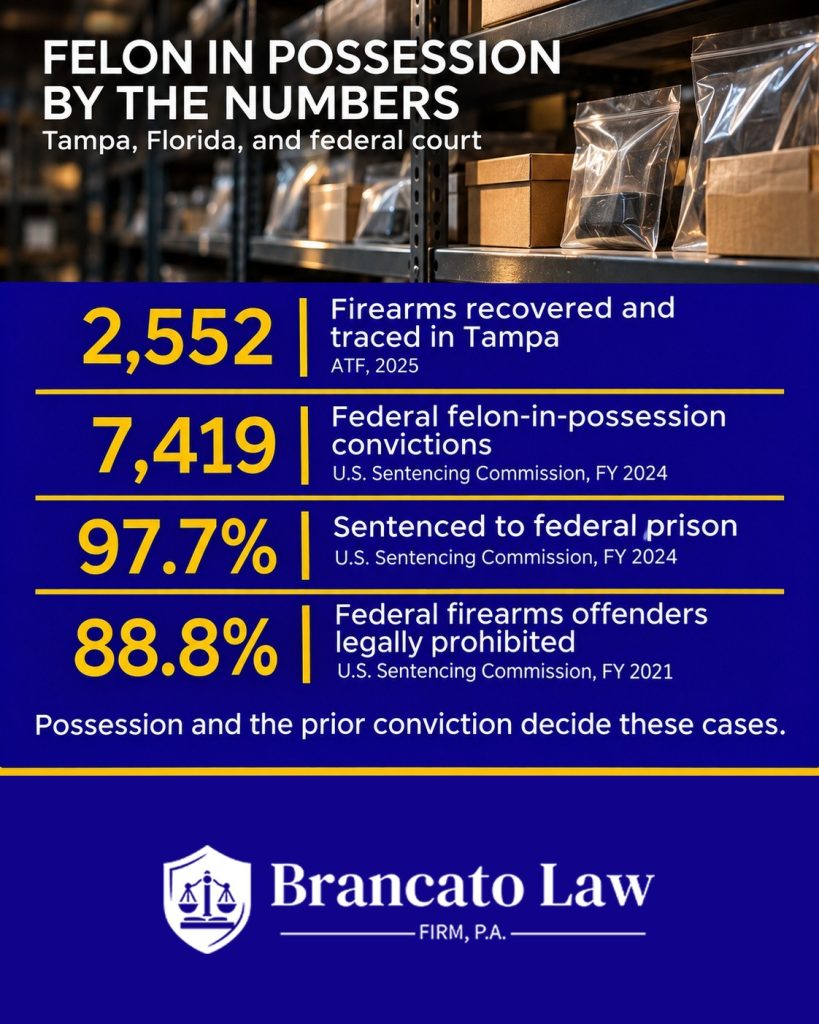
Police in Tampa recover thousands of guns a year. ATF’s Firearms Tracing System recorded 2,552 firearms recovered and traced in Tampa in 2025, out of 35,572 statewide, and any of those recoveries from a person with a felony record can become a section 790.23 case.
When do the 3-year and 10-year mandatory minimums apply?
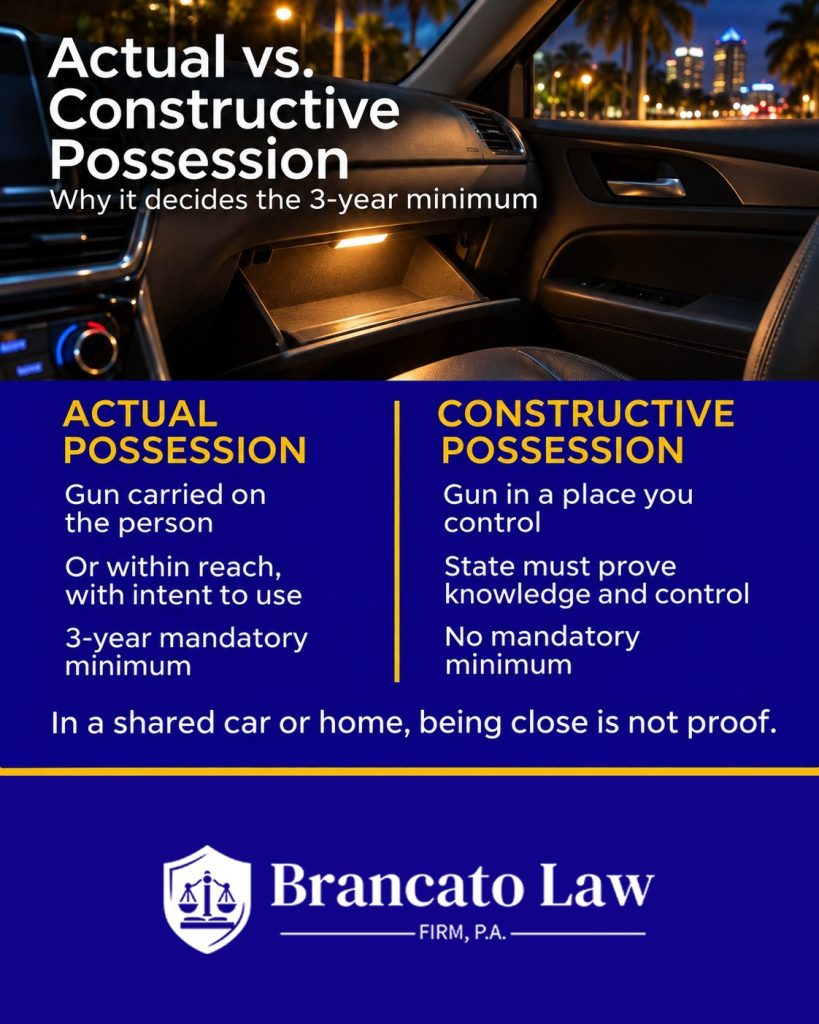
The 3-year minimum applies only when the State proves actual possession, and the 10-year minimum adds a second requirement about the prior felony. Without actual possession, there is no mandatory minimum, and the judge sentences under the Criminal Punishment Code scoresheet.
| Situation | Charge level | Mandatory minimum |
|---|---|---|
| Constructive possession only (gun in a place the person controlled) | Second-degree felony, up to 15 years | None |
| Actual possession | Second-degree felony, up to 15 years | 3 years |
| Actual possession, plus a prior conviction for a felony listed in s. 775.084(1)(b)1. during which the person actually possessed a firearm or destructive device | Second-degree felony, up to 15 years | 10 years |
| The person qualified, or qualifies, for the criminal gang enhancement in s. 874.04 | First-degree felony, up to life | Depends on the facts |
The source of the minimums is section 775.087(2)(a)1.. For those minimums, section 775.087(4) defines possession as carrying the gun on the person, or having it “within immediate physical reach with ready access with the intent to use the firearm during the commission of the offense,” proven beyond a reasonable doubt. That intent language matters in vehicle cases. A gun locked in a glove box or a trunk is often a poor fit for the definition, and when the State cannot prove actual possession, the judge keeps discretion over the sentence. When a minimum does apply, the statute bars a withhold of adjudication.
Federal prosecution is a separate risk. The U.S. Sentencing Commission’s fiscal year 2024 Quick Facts report 7,419 federal convictions under 18 U.S.C. section 922(g), with 97.7% of those people sentenced to prison and an average sentence of 71 months. A 2022 Commission study, What Do Federal Firearms Offenses Really Look Like?, found that 88.8% of people sentenced under the main federal firearms guideline in fiscal year 2021 were prohibited from having a gun, usually because of a felony record.
How do our attorneys fight a gun found in a shared car or house?
When a car or home is shared, the State has to prove with independent evidence that the accused knew about the gun and could control it. The Florida Supreme Court set that rule in Brown v. State, 428 So. 2d 250 (Fla. 1983): in jointly occupied premises, knowledge and the ability to control “must be established by independent proof.” Independent proof usually means fingerprints or DNA on the gun, an admission, or other evidence tying the gun to one person.
Two felon in possession cases show how this works. In Smith v. State, 175 So. 3d 900 (Fla. 1st DCA 2015), deputies found a bag of ammunition in plain view in the cup holder between a driver with a felony record and his passenger in Panama City. The First District reversed his conviction because he did not own the truck, the ammunition sat closer to the passenger, and no fingerprints or other independent proof tied it to him. In Kemp v. State, 166 So. 3d 213 (Fla. 1st DCA 2015), officers found a handgun in the closed console of a rental car in the defendant’s name, next to a receipt with his name on it, but the defense showed other people had driven the car. The court reversed with directions to discharge him.
Our attorneys build the same kind of record. We find out who owned or rented the car, who had the keys, who else lived in the home, and whether the State asked a lab to test the gun for prints or DNA. In one case, attorney Jean-Luc Adrien filed a motion to dismiss for failure to establish actual or constructive possession of a short-barreled rifle, and the client was admitted into a diversion program. Our guide to constructive possession in Florida covers shared spaces in more detail.
Can the stop or the search be challenged?
Yes. If the stop, the frisk, or the search was illegal, a judge can suppress the gun through a motion to suppress, and without the gun the State has no case. Many felon in possession arrests start with a traffic stop for a minor violation. In Rodriguez v. United States, 575 U.S. 348 (2015), the Supreme Court held that a stop “prolonged beyond the time reasonably required” to finish its traffic mission is unlawful without reasonable suspicion, so the minutes between the ticket and the search often decide the motion.
As a former police academy instructor, I taught officers the procedures they are supposed to follow at a stop. One of my first suppression motions involved an officer who wrote that my client failed to maintain a single lane and drove over a concrete curb. I went to the scene and photographed it. There was no curb, and the judge granted the motion. Our attorneys still compare every report with the body camera video and the scene. Our guide to motions to suppress in Florida explains how the hearing works.
What happens at first appearance in Hillsborough County?
A person arrested for felon in possession in Hillsborough County sees a judge at first appearance, usually by video from the jail within 24 hours of arrest. The judge decides whether there is probable cause and sets bond and release conditions, and the State may ask for a high bond or, in some cases, pretrial detention under section 907.041. Hillsborough County does not offer pretrial services supervision as a release option, unlike some nearby counties, so a prepared bond argument matters. In one of our cases, a client arrested for possession of cocaine and possession of a firearm during a felony got low bonds after we argued at first appearance that the facts did not fit the firearm statute, and both charges were later dismissed.
Do not talk about the gun at the hearing or on jail phones. Both can be used as the admission the State needs in a shared space case. After first appearance, the State Attorney’s Office decides what to file, and that is the time to raise a search or possession problem through pre-file advocacy. Our guide to the Florida criminal case process covers each stage, and our Hillsborough County criminal defense page covers the local courts.
How can the prior felony conviction be challenged?
The prior conviction is an element, so the State has to prove it, and the defense can contest it in several ways:
- A withheld adjudication is not a conviction. In Clarke v. United States, 184 So. 3d 1107 (Fla. 2016), the Florida Supreme Court held that a guilty plea to a felony with adjudication withheld does not count as a “conviction” under section 790.23(1)(a), because the State must prove an adjudication of guilt.
- The State must prove the prior belongs to this person. In Ling v. State, 15 So. 3d 914 (Fla. 1st DCA 2009), the court held that a matching name is not enough, and because the arrest fingerprints were kept out of evidence, the felon in possession conviction was reversed and the defendant discharged.
- An out-of-state conviction must have been a felony punishable by more than one year in prison. The prior judgment, the statute it was entered under, and the sentence it allowed all have to be checked.
- A person whose civil rights and firearm authority were both restored is outside the statute under section 790.23(2)(a).
- The jury does not have to hear what the prior was. Under Brown v. State, 719 So. 2d 882 (Fla. 1998), when the defendant offers to stipulate that he is a convicted felon, the court must accept it, and the number and nature of the prior convictions stay out of the trial.
What about restoring gun rights?
Florida restores firearm authority only through executive clemency, a separate process from the criminal case. Our firm does not handle clemency petitions. Our article on whether a convicted felon can own a gun in Florida explains the clemency rules, the exceptions, and the pending Second Amendment challenges. Our firm is not currently offering gun rights restoration services.
Gun possession results from our firm
| Charge | Result | What made the difference |
|---|---|---|
| Possession of a short-barreled rifle, felony cannabis, and paraphernalia | Diversion program, avoiding a felony conviction and likely deportation | Mitigation report, a motion to dismiss for failure to establish actual or constructive possession, and a requested jury instruction on knowledge |
| Possession of cocaine and possession of a firearm during a felony (January 2025) | Both charges dismissed | At first appearance we argued the facts did not fit the firearm statute and secured low bonds |
Past results do not guarantee future outcomes. Every case turns on its own facts.
Felon in possession FAQs
Can felon in possession charges be dropped in Florida?
Yes. Prosecutors drop or reduce these charges when the gun is suppressed, when the State cannot tie it to the accused, or when the prior conviction does not qualify. The Brancato Law Firm raises those problems with the prosecutor before the filing decision through representation before charges are filed.
Is a felon automatically guilty if a gun is found in a car he was driving?
No. If others used the car, the State needs independent proof that he knew about the gun and could control it, and courts reversed convictions in both Smith and Kemp when that proof was missing. Our attorneys at The Brancato Law Firm track down who owned the car, who had the keys, and whether the gun was ever tested for prints or DNA.
Does a withheld adjudication count as a felony conviction for gun possession in Florida?
Not for a Florida case charged under section 790.23(1)(a); Clarke v. United States, 184 So. 3d 1107 (Fla. 2016) held that a withheld adjudication is not a conviction. The Brancato Law Firm pulls the certified judgment in every case, because the disposition on that paper can end the prosecution.
Can a felon be charged for having one bullet in Florida?
Yes. Section 790.23 covers ammunition separately from firearms, so a single round can support the charge. Our attorneys at The Brancato Law Firm apply the same possession defenses to ammunition, as the defendant in Smith did successfully.
Does the 3-year minimum apply if the gun was in the glove box?
Only if the State proves actual possession, which section 775.087(4) defines as carrying the gun or having it within immediate physical reach, with ready access and the intent to use it during the offense. The Brancato Law Firm challenges that intent element in vehicle cases, because without it the judge is not bound by the minimum; our gun crimes defense team handles these sentencing fights.
Can a state felon in possession case be moved to federal court?
Federal prosecutors can bring a separate case under 18 U.S.C. section 922(g), and the U.S. Sentencing Commission reported 7,419 such convictions in fiscal year 2024. The Brancato Law Firm defends the state case and tells clients early when the facts carry federal exposure.
Talk to a Tampa gun crimes defense attorney
For more about our defense strategies, visit our Tampa gun crimes page.
Your next step after a felon in possession arrest is getting the stop, the search, and the prior judgment in front of a defense attorney before the State files. The Brancato Law Firm, P.A., founded by Tampa Criminal Defense Attorney Rocky Brancato, takes these calls at (813) 727-7159, and you can call us at any hour. Our firm has Spanish-speaking staff, and attorney Jean-Luc Adrien speaks Spanish, Haitian Creole, and French.
The Brancato Law Firm, P.A.
620 E. Twiggs Street, Suite 205, Tampa, FL 33602
(813) 727-7159
Serving Hillsborough, Pinellas, and Pasco Counties
The Brancato Law Firm, P.A. is a Tampa-based criminal defense practice. We are not affiliated with any other Brancato-named law firms.
Visit Us

Tampa, FL 33602

Contact Us Now
Free Legal Consultation (813) 727-7159
