- Free Consultation 24/7: (813) 727-7159 Tap Here To Call Us


From First DUI to Death Penalty



Can a Convicted Felon Own a Gun in Florida? What the Law Says in 2026


No. Under Florida Statute 790.23, a convicted felon cannot own, possess, or have in their care, custody, or control any firearm, ammunition, or electric weapon or device. Violating that law is a second-degree felony carrying up to 15 years in prison, and actual possession of the firearm triggers a 3-year mandatory minimum sentence. The ban stays in place unless firearm authority has been restored through executive clemency. A narrow exception also applies to juvenile records that have been expunged under Florida Statute 943.0515(1)(b).
The Brancato Law Firm practices criminal defense exclusively. We defend clients charged with felon in possession of a firearm across Hillsborough, Pinellas, and Pasco Counties. We do not handle clemency petitions or firearm rights restoration. That process is mainly political and only a little bit legal, and the section below explains what we mean by that.
One development is worth watching in 2026: Florida’s Attorney General has told a state appellate court that the categorical ban on nondangerous felons possessing firearms is unconstitutional, in Morgan v. State, No. 1D2025-0377, now pending in the First District Court of Appeal. That case is still pending. Section 790.23 is still being enforced against people arrested today.
What Florida Statute 790.23 Prohibits
Florida’s felon-in-possession law is broad. It is unlawful for any person to own or have in their care, custody, possession, or control any firearm, ammunition, or electric weapon or device, or to carry a concealed weapon, including a tear gas gun or chemical weapon or device, if that person has been:
- Convicted of a felony in any Florida court
- Found to have committed a delinquent act in Florida that would be a felony if committed by an adult (if the person is under 24)
- Convicted of or found to have committed a federal felony (no minimum sentence length required)
- Found guilty of an offense that is a felony in another state, territory, or country and was punishable by more than one year in prison
- Found to have committed a delinquent act in another state, territory, or country that would be a felony punishable by more than one year if committed by an adult (if the person is under 24)
The word “firearm” is defined broadly under Florida Statute 790.001(9) to include any weapon designed to expel a projectile by the action of an explosive, along with frames, receivers, silencers, destructive devices, and machine guns. That same definition contains the exception we discuss below: the term “firearm” does not include an antique firearm unless the antique firearm is used in the commission of a crime.
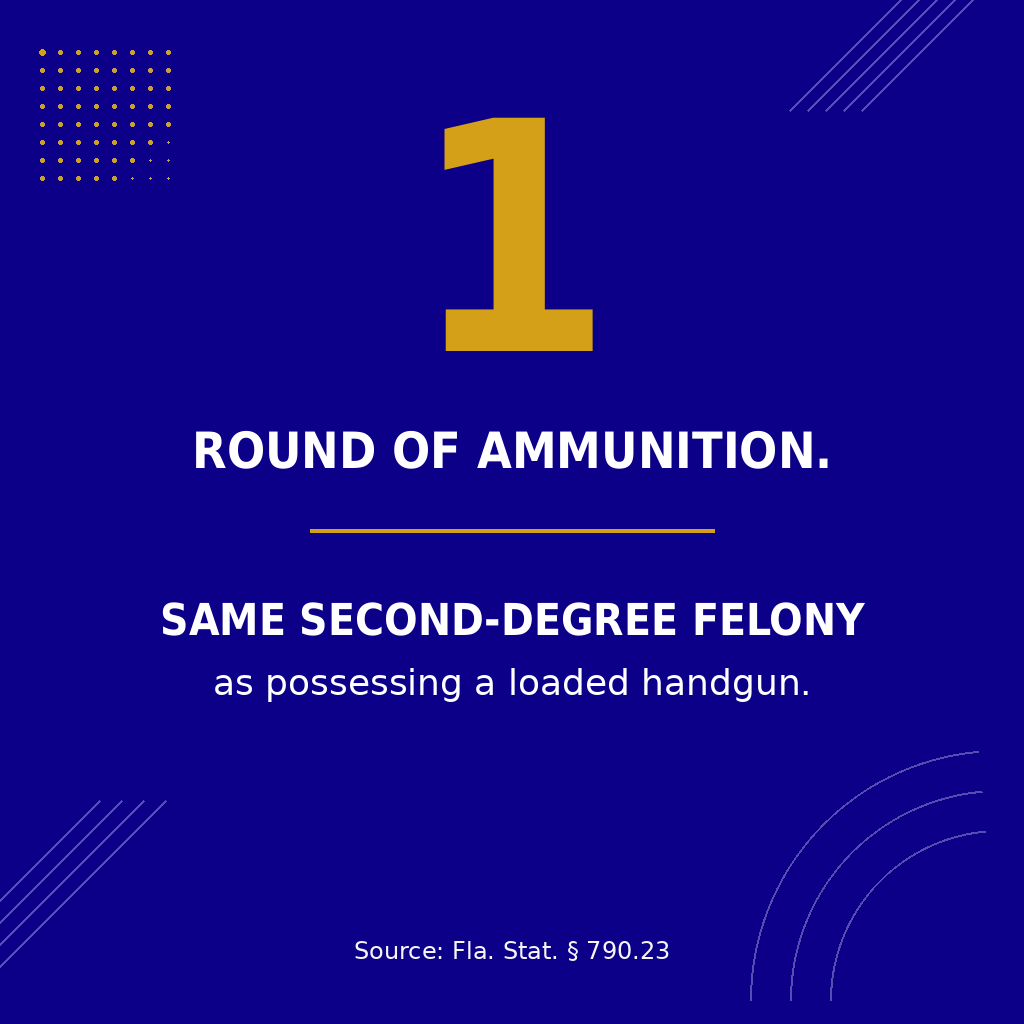
The statute covers ammunition and electric weapons separately. A convicted felon who possesses a single round of ammunition is violating the same law as one who possesses a loaded handgun.
Florida’s broader gun laws also restrict where and how firearms can be carried, even for people who are legally allowed to possess them. Our overview of gun crime laws in Florida covers those restrictions, and we have written separately about carrying at a Buccaneers game.
Penalties for Felon in Possession of a Firearm in Florida
A standard felon-in-possession conviction is a second-degree felony. Depending on the circumstances, the penalties escalate significantly.
| Scenario | Charge Level | Maximum Sentence | Mandatory Minimum |
| Felon in possession (constructive) | 2nd-degree felony | 15 years | None |
| Felon in possession (actual) | 2nd-degree felony | 15 years | 3 years |
| Felon in possession, actual possession, where the defendant has a prior conviction listed in Fla. Stat. § 775.084(1)(b)1 and actually possessed a firearm during that prior felony | 2nd-degree felony | 15 years | 10 years |
| Felon in possession by a person who previously qualified or currently qualifies for the gang enhancement (Fla. Stat. § 790.23(4)) | 1st-degree felony (life) | Life | Varies |
| Possession of a firearm or ammunition by a violent career criminal (Fla. Stat. § 790.235) | 1st-degree felony | 30 years | 15 years |
Under Florida’s 10-20-Life law, Fla. Stat. § 775.087, anyone who actually possessed a firearm during the commission of the offense faces a 3-year mandatory minimum. A prior conviction for one of the felonies listed in Fla. Stat. § 775.084(1)(b)1 pushes that mandatory minimum to 10 years, but only if the defendant actually possessed a firearm or destructive device during that earlier felony as well. If the charge involves gang activity under Section 874.04, Section 790.23(4) makes the offense a first-degree felony punishable by a term of years not exceeding life. And if the defendant meets the violent career criminal criteria, the charge is not Section 790.23 at all. It is Section 790.235, a first-degree felony carrying a 15-year mandatory minimum with no discretionary early release.
Which type of possession the state can prove controls whether a mandatory minimum applies to your case at all.
Actual Possession vs. Constructive Possession
This distinction carries real sentencing consequences, and it is one of the most contested issues in felon-in-possession cases.
| Actual possession | Constructive possession | |
| What the state must prove | The firearm was on your person, or within immediate physical reach with ready access, and you intended to use it during the commission of the offense, all beyond a reasonable doubt | The firearm was in a place you controlled, you knew it was there, and you could exercise dominion and control over it |
| Typical example | A gun in your waistband, in your hand, or on the seat beside you | A gun in the glovebox or under the seat of a car you were driving |
| Maximum sentence | 15 years | 15 years |
| Mandatory minimum | 3 years | None |
The sentencing difference is the reason prosecutors and defense attorneys fight over this. Only actual possession triggers the 3-year mandatory minimum under Section 775.087, and Section 775.087(4) defines actual possession to require that the firearm was within immediate physical reach with ready access and that the defendant intended to use it during the commission of the offense. That intent element is frequently the defense’s strongest argument in reach cases. When the state can prove only constructive possession, the judge keeps discretion over the sentence.
Proximity alone does not establish constructive possession. If you were a passenger in someone else’s vehicle, or if other people had equal access to the place the gun was found, the state has to prove more than your presence near it. Florida’s standard jury instructions require proof that the defendant knew of the firearm and had the ability to control it.
In our experience defending these cases in Hillsborough County, the actual versus constructive question is frequently the central issue at trial. How the firearm was discovered, where it was located, who else had access, and what the defendant said or did not say to officers all feed into that analysis.
Federal Law Bans Felons From Having Guns Too
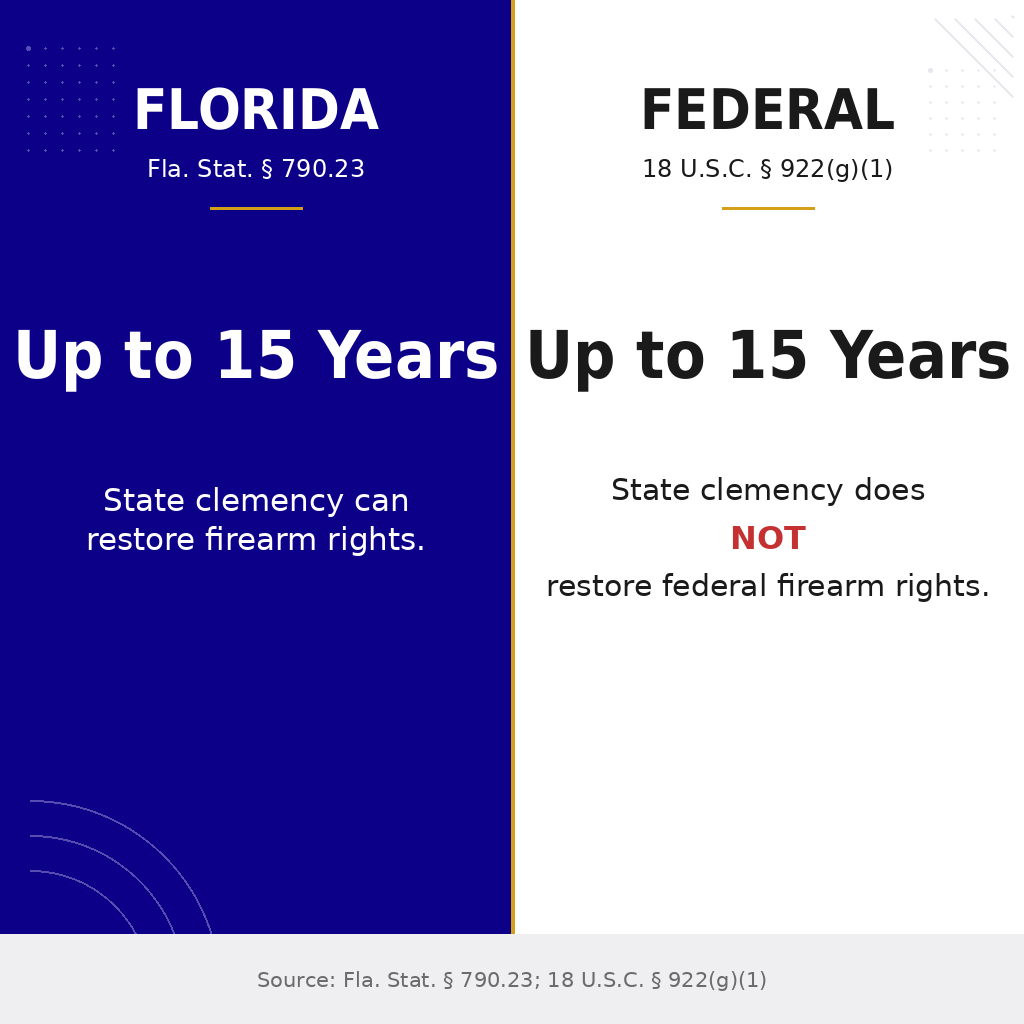
Even if Florida changes its state law, federal law independently prohibits convicted felons from possessing firearms. Under 18 U.S.C. § 922(g)(1), any person convicted of a crime punishable by more than one year of imprisonment is prohibited from possessing any firearm or ammunition that has been shipped or transported in interstate commerce.
A federal felon-in-possession conviction carries up to 15 years in federal prison. Under the Armed Career Criminal Act, 18 U.S.C. § 924(e), three or more prior convictions for violent felonies or serious drug offenses raise the mandatory minimum to 15 years.
Two points about federal law matter here:
- How complete your state restoration is determines whether the federal ban survives it. Florida can restore your state-level right to possess firearms through executive clemency. Under 18 U.S.C. § 921(a)(20), a conviction for which civil rights have been restored is not a conviction for federal purposes unless the restoration expressly provides that the person may not possess firearms. Florida’s plain Restoration of Civil Rights does expressly withhold firearm authority, so the federal ban survives it. A full restoration, meaning civil rights together with Specific Authority to Own, Possess, or Use Firearms, removes the federal disability arising from that Florida conviction. None of this helps with a federal or out-of-state conviction, which only the jurisdiction that entered it can relieve.
- The DOJ reopened federal relief in August 2026. On August 17, 2026, the Justice Department finalized its rule implementing 18 U.S.C. § 925(c) and launched the Federal Firearm Rights Restoration program, administered by the Office of the Pardon Attorney rather than ATF. Applications open to invited candidates on September 25, 2026 and to the public on November 4, 2026, capped at the first 5,000 filings, with a further 500 slots and a $30 application fee opening in early 2027. Relief is individualized and never guaranteed. The rule builds in presumptions against relief: a permanent presumptive bar for violent felonies, ten years for drug trafficking and certain firearms offenses, and five years for most other felonies, measured from completion of every component of the sentence, including restitution. Apart from a presidential pardon, this is the only route for a federal conviction.
Anyone whose state firearm rights have been restored should understand that picking up a firearm can still result in federal prosecution.
Exceptions to Florida’s Felon Gun Ban
Florida’s felon-in-possession law has several exceptions. Some are statutory. Others depend on how the underlying conviction was handled.
- Executive clemency with firearm authority: A grant of Specific Authority to Own, Possess, or Use Firearms (Rules 4.I.F and 5.D of the Rules of Executive Clemency), which is a separate form of clemency from Restoration of Civil Rights, from the Florida Executive Clemency Board lifts the state ban.
- Expunged juvenile record: If your juvenile criminal history record has been expunged under Florida Statute 943.0515(1)(b), Section 790.23(2)(b) exempts you by name. This is a narrow, juvenile-only exception. An adult felony conviction cannot be sealed or expunged in Florida at all. Both Section 943.0585 and Section 943.059 require that adjudication was withheld, which by definition means there was never a conviction.
- Withheld adjudication (adults): A felony charge that resulted in a withhold of adjudication was never a formal conviction under Florida law. Section 790.23 applies to people who have been convicted, so a withheld adjudication for an adult does not trigger the ban. The Florida Supreme Court settled this in Clarke v. United States, 184 So. 3d 1107 (Fla. 2016), where a man charged federally after a Florida guilty plea with adjudication withheld asked whether that plea counted as a conviction. The court held it did not, and the Eleventh Circuit then vacated his federal conviction. Two limits matter. The exception applies to Florida convictions under subsection (1)(a). Subsections (1)(c) and (1)(e) reach a person “found to have committed” a federal felony or “found guilty” of an out-of-state felony, which is broader language a withhold-style disposition may not escape. And a juvenile finding counts even where adjudication of delinquency was withheld.
- An important limit on the withhold exception: Falling outside Section 790.23 does not make you an ordinary buyer. FDLE must deny a dealer purchase for anyone who has had adjudication withheld on any felony unless three years have elapsed since probation or any other court-ordered conditions were fulfilled (Section 790.065(2)(a)3), and the same three-year rule disqualifies you from a concealed weapon license (Section 790.06(2)(k)). While you are still on probation, firearm possession is almost always a condition of supervision regardless of the withhold.
- Antique firearms: Florida law excludes antique firearms from the definition of “firearm.” An antique firearm is one manufactured in or before 1918, or a replica of one, whether the replica itself was made before or after 1918, or a firearm using fixed ammunition manufactured in or before 1918 that is no longer manufactured in the United States and not readily available commercially. A genuine antique falls outside the ban unless it is used in the commission of a crime. Two practical notes: antique status is an affirmative defense you have to raise rather than something the State must disprove up front, Williams v. State, 468 So. 2d 447 (Fla. 1st DCA 1985), and the carve-out lives in the definition of “firearm” only, so the separate bans on ammunition and electric weapons still apply.
Each exception comes with conditions. If you believe an exception covers your situation, talk to an attorney before you act on that belief. The cost of being wrong is a second-degree felony charge.
How to Restore Firearm Rights in Florida
Before the mechanics, the thing nobody tells you: this is a political process, not a legal one. The Clemency Board is the Governor and the three members of the Cabinet, and clemency is an executive act. There is no legal standard to satisfy, no burden of proof, no right to relief, and no appeal from a denial. Rule 4 of the Rules of Executive Clemency states that the Governor “has the unfettered discretion to deny clemency at any time, for any reason.” A lawyer can make sure an application is complete, accurate and eligible. Nothing a lawyer files controls the outcome.
That is also the reason our firm does not take these matters, and we would rather say it plainly than leave it unexplained. The legal part, meaning confirming eligibility, assembling a complete and accurate application, and making sure the financial conditions are satisfied, is real, but it is the small part. The rest is executive discretion, and no filing controls it. We are not willing to charge a criminal defense fee for work whose outcome we cannot influence. If that balance changes, whether because the Legislature creates a judicial path to restoration or because the courts adopt the as-applied argument the Attorney General is now making in Morgan and firearm rights become something a lawyer can litigate rather than petition for, we will look at it again. Until then, if you are seeking clemency, firearm authority, or federal relief under Section 925(c), the Office of Executive Clemency at (850) 488-2952 is where the process begins, and attorneys who handle clemency full time are better positioned than we are. We set the process out here because people charged under Section 790.23 ask about it constantly and the accurate answer is hard to find.
The formal path runs through the executive clemency process, with investigations conducted by the Florida Commission on Offender Review.
The current requirements for firearm authority specifically:
- You must wait at least 8 years after completing all terms of your sentence, including prison, probation, parole, fines, restitution, and any other court-ordered conditions
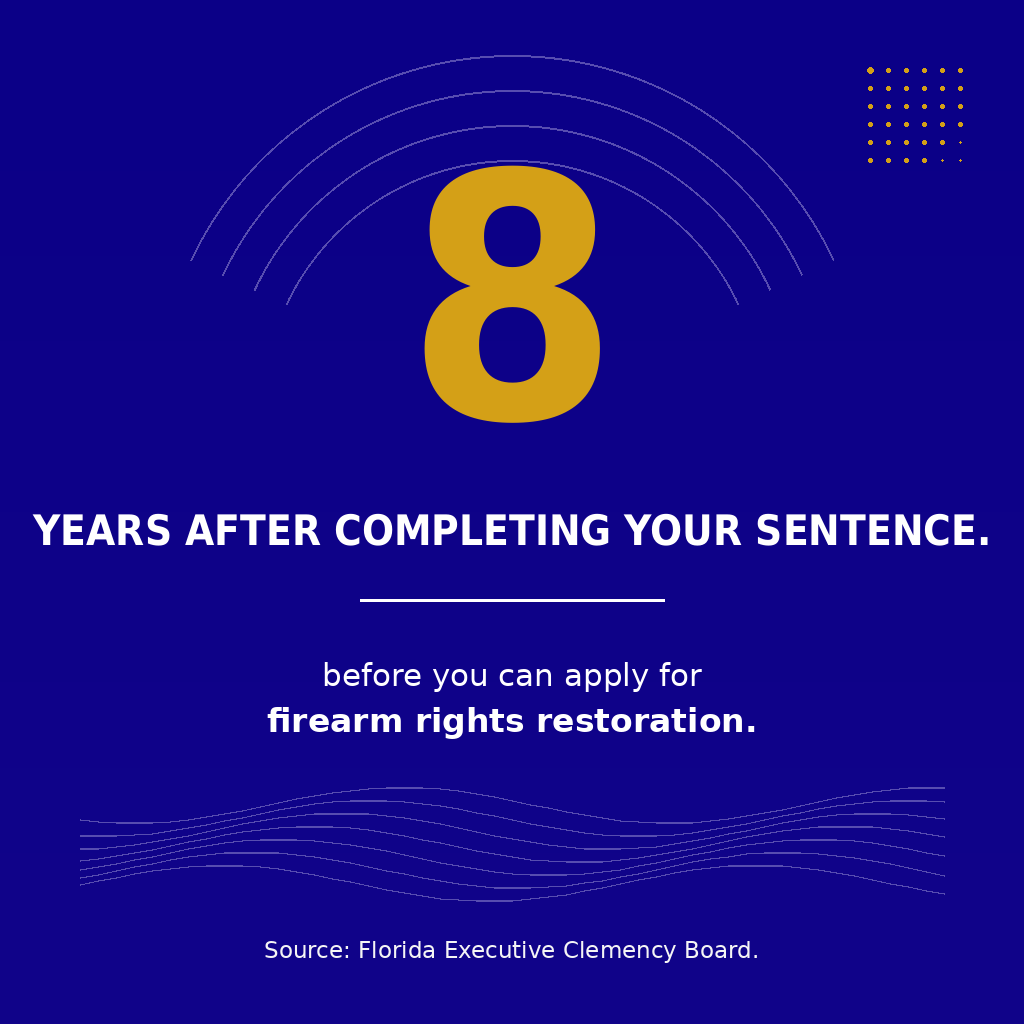
- The 8 years runs from the date all sentences and all conditions of supervision on your most recent felony expired or were completed. Time served is what starts the clock, not what runs it
- A new felony conviction after the waiting period begins resets the clock, because the clock always runs from your most recent felony
- Persons convicted in a federal, military, or out-of-state court are not eligible to apply for Florida firearm authority at all
- You must have no outstanding detainers, no pecuniary penalties or liabilities totaling more than $1,000 from any criminal conviction or traffic infraction, and no outstanding victim restitution or Chapter 960 obligations
- The application goes to the Clemency Board, which evaluates the petition and schedules a hearing
- Approval requires the Governor plus at least two Cabinet members, and the Governor’s vote is always required. The rules give the Governor unfettered discretion to deny clemency at any time, for any reason
Florida offers two different forms of restoration, and people frequently confuse them:
| Relief | What it restores | Restores firearm rights? |
| Restoration of Civil Rights (RCR) | Voting, jury service, holding public office | No |
| Specific Authority to Own, Possess, or Use Firearms (Rules 4.I.F, 5.D) | State-level firearm rights. A separate grant from RCR, and not available at all for federal, military, or out-of-state convictions | Yes, under Florida law only |
Firearm authority is the hardest form of clemency Florida grants. There is no administrative track for it. Rules 9 and 10 cover Restoration of Civil Rights only and both expressly exclude firearms, so every firearm application is investigated by the Florida Commission on Offender Review, including a personal interview, and then heard by the Clemency Board, which meets four times a year. Attorneys who file these routinely describe waits of three to twelve years from application to decision. Eight years of eligibility is where the process begins, not where it ends.
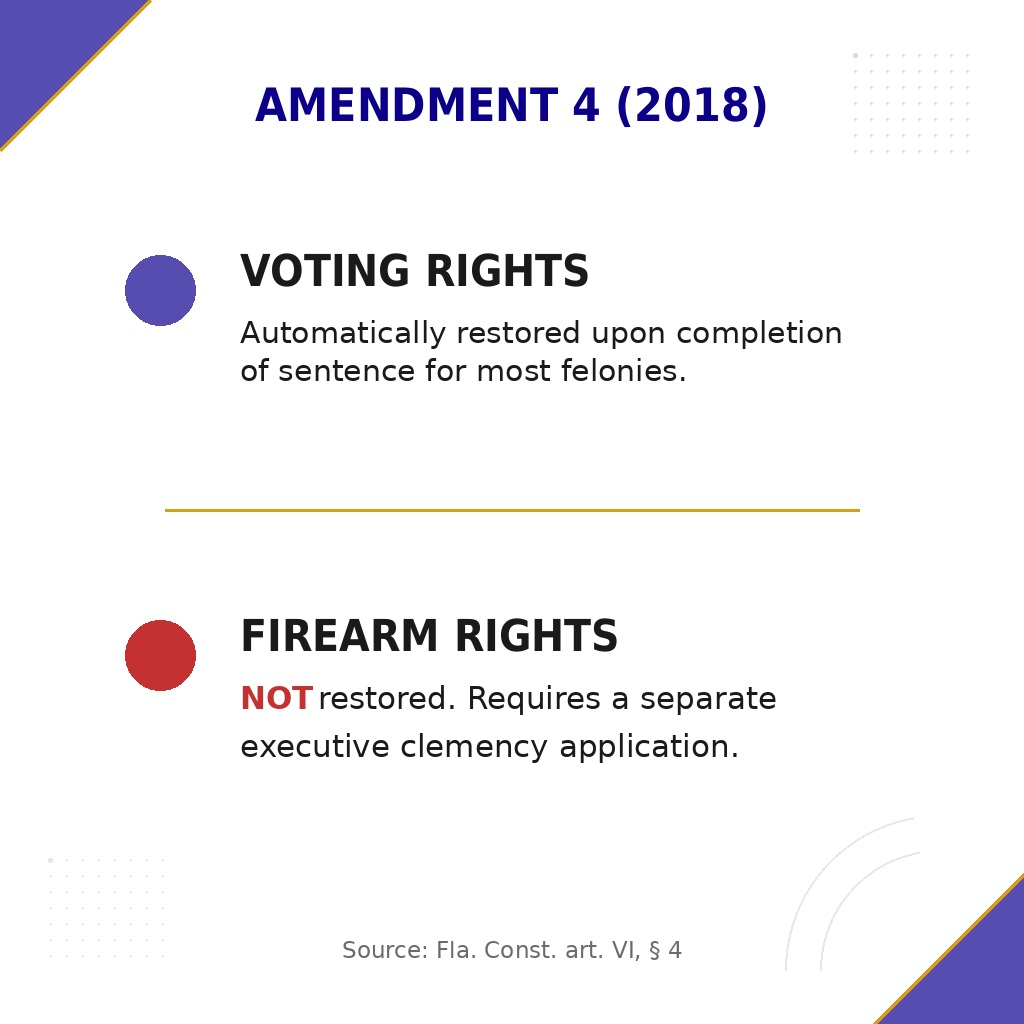
One point that causes regular confusion: Amendment 4 to the Florida Constitution, passed in 2018, restored voting rights for most people with felony convictions upon completion of all terms of their sentence, excluding those convicted of murder or a felony sexual offense. Restoration is not automatic in practice. Florida Statute 98.0751 defines “completion of all terms of sentence” to include full payment of restitution and of every fine and fee ordered as part of the sentence, and the Eleventh Circuit upheld that requirement sitting en banc in Jones v. Governor of Florida, 975 F.3d 1016 (11th Cir. 2020). Outstanding court debt keeps a person off the voter rolls. Amendment 4 also restores voting only. Jury service and the right to hold office still require clemency. Amendment 4 did not restore firearm rights. Voting and firearm rights follow separate paths in Florida.
Is Florida’s Felon Gun Ban Changing? Morgan v. State
The most significant development in this area is currently before Florida’s First District Court of Appeal, in Morgan v. State, No. 1D2025-0377.
In September 2022, Christopher Morgan, who had a single nonviolent 2007 Pennsylvania felony conviction for carrying a firearm without a license, was stopped by a Tallahassee police officer during a routine traffic stop. Morgan volunteered that he had an unloaded pistol in his center console and disclosed his prior felony conviction. He was arrested and charged under Section 790.23.
Morgan pleaded no contest but reserved his right to appeal, arguing that Florida’s categorical ban on felons possessing firearms violates the Second Amendment under the U.S. Supreme Court’s framework in New York State Rifle & Pistol Association v. Bruen (2022).
Florida Attorney General James Uthmeier initially defended the law. A September 2025 brief from his office argued that the statute was constitutional and that Morgan, as a convicted felon, was not a law-abiding citizen.
Then in February 2026, Uthmeier reversed course. In a brief confessing error filed on February 13, 2026, the AG argued that the Second Amendment lets the government disarm felons whose convictions show they are dangerous, but does not support a blanket ban on every felon regardless of whether the offense involved violence. A supplemental brief filed on March 18, 2026 applied the Bruen test to argue that disarming nondangerous felons is inconsistent with the nation’s historical tradition of firearm regulation. No Florida Attorney General had taken that position before. The Florida Prosecuting Attorneys Association sought leave on March 27, 2026 to file an amicus brief opposing that position, arguing that felon disarmament is consistent with the nation’s historical tradition. As of September 2026 the First DCA has not ruled.
What this means for you right now: nothing has changed. The First DCA has not ruled. Florida’s Prosecuting Attorneys Association has opposed the AG’s position. Section 790.23 remains fully enforceable, and people are still being arrested and charged under it every week. If you are a convicted felon holding a firearm today because you expect the law to change, you are risking a second-degree felony and serious prison time on a legal theory no court has adopted yet.
There is one distinction worth understanding, because it explains why this is still an open question. Every Florida appellate decision upholding Section 790.23 so far, most recently Villarreal v. State, No. 6D2024-2157 (Fla. 6th DCA June 5, 2026), and before that Gibbs v. State (Fla. 3d DCA 2025) and Edenfield v. State, 379 So. 3d 5 (Fla. 1st DCA 2023), rejected a facial challenge, meaning an argument that the statute is unconstitutional in every application. The Attorney General’s position in Morgan is an as-applied challenge: that the statute is unconstitutional as applied to this particular nondangerous defendant. Villarreal expressly declined to decide that question. So while no Florida court has adopted the as-applied argument, none has rejected it either. One practical warning from Villarreal: the defendant’s as-applied claim failed because it was not preserved in the trial court. If this argument matters to your case, it has to be raised early and correctly, at the trial level, or it is gone on appeal.
Common Defenses in Felon-in-Possession Cases
The facts of the case determine the defense. These are the approaches that come up most often:
- Challenging the search. Many felon-in-possession charges begin with a traffic stop or a search of a home or vehicle. If officers conducted an unlawful search or lacked probable cause for the stop, the firearm can be excluded through a motion to suppress. As a former police academy instructor, Rocky Brancato trained officers on the procedures they are supposed to follow during stops and searches. That training informs how our attorneys examine what actually happened before the gun was found.
- Disputing possession. In constructive possession cases, the state has to prove you knew the firearm was there and could control it. When the gun was in a shared space, such as a vehicle with several occupants or a home with several residents, that burden gets harder to carry.
- Challenging the underlying conviction. If the prior felony that triggers the ban was itself defective, reversed on appeal, or resolved with a withhold of adjudication, the prosecution’s case can collapse at its foundation. Under Clarke v. United States, a Florida withhold is not a conviction for purposes of Section 790.23 at all.
- Arguing a statutory exception. A weapon that qualifies as an antique under Florida’s definitions falls outside the reach of 790.23. After State v. Weeks, 202 So. 3d 1 (Fla. 2016), that category is broader than most people assume. See the muzzleloader question below.
Rocky Brancato served as Chief Operations Officer of the Hillsborough County Public Defender’s Office, where he oversaw a staff of over 100 attorneys. That system-level view of how charging decisions get made in gun cases shapes how the firm evaluates them from the first phone call.
In felon-in-possession cases charged alongside a drug offense, one of the first questions is whether the firearm allegation actually fits the statute the State charged under. Reading the statute against the facts, rather than accepting the State’s characterization of them, is often where the case turns.
Our defense team has also worked with forensic firearms experts to challenge weapon identification and the reliability of the state’s physical evidence.
Frequently Asked Questions
Can a nonviolent felon own a gun in Florida?
Not under current law. Florida Statute 790.23 does not distinguish between violent and nonviolent felonies. If you have any felony conviction, the ban applies to you. The Florida Attorney General has argued in the Morgan v. State appeal that this categorical approach is unconstitutional for nondangerous felons, but no court has yet decided that as-applied question. Florida’s appellate courts have so far rejected only facial challenges, most recently in Villarreal v. State (Fla. 6th DCA June 5, 2026). Until a court rules or the legislature acts, all felons are prohibited from possessing firearms in Florida.
Can a felon have a gun in their home in Florida?
No. The statute prohibits a convicted felon from having a firearm in their care, custody, possession, or control. A gun stored in your home is under your control. That is constructive possession, and it violates Section 790.23. Constructive possession carries the same 15-year maximum as actual possession, though it does not trigger the 3-year mandatory minimum.
Can a felon’s spouse own a gun in Florida?
Florida law does not prohibit a felon’s spouse from owning a firearm. The spouse has an independent right to possess firearms if they are not otherwise disqualified. The risk comes from access. If prosecutors can establish that the felon knew the gun was in the home and could exercise dominion and control over it, a constructive possession charge is possible. Storing the firearm in a locked safe the felon cannot open reduces that risk, but the specifics of the living arrangement matter enough to be worth a conversation with a defense attorney.
What is constructive possession of a firearm?
Constructive possession means a firearm is not on your person but sits in a place you control, you know it is there, and you have the ability to exercise dominion over it. The state must prove both knowledge and control. Being in the same room or the same vehicle as a firearm is not enough by itself.
Can a felon own a muzzleloader in Florida?
Often, yes. Florida’s antique firearm exception covers any firearm manufactured in or before 1918, any replica of one regardless of when the replica itself was made, and any firearm using fixed ammunition manufactured in or before 1918 that is no longer commercially available. In State v. Weeks, 202 So. 3d 1 (Fla. 2016), a convicted felon was prosecuted for possessing a modern muzzleloading rifle fitted with a scope. The Florida Supreme Court held that what makes a firearm a “replica” is its ignition or firing system, meaning matchlock, flintlock, percussion cap or similar, and that modern accessories like a scope do not remove it from the exception. Most percussion-ignition muzzleloaders therefore fall outside the definition of “firearm” in Section 790.001(6). Two cautions: antique status is an affirmative defense you have to raise, and the exception disappears if the weapon is used in the commission of a crime. Check with an attorney before purchasing or possessing one.
How long does the clemency process take in Florida?
The minimum wait before you can apply is 8 years after completing all terms of your sentence. After you file, the wait for a hearing can run considerably longer because of the backlog at the Executive Clemency Board. Attorneys who file these applications routinely describe three to twelve years from filing to decision for firearm authority, because every firearm application requires an investigation by the Florida Commission on Offender Review and a hearing before the Clemency Board, which meets only four times a year. There is no guaranteed timeline, and approval is not guaranteed even after a hearing. Clemency is an executive process rather than a court process, and our firm does not handle these petitions. The Office of Executive Clemency at (850) 488-2952 is the starting point.
Talk to a Tampa Gun Crimes Defense Attorney
If you are facing a felon-in-possession charge in Tampa Bay, we can evaluate your situation and tell you what the realistic paths forward look like. If you are looking for help restoring firearm rights, we are not the right firm for that. That process is mainly political rather than legal, and the clemency section above explains why and where it actually starts.
The Brancato Law Firm defends clients charged with gun crimes from our Tampa office, serving Hillsborough, Pinellas, and Pasco Counties. We track the Second Amendment developments that affect our clients, including the Florida open carry ruling.
Call (813) 727-7159 for a free consultation, or contact us online to discuss your case. A felon-in-possession arrest moves quickly toward a filing decision, and the window to influence that decision is measured in weeks. The attorneys of The Brancato Law Firm, P.A., founded by Tampa Criminal Defense Attorney Rocky Brancato, can be reached at (813) 727-7159.
The Brancato Law Firm, P.A.
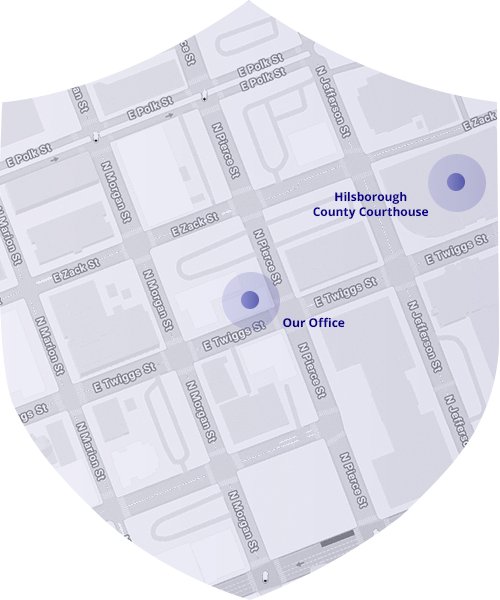
620 E. Twiggs Street, Suite 205, Tampa, FL 33602
(813) 727-7159
Serving Hillsborough, Pinellas, and Pasco Counties
The Brancato Law Firm, P.A. is a Tampa-based criminal defense practice. We are not affiliated with any other Brancato-named law firms.
Visit Us
Tampa, FL 33602
Contact Us Now
Free Legal Consultation (813) 727-7159