

From First DUI to Death Penalty



Can You Own a Gun After a Juvenile Felony in Florida? (2026)


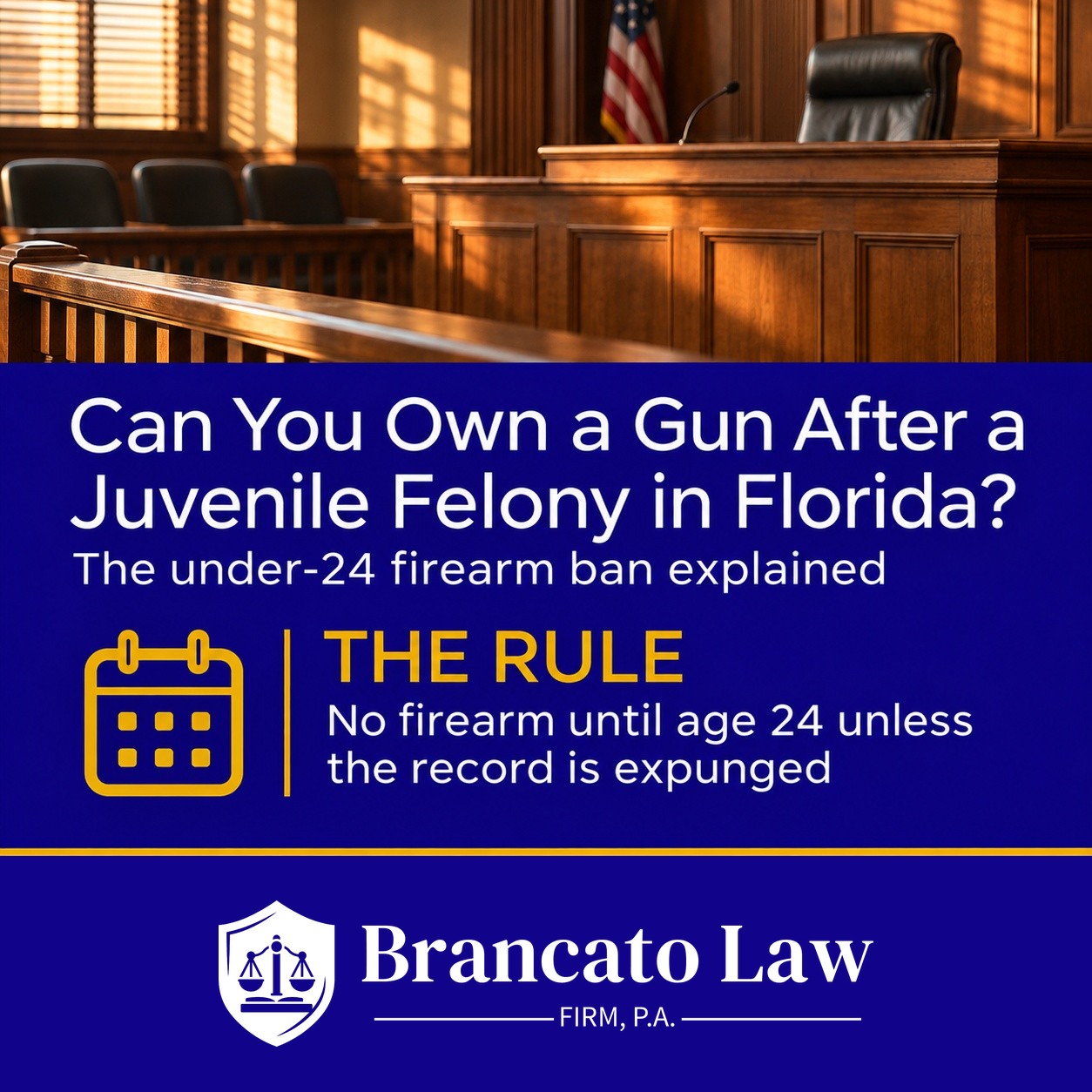
Not until age 24, unless your juvenile record has been expunged. Under section 790.23(1)(b), Florida Statutes, a person who was found in juvenile court to have committed a delinquent act that would be a felony for an adult may not own or possess a firearm, ammunition, or an electric weapon until age 24, even if adjudication was withheld. A violation is a second-degree felony punishable by up to 15 years in prison. The ban does not apply to a person whose juvenile record was expunged under section 943.0515(1)(b), which for many people happens automatically at age 21.
Prosecutors who file a delinquent in possession charge have to prove three things: an old juvenile court finding, a gun the accused knowingly possessed, and the accused’s age on the day of the arrest. Each one can be tested. I’m Rocky Brancato, founder of The Brancato Law Firm, P.A., a Tampa criminal defense firm, and a former Chief Operations Officer of the Hillsborough County Public Defender’s Office, where I oversaw a staff of over 100 attorneys. I have tried more than 150 jury trials to verdict, and in these cases our attorneys start with the juvenile court file itself, because many young adults charged with this crime have records that were already expunged, or never qualified, under the statute.
What is the juvenile felony gun ban in Florida?
Florida bars anyone under 24 who was found to have committed a felony-level delinquent act from owning or having a firearm. The law is section 790.23(1)(b), Florida Statutes, the same statute that prohibits convicted felons from having guns. It covers anyone “found, in the courts of this state, to have committed a delinquent act that would be a felony if committed by an adult” who “is under 24 years of age.” A separate subsection, 790.23(1)(d), applies the same rule to delinquency findings from another state or country when the act was punishable by more than one year.
The ban covers more than guns. It reaches any firearm, ammunition, electric weapon or device, and carrying a concealed weapon, including a tear gas gun or chemical weapon. Our firm’s guide to whether a convicted felon can own a gun in Florida covers the adult version of this law; this article covers the juvenile rule and how our attorneys defend it.
Does a withheld adjudication in juvenile court still count?
Yes. A juvenile disposition with adjudication withheld still counts as being “found” to have committed a delinquent act. The Second District decided this in State v. Menuto, 912 So. 2d 603 (Fla. 2d DCA 2005). Mathew Menuto had been found, six years earlier as a juvenile, to have committed burglary of a dwelling, with adjudication withheld. When he was charged with having a firearm before age 24, the trial court dismissed the case and held the statute unconstitutional. The Second District reversed, explaining that in juvenile court a finding that the child committed the act comes first and must exist before a judge can withhold adjudication.
The Florida Supreme Court built that rule into the standard jury instruction for this crime. The note to judges on Instruction 10.15(a), approved in In re Standard Jury Instructions in Criminal Cases, Report 2018-01, 253 So. 3d 1024 (Fla. 2018), says “found” refers to a finding of fact by a court and “does not require an adjudication of guilt.” A withhold of adjudication in juvenile court does not avoid this ban.
What must the State prove for a delinquent in possession charge?
The State must prove three elements beyond a reasonable doubt under Fla. Std. Jury Instr. (Crim.) 10.15(a):
- The accused had been found by a court to have committed a delinquent act that would be a felony if committed by an adult.
- After that finding, the accused knowingly owned or had in his or her care, custody, possession, or control a firearm, electric weapon or device, or ammunition, or carried a concealed weapon.
- The accused was under 24 years of age at the time of the possession.
| Situation | Charge level | Maximum prison term |
|---|---|---|
| Under 24 with a prior felony-level juvenile finding, possessing a firearm or ammunition | Second-degree felony, s. 790.23(3) | 15 years |
| Same offense by a person who qualifies for criminal gang enhancements under s. 874.04 | First-degree felony, s. 790.23(4) | Life |
| Juvenile record expunged under s. 943.0515(1)(b) | Statute does not apply, s. 790.23(2)(b) | None under s. 790.23 |
The 15-year maximum comes from section 775.082, which caps a second-degree felony at 15 years. For a young adult with no adult record, a conviction also creates an adult felony record, which brings the adult felon firearm ban under section 790.23(1)(a).
Does the gun ban end at 21 if my juvenile record is expunged?
For many people, yes. Section 790.23(2)(b) says the ban does not apply to a person “whose criminal history record has been expunged pursuant to s. 943.0515(1)(b).” Under section 943.0515(1)(b), the juvenile record of a person who was not classified as a serious or habitual juvenile offender, and was not committed to a maximum-risk residential facility, is kept for two years after the person turns 19 and then expunged. That means the record of a typical juvenile case is expunged at 21.
There are important exceptions. A serious or habitual juvenile offender’s record is kept until five years after age 21. A juvenile record is not destroyed if the person is charged with or convicted of a forcible felony at 18 or older before it is expunged; it is merged into the adult record instead. A young adult can also apply for early expunction between 18 and 21 if he or she has no charges in the prior five years, but that requires the approval of the State Attorney in each circuit where an offense occurred.
| Juvenile record situation | When the s. 790.23(1)(b) ban ends | Source |
|---|---|---|
| Typical juvenile case, not serious or habitual, no maximum-risk commitment | When the record is expunged, two years after age 19 (age 21) | s. 943.0515(1)(b)1.; s. 790.23(2)(b) |
| Early expunction approved by the State Attorney | On expunction, between ages 18 and 21 | s. 943.0515(1)(b)2. |
| Serious or habitual juvenile offender, or maximum-risk commitment | At age 24, when the age element ends | s. 790.23(1)(b); s. 943.0515(1)(a) |
| Forcible felony charged or convicted at 18 or older before expunction | At age 24 for the juvenile ban, but the record is merged into the adult record | s. 943.0515(2)(a) |
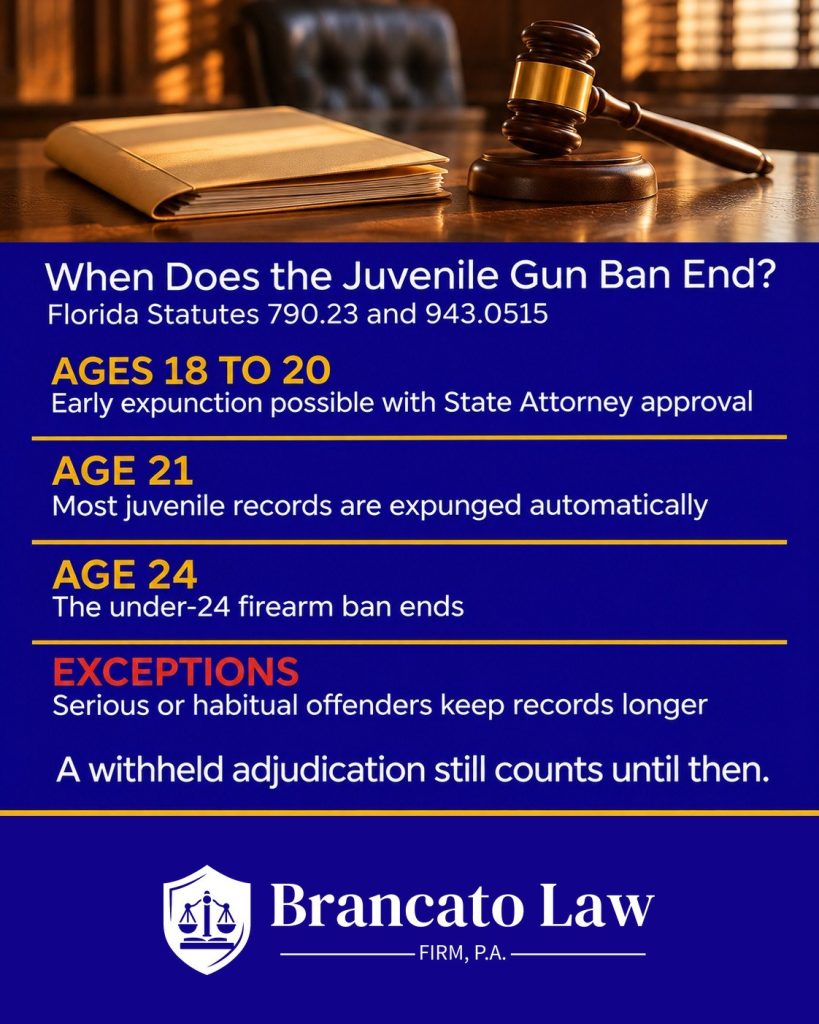
These rules make the client’s full record the first thing our attorneys check. We obtain the juvenile disposition, the classification, and the expunction status before anything else, and our guide to juvenile expungement in Florida explains the process in more detail.
How do our attorneys fight a delinquent in possession charge?
The defense attacks each element and the stop that led to the gun. Our attorneys work through these questions:
- Was there a qualifying finding? The prior act must be one that would be a felony for an adult, found by a court. A misdemeanor-level finding, or a case that ended in diversion or a civil citation without a finding, does not qualify.
- Was the record expunged? A record expunged under section 943.0515(1)(b) takes the person outside the statute entirely.
- Was the accused under 24 on the day of the possession? The age element is measured at the time of possession, not at arrest or trial.
- Did the accused knowingly possess the gun? In a shared car or home, mere proximity is not enough; the State must prove knowledge and control.
- Was the stop or search lawful? A gun found after an illegal stop or search can be suppressed.
- Can the State prove the old finding? The State must prove the prior delinquency finding and that the accused is the same person, usually through certified juvenile court records.
Constructive possession is where many of these cases are won. In N.G.S. v. State, 272 So. 3d 830 (Fla. 2d DCA 2019), a Clearwater case, a detective found a gun under a seat in a car with four young men inside. Only one, N.G.S., was shown to have a prior delinquency finding, and he confessed. The Second District reversed, holding that the State had to prove independently of the confession that N.G.S. himself possessed the gun, because his status was what made the possession a crime. Proximity in a jointly occupied car was not enough, and the court ordered the charges dismissed.
N.G.S. matters in Pinellas, Hillsborough, and Pasco courts because the Second District covers all three counties. When a gun is found in a car or apartment shared with friends, our attorneys focus on who owned it, whose fingerprints or DNA are on it, and what the other occupants said. Our Tampa gun crimes attorney team can retain forensic experts for this kind of testing.
What happens if a minor is charged with this crime?
A minor charged in juvenile court faces a presumption of secure detention. Under section 985.255(1)(g) and (h), when a judge finds probable cause that a child committed delinquent in possession of a firearm, the child “must be held in secure detention” before the adjudicatory hearing unless the court enters a written order, based on clear and convincing evidence, that the child would not be a danger on supervised release. A child released under that order must be placed on electronic monitoring.
That makes the detention hearing, which comes quickly after the arrest, the first real fight in a juvenile gun case. Our attorneys come prepared with school records, family support, and a supervision plan. For more on how cases move after an arrest, see our Florida criminal case process guide.
Should you talk to police about a gun found near you?
No. Ask for a lawyer and stay silent. In a delinquent in possession case, a statement like “it’s my gun” or “I knew it was there” often supplies the knowledge and control the State cannot otherwise prove, as the confession in N.G.S. shows.
When police are still investigating, our firm offers representation before charges are filed, and nearly every month we see cases that never get filed because of that front-end advocacy. We decide case by case what, if anything, to provide to detectives. In a gun case, that can mean showing the State Attorney’s Office in Hillsborough County that the juvenile record was expunged, that the prior case was not a felony, or that the gun belonged to someone else.
Frequently asked questions about juvenile felony gun possession in Florida
Can delinquent in possession of a firearm charges be dropped?
Yes, the charge can be dropped when the juvenile record was expunged, the prior finding was not felony-level, or the State cannot prove possession. The Brancato Law Firm pulls the juvenile court file and the expunction records first and presents them to prosecutors through pre-file advocacy when they show the charge cannot stand.
Can I buy a gun at 21 if I had a juvenile felony in Florida?
Only if the ban no longer applies to you, which usually means your juvenile record has been expunged under section 943.0515(1)(b); otherwise the ban runs until 24. Our attorneys at The Brancato Law Firm can review your record and expunction status before you try to buy or possess any firearm.
Does a juvenile civil citation or diversion count as a juvenile felony?
Generally no, because the statute requires a court finding that you committed a felony-level delinquent act, and a case resolved by civil citation or pre-arrest diversion without a court finding does not meet that element. The Brancato Law Firm confirms how the old case actually ended, since the paperwork families remember and the court record do not always match, and our article on Hillsborough County’s juvenile civil citation program explains how those cases work.
Does the gun ban apply to ammunition alone?
Yes, section 790.23 prohibits owning or possessing ammunition, so a box of bullets in a car can support the charge even with no gun present. Our attorneys at The Brancato Law Firm challenge knowledge and control of ammunition the same way they challenge possession of a firearm.
What if my juvenile case was in another state?
An out-of-state delinquency finding counts under section 790.23(1)(d) only if the act would be a felony for an adult and was punishable by more than one year of imprisonment. The Brancato Law Firm obtains the other state’s statute and records to test whether the old case meets that standard, and our Tampa gun crime lawyer page explains our approach to firearm charges.
Can a 17-year-old be charged as an adult for this?
Possibly, because Florida law allows some 16- and 17-year-olds to be prosecuted in adult court, but most minors charged with this offense are handled in juvenile court with a presumption of secure detention. The Brancato Law Firm fights for juvenile court jurisdiction whenever the State tries to move a young client’s case to adult court.
For more about our defense strategies, visit our Gun Crimes page.
The first question in your case is what your juvenile record actually says, and our attorneys can answer it quickly. Call The Brancato Law Firm, P.A., founded by Tampa Criminal Defense Attorney Rocky Brancato, at (813) 727-7159, especially if a detention or first appearance hearing is coming up. You can call us at any hour, and our office is two blocks from the courthouse. Our firm has Spanish-speaking staff, and attorney Jean-Luc Adrien speaks Spanish, Haitian Creole, and French.
The Brancato Law Firm, P.A.
620 E. Twiggs Street, Suite 205, Tampa, FL 33602
(813) 727-7159
Serving Hillsborough, Pinellas, and Pasco Counties
The Brancato Law Firm, P.A. is a Tampa-based criminal defense practice. We are not affiliated with any other Brancato-named law firms.
Visit Us

Tampa, FL 33602

Contact Us Now
Free Legal Consultation (813) 727-7159
