- Free Consultation 24/7: (813) 727-7159 Tap Here To Call Us


From First DUI to Death Penalty



How to Fight an Assault Charge in Florida (2026)


Updated October 22, 2026
To fight an assault charge in Florida, test each element the State must prove under section 784.011: an intentional, unlawful threat by word or act, an apparent ability to carry it out, and an act that created a well-founded fear that violence was imminent. Words alone, a threat about the future, or a threat with no present ability to act usually fall short. Simple assault is a second-degree misdemeanor (up to 60 days); aggravated assault with a deadly weapon or intent to commit a felony is a third-degree felony (up to 5 years). Since 2016, Florida’s 10-20-Life firearm minimums do not apply to aggravated assault, and self-defense covers threats of force as well as force itself.
Assault cases are usually decided by one disputed moment: whether the other person reasonably feared violence was about to happen right then. That moment is often captured on body camera or a phone, and it often looks different on video than in the report. I’m Rocky Brancato, founder of The Brancato Law Firm, P.A., a Tampa criminal defense firm. I have taken more than 150 jury trials to verdict over more than 25 years in Hillsborough County courtrooms, and assault cases are where our attorneys often see overcharging: road-rage arguments, bar disputes, and neighbor feuds written up as felonies because someone mentioned a weapon.
This guide explains what the State must prove, how Hillsborough cases have been decided on the fear and weapon elements, the penalties, the 10-20-Life correction, and the defenses that work.
How does Florida define assault?
Assault is the threat; battery is the touch. Under section 784.011, Florida Statutes, “An ‘assault’ is an intentional, unlawful threat by word or act to do violence to the person of another, coupled with an apparent ability to do so, and doing some act which creates a well-founded fear in such other person that such violence is imminent.” No touching is required.
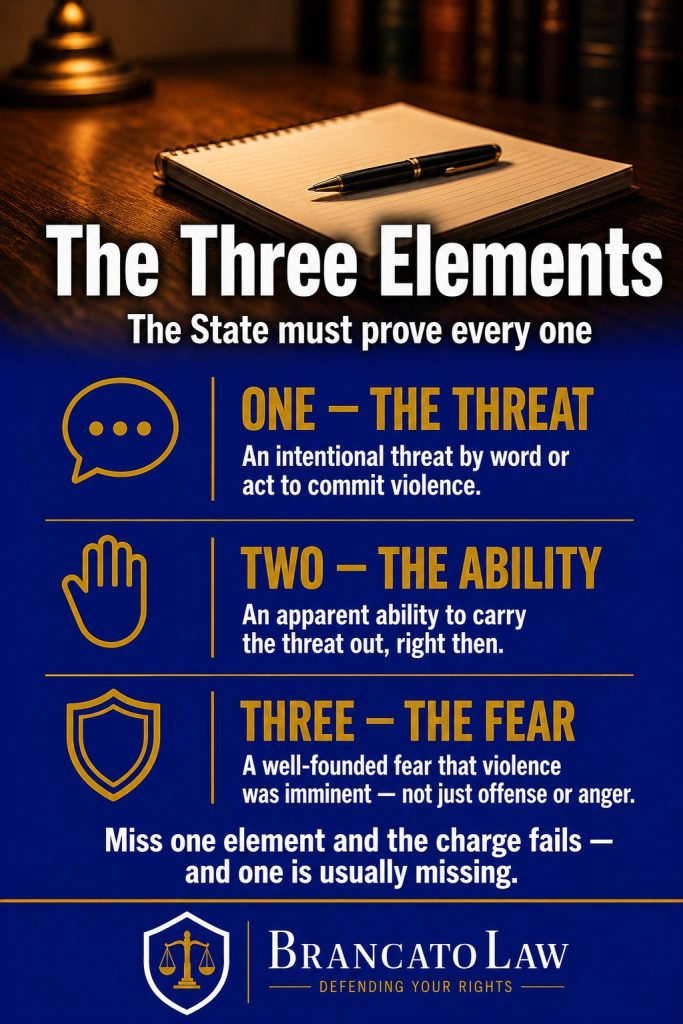
The State must prove three things beyond a reasonable doubt:
- An intentional, unlawful threat by word or act to do violence.
- An apparent ability to carry out the threat at that moment.
- An act creating a well-founded fear that the violence was imminent.
Each element is a place the case can fail. A threat about next week is not imminent. An angry person across a parking lot with no weapon may lack the apparent ability. Our attorneys at The Brancato Law Firm build the defense around whichever element the State’s evidence leaves weakest.
Can words alone be assault in Florida?
Usually not. In H.W. v. State, 79 So. 3d 143 (Fla. 3d DCA 2012), the Third District reversed an assault finding against a student who threatened a school administrator, holding that “Proof of the crime of assault requires not just proof of a threat, but also proof of some physical act directed toward the victim.” The court quoted an older case: “A person’s mere intention to commit an assault is not enough; there must be some overt act sufficient to demonstrate a threat directed at the person placed in fear.”
Words become assault when they arrive with conduct: stepping toward someone, raising a fist, or reaching for a waistband. In our firm’s experience, assault charges are sometimes filed on facts that amount to an ugly argument, and the overt-act requirement is where those cases fall apart.
Does the alleged victim have to be afraid?
Not necessarily, and this cuts both ways in the Second District, which hears appeals from Hillsborough, Pinellas, and Pasco Counties. In Sullivan v. State, 898 So. 2d 105 (Fla. 2d DCA 2005), a Hillsborough County case from Riverview, the court held that a victim’s own lack of fear is not decisive when “the circumstances were such as to ordinarily induce fear in the mind of a reasonable man.” But the court also held the violence must be imminent, meaning “near at hand.” A deputy more than 30 feet away behind a patrol car, with another deputy in between, was too far from the knife for an assault, and the court reversed that count.
The Second District later affirmed an assault adjudication in S.P.M. v. State, 66 So. 3d 317 (Fla. 2d DCA 2011) even though the victim testified he was not afraid, applying Sullivan’s reasonable-person rule. The practical lesson: an alleged victim saying “I wasn’t scared” helps, but the stronger defense is usually distance, timing, and the absence of imminent violence. Our attorneys measure those facts from the video and the scene.
What is aggravated assault in Florida?
Aggravated assault is an assault committed “With a deadly weapon without intent to kill” or “With an intent to commit a felony” under section 784.021, Florida Statutes. It is a third-degree felony punishable by up to 5 years in prison and a $5,000 fine.
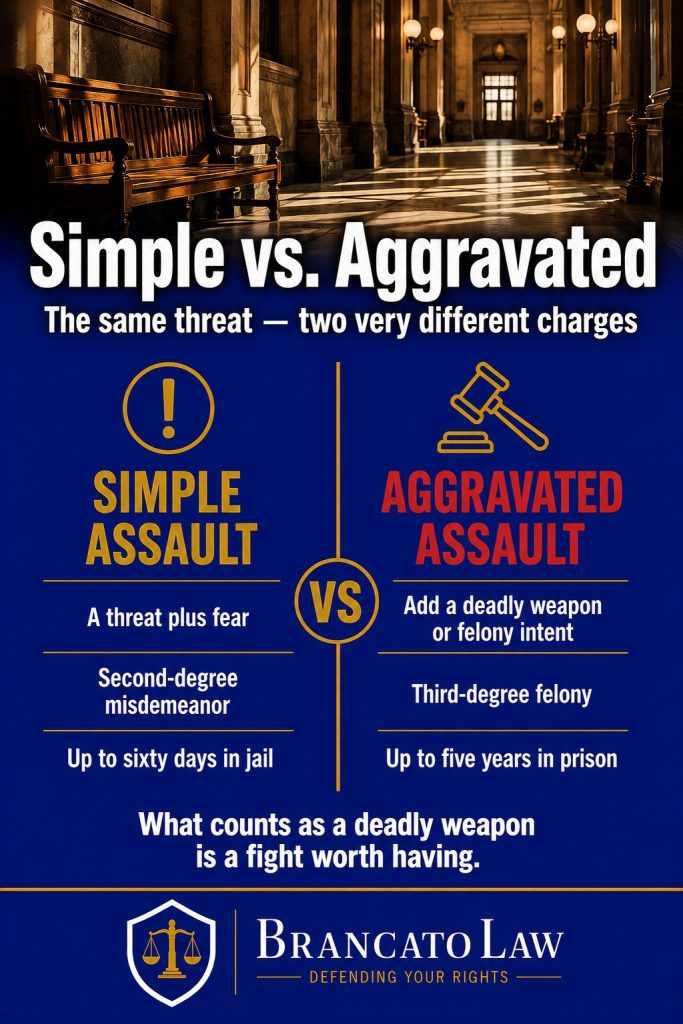
| Charge | Statute | Classification | Maximum penalty |
|---|---|---|---|
| Assault | § 784.011 | Second-degree misdemeanor | 60 days in jail, $500 fine |
| Aggravated assault | § 784.021 | Third-degree felony | 5 years in prison, $5,000 fine |
| Assault on a law enforcement officer or other listed person | § 784.07(2)(a) | First-degree misdemeanor | 1 year in jail, $1,000 fine |
| Aggravated assault on a law enforcement officer | § 784.07(2)(c) | Second-degree felony | 15 years in prison, with a 3-year mandatory minimum |
| Assault on a person 65 or older | § 784.08(2)(d) | First-degree misdemeanor | 1 year in jail, $1,000 fine |
| Aggravated assault on a person 65 or older | § 784.08(2)(b) | Second-degree felony | 15 years in prison |
The jump from a 60-day misdemeanor to a 5-year felony usually turns on one fact: whether the object was a “deadly weapon.” Our Tampa violent crime lawyer team treats that question as the center of every aggravated assault case.
What counts as a deadly weapon in Florida?
A deadly weapon is an instrument likely to cause death or great bodily harm when used as designed, or an object used or threatened to be used in a way likely to cause death or great bodily harm. Florida’s standard jury instruction uses that two-part test. Under it, a knife, a bat, a bottle, or a car may or may not be a deadly weapon depending on how it was used.
Hillsborough County cases show how much precision matters. In Proctor v. State, 205 So. 3d 784 (Fla. 2d DCA 2016), a jury convicted a defendant of aggravated assault with a firearm but specially found he did not possess a firearm. The Second District held that was a true inconsistent verdict, because “the firearm was a necessary element of the aggravated assault,” and reduced the conviction. In J.M. v. State, No. 2D2022-3344 (Fla. 2d DCA Jan. 31, 2025), the court reversed an aggravated assault finding because the charge alleged the juvenile “carried” a knife, and “the word ‘carry’ cannot be replaced or assumed to be a synonym for ‘use’ in the context of the aggravated assault statute.” In Verela v. State, No. 3D2024-0402 (Fla. 3d DCA Mar. 5, 2025), the Third District reduced an aggravated battery conviction to simple battery because the charging document never alleged a deadly weapon at all. Our attorneys read the charging document as closely as the police report.
Does 10-20-Life apply to aggravated assault?
No. Florida removed aggravated assault from its 10-20-Life statute in 2016. Chapter 2016-7, Laws of Florida, effective July 1, 2016, struck aggravated assault from the list of offenses in section 775.087, Florida Statutes. The current list includes aggravated battery, robbery, burglary, and other felonies, but not aggravated assault.

Many websites still say otherwise. Displaying a gun during an assault does not trigger an automatic 3-, 10-, or 20-year minimum. The weapon reclassification rule in section 775.087(1) does not apply either, because a weapon is an essential element of aggravated assault with a deadly weapon. The one minimum that remains is the 3-year mandatory sentence for aggravated assault on a law enforcement officer under section 784.07, Florida Statutes. When a plea offer assumes a firearm minimum that no longer exists, our attorneys at The Brancato Law Firm correct it in writing.
What are the enhanced penalties for assault on protected people?
Florida reclassifies assault upward for certain victims. Under section 784.07, “knowingly committing an assault or battery upon” a law enforcement officer, firefighter, emergency medical care provider, and other listed people while they perform their duties raises simple assault to a first-degree misdemeanor and aggravated assault to a second-degree felony. Utility workers performing work on critical infrastructure were added effective October 1, 2025. The State must prove the defendant knew the person’s status and that the person was performing official duties.
Age works differently. Under section 784.08, Florida Statutes, an assault on a person 65 or older is reclassified “regardless of whether he or she knows or has reason to know the age of the victim.” When the alleged victim is 60 or older, prosecutors may instead charge abuse of an elderly person, which is a felony; our guide on whether elder abuse is a felony in Florida explains that charge.
Is self-defense a defense to assault in Florida?
Yes. Florida’s self-defense statutes cover “using or threatening to use” force, so a threat made to stop someone else’s imminent unlawful force can be justified. Under section 776.012, Florida Statutes, a person may threaten non-deadly force to defend against imminent unlawful force, and may threaten deadly force to prevent imminent death, great bodily harm, or a forcible felony. An aggravated assault charge is often a threatened-force case, and a Stand Your Ground immunity motion can end it before trial. Our guide on when you can use force in self-defense in Florida explains the rules.
How common are aggravated assault cases in Hillsborough County?
Common, though declining. FDLE arrest data published by Florida Health CHARTS show 1,772 aggravated assault arrests in Hillsborough County in 2025, down from 2,050 in 2023. Florida recorded 22,868 aggravated assault arrests statewide in 2025. The measure includes attempted murder and counts arrests, not reported offenses.
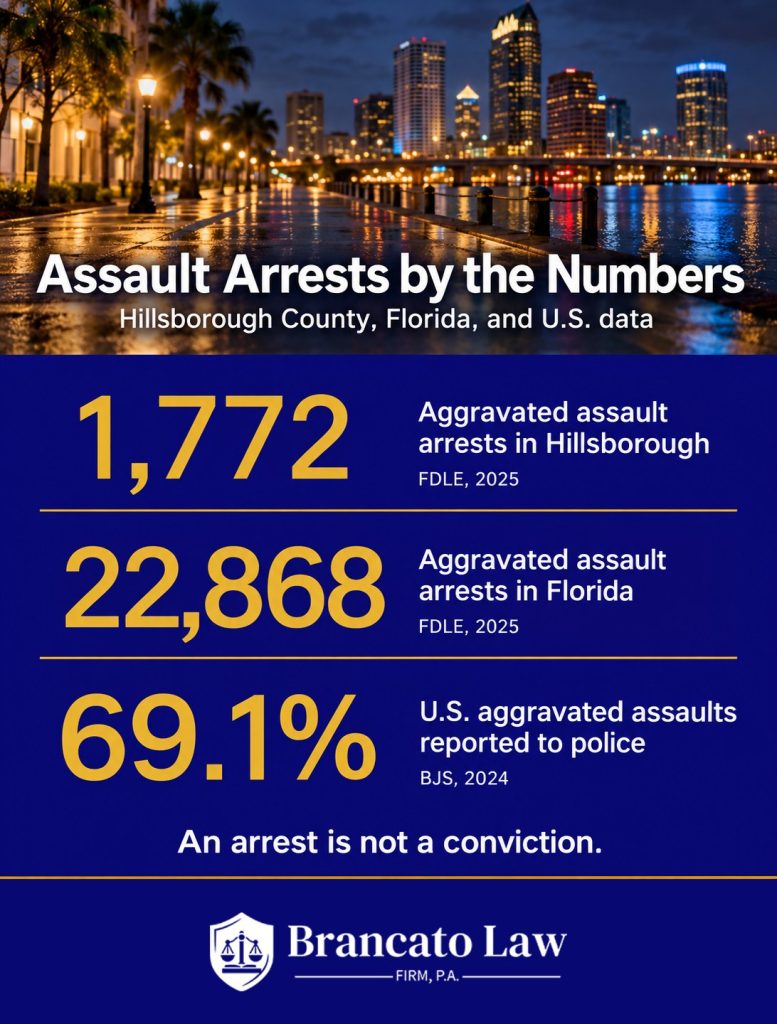
National research shows most aggravated assaults reach the police. The Bureau of Justice Statistics reported in Criminal Victimization, 2024 that 69.1% of aggravated assaults were reported to police in 2024, compared with 40.4% of simple assaults. The Council on Criminal Justice found in its Crime Trends in U.S. Cities: Year-End 2025 Update that reported aggravated assaults were 9% lower in 2025 than in 2024 across the cities it tracks.
Can assault charges be dropped in Florida?
Yes, but not by the alleged victim. Only the State Attorney decides whether to prosecute. What gets assault charges dropped or reduced is evidence: video showing the distance and timing, witnesses who saw who approached whom, proof the threat was conditional or in the future, self-defense facts, and the weakness of a one-witness case. The period after arrest and before the formal charge is the most important window, and our attorneys use it for pre-file advocacy.
| Charge | Result |
|---|---|
| Aggravated assault (February 2026) | Hired the day of the arrest; the alleged victim’s affidavit led the State to decline charges within 24 days |
| Aggravated assault with a deadly weapon (May 2026) | All charges dismissed |
| Aggravated assault with a deadly weapon (October 2026) | A veteran facing five years in prison; a Stand Your Ground motion and the firm’s mitigation report led to Pretrial Intervention, with the charge to be dismissed |
Past results do not guarantee future outcomes. More results are on our case results page.
What should you do if you are charged with assault?
Say nothing about the incident to anyone but your lawyer, and start preserving your side now. Save texts, social media messages, and any video, and list every witness. Surveillance video is often overwritten within weeks. Do not contact the alleged victim, especially if a no-contact order was entered at first appearance. Our post on battery and aggravated battery in Florida covers the charge that often travels with assault.
Frequently asked questions about assault charges in Florida
Is assault a felony in Florida?
Simple assault is a second-degree misdemeanor, but aggravated assault with a deadly weapon or intent to commit a felony is a third-degree felony. The Brancato Law Firm focuses first on whether the State can prove the weapon or the felony intent that makes the charge a felony.
Can I be charged with assault if I never touched anyone?
Yes. Assault in Florida is the threat, not the touch, but the State must prove an overt act, an apparent ability, and a well-founded fear of imminent violence. Our attorneys at The Brancato Law Firm look for the missing element, often the imminence of the threat.
Is pointing a gun at someone aggravated assault in Florida?
It can be, but it can also be justified self-defense if you reasonably believed it was necessary to stop imminent unlawful force. The Brancato Law Firm raises Stand Your Ground immunity when the facts support it, and our Tampa gun crimes lawyer page explains how firearm charges are defended.
Does aggravated assault with a firearm carry a mandatory minimum in Florida?
Not under 10-20-Life, which no longer applies to aggravated assault after July 1, 2016. The only remaining minimum is 3 years when the victim is a law enforcement officer, and our attorneys at The Brancato Law Firm correct any offer that assumes otherwise.
What happens if the alleged victim does not want to press charges?
The State Attorney still decides, but a reluctant witness changes the strength of the case. The Brancato Law Firm presents the alleged victim’s truthful sworn statement and the other evidence to the prosecutor during the filing window, as described on our Tampa violent crimes defense page.
Is a knife automatically a deadly weapon in Florida?
No. Whether a knife is a deadly weapon depends on how it was used or threatened, which makes it a question for the jury. Our attorneys at The Brancato Law Firm also check whether the charging document properly alleged the weapon, because Florida courts have reversed convictions when it did not.
Talk to our Tampa assault defense attorneys before the charging decision
The prosecutor deciding your case has usually heard only one side. The Brancato Law Firm, P.A., founded by Tampa Criminal Defense Attorney Rocky Brancato, will get the video, find the witnesses, and put your side in front of the prosecutor before the charge is filed or the case is set for trial. Call (813) 727-7159 for a free, confidential consultation. You can call us at any hour. Our firm has Spanish-speaking staff, and attorney Jean-Luc Adrien speaks Spanish, Haitian Creole, and French. Read about our Spanish and Haitian Creole criminal defense services.
For more about our defense strategies, visit our Violent Crimes page.
The Brancato Law Firm, P.A.
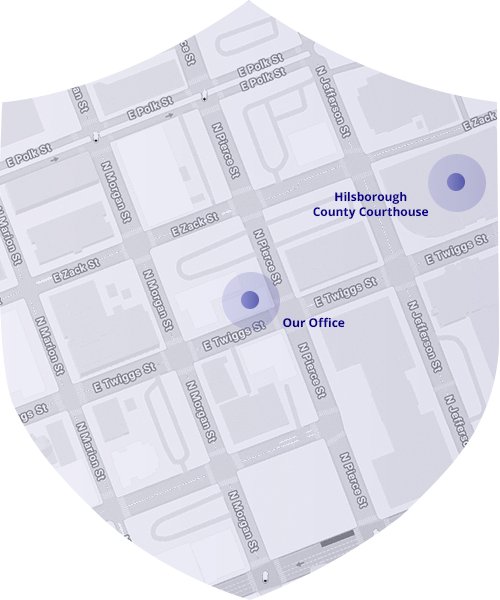
620 E. Twiggs Street, Suite 205, Tampa, FL 33602
(813) 727-7159
Serving Hillsborough, Pinellas, and Pasco Counties
The Brancato Law Firm, P.A. is a Tampa-based criminal defense practice. We are not affiliated with any other Brancato-named law firms.
Visit Us

Tampa, FL 33602
Contact Us Now
Free Legal Consultation (813) 727-7159