- Free Consultation 24/7: (813) 727-7159 Tap Here To Call Us


From First DUI to Death Penalty



How Does a Stand Your Ground Immunity Hearing Work in Florida? (2026)


Updated October 22, 2026
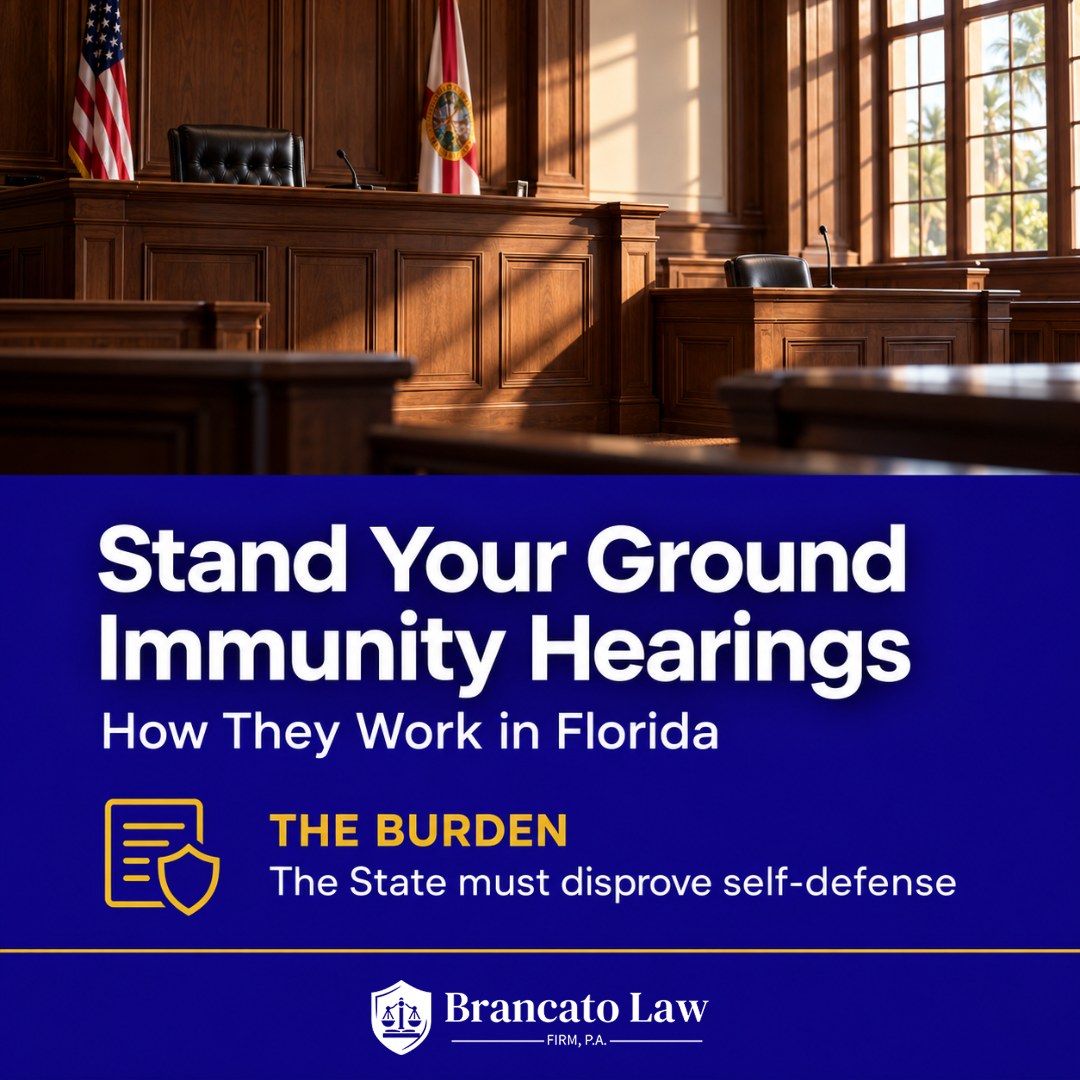
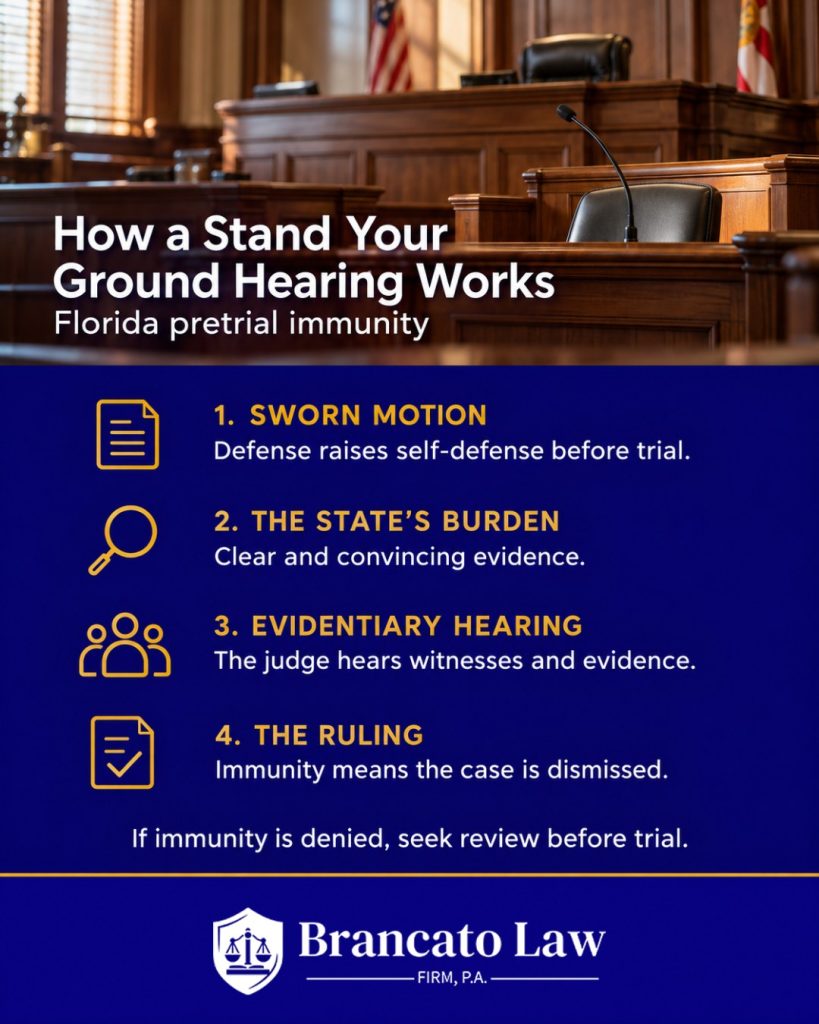
A Stand Your Ground immunity hearing is a pretrial evidentiary hearing where a Florida judge decides whether a person who used or threatened force in self-defense is immune from prosecution. The defense files a sworn motion to dismiss that makes a prima facie claim of self-defense. Under section 776.032(4), Florida Statutes, the State must then prove by clear and convincing evidence that the force was not justified. If the State fails, the judge must dismiss the case before trial. If the judge denies immunity, the defense can ask the appellate court for a writ of prohibition, but that petition must be filed before trial.
A Florida judge can end a homicide or aggravated assault case before a jury is ever picked, and it happens at a Stand Your Ground hearing. I have handled self-defense cases at every stage, including a second-degree murder trial where the jury acquitted our client on self-defense. I’m Rocky Brancato, founder of The Brancato Law Firm, P.A., a Tampa criminal defense firm, and I have tried more than 150 jury trials to verdict. Our attorneys file and argue immunity motions in Hillsborough, Pinellas, and Pasco Counties.
This post explains how the hearing works, step by step. For the substance of the self-defense statutes, read our companion guides on Stand Your Ground vs. self-defense in Florida and how to claim self-defense in a Florida criminal case.
What is Stand Your Ground immunity?
Stand Your Ground immunity is protection from prosecution, not just a defense at trial. Under section 776.032(1), Florida Statutes, a person who uses or threatens force as permitted by Florida’s justification statutes “is justified in such conduct and is immune from criminal prosecution and civil action.” The statute defines “criminal prosecution” to include “arresting, detaining in custody, and charging or prosecuting the defendant.”
The force itself must be justified under section 776.012, Florida Statutes. Deadly force is justified when a person “reasonably believes that using or threatening to use such force is necessary to prevent imminent death or great bodily harm” or the imminent commission of a forcible felony. A person who is not engaged in criminal activity and is in a place where he or she has a right to be “does not have a duty to retreat and has the right to stand his or her ground.” Inside a home or occupied vehicle, section 776.013, Florida Statutes adds a presumption of reasonable fear against an unlawful, forcible intruder.
Who has the burden of proof at a Stand Your Ground hearing?
The State has the burden. Since the Legislature amended the statute in 2017, section 776.032(4) provides that “once a prima facie claim of self-defense immunity from criminal prosecution has been raised by the defendant at a pretrial immunity hearing, the burden of proof by clear and convincing evidence is on the party seeking to overcome the immunity.”
| Question | Before the 2017 amendment | Since the 2017 amendment |
|---|---|---|
| Who carries the burden? | The defendant | The State |
| What is the standard? | Preponderance of the evidence | Clear and convincing evidence |
| Source | Bretherick v. State, 170 So. 3d 766 (Fla. 2015) | § 776.032(4), Fla. Stat. |
| Which hearings does it apply to? | Hearings held before June 9, 2017 | Every immunity hearing held on or after the effective date, under Love v. State, 286 So. 3d 177 (Fla. 2019) |
In Love, the Florida Supreme Court held that the amendment “is a procedural change in the law” and applies to all immunity hearings conducted on or after its effective date, because “the relevant event is the immunity hearing.” Clear and convincing evidence is a higher standard than the preponderance standard used in most civil cases, though lower than proof beyond a reasonable doubt.
How does the immunity hearing work, step by step?
The hearing follows a predictable sequence. In our cases, the work before the hearing decides more than the hearing itself.
- Independent investigation. Our attorneys gather scene video, 911 audio, phone records, the other person’s history of threats or violence, medical records, and witness statements before the State has locked in its version.
- The sworn motion to dismiss. The defense files a motion under Florida Rule of Criminal Procedure 3.190(b), which the Florida Supreme Court identified as “the appropriate procedural vehicle” in Dennis v. State, 51 So. 3d 456 (Fla. 2010). Under Dennis, a State traverse does not defeat the motion, and the court must resolve disputed facts at an evidentiary hearing.
- The prima facie claim. In the Second District, which hears appeals from Hillsborough, Pinellas, and Pasco Counties, Jefferson v. State, 264 So. 3d 1019 (Fla. 2d DCA 2018) held that an accused “must simply allege a facially sufficient prima facie claim of justifiable use of force” in the motion and argue it at the hearing. The defendant carries no evidentiary burden.
- The evidentiary hearing. The State presents witnesses and evidence to try to overcome the immunity by clear and convincing evidence. The defense cross-examines and may present its own witnesses and experts.
- The decision whether the client testifies. The client is not required to testify. Testimony can help the judge understand the client’s fear, but it also creates a sworn record the State will study before trial, so this is a strategic decision made case by case.
- The ruling. If the State fails to meet its burden, the court must grant immunity and dismiss the charge. If the court denies immunity, the case proceeds toward trial, and self-defense can still be argued to the jury.
In Moore v. State, 426 So. 3d 906 (Fla. 6th DCA 2025), a Polk County second-degree murder case, the trial court held the defendant’s lack of evidence against him. The Sixth District granted relief and wrote that “Moore was not required to submit any evidence,” and that because the State failed to meet its burden, “Moore’s prima facie claim of self-defense stands, and he is immune from further prosecution.”
What happened in Spencer v. State?
In Spencer v. State, 419 So. 3d 654 (Fla. 4th DCA 2025), Ivin Spencer was charged with second-degree murder in Palm Beach County for shooting Brandon Bell. Spencer did not dispute that he fired. Bell had threatened him about two months earlier and often carried a gun. On the day of the shooting, Bell yelled repeatedly that he would “whoop his ass,” got out of his car, and started walking quickly toward Spencer “in an aggressive manner,” with his hands at his front pocket. Spencer, who had several medical conditions and physical limitations, fired one shot when Bell was about six feet away, and he called 911 less than a minute later.
The trial court found Spencer credible but denied immunity because Spencer had turned around soon after Bell got out of his car. The Fourth District granted Spencer’s petition for a writ of prohibition. The court held that “the state failed to meet its burden of proving by clear and convincing evidence that the defendant’s use of deadly force was not justified,” and directed the trial court “to discharge the defendant from prosecution.” Spencer had no duty to retreat, warn, or otherwise defuse the threat.
The evergreen lesson is that the facts surrounding the moment of force decide these hearings: prior threats, the other person’s reputation for carrying a weapon, physical disparity, the distance between the parties, and what the defendant did immediately afterward. Our attorneys build the hearing around exactly those facts.
What happens if the judge denies Stand Your Ground immunity?
If the judge denies immunity, the defense can file a petition for a writ of prohibition in the district court of appeal, and it must do so before trial. In Boston v. State, 326 So. 3d 673 (Fla. 2021), the Florida Supreme Court held that a defendant who believes the immunity ruling was wrong “may still seek relief by filing a petition for a writ of prohibition before invoking his or her right to a trial.” If the case goes to trial and a jury convicts beyond a reasonable doubt, that verdict makes any error at the immunity hearing harmless.
The Florida Supreme Court reaffirmed that prohibition remains the remedy in In re Amendments to Florida Rules of Appellate Procedure, 405 So. 3d 332 (Fla. 2025), when it created an appeal right for civil defendants but declined to create one for criminal defendants. In the Second District, Jefferson explains the two routes: prohibition when the trial court ruled on the merits, and certiorari when the trial court denied the motion summarily without making the State present evidence.
A denial does not end the self-defense issue. The same facts can be presented to the jury at trial, where the State must disprove self-defense beyond a reasonable doubt. Losing the hearing is not losing the defense.
How often do Stand Your Ground cases come up?
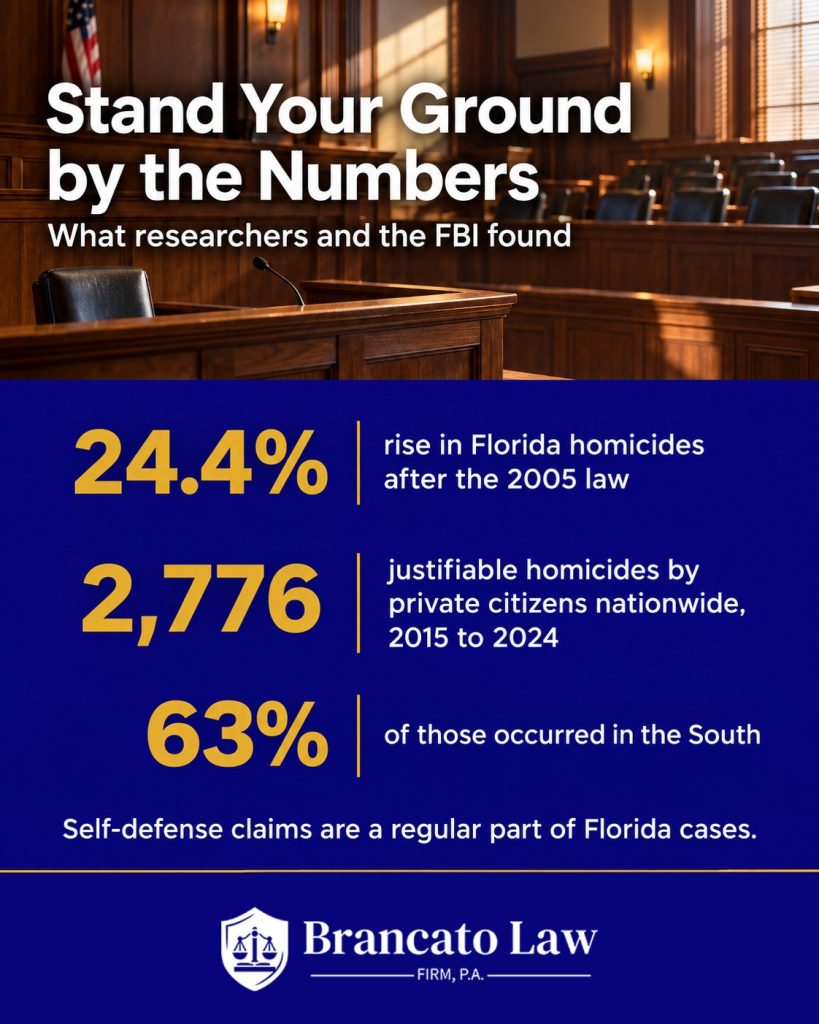
Self-defense claims are a regular part of homicide and assault litigation in Florida. Researchers who studied the law’s effects found that Florida’s homicide rate rose after the 2005 law took effect. In Evaluating the Impact of Florida’s “Stand Your Ground” Self-defense Law on Homicide and Suicide by Firearm, JAMA Internal Medicine (2017), Humphreys, Gasparrini, and Wiebe reported a 24.4% increase in homicides and found no change in suicides, which they used as a control.
The FBI’s Justifiable Homicide, 2015 to 2024 report counted 2,776 justifiable homicides by private citizens nationally over that decade, 63% of them in the South. Florida does not publish a current county breakdown of justifiable homicides. When self-defense is in play, the immunity hearing is often the most important hearing in the case.
How do our attorneys win immunity hearings?
Our attorneys win immunity hearings by preparing them like trials. You can learn more on our Tampa violent crime lawyer page and our Tampa homicide attorney page.
- We investigate the other person. Prior threats, prior violence, and a reputation for carrying a weapon are often decisive, as Spencer shows.
- We reconstruct the distances and timing. Video, measurements, and sometimes a reconstruction expert show how much time the client had to decide.
- We document the client’s limitations. Age, size, injuries, and medical conditions matter to whether fear was reasonable.
- We present the client’s conduct afterward. Calling 911, staying at the scene, and cooperating all support self-defense.
- We use mental health evidence when it applies. Our post on PTSD and self-defense in Florida explains how.
The results show the value of that preparation. Our firm won a not guilty verdict in a second-degree murder trial on self-defense. In October 2026, a veteran facing five years in prison on aggravated assault with a deadly weapon was accepted into Pretrial Intervention after our Stand Your Ground motion and the firm’s mitigation report. See our case results page. Past results do not guarantee future outcomes.
Frequently asked questions about Stand Your Ground hearings
Can Stand Your Ground apply to aggravated assault, not just homicide?
Yes. Section 776.012 covers both using and threatening to use force, so immunity can apply to aggravated assault, aggravated battery, and homicide charges. The Brancato Law Firm has used a Stand Your Ground motion to resolve an aggravated assault with a deadly weapon case through Pretrial Intervention.
Do I have to testify at a Stand Your Ground hearing?
No. The defendant does not have to testify, and under Jefferson v. State, 264 So. 3d 1019 (Fla. 2d DCA 2018), the defendant carries no evidentiary burden once the motion makes a facially sufficient claim. Our attorneys at The Brancato Law Firm decide with each client whether testimony helps more than it risks.
Does Stand Your Ground apply in my own home in a domestic dispute?
Partly. The no-duty-to-retreat rule applies in the home, but the presumption of reasonable fear in section 776.013 generally does not apply against another lawful resident unless an injunction or no-contact order was in place. The Brancato Law Firm handles self-defense claims in domestic violence cases with that limit in mind.
What is a prima facie claim of self-defense?
It is a sworn motion that, if the facts in it are true, would show the force was justified under Florida law. Our attorneys at The Brancato Law Firm draft these motions carefully, because in the Second District a facially sufficient motion is what triggers the State’s clear and convincing burden.
Can a Stand Your Ground denial be appealed?
It can be challenged before trial by a petition for a writ of prohibition, under Boston v. State, 326 So. 3d 673 (Fla. 2021), but there is no ordinary appeal for criminal defendants. The Brancato Law Firm prepares the record at the hearing with that petition in mind, so the appellate court has what it needs.
Can police arrest me if I acted in self-defense?
Under section 776.032(2), police may not arrest a person for using or threatening force unless they determine there is probable cause that the force was unlawful. When a client calls before an arrest, The Brancato Law Firm can present the self-defense evidence to investigators and prosecutors through pre-file advocacy.
Talk to our attorneys about a self-defense case
The evidence that wins an immunity hearing, including video, 911 calls, and the other person’s history, is easiest to find in the first days after an incident. The Brancato Law Firm, P.A., founded by Tampa Criminal Defense Attorney Rocky Brancato, will begin that investigation immediately and prepare the immunity motion. Call (813) 727-7159. You can call us at any hour. Our firm has Spanish-speaking staff, and attorney Jean-Luc Adrien speaks Spanish, Haitian Creole, and French. Read about our Spanish and Haitian Creole criminal defense services.
For more about our defense strategies, visit our Tampa Violent Crimes Defense page.
The Brancato Law Firm, P.A.
620 E. Twiggs Street, Suite 205, Tampa, FL 33602
(813) 727-7159
Serving Hillsborough, Pinellas, and Pasco Counties
The Brancato Law Firm, P.A. is a Tampa-based criminal defense practice. We are not affiliated with any other Brancato-named law firms.
Each case is unique, and past results do not guarantee future outcomes. This article is general information, not legal advice.
Visit Us

Tampa, FL 33602

Contact Us Now
Free Legal Consultation (813) 727-7159
