- Free Consultation 24/7: (813) 727-7159 Tap Here To Call Us


From First DUI to Death Penalty



How to Claim Self-Defense in a Florida Criminal Case (2026)



If you used force to protect yourself and now you are under arrest or under investigation, the single most important thing to understand is this: “I was defending myself” is not a feeling the system accepts on faith. It is a legal claim with specific elements, deadlines, and disqualifiers. Florida law tilts further toward the defender than almost any other state, but the facts do not speak for themselves. A prosecutor can look at the same incident you lived through and build a very different story from it.
At The Brancato Law Firm, we defend serious cases across Tampa Bay, and our founder has tried more than 150 jury trials to verdict, including cases won on self-defense. We have used Florida’s self-defense law to get charges dismissed before trial. This guide explains how a self-defense claim actually works in Florida: what you have to prove, how Stand Your Ground and the Castle Doctrine change the math, what a pretrial immunity hearing is, and what your early decisions (especially whether to talk to police) do to the rest of the case. We will not tell you that everything will be fine, because that depends on facts we cannot see. What we can do is explain the machine you are now inside of, so you understand the decisions in front of you.
What does “claiming self-defense” mean in Florida?
In Florida, self-defense is called the justifiable use of force, and it lives in Chapter 776, Florida Statutes. That chapter sets the rules for when force is legally allowed and when it is not.
This matters because “self-defense” in everyday speech is a moral statement: I did the right thing. In a courtroom it is a technical defense. The law does not ask whether you are a good person who was put in a terrible position. It asks whether your conduct fits the specific conditions the statute lays out. When those conditions are met, the force was justified and you are not guilty of a crime. When the prosecution can knock out even one of them, the claim weakens fast.
Florida’s framework did not invent self-defense. It expanded the older common-law right by removing the duty to retreat, adding strong presumptions inside the home, and creating immunity from prosecution. Those three additions are why Florida is one of the most defendant-favorable self-defense states in the country. But they are conditions, not guarantees. Knowing exactly what they require is the difference between a claim that holds and one that collapses under cross-examination.
The four things a self-defense claim has to prove
To raise self-defense successfully, the facts generally have to support four elements. Think of these as the legs of a table. Remove one and the whole thing falls.
| Element | What it means | Where prosecutors attack |
| Reasonable belief | You believed force was necessary, and a reasonable person in your shoes, knowing what you knew, would have believed the same | Arguing your fear was exaggerated or that you misread the situation |
| Imminent threat | The danger was immediate, not something already over or merely possible later | Arguing the threat had passed, or that you went looking for a confrontation |
| Proportional force | The level of force matched the threat (deadly force only for deadly threats) | Arguing you escalated, used a weapon against an unarmed person, or kept going after the threat ended |
| Lawful presence, no crime | You were somewhere you had a right to be and were not committing a crime yourself | Arguing you were trespassing, dealing drugs, or otherwise engaged in criminal activity |
A few points worth understanding, because they come up constantly:
- The danger does not have to be real, only reasonably perceived. Florida law allows a person to act in self-defense based on a threat that turns out to be a mistake, as long as the appearance of danger was real enough that a reasonable person would have believed it. If someone pulls what looks like a gun and it later turns out to be a phone, that does not automatically destroy the claim.
- “Reasonable” is judged from your position, not with hindsight. The standard asks what a reasonable and prudent person, in the same circumstances and knowing what you knew at that instant, would have done. Not what looks reasonable on a calm afternoon months later with all the facts laid out.
- Proportionality is where good claims go to die. The most common way a self-defense case falls apart is force that the jury sees as too much: continuing to strike after the other person is down, or answering a shove with a gun. Matching the response to the threat is everything.
Non-deadly force vs. deadly force in Florida (and the warning-shot trap)
Florida treats non-deadly and deadly force as two different things with two different triggers, both set out in the state’s use-of-force statute. Getting this distinction wrong is one of the most dangerous mistakes a defender can make, often without realizing it.
| Non-deadly force | Deadly force | |
| Definition | Force not likely to cause death or great bodily harm | Force likely to cause death or great bodily harm |
| When it’s justified | Reasonable belief it’s necessary to defend against another’s imminent unlawful force | Reasonable belief it’s necessary to prevent imminent death, great bodily harm, or a forcible felony |
| Defense of property | Allowed to stop a trespass or interference | Never allowed for property alone |
| Examples | Pushing, striking, pointing or displaying a firearm | Firing a gun, including a warning shot |
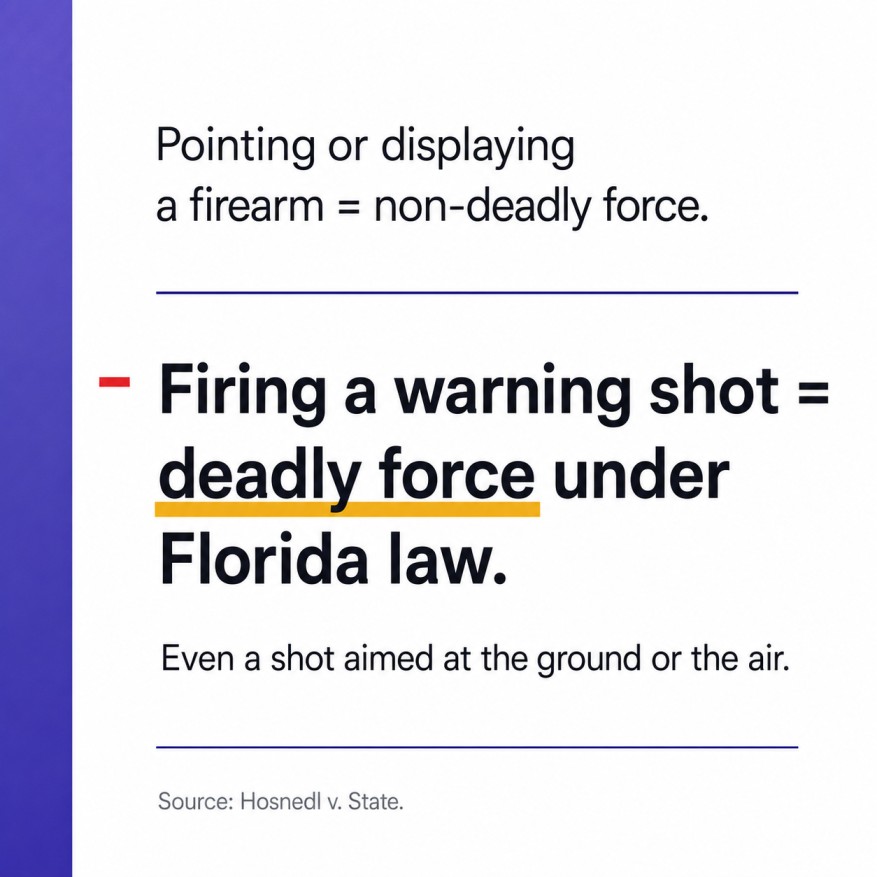
Here is the trap that catches people who believe they were being careful. Under Florida law, pointing or displaying a firearm is generally treated as non-deadly force, but firing it is deadly force as a matter of law, even a warning shot fired into the air or the ground (Hosnedl v. State). People often think a warning shot is the restrained, de-escalating choice. Legally, the moment the gun goes off, you have used deadly force, and you now have to justify it as if you had aimed at the person. That single fact has turned what felt like a measured response into a far more serious charge for many defenders, which is why firearm-related charges and self-defense so often have to be worked together.
What is “Stand Your Ground” and how does it remove the “you could have walked away” argument?
Stand Your Ground means you have no legal duty to retreat before defending yourself, as long as you are somewhere you have a right to be and are not committing a crime. Before 2005, Florida followed the common-law “duty to retreat,” which generally required a person to back away if they safely could before using deadly force in public. The 2005 law abolished that duty anywhere a person is lawfully present.
In practical terms, this takes a powerful weapon away from the prosecution. Without Stand Your Ground, a prosecutor can stand in front of a jury and ask, “Why didn’t you just leave? You could have walked away.” Under Florida law, that argument is off the table. The jury is not allowed to convict you on the theory that you should have retreated. You were entitled to stand your ground.
Florida is one of the majority of states that have adopted some form of Stand Your Ground, whether by statute or through court decisions. Only a small group of states, eleven in total, still impose a duty to retreat in public, and even those drop the requirement inside your own home.
| Stand Your Ground (Florida) | Duty to Retreat (e.g., NY, NJ, MA) | |
| Retreat required before deadly force in public | No, if lawfully present and not committing a crime | Yes, if safe retreat is possible |
| Castle Doctrine at home | Yes, plus a presumption of reasonable fear | Yes (no retreat at home), usually without Florida’s presumption |
| Effect of not retreating | No legal penalty | Can defeat the self-defense claim |
The strategic takeaway: in Florida, the fight is almost always about whether your belief and your level of force were reasonable, not about whether you had an escape route you ignored.
How does the Castle Doctrine protect you at home or in your vehicle?
The Castle Doctrine is the strongest version of self-defense Florida offers, and it applies to your home and your occupied vehicle. Under Florida’s home-protection statute, if someone unlawfully and forcibly enters your dwelling or occupied vehicle, the law presumes you held a reasonable fear of imminent death or great bodily harm. Florida is one of the few states that builds in this presumption of fear, rather than making you prove it from scratch.
That presumption is the whole game. Normally you have to prove your fear was reasonable. With the Castle Doctrine, the law starts by assuming it was, and the prosecution has to rebut that assumption. A documented forcible entry, such as a kicked-in door or a smashed window, dramatically strengthens the claim, because it triggers the presumption in your favor and forces the State onto the back foot.
“Dwelling” is defined broadly. It covers any building or conveyance with a roof designed for people to sleep in, temporary or permanent, including a tent. The presumption does not apply in a few situations, including when the person you used force against had a legal right to be there (for example, a co-owner or someone on the lease, absent a domestic violence injunction), when you were engaged in criminal activity, or when the person entering was a law enforcement officer performing official duties.
What is a Stand Your Ground immunity hearing?
This is the part most people have never heard of, and it can change everything. In Florida, self-defense is not only a defense you raise at trial. It is also grounds for immunity from prosecution, decided at a separate hearing before trial.
Section 776.032 grants true immunity, not just a defense. The statute says a person who used justified force is immune from criminal prosecution, and it defines “criminal prosecution” to include being arrested, detained, charged, and prosecuted. Your attorney raises this by filing a pretrial motion to dismiss. The judge then holds an evidentiary hearing and decides whether the immunity applies.
If the judge grants immunity, the case is over. It ends before a jury is ever seated. That is why a self-defense case in Florida often has two separate shots at winning, and the immunity hearing is the earlier one. These hearings carry the most weight in the most serious cases, including homicide cases where a dismissal means avoiding a trial that could otherwise put a person’s life on the line.
The 2017 burden shift that made Florida unique
For years, the defendant carried the burden at the immunity hearing. That changed in 2017. The Legislature amended the statute so that once the defendant makes a prima facie claim of self-defense (essentially, a basic showing that the defense applies), the burden shifts to the State to overcome immunity by clear and convincing evidence. Florida is the only state to put the burden on the prosecution at this stage.
| Stage | Who carries the burden | Standard of proof |
| Pretrial immunity hearing (since 2017) | Defendant makes a basic showing, then the State | State must overcome immunity by clear and convincing evidence |
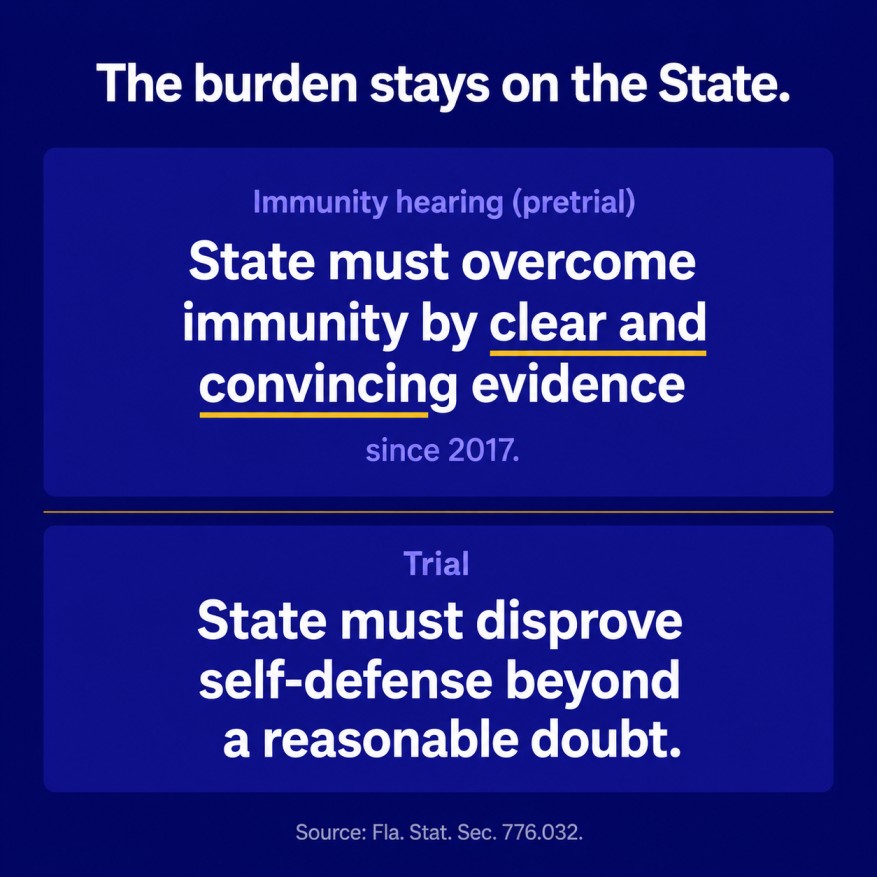
| Trial (jury) | The State | Must disprove self-defense beyond a reasonable doubt |
Read those two standards together and you can see why Florida is so favorable to defenders. At the hearing, the State has to clear a high bar to keep the case alive. At trial, it has to clear an even higher one. At no point does the law make you prove you are innocent. The State has to prove you were not justified.
Why the immunity hearing is not a free swing
Here is the catch, and it is a real one. To make your case at the immunity hearing, you may have to testify, and that testimony can be used against you later at trial.
So the immunity hearing is not a costless first attempt. If you take the stand at the hearing and the judge denies immunity, the prosecution now has your sworn account, locked in, to pick apart in front of the jury. Every word becomes material for cross-examination. A skilled prosecutor will compare your hearing testimony against every other piece of evidence, looking for any inconsistency.
This is exactly the kind of decision that separates experienced self-defense counsel from a lawyer who treats the immunity hearing as an obvious move. Sometimes leading with the hearing is clearly right, especially when the Castle Doctrine presumption applies or when you are the only surviving witness and the State may not be able to meet its burden. Sometimes the smarter play is to hold your testimony and fight at trial, where the State faces the higher standard. There is no universal answer. It depends on the specific facts, the evidence the State holds, and what your testimony exposes.
If you lose the immunity hearing, is the case over?
No. Losing immunity is not losing the case. This is one of the most important things for a frightened defendant to understand.
If the judge denies immunity, self-defense is still a full defense at trial. You get to make the entire argument again to a jury, and at trial the State faces the tougher standard: it must disprove self-defense beyond a reasonable doubt. Florida courts have made clear that once any evidence of self-defense is presented, the burden is on the State to disprove it. That is why people describe Florida self-defense cases as having “two bites at the apple.”
A denial at the immunity hearing is a hard day, but the fight continues at trial under rules that still favor you.
There is also a procedural option to challenge a denial of immunity before trial through an appellate filing, which an experienced attorney will evaluate depending on the situation.
When does a self-defense claim collapse?
Florida’s law is generous, but it has hard limits. The claim is unavailable, or badly weakened, in these situations:
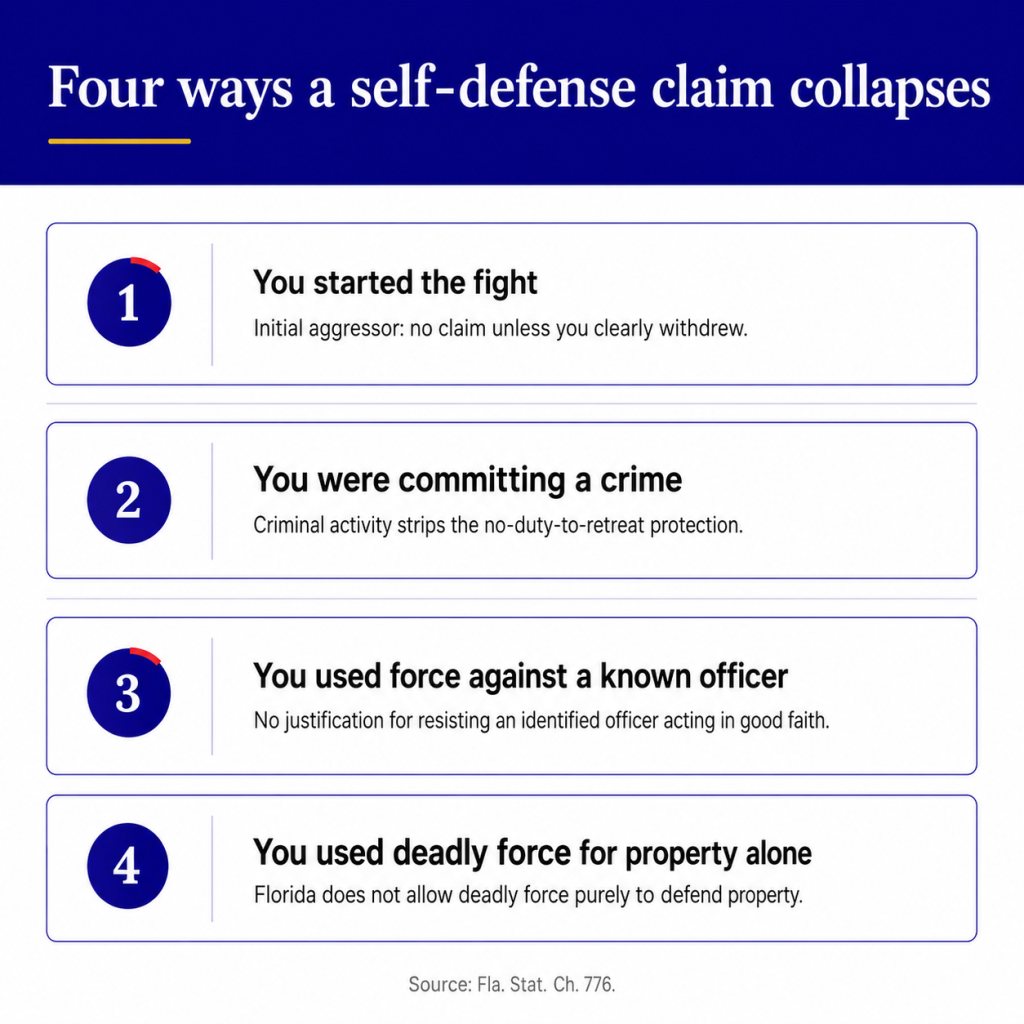
- You were the initial aggressor. If you started the fight, you generally cannot claim self-defense, unless you genuinely withdrew, clearly communicated that you were withdrawing, and the other person kept coming. Florida’s aggressor rule means provoking a confrontation and then using force is the fastest way to lose the defense.
- You were committing another crime. Engaging in criminal activity strips away the “no duty to retreat” protection and can disqualify the claim entirely. The benefit of Stand Your Ground is reserved for people who were lawfully present and law-abiding at the time.
- You used force against a known law enforcement officer. Under the statute on resisting arrest, you are not justified in using force to resist an arrest by an officer who is acting in good faith and is known, or reasonably appears, to be an officer. Immunity does not apply against an identified officer performing official duties.
- You used deadly force to protect property alone. Florida does not allow deadly force purely to defend property. Deadly force in a property situation is only justified if you were preventing an imminent forcible felony, not simply stopping a theft or trespass.
The reason these matters require careful legal analysis is that prosecutors look hard for any of these facts. A claim that looks clean to the person who lived it can have a disqualifier buried in it that only surfaces under scrutiny. Identifying that early, and addressing it, is core defense work.
What should you do in the first 24 hours after a self-defense incident?
The early hours shape the entire case. What you do now, while the adrenaline is still up, often matters more than anything that happens months later in a courtroom. Three things matter most:
- Stay silent and ask for a lawyer. This is the hardest advice to follow and the most important. When you believe you did nothing wrong, the instinct is to explain, to make the officers understand. Resist it. Even a truthful, innocent explanation can be reframed by a prosecutor into something that sounds like an admission. You have the right to remain silent and the right to counsel. Use both. Say you want a lawyer, and then stop talking.
- Preserve evidence before it disappears. Surveillance footage gets overwritten. Witnesses leave and their memories fade. Injuries heal. Early counsel can move quickly to secure video, lock down witness statements, and document physical evidence and medical records while they still exist. In self-defense cases, the evidence that proves your fear was reasonable is often the first to vanish.
- Get experienced criminal defense counsel involved immediately. Self-defense cases are fact-intensive and procedure-heavy. The decisions made in the first days, including whether to pursue an immunity hearing and how to protect your testimony, set the trajectory of everything that follows.
If you already gave a statement to police before reading this, do not panic, and do not assume the case is lost. It complicates things, but experienced counsel deals with this situation regularly. The most useful thing you can do now is stop talking to anyone except your attorney.
What does experienced counsel change in a self-defense case?
A self-defense claim is won or lost on judgment calls that a first-time defendant has no way to evaluate alone. Whether to testify at the immunity hearing. Whether the Castle Doctrine presumption applies to your facts. Whether a disqualifier is lurking in the timeline. How to preserve the evidence that makes your fear look reasonable to a jury. Whether to lead with the pretrial motion or hold your fire for trial.
These are not abstract questions. They are the actual machinery of the case, and they get decided in the first weeks. At The Brancato Law Firm, our work on self-defense and other violent crime cases draws on attorney Rocky Brancato’s background as a former Chief Operations Officer of the Hillsborough County Public Defender’s Office, where he helped lead the largest criminal defense operation in the Tampa Bay region. That system-level knowledge informs how we evaluate self-defense cases: where the State’s proof tends to be weak, how prosecutors build around a self-defense claim, and which early moves protect a client’s position. We pursue Stand Your Ground immunity hearings where the facts support it, and we have used these motions to get serious charges dismissed before trial. Each case is unique, and past results do not guarantee future outcomes.
A public defender can do excellent work, and for someone who cannot afford private counsel, that is the right path. But public defender offices carry heavy caseloads. A self-defense case demands the time to investigate fast, prepare the immunity motion carefully, and make the strategic call on testimony with full attention. That bandwidth is what serious self-defense preparation requires.
Frequently asked questions about claiming self-defense in Florida
These are the questions we hear most often from people in this situation. You can find answers to more general questions on our Tampa criminal law FAQ page.
Does Florida law require me to retreat before defending myself?
No. Under Florida’s Stand Your Ground law, you have no duty to retreat as long as you are somewhere you have a legal right to be and are not committing a crime. The prosecution cannot argue to a jury that you should have walked away.
Is a warning shot considered self-defense in Florida?
Firing a warning shot is treated as deadly force under Florida law, even if you aimed away from the person. That means you have to justify it under the deadly-force standard: a reasonable belief that force was necessary to prevent imminent death, great bodily harm, or a forcible felony. Many people assume a warning shot is the safe, restrained choice, but legally it is not treated that way.
Can self-defense get my charges dismissed before trial?
Yes. Florida allows a pretrial Stand Your Ground immunity hearing where a judge can dismiss the case before it ever reaches a jury. Since 2017, once you make a basic showing of self-defense, the State must overcome immunity by clear and convincing evidence to keep the case alive.
What happens if I already talked to the police?
A prior statement makes the case more complicated, but it does not automatically end your self-defense claim. The most important step now is to stop talking to anyone but your attorney and let experienced counsel manage all further communication with law enforcement.
Does claiming self-defense mean I have to prove I’m innocent?
No. At trial, the State must disprove your self-defense claim beyond a reasonable doubt. At the pretrial immunity hearing, the State must overcome immunity by clear and convincing evidence once you make a prima facie showing. The burden does not rest on you to prove your innocence.
Talk to a Tampa criminal defense attorney about your self-defense case
If you used force to protect yourself and you are now under arrest or under investigation, the early decisions matter most, and they are being made right now. The Brancato Law Firm defends self-defense and serious felony cases throughout Hillsborough, Pinellas, and Pasco Counties. To talk through your situation in a free and confidential consultation, call (813) 727-7159 or reach out through our contact page. We will give you a straight answer about where you stand and what comes next.
This article is general legal information, not legal advice. Self-defense outcomes are highly fact-specific and depend on how police, prosecutors, judges, and juries interpret the evidence in a particular case.
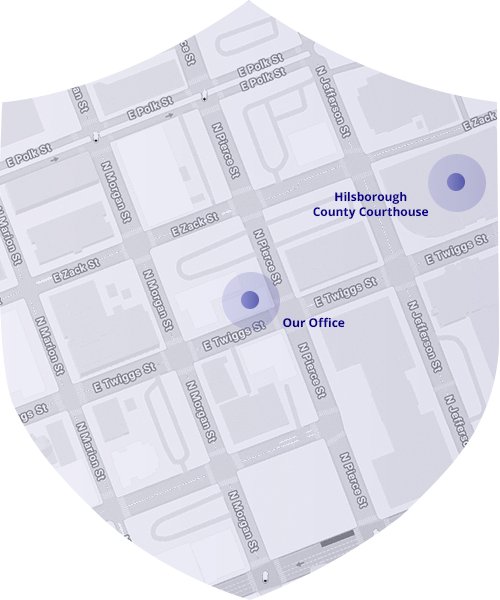
Visit Us
Tampa, FL 33602
Contact Us Now
Free Legal Consultation (813) 727-7159