- Free Consultation 24/7: (813) 727-7159 Tap Here To Call Us


From First DUI to Death Penalty



Can You Own a Gun If You Use Marijuana in Florida?


Rewrite/update date: September 2, 2026
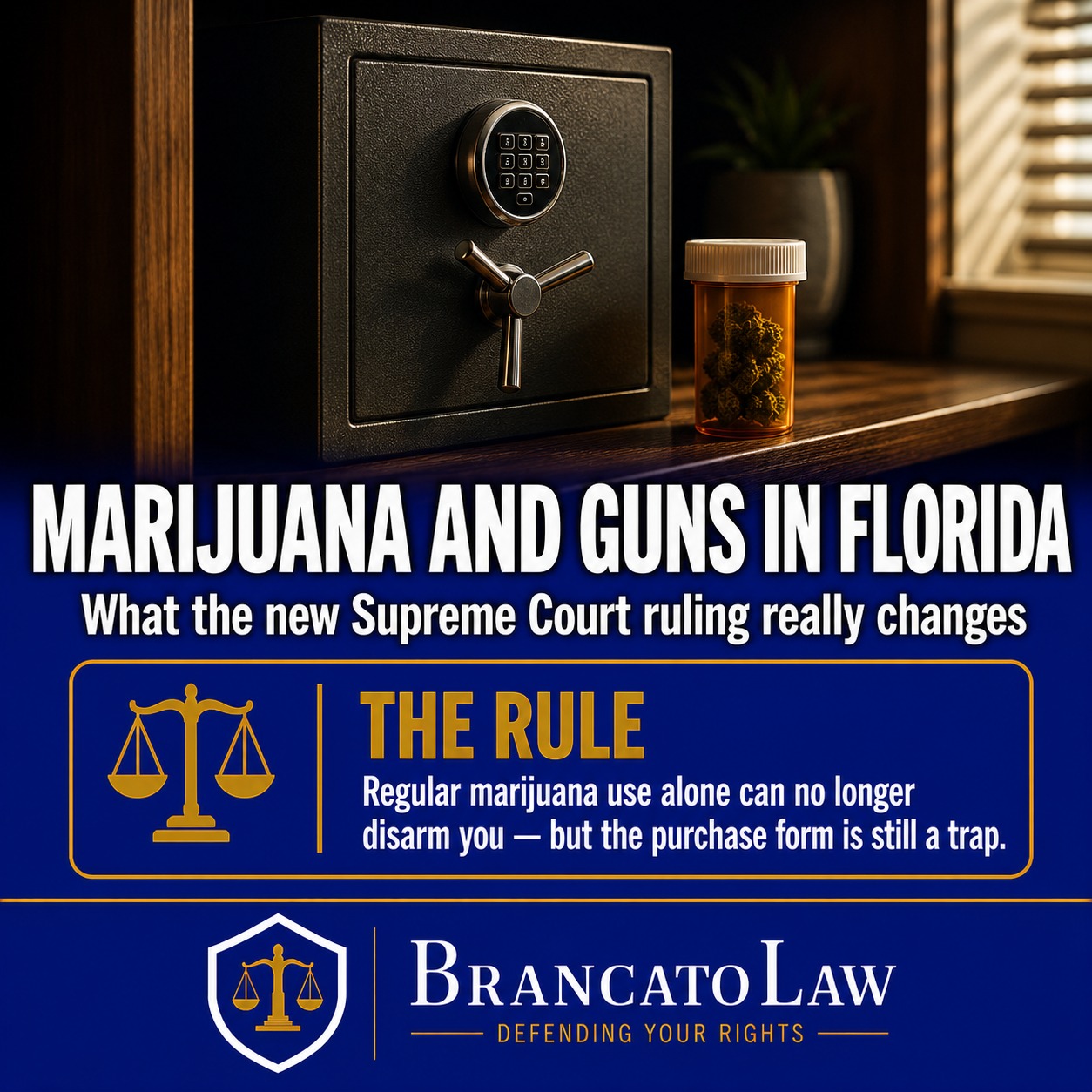
| Florida does not automatically take away your gun rights because you use medical marijuana — but federal law does make it a crime for any “unlawful user” of a controlled substance to possess a firearm, and marijuana is still a controlled substance under federal law. In June 2026, the U.S. Supreme Court held in United States v. Hemani that prosecuting someone under that federal ban based on regular marijuana use alone — without proof the person is dangerous or incapacitated — violates the Second Amendment. That decision changes the risk calculus, but it did not legalize guns for every drug user, and lying on a federal firearms purchase form is still a felony. |
I’m Rocky Brancato, founder of The Brancato Law Firm, P.A., a Tampa criminal defense firm. I have served as a police academy legal instructor teaching officers the constitutional limits of search, seizure, and arrest, and I served as Chief Operating Officer of the Hillsborough County Public Defender’s Office. Today our attorneys defend gun and drug charges across Tampa Bay, and this question — marijuana and guns — now sits at the center of one of the fastest-moving areas in criminal law.
What Does Federal Law Say About Marijuana Users and Guns?
Federal law makes it a crime for any person “who is an unlawful user of or addicted to any controlled substance” to possess a firearm or ammunition. That ban lives in 18 U.S.C. § 922(g)(3), and because marijuana remains a controlled substance under federal law, it has always applied to marijuana users — including Florida’s hundreds of thousands of registered medical marijuana patients. A state card has never been a defense to the federal statute, because Florida’s medical marijuana program does not change what federal law says.
The federal ban shows up in a second place that trips up ordinary gun buyers: ATF Form 4473, the questionnaire every purchaser completes at a licensed dealer. The form asks directly whether you are an unlawful user of marijuana or any other controlled substance, and it warns that marijuana remains federally unlawful regardless of state medical programs. Answering falsely is a separate federal felony. Our attorneys have seen careful, law-abiding people put themselves in federal jeopardy with one checkbox — which is why the Supreme Court’s 2026 decision matters so much, and why it must be read carefully rather than treated as a green light.
What Did the Supreme Court Decide in United States v. Hemani?
In United States v. Hemani, No. 24-1234 (U.S. June 18, 2026), the U.S. Supreme Court held that the government’s prosecution of a regular marijuana user under § 922(g)(3) violated the Second Amendment — the first time the Court has struck down the application of a federal gun ban to drug users. Ali Hemani was prosecuted for having a gun in his home while being a regular marijuana user; the government’s theory was that regular use of a controlled substance, by itself, was enough to disarm him. It did not claim he was addicted, that he was high when found with the gun, or that he posed any particular danger.
Justice Gorsuch’s majority opinion, affirming the Fifth Circuit 7-2, rejected that theory under the historical-tradition test. The government leaned on founding-era “habitual drunkard” laws, but the Court found those laws targeted people whose drinking left them “practically incapacitated and incapable of managing their affairs” — not everyone who drank regularly. The Court also stressed how the modern statute operates: it “automatically divests an individual of his constitutional right to bear arms the moment he becomes an unlawful user . . . all without any pre-deprivation process,” while the historical laws required some proceeding — a conviction, a guardianship, a hearing — before anyone lost liberty. And the Court pointed out that the government’s own conduct undercuts the claim that all marijuana users are categorically dangerous: federal prosecutors have been directed to curtail enforcement against marijuana users, most states have legalized some use, and the government itself recently moved certain marijuana products down the federal schedules.
For Florida gun owners who hold medical marijuana cards, the practical takeaway is this: after Hemani, a federal prosecution built on nothing more than the fact that you regularly use marijuana is unconstitutional. That is a real shield. But it is a shield with defined edges, described next.
What Did Hemani Leave Undecided?
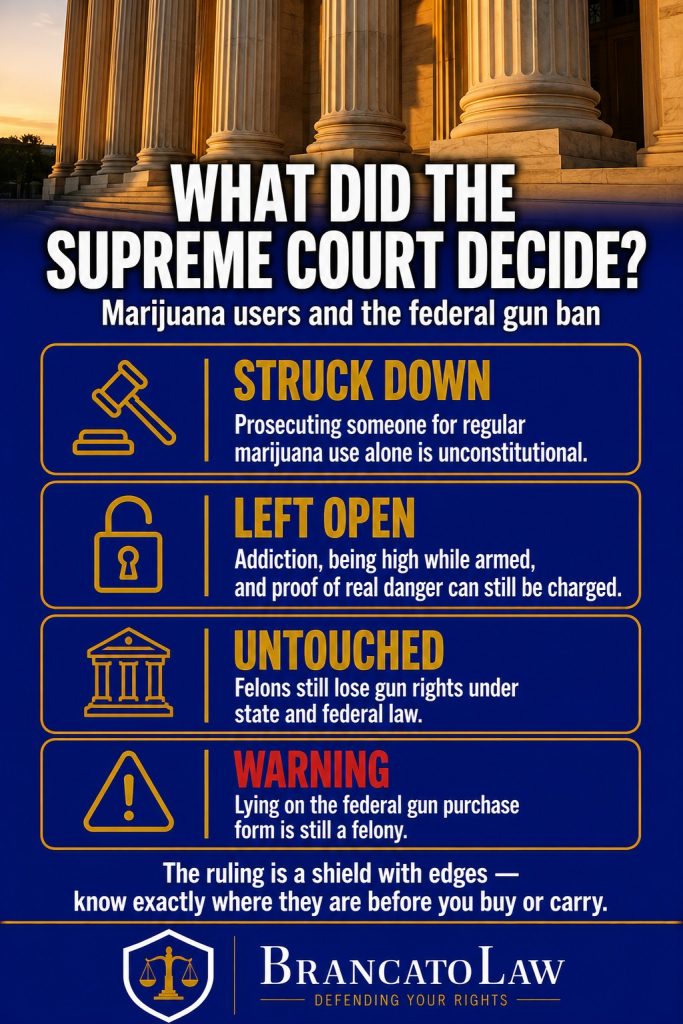
Hemani was an as-applied ruling, not a repeal — § 922(g)(3) is still on the books, and the Court expressly reserved several theories the government may still pursue. Anyone mixing marijuana and firearms in Florida should understand exactly where the line now sits.
| Question | Where the law stands after Hemani |
|---|---|
| Prosecution for regular marijuana use alone | Unconstitutional — the government cannot disarm you just because you use marijuana regularly |
| Prosecution of someone who is addicted | Left open — the Court did not decide the “addicted to” prong of § 922(g)(3) |
| Prosecution of someone armed while presently intoxicated | Left open — bans on carrying while high remain on the table |
| Prosecution with individualized proof of dangerousness | Left open — the Court said proof that a specific person’s drug use makes them dangerous may change the analysis |
| Felon-in-possession bans (§ 922(g)(1)) | Untouched — felony convictions still strip gun rights under both federal law and Fla. Stat. § 790.23 |
| Lying on ATF Form 4473 | Still a federal felony — Hemani is not a license to answer the marijuana question falsely |
That last row deserves emphasis. Nothing in Hemani changed the purchase paperwork. Until ATF revises Form 4473, a medical marijuana patient who answers “no” to the unlawful-user question is still committing a federal crime, whatever the Second Amendment now says about possession prosecutions. This is exactly the kind of trap where getting legal advice before you act is worth far more than defending a charge afterward.
Does a Florida Medical Marijuana Card Take Away Your Gun Rights?
No — holding a Florida medical marijuana card does not, by itself, disqualify you from owning or possessing a firearm under Florida law. Florida’s medical marijuana statute, Fla. Stat. § 381.986, created a physician-certification system with a patient registry, and nothing in Florida’s gun statutes makes registered patients prohibited possessors.
Florida’s concealed-carry licensing statute, Fla. Stat. § 790.06, does contain drug-related disqualifiers that patients should know about. The Department of Agriculture must deny a license to an applicant who “chronically and habitually uses alcoholic beverages or other substances to the extent that his or her normal faculties are impaired,” and to anyone found guilty of a chapter 893 drug crime within the three years before applying. A conviction for a controlled-substance offense also triggers revocation of an existing license. So while the card itself is not a disqualifier, a marijuana-related conviction — even a misdemeanor — can cost you your carry license for years.
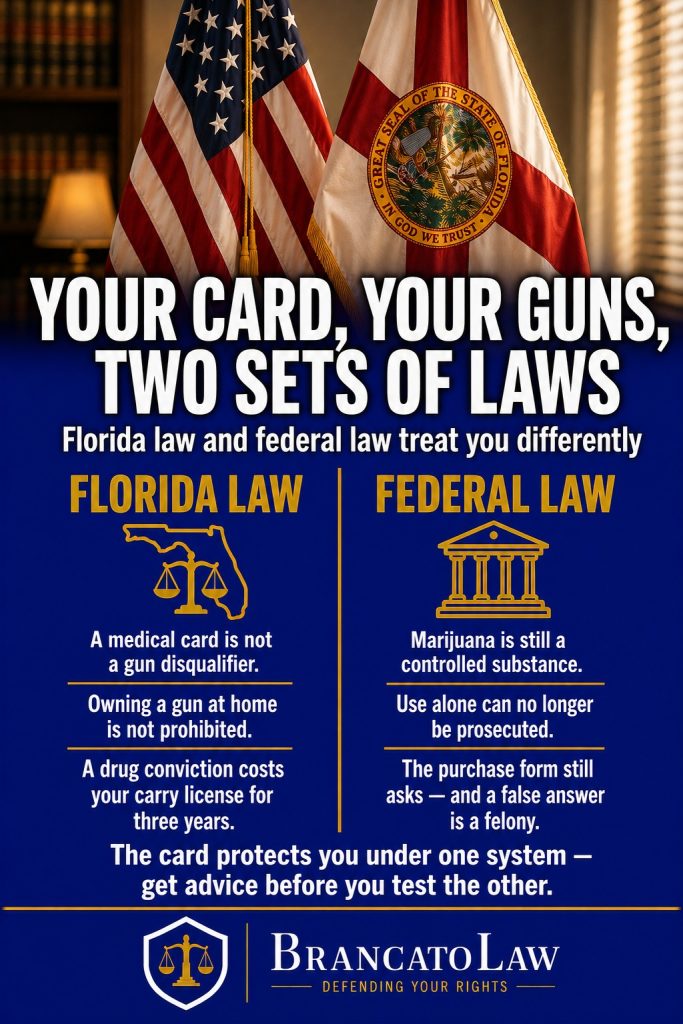
| Situation | Florida law | Federal law after Hemani |
|---|---|---|
| Medical marijuana cardholder owns a gun at home | Not prohibited | Prosecution for use alone unconstitutional; addiction/danger theories reserved |
| Cardholder buys a gun from a licensed dealer | Not prohibited by state law | Form 4473 question still applies — false answer is a felony |
| Recreational (unlicensed) marijuana user with a gun | Possession of cannabis remains a crime under ch. 893 | Same Hemani analysis, but the drug possession itself is chargeable |
| Drug conviction within 3 years | Concealed-carry license denied/revoked under § 790.06 | Purchase may also be blocked by background-check flags |
| Convicted felon with a gun | Felony under § 790.23 | Felony under § 922(g)(1) — Hemani does not help |
Where Is Medical Marijuana Use Still Illegal Even With a Card?
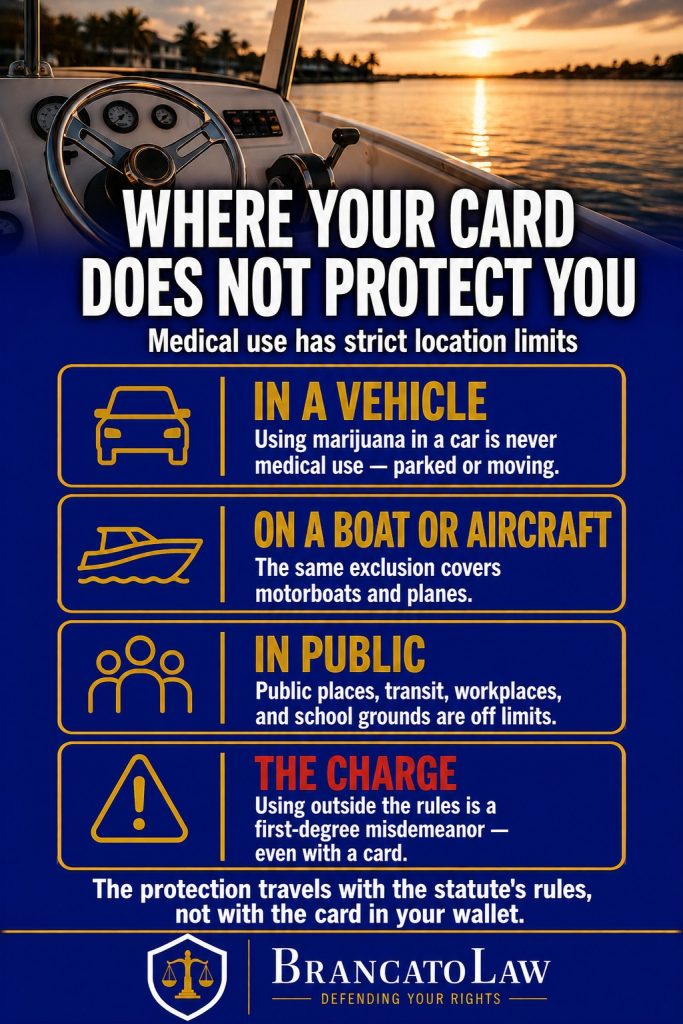
A Florida medical marijuana card authorizes “medical use” — and the statute defines that term to exclude specific places, so using marijuana in the wrong location remains a crime even for a fully registered patient. Under § 381.986, “medical use” does not include using or administering marijuana on public transportation, in any public place, in an enclosed indoor workplace, on school grounds, or — critically for Tampa Bay’s boaters and drivers — “in a school bus, a vehicle, an aircraft, or a motorboat,” with a narrow exception for low-THC cannabis not in a form for smoking. A qualified patient who uses marijuana in plain view of the public or in a vehicle or boat commits a first-degree misdemeanor.
The Sixth District Court of Appeal enforced exactly this limit in Tanaka v. State, No. 6D2024-1581 (Fla. 6th DCA June 19, 2026), a Collier County case where the court affirmed a conviction by quoting the statute’s rule that “medical use” does not cover marijuana in a vehicle, aircraft, or motorboat. The lesson for the hundreds of thousands of Floridians with cards: your protection travels with the statute’s definitions, not with the card in your wallet. Smoking in your car — parked or moving — is outside the program, and once an officer smells it, you may face both the misdemeanor and a vehicle search. Our attorneys have litigated where the odor-of-cannabis doctrine now stands in the Tampa Bay area; see our analysis of Florida’s Second DCA limiting the plain-smell doctrine.
Can 18-to-20-Year-Olds Carry a Concealed Gun in Florida Now?
As of mid-2026, Florida’s ban on concealed-carry licenses for adults under 21 has been declared facially unconstitutional by one of Florida’s appellate courts — a major shift, though not yet a statewide settled rule. In Eubanks v. State, No. 4D2025-1698 (Fla. 4th DCA June 17, 2026), a Broward County prosecution for carrying a concealed firearm, the Fourth District held that § 790.06(2)(b) — which requires concealed-carry applicants to be 21 — “is facially unconstitutional as it relates to 18- to 20-year-olds.” The court reasoned that 18-to-20-year-olds are part of “the people” the Second Amendment protects, that the State produced no historical tradition of categorically disarming young adults, and — quoting the U.S. Supreme Court’s Rahimi decision — that a group cannot be “disarmed simply because he is not ‘responsible.’” The court reversed the young man’s conviction outright.
Two cautions before anyone under 21 straps on a holster. First, Eubanks is a Fourth District decision; Tampa, Hillsborough, Pinellas, and Pasco Counties sit in the Second District, which has not yet spoken, and the State may seek further review in the Florida Supreme Court. Second, the decision addressed concealed carry — it did not touch Florida’s open-carry ban or the separate federal rules for handgun purchases by under-21 buyers. Anyone in that age group facing a carry charge should treat Eubanks as a powerful defense to raise, not a settled right to rely on. For the broader landscape — permitless carry under Fla. Stat. § 790.01, where guns are still prohibited, and how gun charges are penalized — see our guide to gun crime laws in Florida.
How Do These Decisions Change a Florida Gun Charge Defense?
They add constitutional attacks to a defense toolbox that already starts with the Fourth Amendment. When our attorneys defend a Tampa Bay gun charge involving marijuana, the analysis now runs on three tracks at once.
- Was the stop and search lawful? Most marijuana-and-gun cases begin with a traffic stop, a pat-down, or a search justified by the smell of cannabis. If the stop was unlawfully prolonged or the frisk exceeded its limits, the gun itself can be suppressed — see our breakdown of stop and frisk law in Florida.
- Is the charge constitutional after Hemani and Eubanks? A federal § 922(g)(3) charge premised on use alone is now unconstitutional as applied. A state concealed-carry charge against an otherwise law-abiding 18-to-20-year-old is squarely challenged by Eubanks. These arguments are raised by motion — and where a district conflict exists, preserving the issue protects your appeal.
- Does the statute even fit the facts? Was the marijuana “medical use” within § 381.986? Was the firearm actually “possessed”? Was a license exception satisfied? The State must prove every element, and pre-file advocacy — engaging the State Attorney’s Office before charges are formalized — can resolve borderline cases before they ever reach a courtroom.
What Should You Do If You Are Arrested on a Marijuana-Related Gun Charge?
Move fast, and say nothing about your marijuana use to anyone but your lawyer. Statements about how often you use — the exact fact that decides whether the government can build a lawful case after Hemani — are routinely volunteered in the first police interview, and they are admissible. In Hillsborough County, a felony gun arrest means booking at Orient Road Jail, first appearance within 24 hours, and formal charging decisions by the State Attorney’s Office in the weeks that follow. That charging window is where an early defense presentation can change everything: our attorneys use it to put suppression problems, Hemani and Eubanks issues, and medical-marijuana documentation in front of the prosecutor before the filing decision is made. If you were just arrested, our step-by-step guide to what to do after being arrested in Tampa walks through the first 72 hours.
For more about our defense strategies, visit our Hillsborough County criminal defense page.
Frequently Asked Questions
Can I buy a gun in Florida if I have a medical marijuana card?
Florida law does not prohibit the purchase, but the federal purchase form still asks whether you are an unlawful user of marijuana, and marijuana remains federally unlawful even for state medical patients. Answering falsely on ATF Form 4473 is a federal felony that Hemani did not eliminate. Our attorneys advise cardholders on lawful paths before purchase, because this is far easier to get right in advance than to defend afterward.
Did the Supreme Court legalize gun ownership for all drug users?
No. United States v. Hemani, No. 24-1234 (U.S. June 18, 2026), held only that prosecuting a person for regular marijuana use alone violates the Second Amendment. The Court expressly left open prosecutions of people who are addicted, armed while presently intoxicated, or shown by individualized proof to be dangerous — and it did not touch the felon-in-possession ban.
Can I keep a gun in my car along with my medical marijuana?
Carrying a firearm in your vehicle can be lawful under Florida’s permitless-carry framework, but using marijuana in a vehicle is never “medical use” under Fla. Stat. § 381.986 — it is a first-degree misdemeanor even for cardholders. Combining the two also invites a search and a charging decision that treats you as an unlawful user. Keep the marijuana sealed, in its original packaging, and never use it in the car or on a boat.
Can an 18-year-old legally carry a concealed gun in Florida in 2026?
The Fourth District held in Eubanks v. State that the 21-and-over rule in § 790.06(2)(b) is facially unconstitutional, but that ruling comes from South Florida’s appellate district and the issue is not finally settled statewide. In Tampa Bay — the Second District — prosecutors may still file the charge, and the defense must raise Eubanks by motion. The Brancato Law Firm, P.A. litigates these constitutional challenges and preserves them for appeal.
Will a marijuana conviction cost me my concealed weapons license?
Yes — a finding of guilt for a chapter 893 drug crime requires revocation of a Florida concealed-carry license, and it bars a new license for three years under Fla. Stat. § 790.06. That collateral consequence is one more reason to fight a “minor” possession charge rather than plead it out quickly. We routinely defend possession cases with the license consequences as a central goal.
Does Florida report medical marijuana patients to the federal government?
Florida’s medical marijuana use registry is a state system, and Florida law treats patient records as confidential; the registry is not a public list handed to federal authorities. But dispensary purchases, statements to police, and social media can all establish “unlawful user” status in a federal case. If you hold a card and own firearms, The Brancato Law Firm, P.A. can walk you through how the two programs actually interact.
Marijuana-and-gun law is moving faster right now than at any point in decades — Hemani and Eubanks both landed within a single week of June 2026, and the next round of decisions will decide how far they reach in Tampa Bay. If you are facing a gun or marijuana charge, or you hold a medical card and want to keep your gun rights intact, call the attorneys of The Brancato Law Firm, P.A. — founded by Tampa Criminal Defense Attorney Rocky Brancato — at (813) 727-7159 today. Constitutional defenses are strongest when they are raised before the State’s filing decision, not after.
The Brancato Law Firm, P.A.
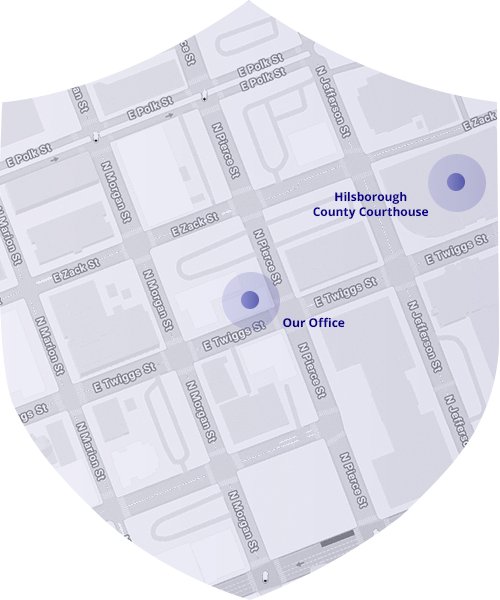
620 E. Twiggs Street, Suite 205, Tampa, FL 33602
(813) 727-7159
Serving Hillsborough, Pinellas, and Pasco Counties
The Brancato Law Firm, P.A. is a Tampa-based criminal defense practice. We are not affiliated with any other Brancato-named law firms.
Visit Us
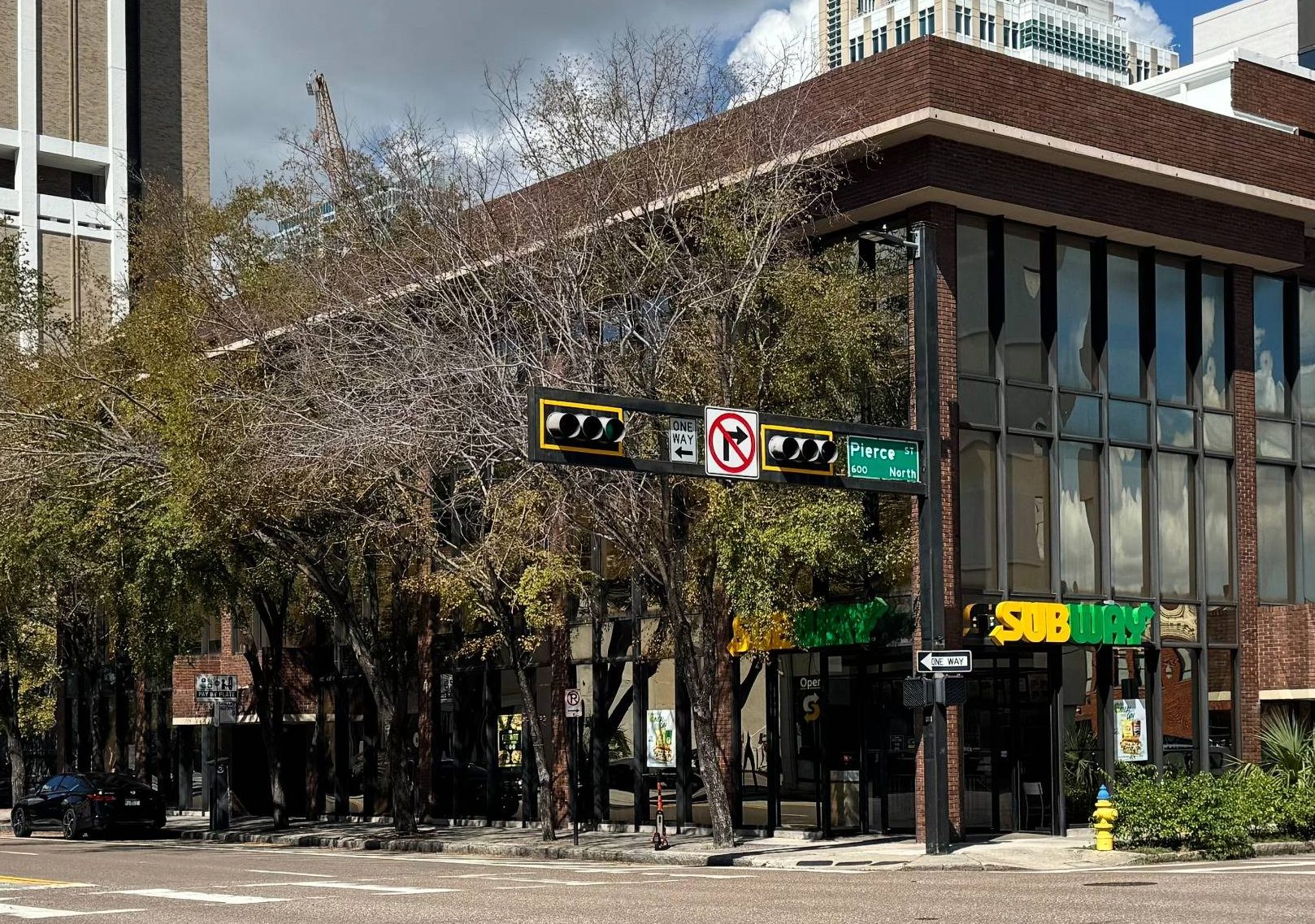
Tampa, FL 33602
Contact Us Now
Free Legal Consultation (813) 727-7159