- Free Consultation 24/7: (813) 727-7159 Tap Here To Call Us


From First DUI to Death Penalty



How Florida’s Risk Protection Order (Red Flag) Law Works in 2026



A Florida risk protection order (RPO) is a civil court order that takes away your right to possess, purchase, receive, or control firearms and ammunition. Only a law enforcement officer or agency can file the petition. If the agency asks for emergency relief, a judge can enter a temporary order the same day it is filed, with no notice to you and no chance for you to respond first. Firearms are surrendered the moment you are served. The hearing that decides whether the restriction continues happens within roughly two weeks, and no attorney is appointed to represent you at any stage.
Rocky Brancato was among the first attorneys in Florida to take risk protection order cases when the law took effect in 2018, and he was featured in local coverage of the new law that May. The Brancato Law Firm handles these cases today across Hillsborough, Pinellas, and Pasco Counties. If you have been served, the timeline is the part to understand first, because the schedule is short and the hearing arrives fast.
What Is a Risk Protection Order in Florida?
A risk protection order is a civil proceeding under section 790.401, Florida Statutes. Law enforcement asks a circuit court to find that a person poses a significant danger of causing personal injury to themselves or others by having access to firearms or ammunition. If the court agrees, it orders the firearms and ammunition surrendered and prohibits the person from possessing, purchasing, or receiving more while the order is in effect.
An RPO is not a criminal charge and does not produce a conviction. It also does not do the things people expect from a domestic injunction. It does not order you to stay away from anyone, remove you from your home, set child time-sharing, or order support.
| Risk protection order | Domestic violence injunction | Criminal case | |
| Who files | Law enforcement officer or agency only | The person seeking protection | The State Attorney |
| Standard of proof | Clear and convincing evidence at the final hearing | Preponderance of the evidence at the final hearing | Beyond a reasonable doubt |
| Court-appointed attorney | None | None | Yes, where constitutionally required |
| Main relief | Firearm and ammunition surrender, purchase ban, concealed license suspension | No contact, residence exclusion, time-sharing, support, firearm restrictions | Conviction, sentence, probation |
| Produces a criminal record | No | No | Yes, on conviction |
The rules that govern a domestic violence injunction come from section 741.30, and they matter here for a reason we cover below. Section 790.401 borrows that statute’s evidentiary procedure for the RPO hearing.
Who Can File a Risk Protection Order in Florida?
Only a law enforcement officer or a law enforcement agency. Florida is narrower on this point than most red flag states, and it is the detail readers get wrong most often, because national coverage describes states where family members can petition directly.
A spouse, parent, sibling, adult child, dating partner, therapist, coworker, school employee, or neighbor cannot file a Florida RPO petition. They can report concerns to law enforcement, and that report can become the factual basis for a petition. The decision to file belongs to the agency, and the agency becomes the named petitioner. A 2023 proposal to extend standing to parents, guardians, spouses, and siblings died in committee.
The petition is filed in the circuit court either where the agency is located or where the respondent lives. There is no filing fee, service fee, or bond.
Is Florida’s Red Flag Law Still in Effect?
Yes. House Bill 6029 would have repealed section 790.401 effective July 1, 2026. It was filed on January 6, 2026, referred to the House Criminal Justice Subcommittee, and died there on March 13, 2026 without a committee amendment, floor amendment, or recorded vote. The statute was not repealed and continues to operate exactly as it did before.
If you saw news coverage of the repeal effort and assumed the law was on its way out, that assumption will not help you at a hearing. The process below is the process you are in.
The Two Stages of a Florida Risk Protection Order
Almost every RPO moves through two separate proceedings with two different standards of proof. Knowing which stage you are in tells you what the court is actually deciding.
Stage One: The Temporary Ex Parte Order
Law enforcement can ask for a temporary order at the same time it files the petition. The allegations supporting temporary relief have to be based on the officer’s personal knowledge and have to show that the feared injury may occur in the near future.
The court holds the temporary hearing on the day the petition is filed or the next business day, in person or by telephone. You are not notified, you are not present, and you do not testify or cross-examine anyone. The standard at this stage is reasonable cause, which is materially lower than what the petitioner has to prove later. If the judge finds reasonable cause, the temporary order is issued.
Two things are worth knowing about the temporary order. It is optional. The Florida Courts petition form lets law enforcement seek a final RPO without asking for temporary relief at all, and some agencies do exactly that. It also expires on its own at the full hearing. A temporary order is not a one-year order, and it is not a finding that the allegations are true.
Stage Two: The Full Hearing
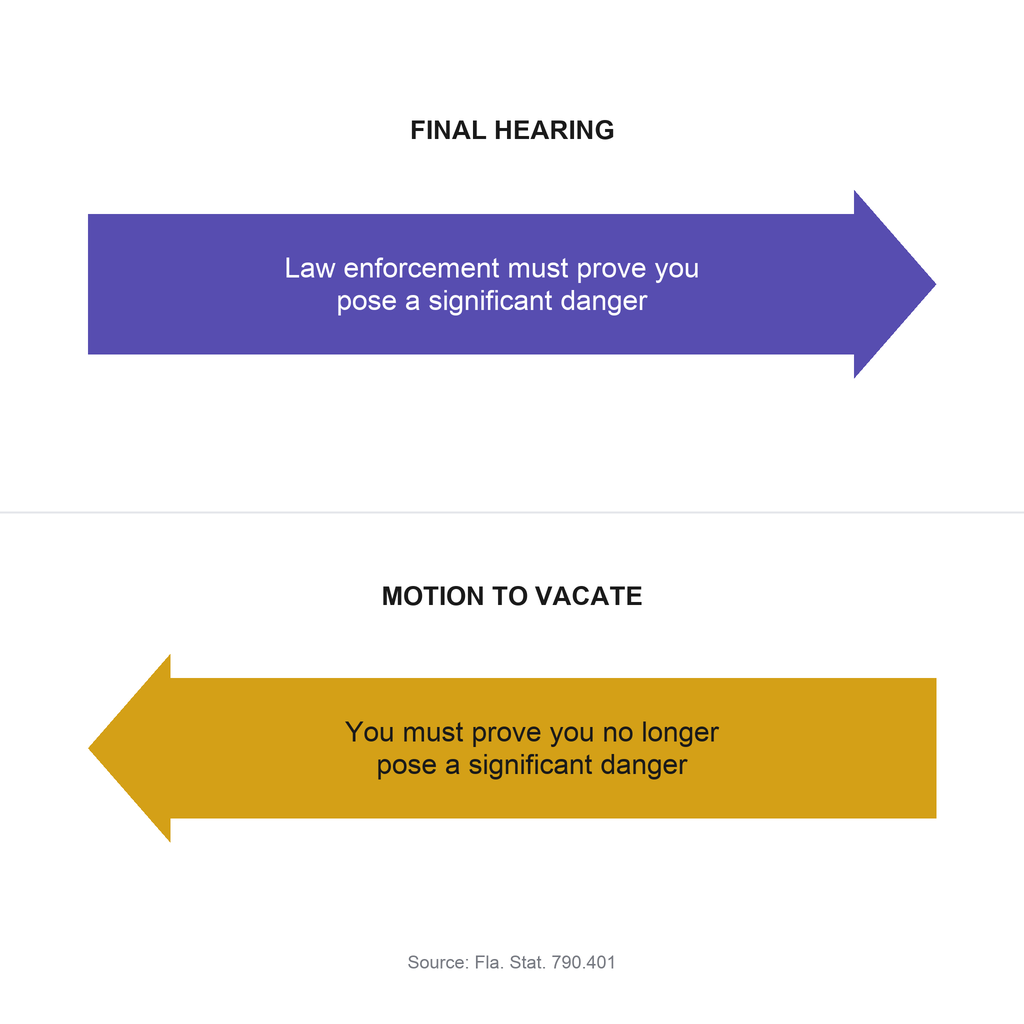
This is where the case is decided. At the noticed hearing, the petitioner must prove by clear and convincing evidence that you pose a significant danger of causing personal injury to yourself or others by having custody or control of, or purchasing, possessing, or receiving, a firearm or ammunition. If that burden is met, the court issues a final order for whatever period it considers appropriate, up to 12 months. If the petition is denied, the court has to state its particular reasons.
The statute lists a nonexclusive set of things a court may consider, including recent acts or threats of violence, acts or threats within the prior 12 months, serious mental illness or recurring mental health issues, violations of prior protective orders, a domestic violence history, threats involving a weapon, reckless display or use of a firearm, stalking, a violent crime history, corroborated substance abuse, and recent firearm acquisition.
The full hearing is a real evidentiary proceeding. Evidence has to be submitted in writing with copies to the other side, or presented under oath with the parties present. The rules of evidence apply to the same extent they do in a domestic violence injunction case.
Florida Risk Protection Order Timeline
Every deadline below comes from section 790.401. Several are measured in hours.
| Event | Statutory timing |
| Temporary ex parte hearing | Day the petition is filed or the next business day |
| Full hearing | No later than 14 days after the order setting the hearing |
| Clerk forwards papers for service | Within 6 hours |
| Sheriff or authorized officer serves respondent | As soon as possible, any day and any time |
| Firearm, ammunition, and concealed license surrender | Immediately upon service, or immediately after the hearing if the respondent is present |
| Surrender receipt filed with the court | Within 72 hours after service |
| Compliance hearing after a final order | No later than 3 business days, unless canceled on satisfactory proof |
| Clerk enters the order in the case reporting system | Within 24 hours |
| Clerk forwards the order to law enforcement | Within 24 hours |
| Order entered in FCIC and NCIC | Upon receipt by the agency |
| Clerk notifies the concealed licensing agency | Within 3 business days |
| Concealed weapon license suspended | Immediately upon receipt and confirmation |
One detail circulates widely in the wrong form. The order does not have to be entered into the FCIC and NCIC databases within 24 hours. The clerk has 24 hours to forward it, and the law enforcement agency enters it on receipt.
What a Risk Protection Order Actually Restricts
The scope is broader than most people expect. While the order is in effect, you may not:
- Possess a firearm or ammunition
- Purchase or receive a firearm or ammunition
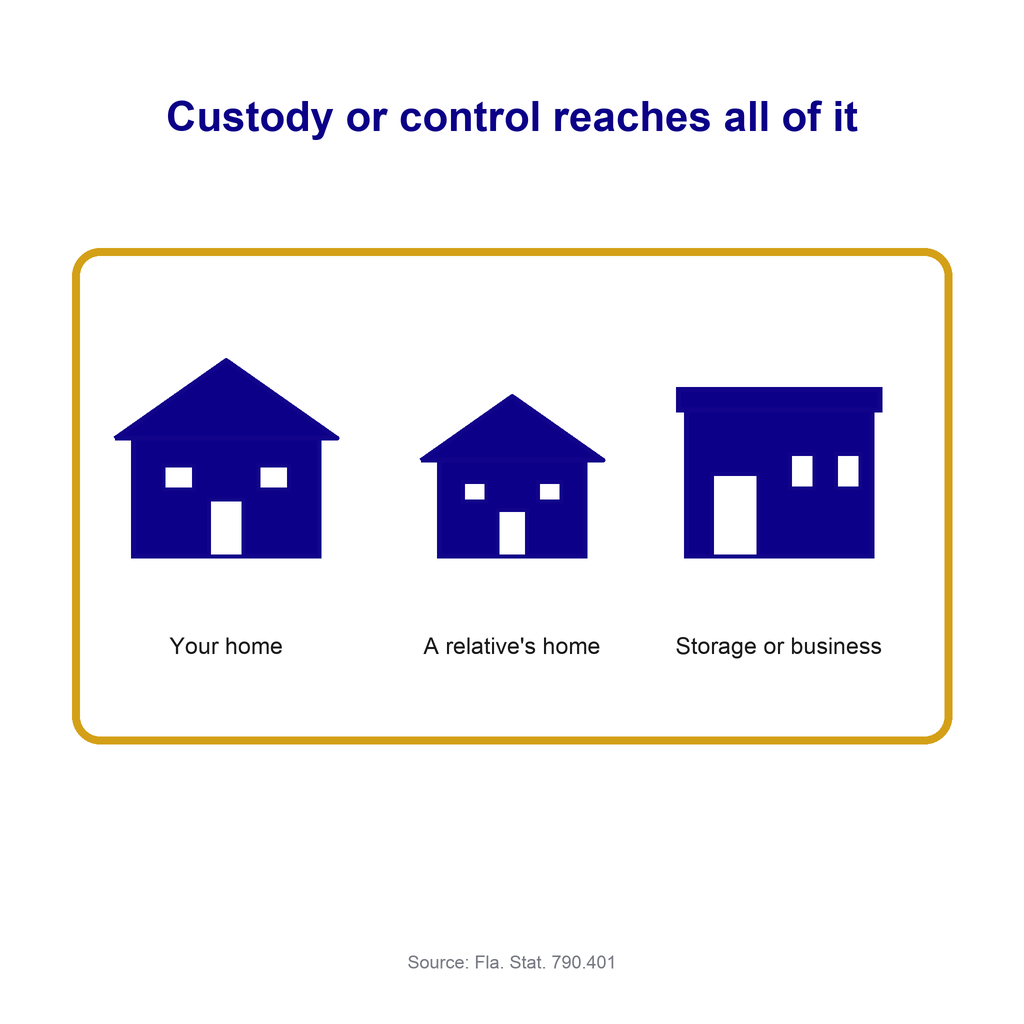
- Have custody or control of a firearm or ammunition, which can include items you do not physically carry
- Hold a Florida concealed weapon or firearm license, which is surrendered and then suspended
The surrender obligation has no grace period. It covers ammunition as well as firearms, and it attaches the moment you are served.
The order does not authorize an unlimited search of your home. The serving officer takes what is surrendered or what is located under lawful authority. If the officer has probable cause to believe firearms or ammunition were not disclosed, the officer can seek a search warrant, and the court must issue one when probable cause exists. Firearms lawfully owned by a spouse or another qualifying third party can be returned to that owner or transferred to an eligible third party, subject to a background check and storage conditions that keep them out of your reach.
An RPO also does not automatically make you a federally prohibited person. The federal prohibition at 18 U.S.C. § 922(g)(8) applies only to a qualifying order entered after notice and an opportunity to participate, restraining conduct against an intimate partner or that partner’s child, and containing specific findings or language. A temporary ex parte Florida RPO ordinarily does not meet the notice element, and a final Florida RPO does not automatically qualify either, because Florida RPOs can involve self-harm risk, non-intimate targets, or generalized danger. The Florida prohibition is fully enforceable on its own regardless.
Violating a Risk Protection Order Is a Separate Crime
This is where a civil order turns into criminal exposure. Under section 790.401(11)(b), a person who has custody or control of, purchases, possesses, or receives a firearm or ammunition knowing they are prohibited by an RPO commits a third-degree felony.
The offense turns on knowledge of the prohibition. Once you have been served, conduct that was lawful the day before becomes a felony. That holds even if you have never been arrested for anything in your life, and even if the underlying allegations are later found unproven at the hearing. Filing a materially false sworn statement to obtain an RPO is also a third-degree felony under subsection (11)(a).
If you own firearms stored somewhere else, held by a relative, or kept at a business, raise them with an attorney immediately rather than assuming the order only reaches what was in the house.
There Is No Court-Appointed Attorney in a Florida RPO Case
This part catches people off guard. The statute says no party is required to be represented by an attorney and bars an award of attorney fees. No public defender is appointed. No private attorney is appointed at public expense. If you cannot afford counsel, the hearing goes forward anyway.
The Legislature has looked at the gap and left it in place. House Bill 1455 would have given RPO respondents a right to retain counsel and a right to appointed counsel if indigent. It cleared the House Criminal Justice Subcommittee in February 2026 and died in the Justice Budget Subcommittee on March 13, 2026. A similar 2024 proposal also failed. A 2024 House staff analysis stated the baseline directly: section 790.401 does not provide a right to counsel, and no other statute authorizes appointment for an indigent RPO respondent.
There is a second gap alongside it. Section 790.401 does not require the court to record the hearing. Florida Courts’ own approved form for extension hearings says so and notes that a party who wants a transcript may arrange for a court reporter at that party’s expense. An appellate challenge generally needs an adequate record, and no one will create one for you.
How the Baker Act Connects to Risk Protection Orders
Many RPO cases begin with a mental health crisis rather than a criminal incident, and families often have no idea the two systems are wired together.
Under section 394.463, an officer taking a person for an involuntary examination may seize firearms or ammunition in that person’s possession when the person poses a potential danger and has made a credible threat of violence against another person. If the officer removes the person from a residence, the officer may seek voluntary surrender of other firearms kept there. When additional firearms are not surrendered or are believed to be somewhere else, the statute expressly authorizes law enforcement to petition for an RPO.
The seizure that happens under the Baker Act alone is short-lived. Property seized or voluntarily surrendered has to be made available for return no later than 24 hours after the person documents release from examination or treatment, and the return process cannot take longer than seven days. That deadline does not apply if an RPO or another legal prohibition requires continued retention. In practice, the RPO is often what keeps the firearms from coming back on discharge.
Clinical records are a separate question. Baker Act records are generally confidential. Section 394.4615 creates a narrow mandatory disclosure route. When a patient communicates a specific threat of serious bodily injury or death to an identified or readily available person, and the provider believes the patient has the apparent intent and ability to carry it out imminently, the facility must give law enforcement enough information to act, and initiating an RPO is one of the listed responses. Ordinary therapy notes do not become court exhibits under that provision.
Two points cut in opposite directions here, and both are true. Being Baker Acted does not by itself establish the elements of an RPO. And a clean discharge does not end the petition. In Davis v. Gilchrist County Sheriff’s Office, the First District upheld a final RPO even though a mental health evaluator had released the respondent and did not consider him a continuing risk of violence, reasoning that the statute does not make an evaluator’s recommendation dispositive. The judge weighs the whole record.
None of that is an argument against the statute. When someone is genuinely in crisis and has made a credible threat, the law is doing what the Legislature built it to do. Our work sits with the other set of cases: the petition built on a secondhand account, a comment taken out of context, an argument that got reported, or a mental health event that has already been treated and resolved. Those cases still have to be proven with evidence at a hearing. If you or someone in your family is in crisis right now, the 988 Suicide and Crisis Lifeline is available by call or text, and asking for help is not something a court holds against you. Our work on Baker Act cases and criminal mental health defense sits at exactly this intersection, including competency evaluations and Mental Health Court in Hillsborough County.
What You Can Do If a Risk Protection Order Is Filed Against You
You cannot participate in the temporary hearing. The full hearing is your first real opportunity, which is why the two-week window matters so much.
At the hearing, a respondent can:
- Testify and present documentary evidence
- Call relevant witnesses, including treating providers, family members, coworkers, and character witnesses
- Cross-examine the officer and any witnesses the petitioner calls
- Object to inadmissible evidence under the rules that apply in domestic violence injunction cases
- Challenge hearsay, which is not automatically admissible just because the case is civil and expedited
- Arrange for a court reporter so there is a transcript if an appeal becomes necessary
The hearsay point does real work in these cases. Petitions are frequently built on what a spouse says a therapist said, or what a coworker says a friend heard. Written allegations in a petition do not prove themselves at the final hearing. Those statements may still come in, because a statement can be nonhearsay, can fall within an exception, or can be replaced by live testimony from the person who actually said it. The petitioner has to do that work rather than rely on the paperwork.
After a final order is entered, there is one more route:
- Motion to vacate. You may file one written request for a hearing to vacate after the final order, and one more after each extension. The hearing is set no sooner than 14 days and no later than 30 days after the request is served on the petitioner. At that hearing the burden flips: you must prove by clear and convincing evidence that you no longer pose a significant danger.
- Extension hearings. At least 30 days before the order expires, the clerk notifies the petitioner. The petitioner can move to extend within that window. Each extension can run up to 12 months, continued danger must again be proven by clear and convincing evidence, and the statute sets no limit on how many extensions can follow. Twelve months is the maximum length of a single order, and the restriction can be renewed.
Getting Firearms Back After a Risk Protection Order Ends
Expiration does not trigger an automatic return. Once the order ends without extension, or is vacated, you have to request the property back from the agency storing it.
Before returning anything, law enforcement must run a background check confirming you are not otherwise barred under state or federal law and verify the RPO is no longer in effect. Family or household members receive notice before firearms or ammunition are returned. A surrendered concealed weapon license is a separate track, reinstated by the Department of Agriculture and Consumer Services only after it confirms eligibility. Firearms and ammunition left unclaimed for a year after an order vacating the RPO may be disposed of under the agency’s policy, so the request should not wait.
If you want a fuller picture of how firearm possession rules work in Florida outside the RPO context, our overview of Florida gun crime laws and our breakdown of the 2025 open carry ruling cover the surrounding law.
How Often Are Risk Protection Orders Used in Tampa Bay?
The best available government tally comes from the Office of the State Courts Administrator, which compiled statewide RPO activity from March 2018 through June 2022.
| County | Temporary orders granted | Final orders granted | Motions to vacate granted | Extensions granted |
| Hillsborough | 1,197 | 1,028 | 28 | 623 |
| Pinellas | 1,245 | 1,095 | 10 | 105 |
| Pasco | 327 | 334 | 2 | 13 |
| Statewide | 9,689 | 8,757 | 139 | 2,080 |
Those numbers carry a caveat the report states itself. Each clerk supplied the data, the figures were not audited, and counties used inconsistent reporting conventions, which is why some county totals do not reconcile cleanly. A 2026 peer-reviewed study in the American Journal of Preventive Medicine independently collected more than 8,600 petitions filed across 65 counties between March 2018 and December 2021 and found wide variation in how heavily different counties use the law.
Local practice varies too, even though the deadlines and burdens do not. In Hillsborough County, the Thirteenth Judicial Circuit’s current administrative order lets any sworn law enforcement officer in the county serve RPO papers rather than limiting service to the sheriff, and RPO matters are administered within the probate, guardianship, mental health, and trust division. Pinellas and Pasco sit in the Sixth Judicial Circuit, where filing, assignment, and hearing logistics can differ. None of that changes the 14-day hearing window, the clear and convincing standard, or the immediate surrender obligation.
Other Consequences of a Florida Risk Protection Order
- Your concealed license is suspended. This is the one automatic licensing consequence in the statute. Reinstatement happens only after the order ends and the state confirms you are otherwise eligible.
- The case is a public record. Although section 790.401 designates RPOs as mental health cases for reporting purposes, the Florida Supreme Court’s electronic access order treats them as publicly viewable circuit civil matters rather than confidential files. Background screeners can find them. Protected clinical records and confidential identifiers remain separately protected.
- Employment effects depend on your job. Section 790.401 does not suspend professional or occupational licenses across the board. Real consequences still show up where a job requires personal firearm possession, a concealed license, a security clearance, or disclosure of civil injunctions. Those turn on your regulator, employer, and any applicable collective bargaining agreement rather than on the RPO statute itself.
- A related case can be running at the same time. An RPO frequently arrives alongside a domestic violence defense matter or a pending criminal investigation. Decisions in one proceeding can affect the other, including anything you say under oath.
Talk to a Tampa RPO Attorney Before Your Hearing
The timeline is the whole problem. From service to the hearing that decides the outcome, you may have less than two weeks to gather records, line up witnesses, prepare cross-examination, and decide whether to testify in a civil proceeding while a criminal investigation may still be open. No one is appointed to do that for you, and no transcript exists unless someone arranges one.
The Brancato Law Firm handles risk protection order cases across Hillsborough, Pinellas, and Pasco Counties, and Rocky Brancato has worked on them since the statute took effect in 2018. You can read more about our approach to gun crimes defense and our work as Hillsborough County criminal defense attorneys.
If you have been served, or if firearms were taken during a Baker Act call and you have been told a petition is coming, call or reach out through our contact page for a confidential consultation.
Visit Us
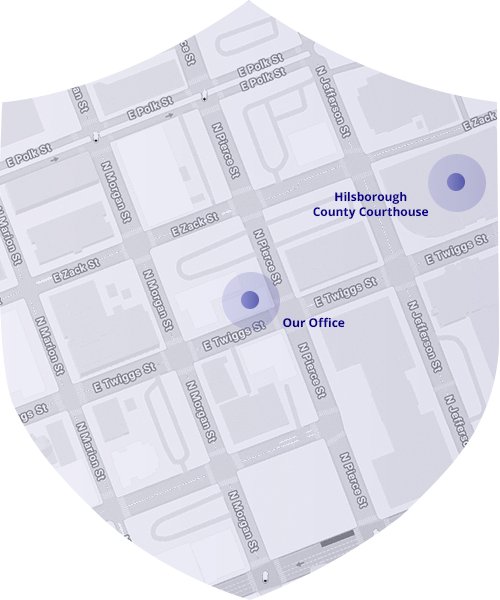
Tampa, FL 33602
Contact Us Now
Free Legal Consultation (813) 727-7159