

From First DUI to Death Penalty



How Does ShotSpotter Gunshot Detection Work in Tampa? (2026)


In brief: ShotSpotter, now sold by SoundThinking, uses microphones mounted in a neighborhood to detect loud bangs, locate them by comparing when each sensor heard the sound, and send an alert to police after a company reviewer labels the sound as gunfire. Tampa police have used it in East Tampa since 2019. An alert tells officers that shots may have been fired near a spot on a map; it does not identify who fired them, so a stop or frisk based on an alert can be challenged, and ShotSpotter evidence at trial is open to expert attack.
If police stopped you in East Tampa minutes after a gunshot alert, the stop itself may be the weakest part of the State’s case. I’m Rocky Brancato, founder of The Brancato Law Firm, P.A., a Tampa criminal defense firm. As a former police academy instructor, I taught officers what reasonable suspicion requires, and I have tried more than 150 jury trials to verdict. Our attorneys look at what the officer actually knew at the moment of the stop, not what was found afterward.
How Does ShotSpotter Work?
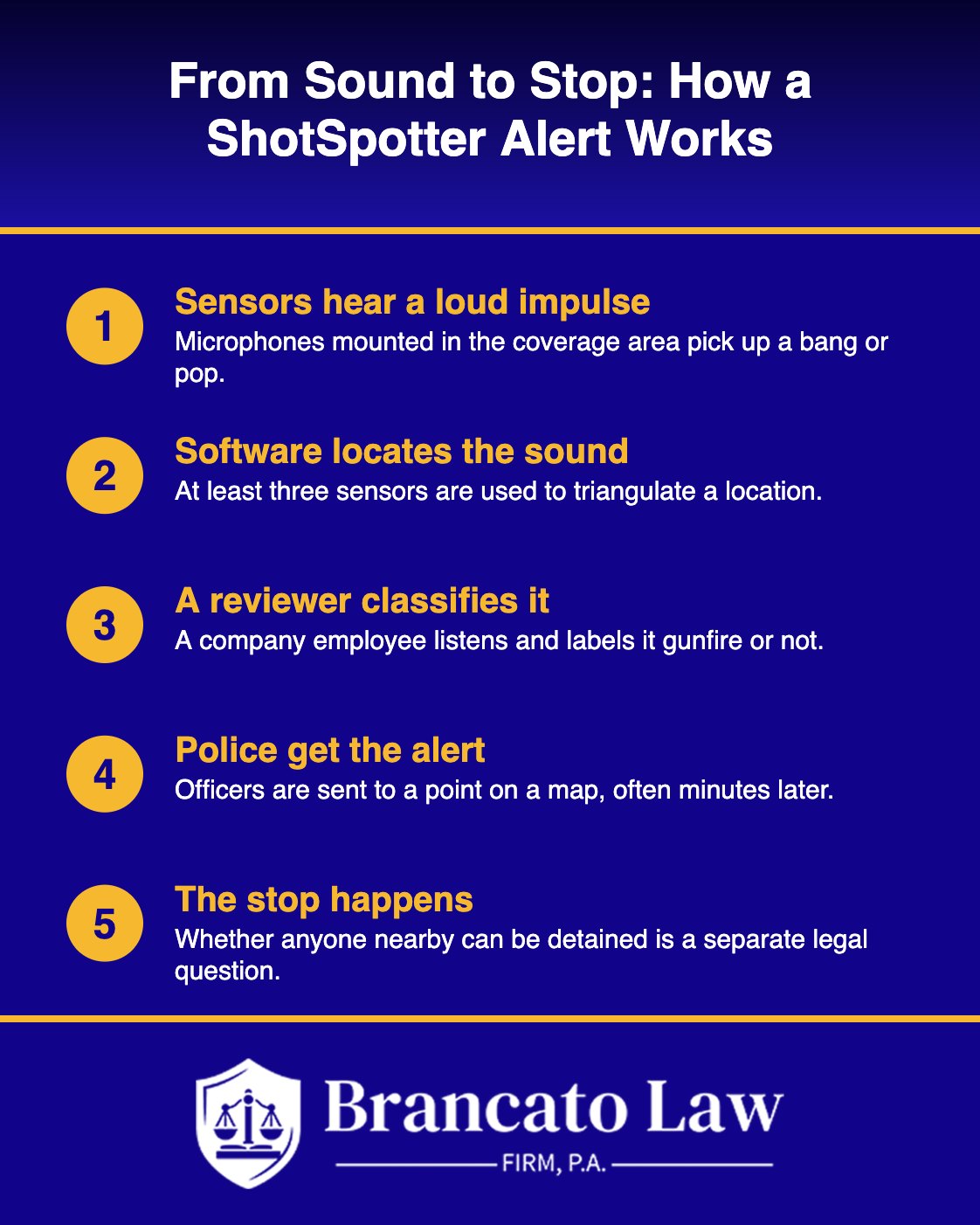
ShotSpotter is an acoustic gunshot detection system: sensors hear an impulsive sound, software estimates where it came from, and a person reviews it before police are alerted. Florida’s Fourth District described the system in J.A.R. v. State, 374 So. 3d 25 (Fla. 4th DCA 2023), a Riviera Beach juvenile gun case. According to the testimony there, GPS-enabled sensors pass sound data to a location server, which uses multilateration (comparing when at least three sensors heard the same sound) to estimate the location, and then a reviewer classifies the sound before the alert is published to officers’ phones and patrol computers.
That human review step matters for the defense. The classification is a judgment call by someone at the company listening to a short clip, and fireworks, backfires, and construction noise can sound alike. The alert is also only as precise as the system’s estimate; the expert in J.A.R. testified to accuracy within a 25-meter radius, which in a dense neighborhood can cover several houses and a street.
Does Tampa Use ShotSpotter?
Yes. The Tampa Police Department has used ShotSpotter since 2019 in a roughly four-square-mile area of East Tampa, according to reporting by the Tampa Bay Times and FOX 13. Tampa City Council approved a $280,000 renewal funded by an FDLE grant in November 2023. In June 2024, council first voted against another $280,000 renewal and then approved it on reconsideration on June 20, 2024, as Creative Loafing Tampa reported. That June 2024 vote is the most recent renewal we could confirm in public reporting.
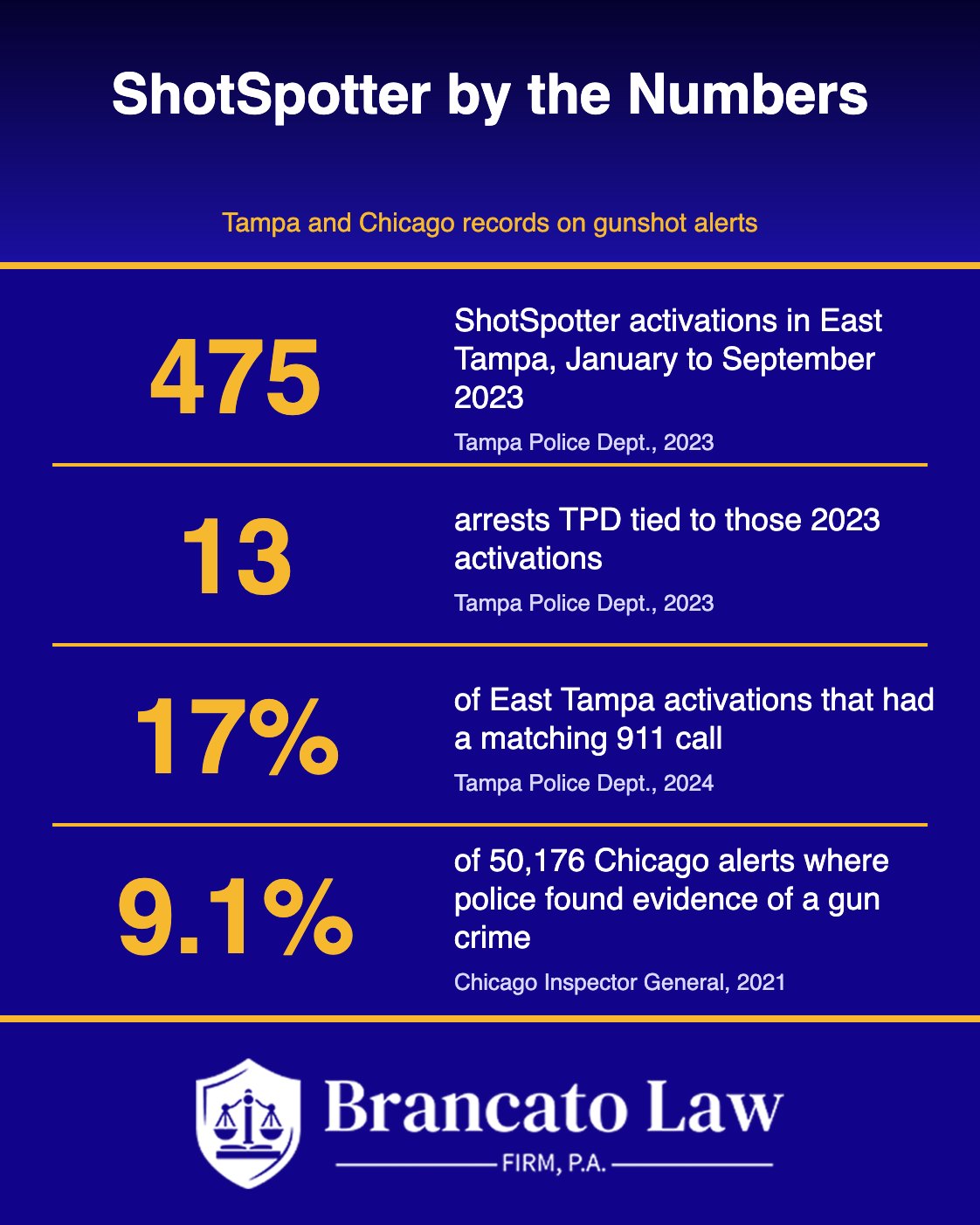
Tampa’s own numbers show how often alerts lead somewhere. In 2023, TPD reported 475 ShotSpotter activations in East Tampa from January through September, and 13 arrests tied to them. In 2024, TPD told FOX 13 that 17% of East Tampa activations had a matching 911 call. The Hillsborough County Sheriff’s Office used ShotSpotter from 2016 to 2019 at a cost of about $800,000 and chose not to renew, according to Creative Loafing Tampa. We have not found a public record of current ShotSpotter use by the Sheriff’s Office, St. Petersburg police, or other Pinellas or Pasco agencies.
Because Tampa’s sensors cover only part of East Tampa, a ShotSpotter-based stop in the city will almost always happen there. When an alert starts the encounter, the State typically uses it to explain why officers were there, as it did in J.A.R., so the defense case starts with the dispatch records and the alert’s time stamps.
How Accurate Is ShotSpotter?
ShotSpotter’s accuracy is disputed, and the best public data shows that most alerts do not lead to evidence of a gun crime. The City of Chicago’s Office of Inspector General reviewed 50,176 alerts that police responded to from January 1, 2020, to May 31, 2021, and found evidence of a gun-related offense in 9.1% of them. Investigatory stops were documented in 2.1% of responses. FOX 13 reported that a 2024 New York City Comptroller audit found alerts wrong 87 percent of the time, though the NYPD disputed some of its measures.
Research on outcomes points the same way. A peer-reviewed study of 68 large metropolitan counties from 1999 to 2016, published in the Journal of Urban Health in 2021 by Mitchell Doucette and colleagues, concluded that ShotSpotter had no significant impact on firearm homicides or arrests. On the other side, an expert in J.A.R. testified that an external audit found an error rate under half a percent. That gap between the company’s figures and public audits is exactly what a defense expert explores.
| Source | What it measured | Finding |
|---|---|---|
| Chicago Inspector General (2021) | 50,176 alerts police responded to, Jan. 2020 to May 2021 | 9.1% led to evidence of a gun-related offense |
| Tampa Police Department (2023) | East Tampa activations, Jan. to Sept. 2023 | 475 activations, 13 arrests |
| Tampa Police Department (2024) | East Tampa activations with a 911 call | 17% had a matching 911 call |
| Doucette et al., Journal of Urban Health (2021) | 68 large counties, 1999 to 2016 | No significant impact on firearm homicides or arrests |
| Company expert testimony in J.A.R. (2023) | System accuracy | Location within 25 meters; audited error rate under 0.5% |
Can Police Stop You Because of a ShotSpotter Alert?
Police can stop you only if the alert plus other specific facts give them reasonable suspicion that you were involved in a crime. Florida’s Stop and Frisk Law, section 901.151, allows a temporary detention only when the circumstances reasonably indicate that the person has committed, is committing, or is about to commit a crime, and allows a frisk only with probable cause to believe the person is armed. Being near the dot on the map is not enough by itself.
Courts look at the whole picture. In State v. Nimmer, 975 N.W.2d 598 (Wis. 2022), the Wisconsin Supreme Court upheld a Milwaukee stop because officers arrived within a minute of an alert, found the defendant at nearly the exact location, saw no one else, and watched him make furtive movements toward his waistband. A concurring justice warned that an alert “doesn’t tell the police” who fired, whether the shooter fled, or how long ago the shots were fired, and pointed to the Chicago audit. The defense in that case had conceded ShotSpotter was reliable, which the concurrence noted left those questions for another day.
A Florida federal court has taken those limits seriously. In Grant v. City of West Palm Beach, No. 9:25-cv-80035 (S.D. Fla. Apr. 22, 2025), a civil rights case, a man alleged that officers stopped him because he was the first person they saw near an alert, with no gunfire evidence and no 911 calls. Ruling on the pleadings, the court compared the alert to an uncorroborated tip about a gunshot and held that being the first person encountered did not create particularized suspicion. That ruling came at an early stage, but it shows how a Florida court reads an alert standing alone.
Stops that begin with an alert often end in gun charges, such as carrying a concealed firearm or possession by a convicted felon. Our Tampa gun crimes lawyer page explains how our firm defends those cases, and our guides to fighting a concealed firearm charge and felon in possession charges cover the charges themselves.
| Facts that help the State | Facts that help the defense |
|---|---|
| Officers arrived within a minute or two of the shots | Unknown or long gap between the shots and the officers’ arrival |
| Person found at or very near the alert location | Person found a block or more away, or officers sent to the wrong spot |
| No one else in the area | Other people, cars, or open businesses nearby |
| Flight, furtive movements, or a visible bulge | Ordinary walking, cooperation, nothing seen |
| 911 calls or witnesses confirming gunfire | No 911 calls, no casings, no witnesses |
Can ShotSpotter Evidence Be Used at Trial in Florida?
Yes, if the State lays a proper foundation through a qualified expert, and the defense can challenge it before trial. Florida applies the Daubert standard through section 90.702, Florida Statutes, which allows expert testimony only if it is based on sufficient facts or data, is the product of reliable principles and methods, and applies those methods reliably to the facts of the case.
In J.A.R., the trial court admitted testimony from a ShotSpotter forensic engineer, and the Fourth District affirmed, finding all three requirements met and treating the defense’s objections as going to weight rather than admissibility. The lesson is that a generic objection loses. A successful challenge targets the specific alert: whether the sensors near the location were working, whether the reviewer reclassified the sound or moved the location after the fact, how the audio compares with other loud noises that night, and whether the forensic report was prepared months later for court. Our forensic science defense team works with acoustic and digital experts on exactly those points.
How Does the Defense Challenge a ShotSpotter Case?
The defense attacks the stop first and the evidence second. A motion to suppress, a request asking the judge to throw out evidence found after an illegal stop, can end a gun possession case entirely if the gun was found during a frisk that lacked legal support. Our attorneys usually take these steps:
- Get the dispatch audio, CAD log, and the alert record with its time stamps, so the gap between shots and stop is clear.
- Compare where the alert placed the sound with where the officer actually stopped the client.
- Use body camera video to test what the officer saw before the stop, such as other people in the area or ordinary behavior.
- Request the alert audio and any reclassification or location changes, and retain an expert when the State plans to use ShotSpotter at trial.
- File a motion to suppress or a Daubert motion, depending on whether the problem is the stop or the evidence.
These records can disappear or become harder to get with time, so early requests matter. If you were stopped and released without charges, our representation before charges are filed can address the case with the State Attorney’s Office before a filing decision. The stages that follow an arrest, from first appearance to trial, are laid out in our Florida criminal case process guide, and ShotSpotter is one of the tools covered in our guide to police surveillance in Florida.
Frequently Asked Questions
Is ShotSpotter used in St. Petersburg or Hillsborough County?
We have not found a public record of current ShotSpotter use outside the Tampa Police Department’s East Tampa coverage area; the Hillsborough County Sheriff’s Office used it from 2016 to 2019 and did not renew. When an arrest report mentions a gunshot alert, The Brancato Law Firm requests the records to confirm which system and agency produced it.
Can I be frisked just because I was near a ShotSpotter alert?
No. Section 901.151 allows a frisk only when the officer has probable cause to believe the person is armed, and a court weighs the alert together with what the officer saw. Our attorneys at The Brancato Law Firm build suppression motions around body camera video of those first seconds; our gun crime defense page explains more.
Can I get the ShotSpotter audio in my case?
Often, yes, through discovery or a subpoena, although the company and the State may resist broad requests. At The Brancato Law Firm, we ask specifically for the audio clip, the reviewer’s classification history, and any location changes for the alert in the case.
Did ShotSpotter change its name?
Yes. The company that makes ShotSpotter renamed itself SoundThinking in April 2023 and still sells the gunshot detection product under the ShotSpotter name. Reports and contracts may use either name, which is something The Brancato Law Firm checks when requesting records.
Can gun charges be dropped if the ShotSpotter stop was illegal?
Yes, they can, if a judge suppresses the gun because the stop or frisk was unlawful, since the State often has no case left without it. The Brancato Law Firm’s suppression work in these cases focuses on the time gap, the location gap, and what the officer actually observed; see our guide to your rights during a police stop.
Will a ShotSpotter expert testify against me at trial?
Possibly. In J.A.R. v. State, a Florida appeals court upheld admission of a ShotSpotter engineer’s testimony under section 90.702, so our attorneys at The Brancato Law Firm prepare a targeted Daubert challenge and, when needed, a defense expert rather than relying on a general objection.
Sources
- J.A.R. v. State, 374 So. 3d 25 (Fla. 4th DCA 2023)
- State v. Nimmer, 975 N.W.2d 598 (Wis. 2022)
- Grant v. City of West Palm Beach, No. 9:25-cv-80035 (S.D. Fla. Apr. 22, 2025)
- Section 901.151, Florida Statutes and Section 90.702, Florida Statutes
- City of Chicago Office of Inspector General, The Chicago Police Department’s Use of ShotSpotter Technology (Aug. 2021)
- Doucette, Green, Dineen, Shapiro & Raissian, Impact of ShotSpotter Technology on Firearm Homicides and Arrests Among Large Metropolitan Counties, 98 J. Urban Health 609 (2021)
Body camera footage, dispatch logs, and alert records are easiest to secure in the first weeks after an arrest, and our attorneys start requesting them right away. Call The Brancato Law Firm, P.A., founded by Tampa Criminal Defense Attorney Rocky Brancato, at (813) 727-7159 to talk about a stop that began with a gunshot alert; you can call us at any hour. Our firm has Spanish-speaking staff, and attorney Jean-Luc Adrien speaks Spanish, Haitian Creole, and French. For more about our defense strategies, visit our Gun Crimes page.
The Brancato Law Firm, P.A.
620 E. Twiggs Street, Suite 205, Tampa, FL 33602
(813) 727-7159
Serving Hillsborough, Pinellas, and Pasco Counties
The Brancato Law Firm, P.A. is a Tampa-based criminal defense practice. We are not affiliated with any other Brancato-named law firms.
Visit Us

Tampa, FL 33602

Contact Us Now
Free Legal Consultation (813) 727-7159
