

From First DUI to Death Penalty



How to Fight a Concealed Firearm Charge in Florida? (2026)



To fight a carrying a concealed firearm charge in Florida, the defense starts with the element most people do not know exists: since July 1, 2023, the State must prove the person was not licensed and was also ineligible for a license. Under section 790.01(3), carrying a concealed firearm while ineligible is a third-degree felony punishable by up to 5 years in prison. Other defenses include showing the gun was not concealed, was securely encased in a vehicle, or was found during an unlawful stop. A 2026 appellate decision also struck down the age-21 rule for adults 18 to 20.
Most concealed firearm arrests in Hillsborough County begin with a traffic stop and a gun in the console, the door pocket, or a waistband. I’m Rocky Brancato, founder of The Brancato Law Firm, P.A., a Tampa criminal defense firm, and a former police academy instructor who has tried more than 150 jury trials to verdict in more than 25 years in Hillsborough County courtrooms. Since Florida adopted permitless carry, our attorneys regularly review arrests of people who may have been legally allowed to carry, because eligibility is hard to sort out at the roadside.
Is carrying a concealed firearm a crime in Florida?
Carrying a concealed firearm is a crime in Florida only when the person is unlicensed and does not meet the criteria for a license. Section 790.01(1), Florida Statutes, authorizes a person to carry a concealed weapon or firearm if the person is licensed or, if unlicensed, “otherwise satisfies the criteria for receiving and maintaining such a license” under section 790.06. That change, often called permitless or constitutional carry, took effect on July 1, 2023.
A person who does not meet those criteria and carries a concealed firearm “on or about his or her person” commits a third-degree felony under section 790.01(3). Carrying a concealed weapon other than a firearm, such as a knife that is not a common pocketknife, is a first-degree misdemeanor under section 790.01(2).
A permitless carrier must carry valid identification and show it when an officer asks, under section 790.013. Failing to do that is a noncriminal violation with a $25 fine. It is not a basis for the felony.
Who is ineligible to carry a concealed firearm in Florida?
A person is ineligible to carry without a license if they would be disqualified from getting a concealed weapon license under section 790.06. The categories our attorneys see most often in arrest reports are listed below.
| Disqualifier | Statute | Time limit |
|---|---|---|
| Under 21 years old | s. 790.06(2)(b) | Until age 21 (but see Eubanks, below, for ages 18 to 20) |
| Felony conviction | s. 790.06(2)(d) | Permanent unless civil and firearm rights are restored |
| Adjudication withheld on a felony | s. 790.06(2)(k) | 3 years after probation or other conditions end, or until expunged |
| Found guilty of a drug crime under chapter 893 | s. 790.06(2)(e) | 3 years before the date in question |
| Two or more DUI convictions | s. 790.06(2)(f) | Presumed disqualified for 3 years |
| Misdemeanor crime of violence (guilty, withhold, or suspended sentence) | s. 790.06(3)(a) | 3 years after probation or conditions end, unless sealed or expunged |
| Domestic violence or repeat violence injunction in force | s. 790.06(2)(m) | While the injunction is in effect |
| Committed to a mental institution | s. 790.06(2)(j) | Unless relief from firearm disabilities is granted |
Several of these disqualifiers expire after three years. In our experience, many arrests involve a person whose old drug case or misdemeanor battery fell outside the three-year window, and the officer simply saw a prior record and made an arrest.
What does the State have to prove in a concealed firearm case?
The State must prove the person carried a firearm on or about the person, that it was concealed from ordinary view, and both that the person was not licensed and was ineligible for a license. Section 790.01(4) puts that burden on the State “as an element of the offense.” Section 790.001 defines a concealed firearm as one carried “in such a manner as to conceal the firearm from the ordinary sight of another person,” and “on or about” the person includes a gun that is “readily accessible for immediate use.”
The ineligibility element is where many of these cases are decided. If the State cannot prove a disqualifying conviction, injunction, or other bar with certified records, it cannot prove the felony. Our attorneys request the certified judgments the State relies on and check every date against the three-year windows.
What are the penalties for carrying a concealed firearm in Florida?
Carrying a concealed firearm while ineligible is a third-degree felony punishable by up to 5 years in prison and a $5,000 fine under section 775.082 and section 775.083. The offense severity chart in section 921.0022 ranks section 790.01(3) at Level 5, which scores 28 points, below the 44-point prison threshold for a person with no other offenses. A felony conviction also makes the person a convicted felon who cannot legally possess any firearm.
| Charge | Statute | Degree | Maximum |
|---|---|---|---|
| Carrying a concealed firearm while ineligible | s. 790.01(3) | Third-degree felony, Level 5 | 5 years, $5,000 |
| Carrying a concealed weapon (not a firearm) while ineligible | s. 790.01(2) | First-degree misdemeanor | 1 year, $1,000 |
| Failing to carry or show ID while carrying without a license | s. 790.013 | Noncriminal violation | $25 fine |
| Felon in possession of a firearm | s. 790.23 | Second-degree felony | 15 years, $10,000 |
| Armed trespass after being told to leave | s. 810.08(2)(c) | Third-degree felony | 5 years, $5,000 |
When the person has a prior felony, prosecutors usually file felon in possession instead, which our firm explains in our post on whether a convicted felon can own a gun in Florida.
Can 18- to 20-year-olds carry a concealed firearm in Florida after Eubanks?
A Florida appellate court has held that the age-21 requirement is unconstitutional for adults 18 to 20. In Eubanks v. State, No. 4D2025-1698 (Fla. 4th DCA June 17, 2026), an 18-year-old in Broward County was found with an unholstered handgun at his waist and pled no contest to carrying a concealed firearm, reserving the right to appeal. The Fourth District held section 790.06(2)(b) “facially unconstitutional as to 18- to 20-year-olds,” reasoning that the State had shown no historical tradition supporting a categorical ban, and it vacated his concealed carry conviction. Florida’s Attorney General publicly announced that the State would not seek further review.
Eubanks matters in Hillsborough County even though it came from another district. Under Pardo v. State, 596 So. 2d 665 (Fla. 1992), “in the absence of interdistrict conflict, district court decisions bind all Florida trial courts.” Our attorneys raise Eubanks in every pending case where an 18- to 20-year-old was charged only because of age. People under 18 remain barred, and Eubanks does not affect the other disqualifiers.
Is open carry legal in Florida now?
Open carry is no longer being prosecuted in Florida for people who may lawfully carry. In McDaniels v. State, 419 So. 3d 1180 (Fla. 1st DCA 2025), a man stood at a downtown Pensacola intersection on the Fourth of July with a visible holstered handgun, waving at drivers and holding a copy of the Constitution. The First District declared Florida’s open carry ban, section 790.053, unconstitutional and reversed his conviction. The Attorney General’s September 15, 2025 guidance memorandum told law enforcement to stop arresting law-abiding people for carrying a visible firearm, while noting that displaying a gun in a rude, careless, angry, or threatening manner is still a crime.
That makes the line between concealed and visible less important than it used to be, but it does not help a person who is ineligible. Our post on Florida gun crime laws covers open carry, prohibited places, and the other firearm offenses in one place.
Can police stop you just for carrying a gun in Florida?
No. Florida courts have held that an officer may not detain and frisk someone based only on apparent possession of a concealed gun. In Johnson v. State, No. 4D2025-1162 (Fla. 4th DCA Nov. 4, 2026), deputies in Belle Glade stopped a man for riding a bicycle at night without a light and then saw the outline of a gun under his shirt. The Fourth District restated that “an officer may not conduct a Terry stop (and frisk) based solely on an individual’s apparent possession of a concealed gun,” but it upheld that frisk because the stop was lawful for the bicycle infraction and other facts suggested danger.
Johnson shows that every concealed firearm case turns on why the officer approached in the first place. If the only reason was the gun, our attorneys file a motion to suppress the firearm and any statements. Our Florida criminal case process page explains where that motion fits before trial.
How do our attorneys fight a concealed firearm charge?
Our attorneys fight these charges element by element through our Tampa gun crimes attorney practice, starting with eligibility. These are the defenses we raise most often.
1. Hold the State to the ineligibility element
We pull the client’s full record, compare every disposition date to the three-year windows in section 790.06, and demand certified records for any disqualifier the State alleges. A charge built on an expired or misread prior should not survive.
2. Show the gun was not concealed
A firearm in plain view on a seat or in an open holster is not concealed from ordinary sight. After McDaniels, a visible gun carried by an eligible person is no longer the basis for an arrest.
3. Apply the vehicle rule
Under section 790.25(4), a person 18 or older who lawfully possesses a handgun may keep it in a private vehicle if it is “securely encased or otherwise not readily accessible for immediate use.” Securely encased includes a glove compartment, locked or not, a snapped holster, a gun case, or a closed box that needs a lid opened for access.
4. Challenge the stop and the search
We review body camera and dash camera video to see whether the officer had a lawful reason to stop and frisk the client before the gun was found. If not, the firearm and statements can be suppressed, and the case usually ends there.
5. Contest possession in a shared car
When a gun is found in a car with more than one person, the State must prove the client knew it was there and could control it. Fingerprints, DNA, ownership records, and seating position all matter.
6. Raise Eubanks for clients 18 to 20
For a client charged only because of age, we move to dismiss under Eubanks and Pardo.
7. Negotiate before filing
Representation before charges are filed lets our attorneys show the State Attorney’s Office proof of eligibility before it decides whether to file a felony. A withhold of adjudication on a felony still bars permitless carry for three years after probation ends, so the form of any resolution matters.
How many people are licensed to carry a concealed firearm in Hillsborough County?
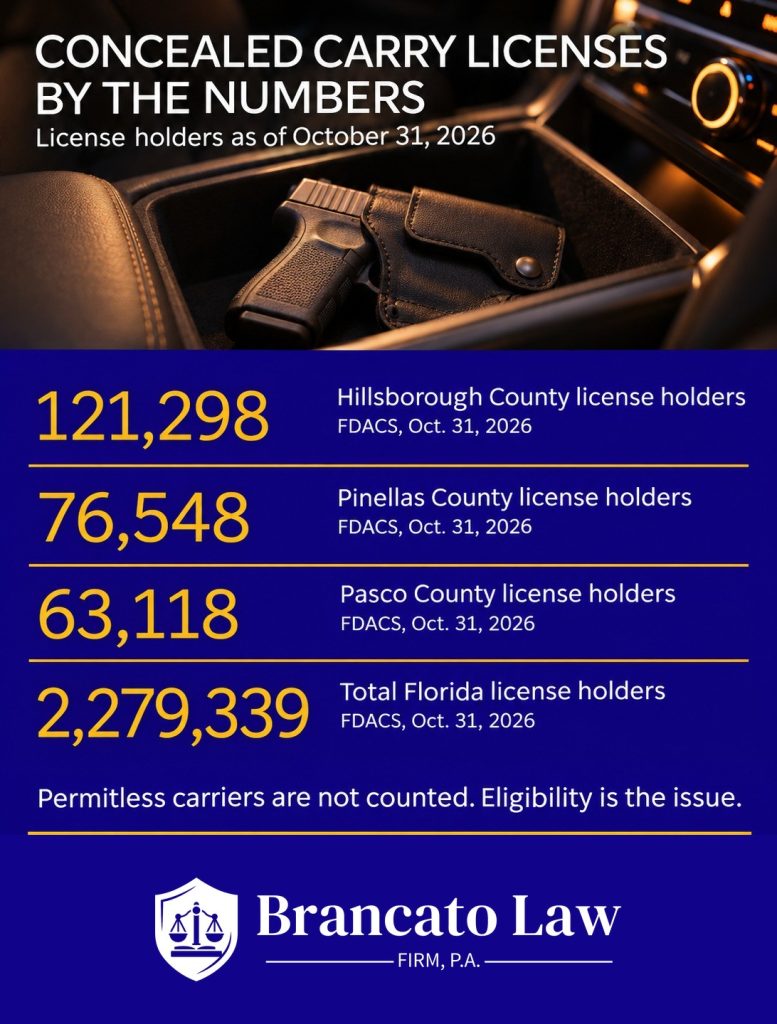
Hillsborough County had 121,298 concealed weapon or firearm license holders as of October 31, 2026, according to the Florida Department of Agriculture and Consumer Services county license report. Pinellas County had 76,548 and Pasco County had 63,118, out of 2,279,339 license holders statewide. Those numbers count only people who applied for a license; permitless carriers are not counted anywhere, which is one reason officers often cannot tell at the roadside whether a person is eligible.
The policy debate over carry laws is ongoing. A study by John J. Donohue, Abhay Aneja, and Kyle D. Weber, Right-to-Carry Laws and Violent Crime, 16 J. Empirical Legal Stud. 198 (2019), reported that right-to-carry laws were associated with 13 to 15 percent higher aggregate violent crime rates ten years after adoption, and other researchers dispute those findings. That debate does not change the elements of the crime in an individual case.
What happens after a concealed firearm arrest in Hillsborough County?
After a concealed firearm arrest in Hillsborough County, the person is booked into jail and either posts bond under the schedule or sees a judge at first appearance within 24 hours. In Hillsborough, the judge sits downtown and the arrested person appears by video from the jail. The firearm is held as evidence, and getting it back usually waits until the case is resolved. Our Hillsborough County criminal defense page covers the local courts, and our post on Hillsborough County first appearance explains that hearing.
What should you do after a concealed firearm arrest?
- Do not explain where the gun came from or why you had it on recorded jail calls.
- Gather proof of eligibility: your license if you have one, and court records showing old cases were closed, sealed, or more than three years old.
- Write down exactly where the gun was in the car or on your body, and who else was present.
- Keep receipts or records showing you own the firearm lawfully.
- Call a defense lawyer before speaking with detectives or the State Attorney’s Office.
Frequently asked questions about concealed firearm charges
Can concealed firearm charges be dropped in Florida?
Yes, prosecutors can drop a concealed firearm charge when the person was actually eligible to carry, when the gun was not concealed or was securely encased in a vehicle, or when the stop was unlawful. The Brancato Law Firm gathers eligibility records quickly and presents them through pre-file advocacy before a felony is filed.
Is it legal to keep a gun in the glove box in Florida without a license?
Yes, a person 18 or older who lawfully possesses a handgun may keep it in a glove compartment, locked or unlocked, because that is securely encased under section 790.001. Our attorneys at The Brancato Law Firm often use the vehicle rule when a gun was found in a closed console or case during a traffic stop.
Do I have to tell police I have a gun in Florida?
Florida law does not require a permitless carrier to announce a firearm, but section 790.013 requires showing valid identification when an officer asks. The Brancato Law Firm advises clients to stay calm, keep hands visible, and avoid reaching for anything without telling the officer first.
Can a person with an old misdemeanor carry a gun in Florida?
Usually yes, if more than three years have passed since probation or court conditions ended on a misdemeanor crime of violence, or if the record was sealed or expunged. Our team at The Brancato Law Firm checks those dates first, and our gun crimes defense page explains how we use them.
Does a withhold of adjudication let me carry a gun in Florida?
A withhold on a felony is not a conviction under Florida law, but section 790.06(2)(k) still bars carrying without a license until three years after probation ends. The Brancato Law Firm explains that timing to every client who resolves a felony with a withhold.
Can I carry a concealed gun if I am 19 in Florida?
After Eubanks, the Fourth District has held the age-21 requirement unconstitutional for adults 18 to 20, and the Attorney General said the State would not seek further review. Our attorneys at The Brancato Law Firm raise that decision for any client charged only because of age.
For more about our defense strategies, visit our Gun Crimes page.
Proof of eligibility is often sitting in court records that can be pulled the same week, so call before the State files. The Brancato Law Firm, P.A., founded by Tampa Criminal Defense Attorney Rocky Brancato, a former COO of the Hillsborough County Public Defender’s Office, overseeing a staff of over 100 attorneys, is two blocks from the courthouse. Reach us at (813) 727-7159; call us at any hour. Our firm has Spanish-speaking staff, and attorney Jean-Luc Adrien speaks Spanish, Haitian Creole, and French.
The Brancato Law Firm, P.A.
620 E. Twiggs Street, Suite 205, Tampa, FL 33602
(813) 727-7159
Serving Hillsborough, Pinellas, and Pasco Counties
The Brancato Law Firm, P.A. is a Tampa-based criminal defense practice. We are not affiliated with any other Brancato-named law firms.
Visit Us

Tampa, FL 33602

Contact Us Now
Free Legal Consultation (813) 727-7159
