

From First DUI to Death Penalty



Do You Have to Give Police Your Name or Show ID in Florida? (2026)


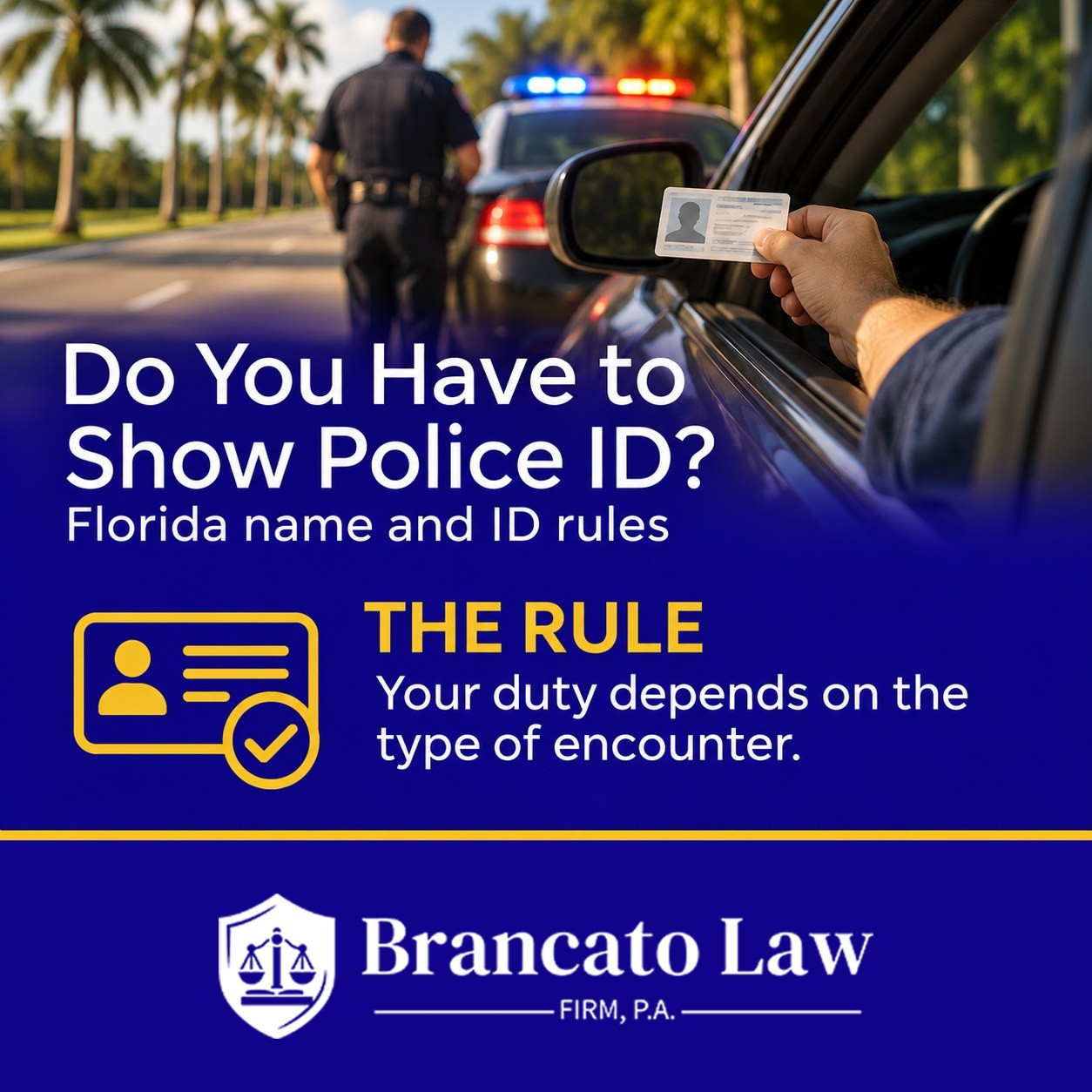
In short
Sometimes. Florida has no law requiring you to carry identification while you walk around, and in a consensual encounter you can decline to give your name. Once an officer lawfully detains you on reasonable suspicion of a crime, Florida courts have upheld resisting-an-officer charges against people who refused to identify themselves, and giving a false name to an officer after arrest or lawful detention is a separate crime under section 901.36. A driver stopped by police must hand over a driver’s license on demand under section 322.15. In practice, giving your name and license rarely hurts a case; refusing on the roadside often starts one, and the place to fight an unlawful demand is in court.
If you have watched a video of someone refusing to hand an officer their ID, you have probably also watched what happens next: the conversation gets louder, a second patrol car arrives, and someone ends up in handcuffs over a stop that might have ended with a warning. As founder of The Brancato Law Firm, P.A., a Tampa criminal defense firm, and a former police academy instructor who taught criminal procedure and courtroom testimony, I have spent more than 25 years in Hillsborough County courtrooms. Our attorneys defend people whose cases began with exactly that kind of standoff, and the advice below reflects both what the law allows and what actually keeps a stop from becoming an arrest.
Do you have to give police your name in Florida?
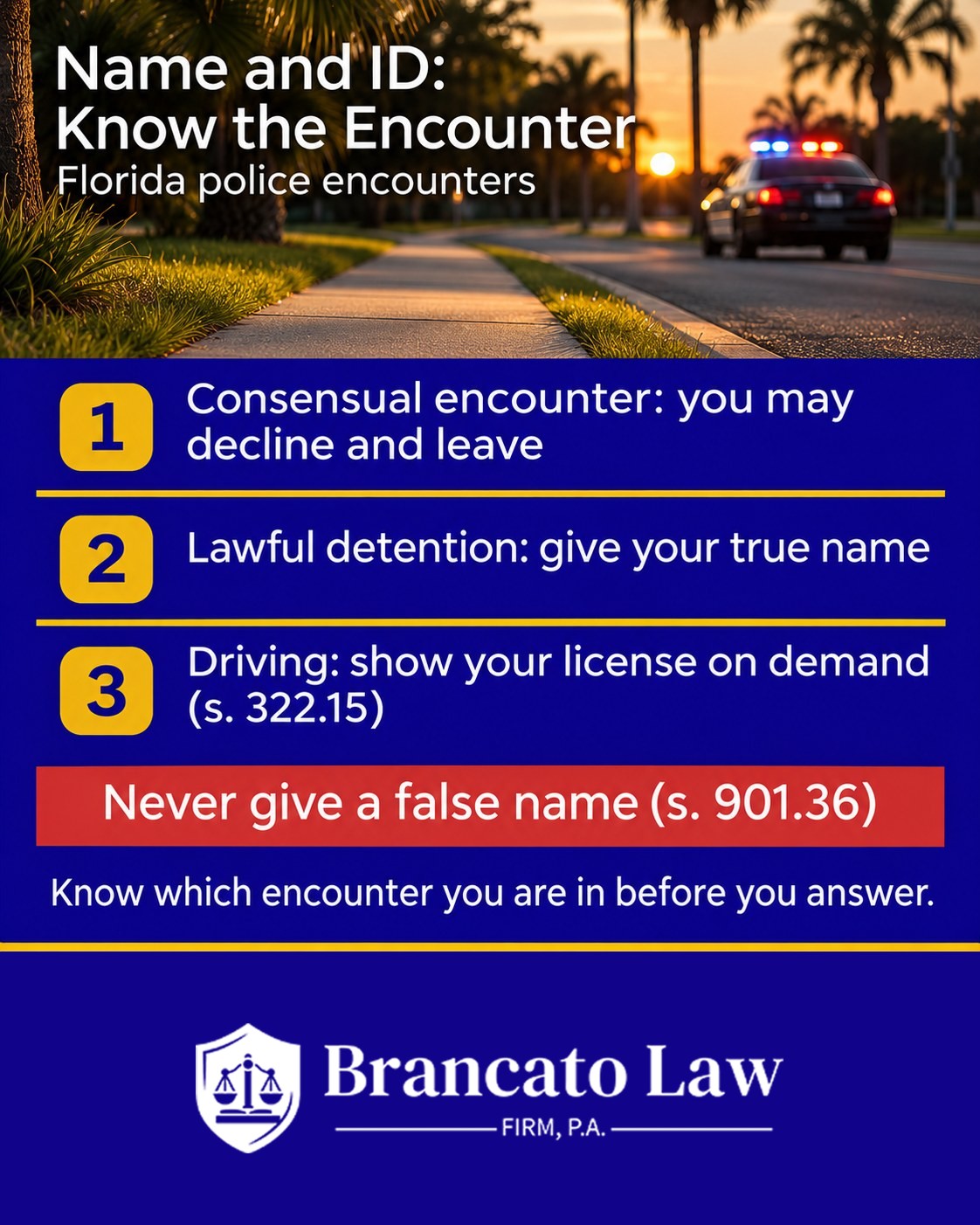
It depends on which kind of encounter you are in. The Florida Supreme Court described three levels of police contact in Popple v. State, 626 So. 2d 185 (Fla. 1993), an Indian River County case where a deputy ordered a man out of his parked car without reasonable suspicion and the Court threw out the cocaine he found. In a consensual encounter, the Court said, a citizen “may either voluntarily comply with a police officer’s requests or choose to ignore them.” An investigatory stop requires a well-founded, articulable suspicion of crime, and an arrest requires probable cause. Your obligations change at each level.
| Situation | Must you give your name? | Must you show ID? | Main risk |
|---|---|---|---|
| Consensual encounter (officer asks questions, you are free to leave) | No | No | Lying about your identity can still be charged as obstruction (Bass v. State) |
| Investigatory stop on reasonable suspicion (s. 901.151) | Refusing has supported a resisting charge (K.A.C. v. State) | No law requires carrying a card, but you must not give false information | Resisting without violence (s. 843.02); false name (s. 901.36) |
| Driver in a traffic stop | Yes, in practice | Yes: driver’s license on demand (s. 322.15) | Citation, and escalation if the officer cannot confirm who is driving |
| Passenger in a traffic stop | No statute requires it; the law is unsettled when a passenger is detained along with the driver | No statute requires it | The stop can become your detention if suspicion develops |
| Loitering or prowling investigation (s. 856.021) | The officer must give you the chance to identify yourself and explain | No | Refusing to identify is a listed factor supporting arrest |
| After arrest | Yes, truthfully, at booking | Fingerprints identify you regardless | False name is a misdemeanor, or a felony if it harms someone else |
Can you refuse to identify yourself in a consensual encounter?
Yes. When an officer has no legal basis to hold you, you can decline to give your name and walk away. In M.M. v. State, 51 So. 3d 614 (Fla. 1st DCA 2011), a teenager who had left the scene of a dispersed disturbance at a Starbucks refused to give an officer his name inside a nearby Publix. The First District reversed his resisting adjudication, holding that because he was never lawfully detained, “he was free to refuse to identify himself to the officer.” The U.S. Supreme Court reached a similar result decades earlier in Brown v. Texas, 443 U.S. 47 (1979), holding that Texas could not punish a man for refusing to identify himself when officers stopped him without any objective basis to suspect him of a crime.
Silence and lying are treated very differently. In Bass v. State, 304 So. 3d 786 (Fla. 1st DCA 2018), the court affirmed a resisting conviction for a man who gave a deputy a false name, holding that section 843.02 does not require a detention when the person affirmatively lies to an investigating officer. The safe rule: if you do not want to answer, say nothing, but never give a fake name.
What happens if you refuse to give your name during a lawful detention?
You risk arrest for resisting an officer without violence, a first-degree misdemeanor under section 843.02, Florida Statutes, punishable by up to a year in jail. Florida’s Stop and Frisk Law, section 901.151, lets an officer with reasonable suspicion temporarily detain a person “for the purpose of ascertaining the identity of the person temporarily detained.” The statute does not say in so many words that you must answer, but courts have filled that gap. In K.A.C. v. State, 707 So. 2d 1175 (Fla. 3d DCA 1998), officers stopped a student they reasonably suspected was skipping school, and he refused to give his name or say where he went to school. The Third District affirmed his resisting adjudication, holding he “was under a legal obligation to answer the officers’ questions.”
That approach fits federal law. In Hiibel v. Sixth Judicial District Court of Nevada, 542 U.S. 177 (2004), the Supreme Court upheld a Nevada rancher’s conviction for refusing to give his name during a valid stop, holding that a state may require a suspect to disclose a name during a lawful detention. The Court stressed two limits: the request must be reasonably related to the reason for the stop, and the Nevada law required only a name, not a driver’s license or other document. Giving a false name after you are lawfully detained is a first-degree misdemeanor under section 901.36, Florida Statutes, and a third-degree felony if someone else is harmed by the use of their name.
Do you have to show your driver’s license during a traffic stop?
Yes, if you are the driver. Section 322.15(1), Florida Statutes, requires every licensed driver to have the license in immediate possession while driving and to present it “upon the demand of a law enforcement officer.” A digital driver license is allowed, but if the officer cannot verify it immediately, you must produce the printed card. Failing to display a license is a noncriminal infraction, but a driver who refuses to identify gives the officer no way to confirm who is behind the wheel or whether that person is licensed, and that is how a ticket turns into a custodial arrest. Our post on how long a traffic stop can last in Florida explains what officers may and may not do while they check your license.
Passengers are in a different position. No Florida statute requires a passenger to carry or show ID, although Florida courts have not clearly settled whether a passenger who is lawfully held during the driver’s stop must give a name. Officers can order passengers to stay in or step out of the car during the stop for safety, and handing over a name voluntarily usually ends the officer’s interest faster than arguing about it.
How often do police stops end without any enforcement action?
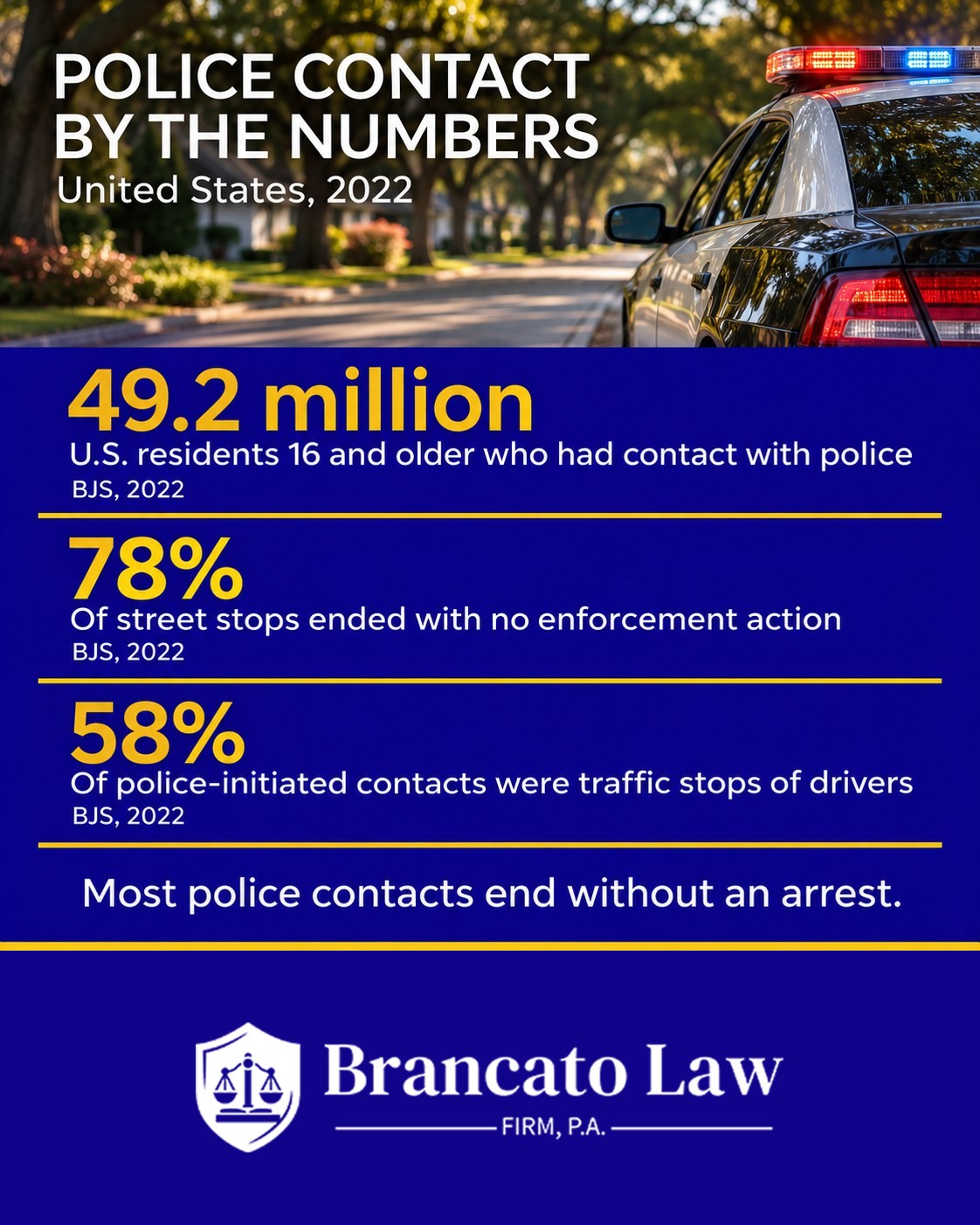
Most street stops do. About 19 percent of U.S. residents age 16 or older, an estimated 49.2 million people, had contact with police in 2022, and 20.3 million of those contacts were initiated by police, according to the Bureau of Justice Statistics report Contacts Between Police and the Public, 2022 (October 2024). Among people whose most recent contact was a street stop, 78 percent experienced no enforcement action (p. 9), and 58 percent of police-initiated contacts were traffic stops with the resident driving (p. 7). Most stops end with nothing, which is why our attorneys tell clients that the goal on the roadside is to get to the end of the stop, not to win it.
Why does refusing ID so often lead to an arrest?
Because the officer’s perception of you changes the stop, even when what you are doing is legal. In a 2019 randomized experiment published in the Journal of Experimental Criminology, Compliance, Noncompliance, and the In-Between, researchers Justin Nix, Justin Pickett, and Renée Mitchell gave 546 officers scenarios that differed only in how the civilian behaved. A civilian who complied but was disrespectful raised officers’ suspicion in all three experiments, and noncompliance had even larger effects, including raising officers’ expectation that the person would become violent. An earlier study of observational data, Worden and Shepard’s Demeanor, Crime, and Police Behavior (Criminology, 1996), found that the likelihood of arrest rose when suspects were disrespectful. None of that makes an unlawful arrest lawful, but it explains why the people in those viral videos so often end up charged.
I taught criminal procedure at the police academy before I spent my career on the defense side, and the difference between a consensual encounter and a detention was part of what recruits had to learn. What I have seen since, from the defense table, is that the person who argues that difference on the roadside rarely gets the benefit of it. The person who stays calm, gives a name, and lets a lawyer argue it later often does.
What about “First Amendment auditors” who refuse ID and record police?
Recording police in public is generally protected, but refusing lawful commands is not. The Eleventh Circuit, which covers Florida, recognized in Smith v. City of Cumming, 212 F.3d 1332 (11th Cir. 2000), a First Amendment right to photograph or videotape police conduct, “subject to reasonable time, manner and place restrictions.” Florida added one of those restrictions in section 843.31, Florida Statutes: after a verbal warning, it is a second-degree misdemeanor to knowingly approach or remain within 25 feet of a first responder performing a legal duty with intent to impede, threaten, or harass. Filming from a distance is one thing; stepping into the scene and refusing to identify during a lawful detention is how auditors end up with resisting charges. Our post on Florida’s recording laws covers the separate rules for recording private conversations.
What should you actually say when an officer asks for ID?
Pick your battles. In most stops, providing your name and, if you are driving, your license costs you nothing legally, and it is usually the fastest way to end the encounter. Stay respectful even if you think the stop is wrong; you do not have to like it, and you do not have to answer questions about where you were or what you were doing. If you believe the officer had no lawful reason to stop you, remember the details, comply, and let your lawyer raise it in a motion to suppress. A judge can suppress evidence from an unlawful stop after the fact; no one can undo an arrest because the person was right about the law while being handcuffed.
Say this, not that
Say: “Officer, am I being detained, or am I free to go?” If free to go, leave calmly.
Say (if detained or driving): “My name is ___.” Then hand over your license if you are driving.
Say: “I don’t want to answer any questions without a lawyer.” Say: “I don’t consent to a search.”
Avoid: giving a false name, arguing case law with the officer, reaching for anything without saying what you are doing, walking away from a detention, or physically pulling away. Each of these can become the charge.
What if you were already arrested for refusing to identify?
The arrest can often be fought, because the State must prove the officer was performing a lawful duty. If the encounter was consensual, or the stop lacked reasonable suspicion, there was no lawful detention to resist, as in M.M. Our attorneys start with the body camera video and the officer’s report to pin down exactly when the encounter became a detention and what the officer knew at that moment. Our guide to resisting an officer without violence in Florida explains the elements and defenses in detail, and our guide to the Florida criminal case process covers what happens from first appearance through trial. In Hillsborough County, a misdemeanor resisting charge is handled in county court, and unlike some nearby counties, Hillsborough does not offer pretrial services supervision, so the first appearance judge has fewer release options. Our Hillsborough County criminal defense attorney page explains how those cases move.
Frequently asked questions about giving police your name or ID in Florida
Is it illegal to not carry ID in Florida if you are not driving?
No. Florida has no general law requiring a pedestrian to carry identification; the carry-and-display rule in section 322.15 applies to people operating a motor vehicle. When a client is arrested after an ID dispute on foot, The Brancato Law Firm looks first at whether the officer ever had grounds to detain.
Can a passenger in Florida refuse to show ID during a traffic stop?
Usually, because no Florida statute requires a passenger to identify, though the answer is less clear once the officer has reasonable suspicion about the passenger. Our attorneys at The Brancato Law Firm still advise passengers that giving a name is usually the quickest way out of the stop, as our post on traffic stop time limits explains.
Is giving police a fake name a crime in Florida?
Yes. After an arrest or lawful detention it is a first-degree misdemeanor under section 901.36, and a third-degree felony if another person is harmed by the use of their name. Lying can also be charged as resisting even without a detention, under Bass, so The Brancato Law Firm tells clients to stay silent rather than invent an answer.
Can I be arrested for loitering if I won’t tell police who I am?
Possibly. Under section 856.021, Florida Statutes, refusing to identify is one factor an officer may consider, and the officer must first give you a chance to identify yourself and explain your presence. At The Brancato Law Firm, a missing or rushed chance to explain is one of the first defenses we check.
Can resisting without violence charges be dropped in Florida?
Yes. When the encounter was consensual or the stop lacked reasonable suspicion, the State cannot prove the officer was performing a lawful duty, and the charge can be dismissed. The Brancato Law Firm pulls the body camera footage early because the timeline on video decides that question.
Sources
- Popple v. State, 626 So. 2d 185 (Fla. 1993); M.M. v. State, 51 So. 3d 614 (Fla. 1st DCA 2011); Bass v. State, 304 So. 3d 786 (Fla. 1st DCA 2018); K.A.C. v. State, 707 So. 2d 1175 (Fla. 3d DCA 1998)
- Hiibel v. Sixth Judicial District Court of Nevada, 542 U.S. 177 (2004); Brown v. Texas, 443 U.S. 47 (1979); Smith v. City of Cumming, 212 F.3d 1332 (11th Cir. 2000)
- Sections 901.151, 901.36, 843.02, 843.31, 856.021, and 322.15, Florida Statutes
- Bureau of Justice Statistics, Contacts Between Police and the Public, 2022 (October 2024)
- Nix, Pickett, and Mitchell, Compliance, Noncompliance, and the In-Between, Journal of Experimental Criminology 15:611 (2019); Worden and Shepard, Demeanor, Crime, and Police Behavior, Criminology 34:83 (1996)
For more about how a case moves after an arrest, visit our Florida Criminal Case Process page.
Arrested after a dispute over your ID?
Body camera footage and dispatch records are the evidence that shows whether you were ever lawfully detained, and they are easiest to secure early. Call The Brancato Law Firm, P.A., founded by Tampa Criminal Defense Attorney Rocky Brancato, at (813) 727-7159, and our attorneys will request that footage and review the stop from its first second. You can call us at any hour. Our firm has Spanish-speaking staff, and attorney Jean-Luc Adrien speaks Spanish, Haitian Creole, and French.
The Brancato Law Firm, P.A.
620 E. Twiggs Street, Suite 205, Tampa, FL 33602
(813) 727-7159
Serving Hillsborough, Pinellas, and Pasco Counties
The Brancato Law Firm, P.A. is a Tampa-based criminal defense practice. We are not affiliated with any other Brancato-named law firms.
Visit Us

Tampa, FL 33602

Contact Us Now
Free Legal Consultation (813) 727-7159
