

From First DUI to Death Penalty



How to Fight a Street Racing Charge in Florida? (2026)


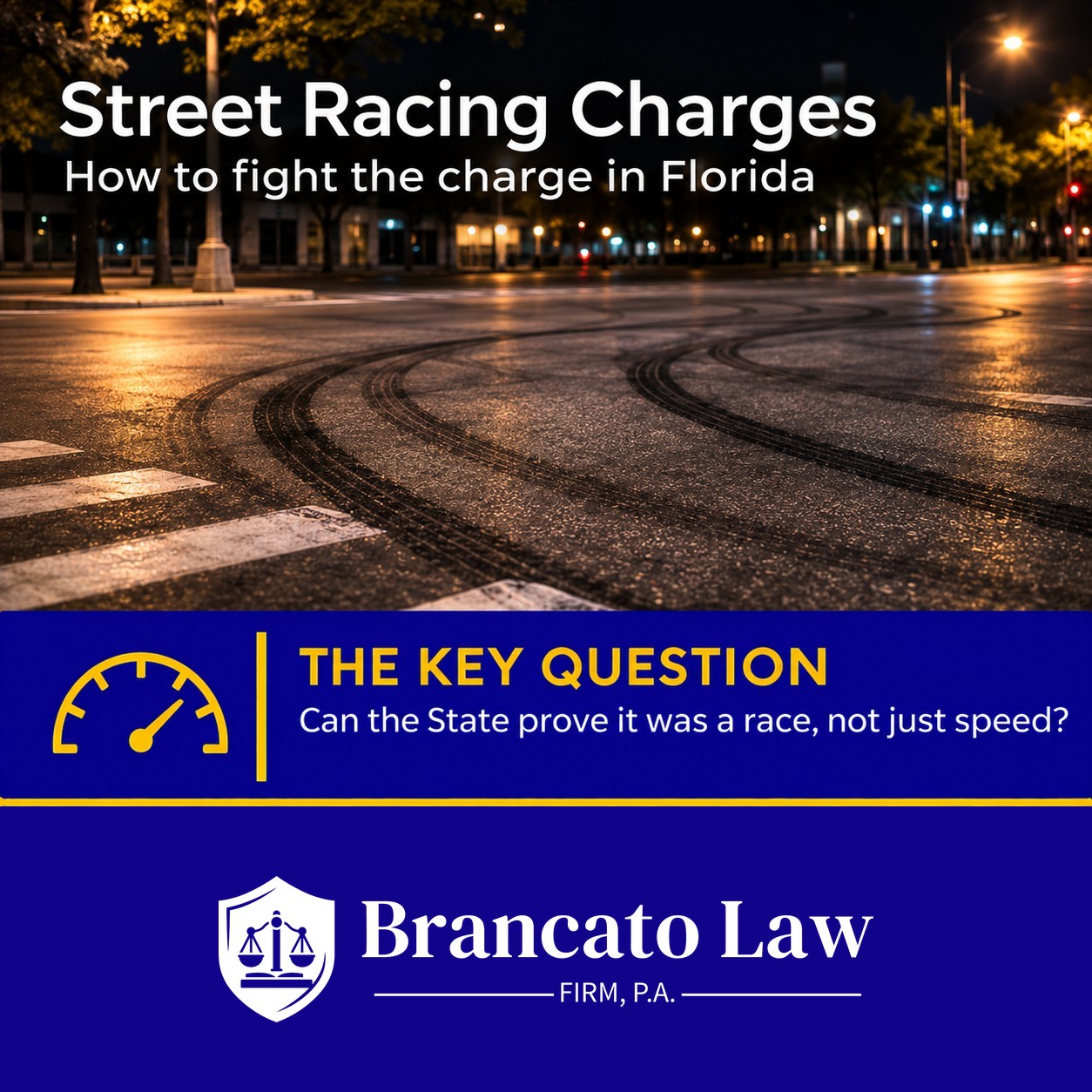
To fight a street racing charge in Florida, the defense attacks the element that separates racing from speeding: the State must prove a competition, meaning a challenge and an acceptance or competitive response between drivers, or a street takeover that blocked traffic for stunts. A first violation of section 316.191 is a first-degree misdemeanor with a $500 to $2,000 fine and a mandatory 1-year driver license revocation, and a second violation within 1 year is a third-degree felony. Common defenses include no proof of a race, misidentification of the car or driver, mere presence as a spectator, and an unlawful stop.
If you were arrested for racing on the Gandy Bridge or the Courtney Campbell Causeway, or picked up after a street takeover in Tampa, the most urgent consequence is often the license: a first conviction means a 1-year revocation, even with a withhold of adjudication. I trained police officers as a police academy instructor before founding The Brancato Law Firm, P.A., a Tampa criminal defense firm, and I am a former Chief Operations Officer of the Hillsborough County Public Defender’s Office, where I oversaw a staff of over 100 attorneys. Our attorneys defend racing and takeover charges by testing whether the officer actually saw a competition, who was driving, and whether the stop was lawful.
What counts as street racing in Florida?
Street racing in Florida means driving in a competition with another vehicle on a highway, roadway, or parking lot. Under section 316.191, Florida Statutes, a “race” requires a challenge to show which car or driver is superior and an acceptance or competitive response to that challenge, either arranged in advance or in the moment. A “drag race” is two or more vehicles accelerating side by side from a point to outdistance each other, or vehicles running a common course to compare speed or acceleration. The statute also covers speed contests, acceleration contests, exhibitions of speed, and attempts to set a speed record.
Section 316.191(2) reaches more than the drivers. It is a crime to:
- Drive in a race, drag race, street takeover, stunt driving event, or exhibition of speed.
- Participate in, coordinate through social media or otherwise, facilitate, or collect money for one.
- Knowingly ride as a passenger in one.
- Purposefully slow, stop, or block traffic, including pedestrian traffic, for one.
- Drive a vehicle to film or record the participants (bona fide news media are exempt).
- Drive a vehicle carrying fuel to refuel a car involved in one.
Parking lots are included, so a late-night meet in a shopping center lot can be charged the same as a race on Dale Mabry Highway. Licensed racetracks and drag strips are exempt under section 316.191(7). Racing is one of several criminal traffic offenses our firm defends; our Tampa criminal traffic lawyer page covers the others.
What is a street takeover under Florida law?
A street takeover is blocking or impeding the regular flow of traffic on a portion of a highway, roadway, or parking lot to perform a race, drag race, burnout, doughnut, drifting, wheelie, or other stunt driving, under section 316.191(1)(j). “Stunt driving” is performing burnouts, doughnuts, drifting, wheelies, or other dangerous motor vehicle activity as part of a street takeover. A “coordinated street takeover” is 10 or more vehicles operated in an organized manner to carry one out.
The coordinated version matters because it turns a misdemeanor into a felony. Under section 316.191(3)(f), driving, blocking traffic, filming from a vehicle, or carrying fuel while engaged in a coordinated street takeover is a third-degree felony with a $2,500 to $4,000 fine and a 2-year license revocation. Takeovers in cars are different from crowd gatherings on foot; our post on teen takeover arrests covers those cases, which are usually charged as affray or trespass.
Is it illegal to watch a street race or takeover in Florida?
Yes, but being a spectator is a noncriminal traffic infraction, not a crime. Under section 316.191(4), a person may not be a spectator at a race, drag race, or street takeover, and the penalty is a $400 fine. A “spectator” is someone knowingly present who views the event as a result of an affirmative choice to attend or participate. The statute tells the fact finder to consider the person’s relationship to a driver, betting on the outcome, filming or recording, and posting the event on social media. Simply being stuck at the intersection when cars started doing doughnuts is not an affirmative choice to attend, and our attorneys contest spectator citations on that basis.
What are the penalties for street racing in Florida?
A first street racing conviction in Florida is a first-degree misdemeanor, punishable by up to 1 year in jail, with a mandatory fine of $500 to $2,000 and a 1-year license revocation by the Department of Highway Safety and Motor Vehicles. The penalties climb quickly for repeat offenses and for interfering with emergency vehicles. Section 316.191(1)(b) defines “conviction” to include a plea or verdict of guilt even when adjudication is withheld, so a withhold does not avoid the revocation.
| Violation | Degree | Mandatory fine | License revocation |
|---|---|---|---|
| First violation of 316.191(2) | First-degree misdemeanor (up to 1 year in jail) | $500 to $2,000 | 1 year |
| Second violation within 1 year of a prior conviction | Third-degree felony (up to 5 years) | $2,500 to $4,000 | 2 years |
| Third or later violation within 5 years of a prior conviction | Second-degree felony (up to 15 years) | $3,500 to $7,500 | 4 years |
| Coordinated street takeover (10 or more vehicles) | Third-degree felony | $2,500 to $4,000 | 2 years |
| Knowingly impeding a responding emergency vehicle | Third-degree felony (second-degree on a repeat) | As for a second violation | 4 years on a repeat |
| Spectator | Noncriminal traffic infraction | $400 | None under 316.191 |
Every revocation under section 316.191(3) allows the driver to request a hearing under section 322.271, the statute that governs restricted licenses after a revocation. Our post on how long you wait for a Florida hardship license explains that process. The 2024 amendments to the statute, passed as Senate Bill 1764, raised the fines and revised the penalties for second-time offenders, according to the Florida Department of Highway Safety and Motor Vehicles.
Can police impound or take your car for street racing?
Yes. When an officer arrests a driver for racing or a takeover, the vehicle may be impounded for 30 business days under section 316.191(5)(c), and the owner pays the towing and storage costs unless the impoundment order is dismissed. A court may also order impoundment or immobilization as a condition of probation. On a second violation within 5 years of a prior conviction, the car may be seized and forfeited under the Florida Contraband Forfeiture Act, but only if the driver charged is also the owner, under section 316.191(6).
Borrowed and financed cars raise their own problems. The clerk must notify a registered owner who is not the defendant, and every lienholder, within 7 business days of an impoundment order. When the car belongs to a parent or a lender, our attorneys move quickly to get it released, because storage fees accumulate every day.
Does speeding alone make it a race?
No. Speeding, even at extreme speeds, is not racing unless the State proves a competition between drivers. Two appellate cases from 2007 and 2008 show why that element exists. In State v. Wells, 965 So. 2d 834 (Fla. 4th DCA 2007), a Broward County driver was clocked at up to 130 mph in a 65 mph zone with another car following him, and the cars later pulled side by side and accelerated to 90 mph. The Fourth District affirmed the dismissal of his racing charge, holding that the statute’s old definition of racing, which covered any attempt to “outgain or outdistance” another car, was unconstitutionally vague because it could reach ordinary passing and accelerating from a light.
A year later, in Reaves v. State, 979 So. 2d 1066 (Fla. 1st DCA 2008), the First District disagreed and upheld the statute in a fatal drag-racing case, reasoning that the law could be applied only when vehicles are “competing” with each other. The Legislature has since rewritten the definition of “race” to require a challenge and an acceptance or competitive response, which is the version in effect today. The lesson for any racing case is the same: the arrest report must describe something more than two fast cars. Our attorneys read it for the facts that show a challenge, such as revving at a light, a signal between drivers, or a prearranged meeting, and when those facts are missing, we move to dismiss or argue for acquittal.
How do our attorneys fight a street racing charge?
Our attorneys fight these charges by holding the State to each element of section 316.191 and by challenging how the evidence was gathered. These are the defenses The Brancato Law Firm uses most often in Hillsborough, Pinellas, and Pasco County courts.
1. No proof of a competition
If the officer saw two cars speeding but no challenge or competitive response, the charge may be reckless driving or a speeding citation, not racing. We compare the officer’s narrative with dash camera and body camera video, because “they took off together from the light” often looks different on video.
2. Wrong car or wrong driver
Takeovers involve dozens of similar cars, many with tinted windows and no front plate visible, at night. Many of these cases are built afterward from social media videos and license plate reader hits. We test whether the video actually shows our client’s car and our client behind the wheel, not just a car of the same color.
3. Present, but not a participant
Being present is not the same as participating, coordinating, or facilitating. A passenger is guilty only if he or she “knowingly” rode in the race, and a bystander is at most a spectator under the $400 infraction. We use texts, location data, and witness statements to show our client arrived for another reason or left when the activity started.
4. An unlawful stop or search
Racing stops often happen after a chase or during a mass enforcement operation, and officers sometimes stop every car leaving a lot. A stop needs reasonable suspicion tied to the specific vehicle, and a search of a phone for takeover videos generally needs a warrant. Evidence from an unlawful stop or search can be suppressed.
5. Keeping a misdemeanor from becoming a felony
Because a second violation within 1 year is a felony, how a first case ends matters. A plea with a withhold still counts as a conviction under section 316.191(1)(b). When the evidence allows, our attorneys work toward dismissal or a reduction to a charge that does not carry the mandatory revocation or the repeat-offense enhancement.
6. Separating the racing charge from a fleeing charge
A fleeing charge is usually the most serious count in a racing arrest. We examine whether the officer gave a clear order to stop, whether the patrol car was marked with lights and siren on, and whether our client knew police were behind the car, because those facts decide whether fleeing can be proven at all.
What other charges come with a street racing arrest?
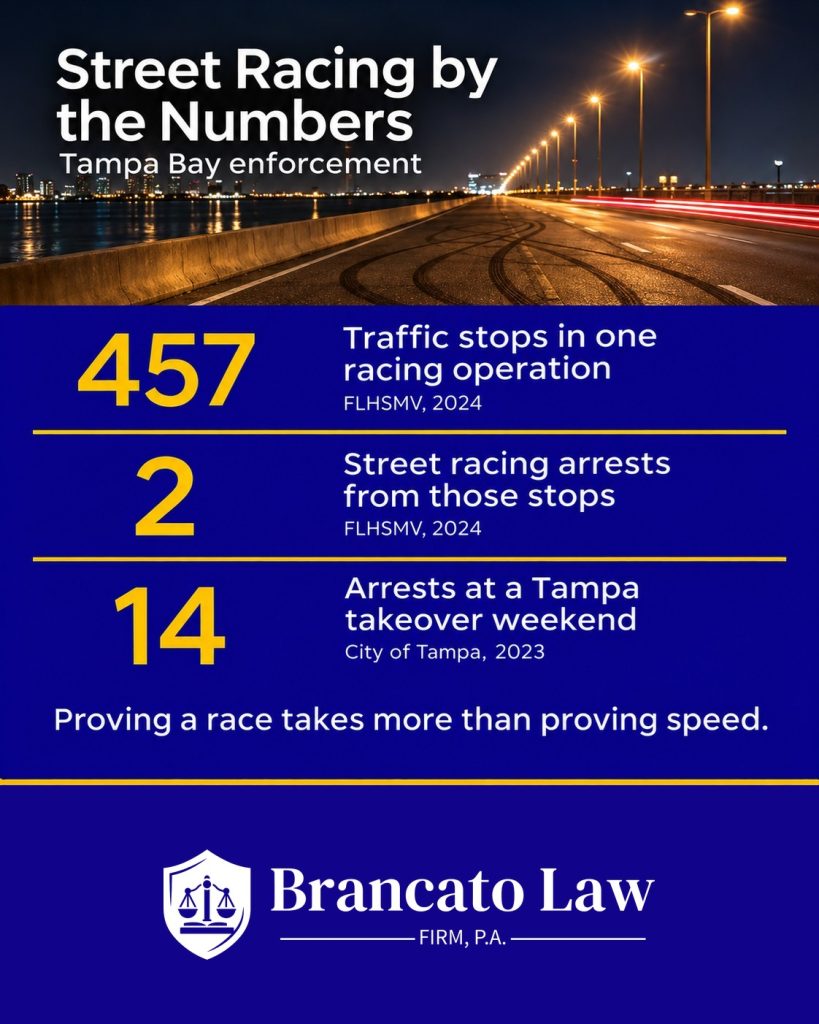
A street racing arrest often brings more serious charges than racing itself, especially fleeing to elude. When Tampa Police broke up a planned “takeover” over the January 2023 Gasparilla weekend, the City of Tampa reported 14 arrests, but only 2 were for racing on highways; most of the others were fleeing or aggravated fleeing charges, along with firearm and drug charges. In our experience, the companion charges, not the racing count, usually drive the sentencing exposure.
| Charge | Statute | Level | Key point |
|---|---|---|---|
| Racing, first violation | 316.191 | First-degree misdemeanor | Mandatory 1-year revocation |
| Reckless driving, first conviction | 316.192 | Up to 90 days, $25 to $500 fine | First-degree misdemeanor with property damage or injury; third-degree felony with serious bodily injury |
| Fleeing or eluding after an order to stop | 316.1935(1) | Third-degree felony | Revocation of 1 to 5 years |
| Fleeing a marked patrol car with lights and siren | 316.1935(2) | Third-degree felony | Revocation of 1 to 5 years |
| Fleeing at high speed or with wanton disregard | 316.1935(3)(a) | Second-degree felony | Revocation of 1 to 5 years |
| Fleeing causing serious bodily injury or death | 316.1935(3)(b) | First-degree felony | 3-year mandatory minimum prison sentence |
Our firm’s guides to Florida’s fleeing and eluding law, fighting a reckless driving charge, and the dangerous excessive speeding law explain each of those charges. When a race ends in a death, the case becomes a homicide prosecution, covered in our post on vehicular homicide in Florida.
How common are street racing arrests in Tampa Bay?
Street racing enforcement in Tampa Bay is heavy, but racing arrests themselves are a small share of the stops. During Operation Keep Our Streets on July 1, 2024, the Florida Highway Patrol and six local agencies, including Tampa Police and the Hillsborough County Sheriff’s Office, targeted racing on the Gandy Bridge and Courtney Campbell Causeway. The Florida Department of Highway Safety and Motor Vehicles reported 457 traffic stops, 162 traffic citations, 295 warnings, 5 DUI arrests, 18 criminal citations, and 2 arrests for street racing. Proving a race takes more than proving speed, and those numbers reflect it.
Prosecutors and judges also know the safety research. A 2017 study in the journal Accident Analysis & Prevention by researchers at the Centre for Addiction and Mental Health and Western University surveyed 11,263 Ontario adults and found that drivers who reported street racing in the past year were five times more likely to report a crash in that period, even after adjusting for age, sex, driving distance, and impaired driving. Because that risk is well documented, our attorneys do not argue that racing is harmless; we argue the evidence, which is where these cases are won.
What happens after a street racing arrest in Hillsborough County?
A racing arrest in Hillsborough County leads to booking at the Orient Road Jail and a first appearance hearing within 24 hours, where a judge reviews probable cause and sets release conditions. In our experience, Hillsborough County does not offer pretrial services supervision as a release option, though some neighboring counties do, so bond and conditions such as a no-driving order are argued at that hearing. Our Hillsborough County criminal defense page covers local procedure, and our guide to the Florida criminal case process walks through every stage after arrest.
Not every takeover case starts with an arrest at the scene. Investigators often identify drivers and organizers later from social media posts, plate reader data, and tips, and the State Attorney’s Office then decides whether to file charges. If you learn you are being investigated, representation before charges are filed gives our attorneys a chance to present the other side before that decision. Hillsborough County’s Adult Pre-Arrest Diversion program has excluded criminal driving offenses, as our post on traffic diversion in Hillsborough County explains, so the outcome usually turns on the evidence and negotiation.
What should you do if you are charged with street racing?
Stay off social media, save your own records, and talk to a lawyer before talking to police. Our attorneys give every client these instructions:
- Do not post or delete videos, stories, or comments about the event. Deleting can be charged as tampering, and posting creates evidence.
- Do not discuss the event with officers, other drivers, or in group chats.
- Write down your timeline: where you were before and after, who you were with, and why you were there.
- Get the impound paperwork and the release date for the car, and tell the owner or lender if it is not your car.
- Calendar the license deadlines and keep driving only if your license is still valid.
Frequently asked questions about street racing charges in Florida
Can street racing charges be dropped in Florida?
Yes, street racing charges can be dropped when the State cannot prove a competition, cannot prove who was driving, or relied on an unlawful stop. The Brancato Law Firm reviews the video and the arrest report early, and in cases still under investigation we raise those problems with the prosecutor through pre-file advocacy.
Will I lose my license for a first street racing conviction?
Yes, a first conviction requires a 1-year revocation under section 316.191(3)(a), even if adjudication is withheld. Our attorneys at The Brancato Law Firm explain the section 322.271 hearing process and the options for a restricted license, covered in our post on what a Florida hardship license lets you drive for.
Is it a crime to film a street takeover from my car?
Yes, operating a vehicle to film or record the participants in a race or takeover is a violation of section 316.191(2)(e), and news media are the only exception. The Brancato Law Firm looks closely at whether the client was actually driving while filming, because a passenger holding a phone is not covered by that paragraph.
What is the fine for being a spectator at a street race in Florida?
The fine is $400, and being a spectator is a noncriminal traffic infraction under section 316.191(4). Our team at The Brancato Law Firm contests these citations when the evidence shows our client did not choose to attend or watch the event.
Is street racing a felony in Florida?
A first street racing violation is a misdemeanor, but a second violation within 1 year of a prior conviction, a coordinated takeover of 10 or more vehicles, or interfering with a responding emergency vehicle is a felony. Lawyers at The Brancato Law Firm check every prior case and the vehicle count alleged, and our criminal traffic defense team works to keep a first case from setting up a felony later.
Can I get my car back after a street racing arrest?
Usually, after the impoundment period of up to 30 business days and payment of towing and storage fees, unless the car is subject to forfeiture for a repeat offense by its owner. The Brancato Law Firm helps owners and lienholders who were not involved in the event seek release of the vehicle.
For more about our defense strategies, visit our Criminal Traffic page.
Our attorneys start every racing case by requesting the video and the impound records, because footage from patrol cars, traffic cameras, and businesses can be overwritten within weeks. Call The Brancato Law Firm, P.A., founded by Tampa Criminal Defense Attorney Rocky Brancato, at (813) 727-7159; you can call us at any hour. Our firm has Spanish-speaking staff, and attorney Jean-Luc Adrien speaks Spanish, Haitian Creole, and French. Our office is two blocks from the courthouse, and we defend street racing and takeover charges in Hillsborough, Pinellas, and Pasco counties.
The Brancato Law Firm, P.A.
620 E. Twiggs Street, Suite 205, Tampa, FL 33602
(813) 727-7159
Serving Hillsborough, Pinellas, and Pasco Counties
The Brancato Law Firm, P.A. is a Tampa-based criminal defense practice. We are not affiliated with any other Brancato-named law firms.
Visit Us

Tampa, FL 33602

Contact Us Now
Free Legal Consultation (813) 727-7159
