- Free Consultation 24/7: (813) 727-7159 Tap Here To Call Us


From First DUI to Death Penalty



What Can You Drive For on a Florida Hardship License? (2026)


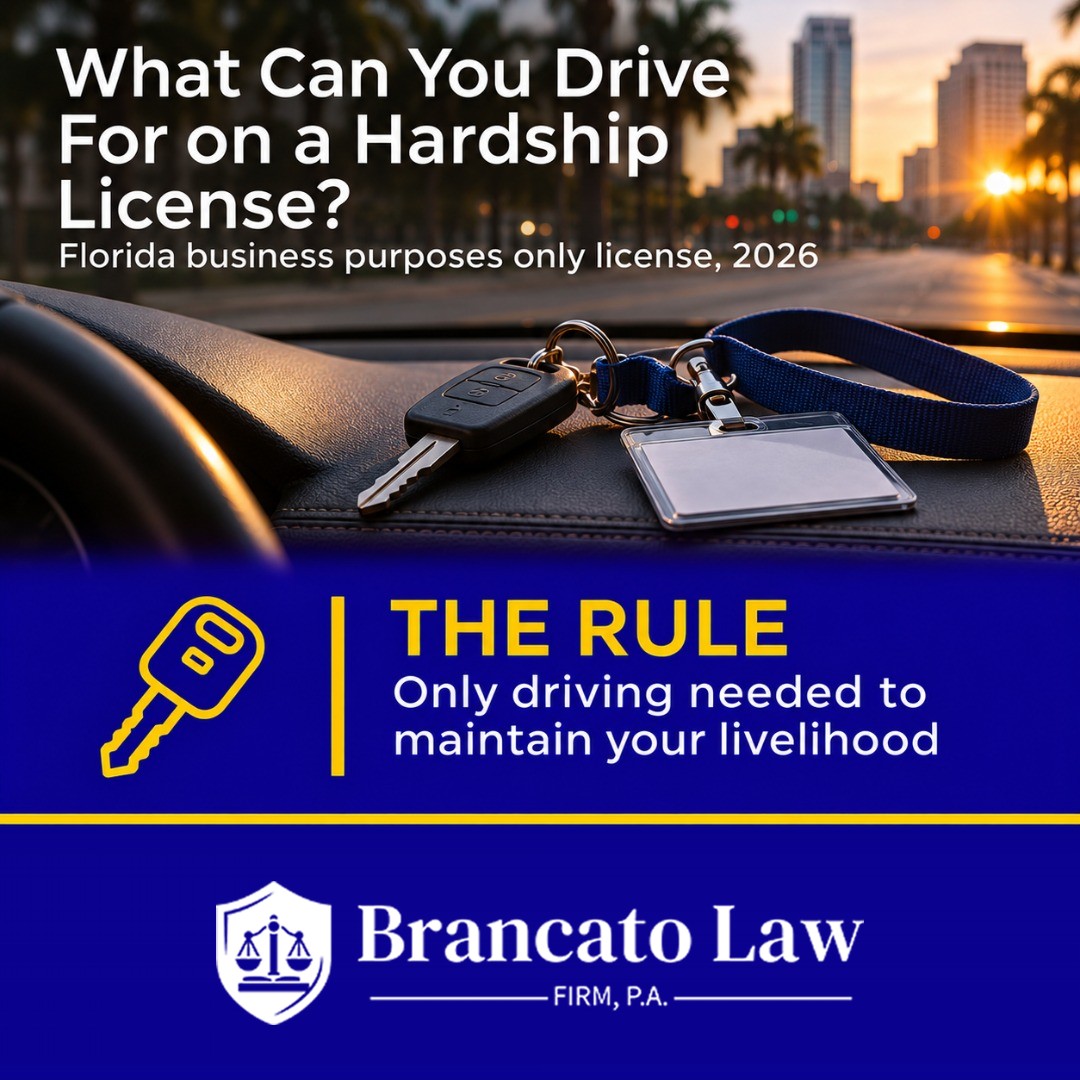
Short answer: A Florida “business purposes only” hardship license lets you drive only when the trip is necessary to maintain your livelihood. Section 322.271(1)(c) names five kinds of trips: driving to and from work, necessary on-the-job driving, educational driving, church, and medical appointments. Recreational trips such as the gym, restaurants, social visits, and vacations are not allowed. Florida courts have also allowed direct trips for food and to pay an overdue utility bill, and driving your children to school is probably fine for the same reason: it keeps a household running.
A hardship license is the most misunderstood piece of plastic a DUI client carries. I am Rocky Brancato, founder of The Brancato Law Firm, P.A., a Tampa criminal defense firm, and I have spent more than 25 years in Hillsborough County courtrooms, taught at the police academy, and belong to the National College for DUI Defense. Our attorneys see drivers lose their hardship privilege over a single trip they assumed was fine. This guide lists the trips Florida law allows, the trips it forbids, and the trips that are probably fine even though no statute names them, with the statute, rule, or court decision behind each answer.
Do you get a business purposes or employment purposes license after a first DUI?
A first-time DUI driver who waives the administrative hearing gets a business purposes only license, the broader of Florida’s two hardship licenses. Section 322.271(7)(b) says that reinstatement “shall be restricted to business purposes only” for the length of the suspension. “Hardship license” is the umbrella term; business purposes and employment purposes are the two kinds.
| How you get there | Which hardship license | When you can drive |
|---|---|---|
| Waive the formal review (first DUI only) | Business purposes only, required by s. 322.271(7)(b) | Right away, for the whole suspension |
| Fight the suspension and lose | Business or employment purposes, FLHSMV decides | After 30 days (0.08 or higher) or 90 days (refusal) |
| Convicted of a first DUI | Business or employment purposes, FLHSMV decides | After you complete DUI school, during the 180-day to 1-year revocation |
Most of our first-DUI clients who keep driving do it on the waiver license, so the trip list below is built around business purposes only.
What does a business purposes only license let you drive for in Florida?
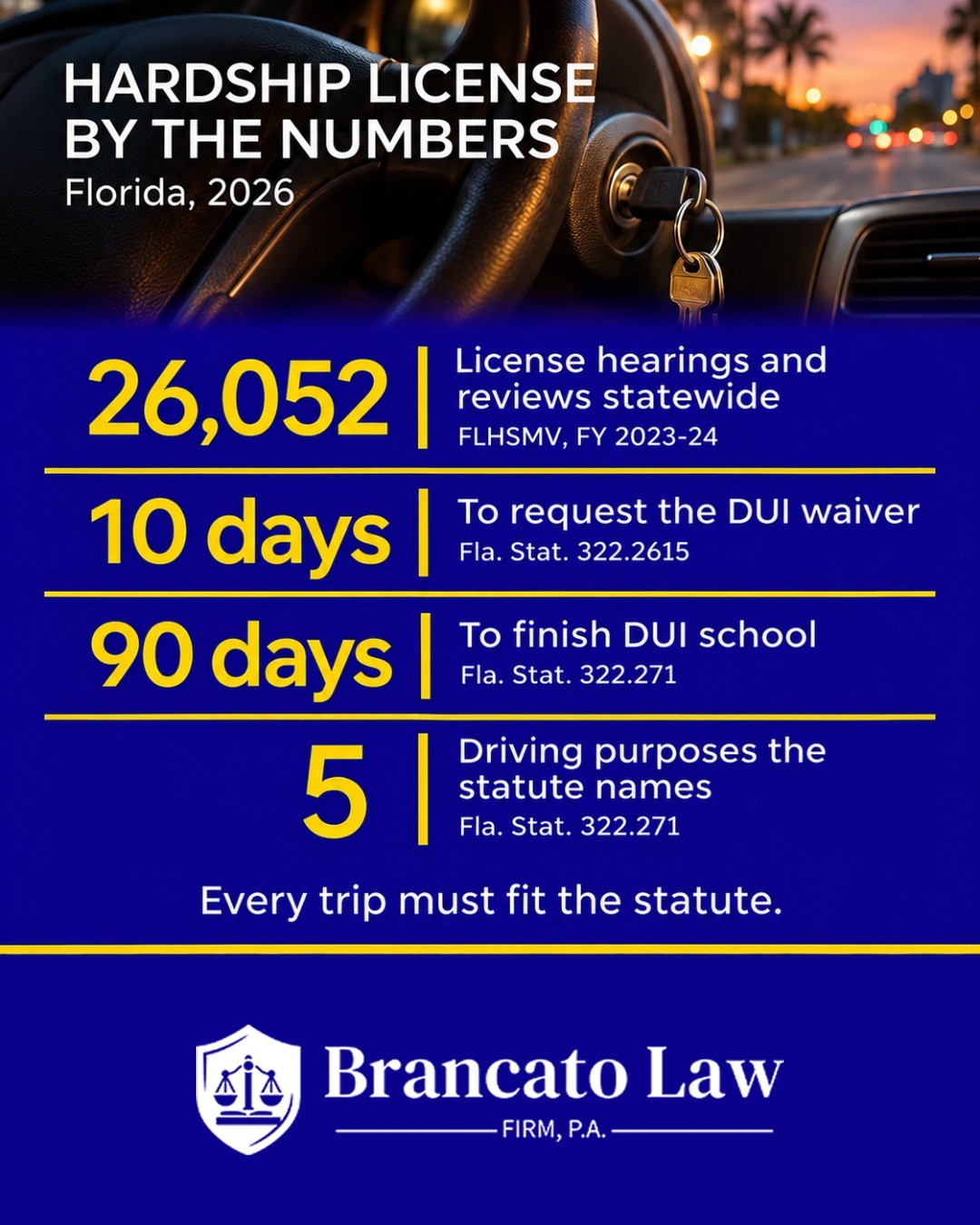
A business purposes only license allows driving necessary to maintain your livelihood and nothing else. Section 322.271(1)(c), Florida Statutes, defines it as “any driving necessary to maintain livelihood, including driving to and from work, necessary on-the-job driving, driving for educational purposes, and driving for church and for medical purposes.” The next sentence closes the door on everything else: “Driving for any purpose other than as provided by this paragraph is not permitted.”
That is the license a first-time DUI driver receives after waiving the administrative review hearing under section 322.271(7). The same definition governs a business purposes license issued after a hardship hearing or after a DUI conviction. When our firm advises a client on the Tampa DUI lawyer side of a case, the license question usually comes up in the first meeting, because the client needs to drive to work the next morning.
The table below sorts common trips into three groups. “Allowed” means the statute names the purpose. “Probably OK” means the statute does not name the trip, but it fits the livelihood language and no court has ruled against it. “Gray area” means a court or FLHSMV has read the statute against the trip. “Not allowed” means the trip is recreational or nonessential.
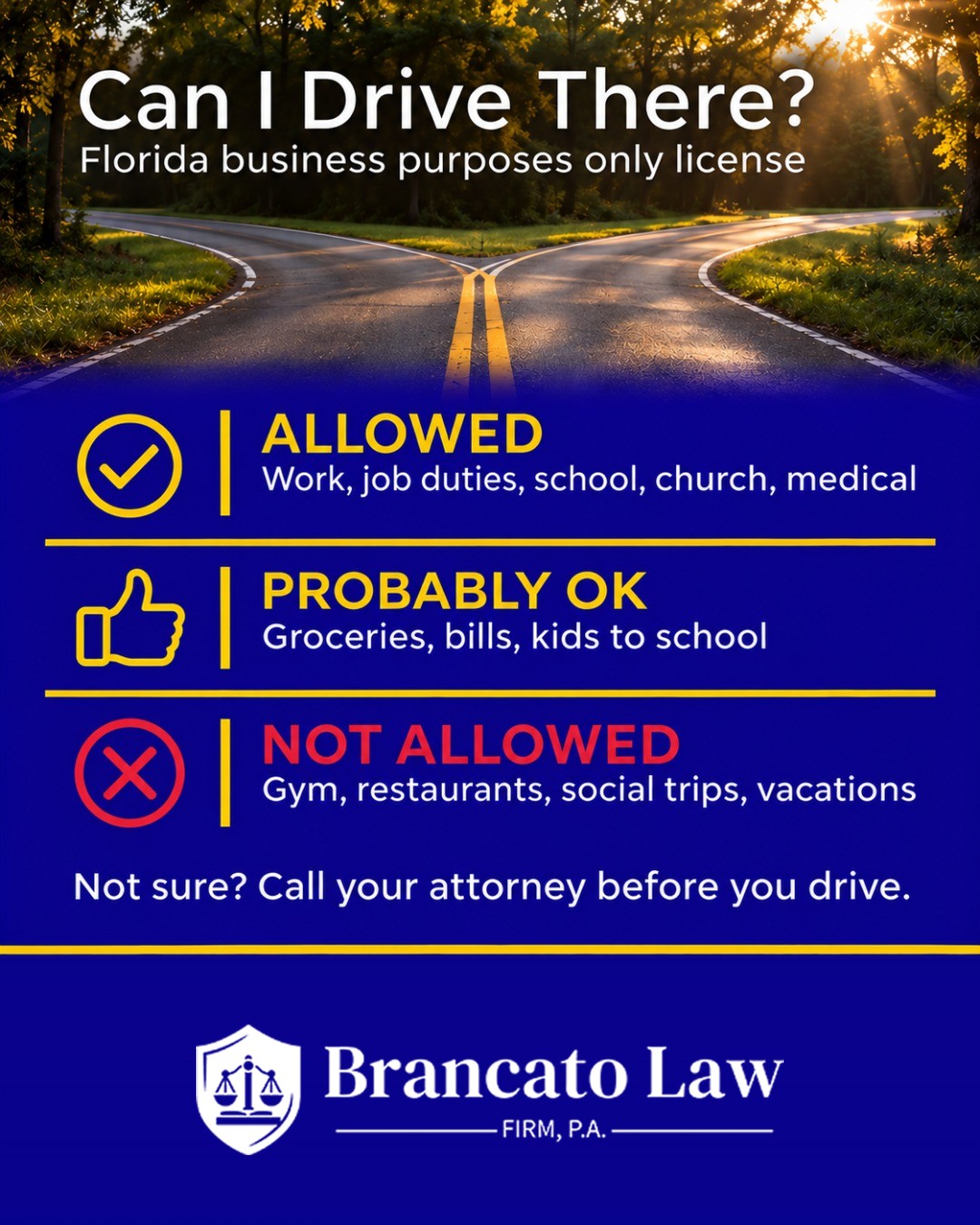
| Trip | Status | Why |
|---|---|---|
| Driving to and from work | Allowed | Named in s. 322.271(1)(c) |
| Driving your job requires (job sites, sales calls, deliveries for your employer) | Allowed | “Necessary on-the-job driving” |
| Driving to your own classes (college, trade school, high school) | Allowed | “Driving for educational purposes” |
| Driving to DUI school | Allowed | An educational course the license requires you to complete |
| Church or other religious services | Allowed | “Driving for church” |
| Your own doctor, dentist, hospital, or treatment appointments | Allowed | “Medical purposes” |
| Picking up your own prescriptions | Probably OK | Tied to your own medical care |
| A direct trip to buy groceries or a meal | Probably OK | Allart v. State, 9 Fla. L. Weekly Supp. 499c (Fla. 6th Cir. Ct. June 6, 2002) and State v. Quiroli, 9 Fla. L. Weekly Supp. 780b (Fla. Palm Beach Cty. Ct. Sept. 12, 2002) held food is a basic necessity |
| Paying an overdue utility bill | Probably OK | Vilches v. State, 12 Fla. L. Weekly Supp. 530a (Fla. 11th Cir. Ct. Mar. 29, 2005) reversed a conviction on these facts |
| Routine banking or the post office | Probably OK | Part of maintaining a household; no case on point |
| Driving a child to school or daycare | Probably OK | Florida law requires school attendance; no case on point |
| Driving a family member to the doctor | Gray area, high risk | A Pinellas appellate court upheld the department reading “medical purposes” as your own care |
| Picking up a spouse or partner from work | Probably OK if your spouse cannot drive; gray area if they can | Britt v. State, 50 Fla. Supp. 2d 16 (Fla. 9th Cir. Ct. 1991) acquitted a driver whose fiancee’s wages paid much of his rent and food; the trip is hard to call necessary if your spouse can drive the car |
| Court dates, probation, or your lawyer’s office | Probably OK | Missing court risks arrest; carry proof of the appointment |
| Job interviews | Probably OK | Finding work is maintaining a livelihood; no case on point |
| The gym, fitness classes, or recreational sports | Not allowed | Recreational driving |
| Restaurants, bars, parties, or social visits | Not allowed | Pleasure driving |
| Beach trips, vacations, or weekend travel | Not allowed | Pleasure driving |
| Errands for friends or nonessential shopping | Not allowed | Nonessential driving |
| A food stop at the end of a social outing | Not allowed | Allart and Dicks v. State, 15 Fla. L. Weekly Supp. 791b (Fla. 17th Cir. Ct. May 17, 2008): the whole trip counts |
| Driving a commercial motor vehicle | Not allowed | Section 322.64 bars commercial driving on these licenses |
Florida law uses the phrase “pleasure, recreational, or nonessential driving” to describe what a business or employment restriction excludes. That language appears in section 322.282(2)(b), which governs temporary permits after a court-ordered reinstatement, and it is a fair summary of how the Department of Highway Safety and Motor Vehicles (FLHSMV) reads every business purposes restriction.
Can I drive to the gym on a Florida hardship license?
No. A trip to the gym is recreational driving, and a business purposes only license does not cover it. The statute lists work, on-the-job driving, education, church, and medical trips. Exercise is not on that list, and no Florida court decision we have found treats a gym visit as necessary to maintain livelihood.
Two narrow exceptions exist. If you work at the gym as a trainer or employee, the trip is driving to and from work. If a doctor has prescribed physical therapy or cardiac rehabilitation at a facility, the trip is a medical appointment, and you should carry the referral. A regular workout does not fit either exception. The safer options are a gym within walking distance, a ride from a licensed driver, or a rideshare for the length of the suspension.
Gym-goers should know about one more risk. In Moore v. Department of Highway Safety & Motor Vehicles, 169 So. 3d 216 (Fla. 2d DCA 2015), a DUI program recommended canceling a driver’s supervised hardship license after he admitted taking a deer-antler-velvet bodybuilding supplement that the program said contained alcohol, and after a single ignition interlock reading of 0.092. FLHSMV canceled the license. The Second District Court of Appeal, which covers Hillsborough, Pinellas, and Pasco Counties, quashed the circuit court’s ruling because that court refused to review the documents behind the cancellation. The case was sent back to decide whether the evidence supported it. The lesson for anyone under DUI program supervision is to read supplement labels and to challenge a cancellation quickly.
Can I drive to the grocery store, pharmacy, or bank?
Usually yes, if the trip is a direct errand for a basic necessity. A pharmacy trip for your own prescription ties to the statute’s medical purpose. Florida courts have also held that buying food and paying an overdue utility bill are driving “necessary to maintain livelihood,” even though section 322.271(1)(c) does not name them.
The leading local decision is Allart v. State, 9 Fla. L. Weekly Supp. 499c (Fla. 6th Cir. Ct. June 6, 2002), from the Pinellas County appellate panel. A driver with a business purposes only license was stopped on his way to McDonald’s. On rehearing, the court held “as a matter of law a business purposes only restriction permits a driver to drive to shop for the basic necessities of life, such as, in this case at bar, food.” It vacated his conviction because the evidence showed only a drive from his house to the restaurant.
Two other courts reached the same result. In State v. Quiroli, 9 Fla. L. Weekly Supp. 780b (Fla. Palm Beach Cty. Ct. Sept. 12, 2002), a county judge dismissed a restriction charge against a driver headed to Burger King for dinner, reasoning that “livelihood” means support, which includes housing, food, clothing, and health. In Vilches v. State, 12 Fla. L. Weekly Supp. 530a (Fla. 11th Cir. Ct. Mar. 29, 2005), the Miami-Dade appellate panel reversed a conviction for driving to pay an overdue electric bill. Vilches relied on the 1986 House bill analysis, which said a business purposes license allows “driving necessary to maintain one’s livelihood, including driving for shopping, church and medical care.”
The older case of Britt v. State, 50 Fla. Supp. 2d 16 (Fla. 9th Cir. Ct. 1991) points the same way. It described a business purposes only restriction as permitting “essential shopping” along with work, school, church, and medical driving. A driver was ticketed while picking up his fiancee from work, and she paid much of his rent and food. The Orange County appellate panel ordered an acquittal, holding that the restriction was “much broader than the trial court’s limited interpretation.”
The limit is the “larger sojourn.” Allart warned that a food stop at the end of an evening of social driving is still a violation. In Dicks v. State, 15 Fla. L. Weekly Supp. 791b (Fla. 17th Cir. Ct. May 17, 2008), a Broward County driver picked up his paycheck, cashed it, then stopped at a relative’s house to give his girlfriend money and drink beer before heading to a restaurant. The appellate court affirmed his conviction. The errand has to be the trip, not the excuse at the end of one.
These are circuit and county court decisions, so none binds a Hillsborough County judge. Allart comes from the Pinellas appellate panel and carries the most weight in Tampa Bay. Our advice is to make each errand a direct trip, combine it with a commute when you can, and keep the receipt.
Can I drive my kids to school or take a family member to the doctor?
Driving your children to school is probably fine. No Florida court has ruled on it, most likely because the answer is obvious. Florida requires children to attend school, and under section 1003.27(2)(b), Florida Statutes, a parent who fails to have a child attend school regularly commits a second-degree misdemeanor. A parent who is prosecuted for truancy, or who has to quit work to stay home, has not maintained a livelihood. The same reasoning covers daycare that lets you get to work. The statute also allows “driving for educational purposes” without limiting it to the driver’s own education.
Driving a family member to the doctor is the riskier trip, because FLHSMV has read “medical purposes” to mean the driver’s own care.
In Harmon v. Department of Highway Safety & Motor Vehicles, 12 Fla. L. Weekly Supp. 902a (Fla. 6th Cir. Ct. July 12, 2005), a driver with an employment purposes only license asked the department for a business purposes license so he could drive his chronically ill mother to her doctor appointments. The hearing officer ruled the medical purpose had to be the driver’s own. The Pinellas County appellate panel acknowledged the statute does not expressly limit “medical purposes” to the driver, but it deferred to the department’s reading as reasonable and denied relief. The hearing officer also found that Harmon had violated his employment license by driving himself to the hearing.
Harmon is a Sixth Judicial Circuit decision, the circuit covering Pinellas and Pasco Counties. If a parent or spouse needs rides to medical appointments, talk with your attorney first, arrange another driver when you can, and keep the medical paperwork in the car. For school runs, keep the child’s school schedule in the car and drive the direct route.
What is the difference between business purposes and employment purposes only?
An employment purposes only license is narrower. It covers only driving to and from work and on-the-job driving required by an employer or occupation. A business purposes only license adds education, church, medical trips, and other driving necessary to maintain livelihood. Both definitions are in section 322.271(1)(c).
| Trip | Business purposes only | Employment purposes only |
|---|---|---|
| To and from work | Yes | Yes |
| On-the-job driving | Yes | Yes, if required by the employer or occupation |
| School or educational driving | Yes | No |
| Church | Yes | No |
| Medical appointments | Yes | No |
| Other livelihood driving (groceries, bills) | Probably OK | No |
| Recreation, social, or pleasure driving | No | No |
The first-DUI waiver license is always business purposes only, because section 322.271(7)(b) says the reinstatement “shall be restricted to business purposes only.” After a hardship hearing, FLHSMV decides which restriction to grant. A hardship license is not a separate card. It is a regular Class E Florida driver license reissued with a business purposes or employment purposes restriction, and the restriction drops off on its own when the suspension ends. Commercial drivers are downgraded to a Class E for the length of the restriction. Check the restriction on your license and the paperwork you received before you drive.
How does the first DUI waiver hardship license work?
A first-time DUI driver can skip the administrative hearing and get a business purposes only license right away. Under section 322.2615(1)(b), the driver must request a review of eligibility under section 322.271(7) within 10 days after the notice of suspension is issued. The 10-day temporary permit on the citation expires at midnight on the 10th day.
The request goes on FLHSMV Form HSMV 72034, Request for Eligibility Review, with a $25 filing fee, a copy of the DUI citation, and proof of enrollment in DUI school. FLHSMV’s Bureau of Administrative Reviews handles these requests. In fiscal year 2023-24, the Bureau conducted 26,052 hearings and reviews across eight offices statewide, according to an FLHSMV Office of Inspector General audit. Hillsborough County drivers file with the Tampa Bureau of Administrative Reviews office at 2814 E. Hillsborough Ave., which handles first-offense waiver reviews and accepts filings by email.
You qualify only if all of these are true:
- You have never had a license suspended under section 322.2615 (a prior DUI breath-test or refusal suspension).
- You have never been disqualified under section 322.64 (the commercial driver statute).
- You have never been convicted of DUI under section 316.193. An out-of-state DUI or DWI conviction counts as a prior conviction.
- Your license is now suspended under section 322.2615 for a breath or blood result of 0.08 or higher or for a refusal.
The trade-off is permanent. Section 322.271(7)(c) says acceptance of the license “is deemed a waiver of the right to formal and informal review.” You give up the chance to have the suspension thrown out, and the suspension stays on your driving record. The waiver cannot be used as evidence in the criminal case. Our firm’s pillar guide on protecting your license after a Tampa DUI arrest explains when we fight the suspension instead.
| Question | Waive the hearing (s. 322.271(7)) | Fight the suspension at a formal review |
|---|---|---|
| Deadline | Request within 10 days of the notice | Request within 10 days of the notice |
| When you can drive | Right away, on a business purposes only license | On the 10-day permit, then on a temporary business purposes permit if FLHSMV issues one while the review is pending (ask for it in the hearing request) |
| If you lose | Not applicable | Wait 30 days (0.08+ result) or 90 days (refusal) for a hardship license |
| Second refusal suspension | Not eligible | No business or employment license |
| Length of restriction | 6 months (0.08+) or 1 year (first refusal) | Same suspension periods if upheld |
| Chance to beat the suspension | None | Yes, if the hearing officer invalidates it |
The waiting periods come from section 322.2615(10). The bar on a business or employment license after two refusal suspensions comes from section 322.271(2)(a).
Fighting can win. In Sierra v. Department of Highway Safety & Motor Vehicles, 33 Fla. L. Weekly Supp. 320b (Fla. 13th Cir. Ct. Sept. 19, 2025), our firm represented a Hillsborough County driver whose license was suspended for refusing a breath test. The deputy’s report said only that the driver had backed up in the westbound lane to make a turn. The Hillsborough County circuit court granted our petition for writ of certiorari, ruling that the record did not show a lawful stop, so the refusal was not incident to a lawful arrest. A driver who took the waiver in that situation would have locked in a one-year suspension. Past results do not guarantee future outcomes.
What happens if you drive outside your hardship restriction?
You can lose the hardship license for the rest of the suspension and face a new charge. Florida Administrative Code Rule 15A-1.019(4) says a violation of the restrictions on a reinstated license “shall cause the license to be automatically suspended or revoked for the remainder of the period of the original suspension or revocation.”
The criminal exposure depends on how the restriction was imposed. Under section 322.16, violating a time-and-purpose restriction the department imposes under subsection (1)(b) is a moving violation fined under chapter 318. Violating a restriction imposed on the recommendation of a court or the Department of Corrections under subsection (1)(c) is a second-degree misdemeanor, punishable by up to 60 days in jail and a $500 fine.
That distinction decides real cases. The Legislature decriminalized violations of department-imposed restrictions in 2010. In Samuels v. State, 22 Fla. L. Weekly Supp. 63b (Fla. 15th Cir. Ct. Aug. 6, 2014), a driver with a business purposes only license was stopped on his way to the movies at 10:20 p.m. and convicted of the misdemeanor. The Palm Beach appellate panel reversed and ordered him discharged, because the State never proved that a court or the Department of Corrections recommended the restriction.
The State also carries the burden of proving the purpose of the trip. In McKnight v. State, 6 Fla. L. Weekly Supp. 265a (Fla. 20th Cir. Ct. Jan. 19, 1999), a conviction was reversed because the State offered no evidence of why the driver was on the road. In Mudge v. State, 20 Fla. L. Weekly Supp. 652a (Fla. 18th Cir. Ct. Feb. 7, 2013), an employment-only driver who said he was collecting scrap metal to sell won reversal because the trial court made him prove he was working. These cases are why our attorneys advise clients to answer an officer’s questions about the trip carefully, or not at all, and to call us before saying anything else.
An officer may also charge driving while license suspended. In Grizzard v. State, 881 So. 2d 673 (Fla. 5th DCA 2004), a driver with a business purpose hardship license was stopped in Hillsborough County. The officer’s computer showed the license as suspended, and a second check showed “some confusion.” The driver pleaded no contest in Hillsborough County court to driving while license suspended with knowledge, and that conviction was then used to revoke his probation. The Fifth District reversed because the trial court treated the no contest plea as conclusive proof of guilt. Grizzard shows two things: database errors happen, and a quick plea on a driving while license suspended charge can cost far more than a fine.
A 2025 federal decision shows how serious that charge can get. In United States v. Donadio, No. 3:25-mj-120-HTC (N.D. Fla. July 11, 2025), a driver with a temporary business purposes permit was arrested after a night of New Year’s Eve bar hopping on federal property, where Florida traffic law applies. A jury convicted her of driving with knowledge that her license was suspended under section 322.34(2), not just a restriction violation. The court denied her motion for acquittal, reasoning that a business purposes license reinstates only part of the driving privilege, so all other driving remains suspended. Donadio does not bind Florida state courts, but it shows that prosecutors can treat a trip outside the restriction as driving on a suspended license.
Officers can see the restriction before they turn on their lights. In Pickenpaugh v. State, 15 Fla. L. Weekly Supp. 238a (Fla. 6th Cir. Ct. Jan. 24, 2008), a Pinellas County deputy saw a car speeding in St. Petersburg at about 2:30 a.m., ran the plate, and learned the owner had a business purposes only restriction. The trial court found that drivers at that hour are not coming from a school, a church, a hospital, or a job. The Pinellas appellate panel affirmed the stop, noting that speeding alone justified it and that the circumstances also reasonably suggested a restriction violation.
Driving outside the rules also hurts the next application. In Brown v. Department of Highway Safety & Motor Vehicles, 29 Fla. L. Weekly Supp. 697a (Fla. 2d Cir. Ct. Dec. 6, 2021), the Leon County appellate panel upheld the denial of a hardship license because the driver had kept driving while his license was revoked. Hearing officers treat unlawful driving as proof that a driver cannot be trusted with a restricted license.
What can cancel a hardship license before the suspension ends?
Four events can end a hardship license early, even if you never drive outside the restriction:
- Missing the DUI school deadline. Under section 322.271(2)(a), if you do not complete the course within 90 days after reinstatement, or later fail to complete treatment, FLHSMV must cancel the license until you finish.
- A DUI conviction. Form HSMV 72034 warns that the waiver license “will no longer be valid” if you are convicted of DUI. Under section 322.28(2)(a), a first DUI conviction brings a revocation of at least 180 days and up to one year. A new business purposes license is available only after you complete DUI school.
- Violating program or interlock conditions. When FLHSMV or a court requires DUI program supervision or an ignition interlock device, a reported violation can lead to cancellation, as in Moore. Section 322.271 also lets the department require an interlock as a condition of reinstatement.
- Driving outside the restriction. Rule 15A-1.019(4) suspends the license for the rest of the original period.
A DUI program’s termination decision can be appealed, and the appeal matters. In Oleksa v. Department of Highway Safety & Motor Vehicles, 12 Fla. L. Weekly Supp. 195a (Fla. 6th Cir. Ct. Sept. 24, 2004), the Pasco County program terminated a supervised driver, who gave notice of an appeal to DUI Counterattack in Hillsborough County. FLHSMV revoked his license before that appeal was heard, and the Pinellas appellate panel quashed the revocation for violating his due process rights. In Johnson v. Department of Highway Safety & Motor Vehicles, 10 Fla. L. Weekly Supp. 144a (Fla. 4th Cir. Ct. Dec. 13, 2002), a driver who skipped the program appeal and went straight to circuit court lost on that ground. The appeal must go to another licensed DUI program in the same or an adjacent judicial circuit, and a driver who appealed to a program outside those circuits lost his challenge to the cancellation in Erb v. Department of Highway Safety & Motor Vehicles, 15 Fla. L. Weekly Supp. 202a (Fla. 4th Cir. Ct. Dec. 21, 2007). File the program appeal under Rule 15A-10.031 first, and file it with the right program.
Hillsborough County’s licensed DUI program is DUI Counterattack Hillsborough, Inc., at 4711 N. Hubert Ave. in Tampa. Pinellas County drivers use Suncoast Safety Council in Clearwater, and Pasco County drivers use Pride Integrated Services in Zephyrhills or New Port Richey, according to FLHSMV’s list of licensed DUI programs. Enroll early, because the 90-day clock runs from reinstatement.
Why does Florida limit hardship driving so tightly?
Florida limits hardship driving because license suspension is one of the few DUI sanctions with strong evidence behind it. The National Highway Traffic Safety Administration’s research guide, Countermeasures That Work, reports that administrative license revocation reduces alcohol-related fatal crash involvement by 5%, saving an estimated 800 lives each year. The same guide notes that most states let offenders obtain an occupational or hardship license for part or all of a suspension.
Florida’s business purposes license is that compromise. It keeps drivers employed while preserving most of the suspension’s safety effect. Hearing officers and judges enforce the limits strictly for that reason, and they are rarely persuaded that a trip outside the statute was harmless.
How do you stay safe on a Florida hardship license? 7 rules
- Read the restriction on your license. Confirm whether it says business purposes or employment purposes, and note the expiration date.
- Carry your paperwork. Keep the FLHSMV approval letter, your DUI school enrollment receipt, and proof of your work schedule in the car.
- Drive the direct route, and think twice about late-night trips. A stop that turns a commute into a social outing is outside the restriction, and deputies can see your restriction when they run your plate.
- Document gray-area trips. Keep medical referrals, pharmacy receipts, and school schedules.
- Finish DUI school early. Do not let the 90-day deadline cancel the license.
- Avoid alcohol and read supplement labels if you are under DUI program supervision or have an interlock.
- Call your attorney before a new kind of trip. A five-minute call costs less than a suspension for the rest of the term.
What should you do in the first 10 days after a Florida DUI arrest?
Decide within 10 days whether to waive the hearing or fight the suspension. That 10-day window under section 322.2615 is the only chance to do either. If you miss it, the suspension takes effect and you lose both the immediate waiver license and the hearing.
Our attorneys review the arrest video and the breath or refusal paperwork before that deadline, because the right choice depends on how strong the hearing issues are. A weak stop or a flawed breath test can justify fighting. A clean stop and a job that requires driving usually favor the waiver. Our timeline of a Hillsborough County DUI case walks through what comes after the license decision, including arraignment and the criminal penalties.
Frequently asked questions
Can I drive to the gym on a business purposes only license in Florida?
No, unless you work at the gym or a doctor has prescribed therapy there. The Brancato Law Firm tells clients to plan a walk, a ride, or a rideshare for workouts until the restriction expires.
Can I stop for food or groceries on a Florida business purposes only license?
Yes, if the food run is the whole trip, because Allart v. State and State v. Quiroli held that driving to buy food is driving necessary to maintain livelihood. The Brancato Law Firm cautions clients that a food stop tacked onto a social outing is still a violation, as the driver in Dicks v. State learned.
Can I drive my child to school on a Florida hardship license?
Probably yes, because Florida requires school attendance and section 322.271(1)(c) allows educational driving without limiting it to the driver. No court has ruled on it, and our attorneys at The Brancato Law Firm advise keeping the school schedule in the car and driving the direct route.
Is driving outside my hardship license restriction a crime in Florida?
It can be, depending on how the restriction was imposed, and it triggers an automatic suspension for the rest of the original term under Rule 15A-1.019(4). The Brancato Law Firm defends these citations and related driving while license suspended charges in Hillsborough, Pinellas, and Pasco Counties.
Can I get a hardship license after refusing a breath test in Florida?
Yes, on a first refusal, either through the waiver right away or after a 90-day wait if a formal review upholds the suspension. Our team at The Brancato Law Firm explains the refusal suspension and the separate criminal exposure in our guide to refusing a breathalyzer in Florida.
How long does the first DUI waiver hardship license last?
It lasts for the length of the administrative suspension: six months for a 0.08 or higher result and one year for a first refusal. The Brancato Law Firm tracks that end date with clients, because a DUI conviction during the term ends the waiver license and starts a new revocation.
Do I need a lawyer to waive my DUI hearing in Florida?
No, a driver can file Form HSMV 72034 alone, but the waiver permanently gives up the right to challenge the suspension. Before the 10-day deadline, The Brancato Law Firm reviews whether a formal review could win, and our DUI defense attorneys handle both the license and the criminal case.
Can I drive a commercial vehicle on a Florida hardship license?
No. Section 322.64 provides that a business or employment purposes license does not authorize operating a commercial motor vehicle, and The Brancato Law Firm explains the CDL rules in our post on restoring a commercial license after a DUI suspension.
Talk with a Tampa DUI defense attorney
The 10-day clock starts the day of the arrest, and the hardship license decision cannot be undone once you accept it. Call The Brancato Law Firm, P.A., founded by Tampa Criminal Defense Attorney Rocky Brancato, at (813) 727-7159. You can call us at any hour, and our office is two blocks from the courthouse. Our firm has Spanish-speaking staff, and attorney Jean-Luc Adrien speaks Spanish, Haitian Creole, and French. For more about our defense strategies, visit our DUI page.
The Brancato Law Firm, P.A.
620 E. Twiggs Street, Suite 205, Tampa, FL 33602
(813) 727-7159
Serving Hillsborough, Pinellas, and Pasco Counties
The Brancato Law Firm, P.A. is a Tampa-based criminal defense practice. We are not affiliated with any other Brancato-named law firms.
Visit Us

Tampa, FL 33602

Contact Us Now
Free Legal Consultation (813) 727-7159
