- Free Consultation 24/7: (813) 727-7159 Tap Here To Call Us


From First DUI to Death Penalty



Teen Takeover Arrests in Tampa Bay: What Every Parent Needs to Know


| Key Takeaway If your child was arrested at a “teen takeover” in Hillsborough, Pinellas, or Pasco County, the most common charge is affray — a first-degree misdemeanor under Florida law (§870.01). But these events are far more dangerous than a misdemeanor suggests. A teen was shot at the Clearwater Beach takeover, and in an armed state like Florida, your child could be shot by a lawful gun carrier who feels threatened by a sudden crowd. An arrest can also follow a young person for years. Early action by a defense attorney is critical. |
I’m Tampa Criminal Defense Attorney Rocky Brancato, founder of The Brancato Law Firm, P.A. For more than 25 years, I’ve defended young people and their families across the 13th Judicial Circuit, and I know how terrifying it is to get the call that your child is in custody — or in the hospital. This guide does not sugarcoat the danger. It explains what a teen takeover really is, the two ways these events turn deadly, what your child is charged with, and exactly what to do right now.
What Is a “Teen Takeover” and Why Are They So Dangerous?
A teen takeover is a large, unplanned swarm of young people, organized in hours through TikTok, Instagram, and group chats. Hundreds show up at a beach, a park, a mall, or a business — no permit, no adults, no plan. They come out of nowhere. One minute a parking lot or a stretch of sand is calm; the next, it is packed with a moving, unpredictable crowd. That suddenness is exactly what makes them so frightening, and so dangerous.
Tampa Bay has seen a string of these events in a matter of weeks. On May 31, 2026, a planned takeover at Clearwater Beach near Pier 60 drew hundreds of teens — and a 17-year-old was shot on Coronado Drive. On May 8, 2026, Tampa police arrested 22 people between the ages of 12 and 21 after a takeover at Curtis Hixon Waterfront Park spilled into downtown streets; officers seized two firearms. In March, eight juveniles were arrested at an Urban Air trampoline park in Brandon.
These are not harmless gatherings of “kids being kids.” They are crowds where guns are present, fights erupt in seconds, and the people most likely to get hurt are the teenagers themselves. At The Brancato Law Firm, P.A., we want parents to understand both ways a takeover can destroy a young life — not just an arrest, but a bullet.
Have You Talked to Your Child About Teen Takeovers Yet?
If you take one thing from this guide, take this: sit your child down tonight and talk about teen takeovers before one happens. Not next week — tonight. Every parent of a teenager in Tampa Bay needs to have this conversation, because the flyers spread on the same apps your kids already use, and a takeover can form in a matter of hours. By the time you hear about it on the news, it is already over — and your child may already be in the middle of it.
Your child needs to understand that these are not parties. A 17-year-old was shot at Clearwater Beach. Guns turn up in these crowds. And in an armed state like Florida, a frightened citizen may open fire on a swarming group of teens. Make sure your child knows that being there at all — even just to watch, even just to be with friends — can get them shot or arrested. The only reliable protection is not being in the crowd.
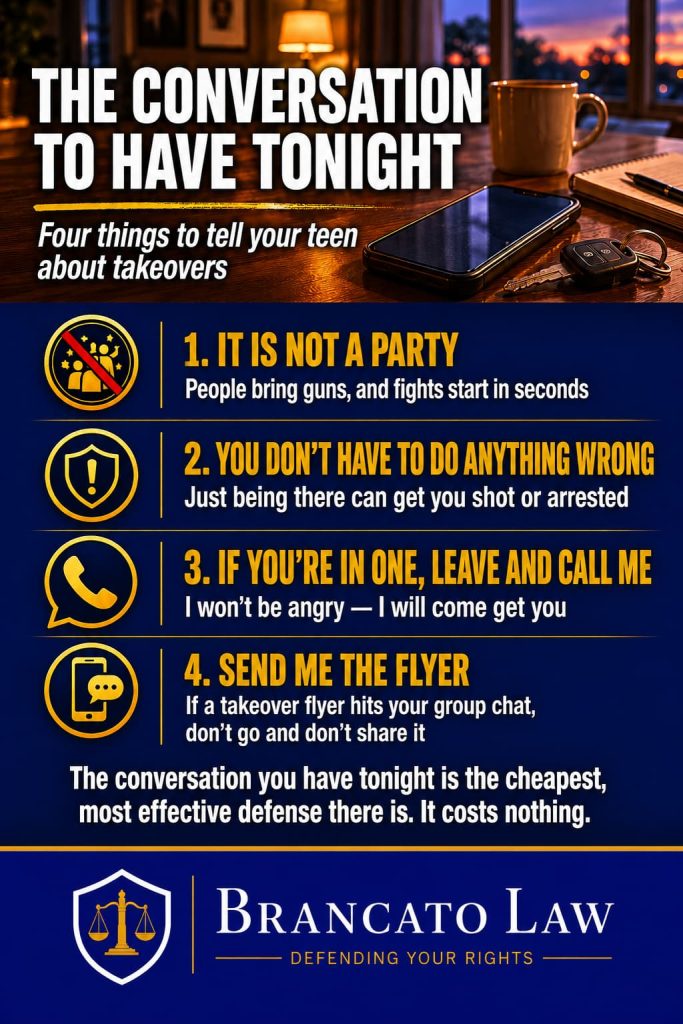
| The Conversation to Have Tonight Tell your child, in plain terms: A teen takeover is not a party. People bring guns, and fights start in seconds.You do not have to do anything wrong to be shot or arrested. Just being there is the risk.If you find yourself in one, leave immediately and call me — I will not be angry, I will come get you.If a flyer for a “takeover” shows up in a group chat, send it to me. Do not go, and do not share it. |
That last point matters. A teenager who has already agreed with a parent on a plan — leave, call home, no anger — is far more likely to walk away when the crowd turns. The conversation you have now is the cheapest, most effective defense available, and it costs nothing. As a firm that defends young people across Hillsborough, Pinellas, and Pasco Counties, we would rather help you keep your child out of the system than defend them after the fact.
Danger One: Your Child Can Be Shot Inside the Takeover
The Clearwater Beach shooting was not a freak accident. It is the predictable result of packing hundreds of teenagers into one space when some of them are armed. When officers cleared Curtis Hixon, they recovered two guns from that single crowd. Multiply that across a beach of hundreds and the math is grim.
In a crush like that, a stray round, a fight that turns into gunfire, or a moment of panic can leave a child dead. And your teenager does not have to be involved in the fight to be the one who gets hit. The 17-year-old shot at Clearwater Beach is a warning to every parent in Tampa Bay: the danger is real, it is immediate, and it does not check whether your child was a participant or a bystander.
| The Hard Truth for Parents A teen takeover is one of the few places where your law-abiding child can be shot simply for being in the crowd. Hundreds of teens, unknown numbers of guns, and fights that ignite in seconds — that combination has already put one Tampa Bay teenager in the hospital. The safest defense is to keep your child away from these events entirely. |
There is also a second-order danger. When a shooting happens and police flood the scene, everyone nearby becomes a suspect, a witness, or a target. Kids scatter, get detained, or run — and running from police creates its own legal problems. We address those below.
Danger Two: Your Child Could Be Shot by a Lawfully Armed Citizen
This is the danger almost no parent has thought about, and it may be the most important part of this guide. Florida is a heavily armed state. Adults can lawfully carry firearms without a permit, and Florida’s self-defense laws are among the broadest in the country.
Picture it from the other side. A shop owner, a driver, or a resident is going about their evening when a screaming crowd of teenagers suddenly swarms the street, pounds on cars, or pushes into a business. To that person, this is not “kids being kids.” It is a mob appearing out of nowhere. Under Florida law, a person who reasonably believes they are about to suffer great bodily harm may use deadly force to defend themselves — and they have no duty to retreat.
| Florida Self-Defense and “Stand Your Ground” (§776.012, §776.013) Under Florida law, a person is justified in using deadly force if they reasonably believe it is necessary to prevent imminent death or great bodily harm. There is generally no duty to retreat if the person is somewhere they have a right to be. A frightened adult facing a sudden, aggressive crowd may believe — rightly or wrongly — that deadly force is justified. The teenagers in that crowd may have no idea they are being perceived as a deadly threat. |
That is the nightmare scenario: your child runs with a crowd toward a business or a car, never intending to hurt anyone, and an armed person who feels cornered opens fire. Whether that shooting is later found justified is a brutal, fact-by-fact legal fight — but your child does not get that day back. I have tried self-defense cases to verdict, including a second-degree murder case where a Tampa jury returned a Not Guilty verdict on a justifiable-use-of-force defense. I know exactly how these cases are argued from both sides, and I know how thin the line is between “justified” and “murder.” Your child should never be standing on that line.
What Charges Can Come From a Teen Takeover Arrest?
Here is what every parent must understand: your child can be completely innocent and still be arrested. When hundreds of teenagers swarm a beach or a park and fights break out, police are not conducting careful, one-by-one investigations. They are trying to control mass chaos with a handful of officers, fast. In that environment, they often detain everyone in the area first and sort out who did what later — if at all. A kid who showed up to meet friends, who never threw a punch, who was simply standing in the wrong place at the wrong time, gets swept up with everyone else and walks out with an arrest record.
At Curtis Hixon, officers arrested 22 people — 18 of them children as young as 12. In a crowd of well over a hundred, the police cannot know in the moment who was fighting and who was just there. That is not a knock on the officers; it is the reality of policing a sudden, overwhelming crowd. But it means the State frequently ends up charging kids it cannot actually prove did anything. We have seen it, and it is one of the strongest points in the defense.
Once your child is arrested, the charges depend on what police say each person did. After the Curtis Hixon arrests, the Tampa Police Department listed affray, drug possession, resisting an officer without violence, and unlawful possession of a firearm. Officers also reported fleeing to elude and obstructing a highway.
| Affray — Florida Statute §870.01 Under Florida law, an affray happens when a person fights another person in a public place “to the terror of the people.” It is a first-degree misdemeanor, punishable by up to 12 months in jail and a $1,000 fine. The State must prove the fight was public AND that it caused fear in bystanders — not just that two people argued. |
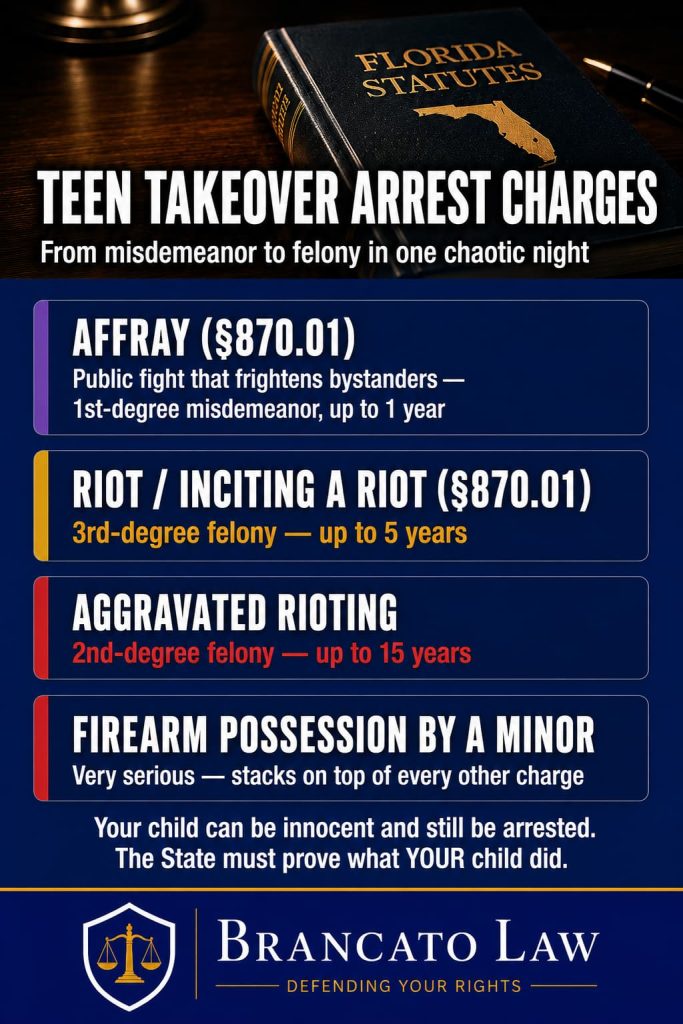
Most of the teens arrested at Curtis Hixon were charged with affray. But the list runs wider, and some charges are far more serious than a misdemeanor:
- Affray (§870.01) — first-degree misdemeanor, the most common takeover charge
- Riot or inciting a riot (§870.01) — a third-degree felony, up to 5 years in prison
- Aggravated rioting — a second-degree felony, up to 15 years in prison
- Drug possession — misdemeanor or felony, depending on the substance
- Unlawful possession of a firearm — very serious for a minor, especially with any prior history
- Resisting an officer without violence (§843.02) — first-degree misdemeanor
- Fleeing to elude / obstructing a roadway — separate charges that stack on top of the rest
Because one chaotic night can produce several charges at once, the difference between a misdemeanor and a felony often comes down to the specific facts and how the case is handled early. That is where an experienced defense attorney makes the biggest difference.
Will My Child Be Charged as an Adult in Florida?
This is the first question most parents ask. In Florida, the prosecutor decides whether a juvenile case stays in juvenile court or moves to adult court through a process called “direct file” (§985.557).
| What Parents Must Know About Direct File For a 14- or 15-year-old, the State can direct file only for a specific list of serious violent felonies — murder, armed robbery, sexual battery, and similar charges. For a 16- or 17-year-old, the prosecutor has much broader power. A misdemeanor like affray usually cannot be sent to adult court unless the child already has the prior record the statute requires. The charge, the age, and the prior history all matter — and so does having a lawyer who can fight to keep the case in juvenile court. |
For most teen takeover arrests involving a misdemeanor affray, the case will stay in the juvenile system, which focuses on rehabilitation rather than punishment. But “less severe” does not mean “no consequences.” A felony charge, a gun, or a prior record can change everything — which is why you should never assume your child’s case will quietly resolve on its own.
How Long Does a Teen Takeover Arrest Stay on My Child’s Record?
A common myth is that juvenile records vanish at 18. They do not. In Florida, a juvenile record is generally kept by the courts until the person turns 21, and the Florida Department of Law Enforcement maintains juvenile arrest and adjudication records that do not disappear automatically at 18.
For many non-serious offenses, a juvenile record is automatically expunged later — often at 21, and in some cases at 24 or 26 depending on the offense and history. But there is a catch: if your child picks up an adult conviction before that automatic expungement, the juvenile record can become part of the adult record and stay there. In serious cases, a juvenile record may never be destroyed.
There is also a faster path. Completing a teen court or diversion program can lead to an early expungement. In our experience handling juvenile matters across Hillsborough, Pinellas, and Pasco Counties, getting a young person into the right diversion track early is often the single most valuable thing a family can do.
What Should I Do If My Child Was Arrested at a Teen Takeover?
The hours right after an arrest matter most. What your child says — and what you say — can shape the entire case. Here is what we tell every parent who calls us.
Make Sure Your Child Is Physically Safe First
Before anything legal, confirm your child is unhurt. These events have already put a teen in the hospital. If your child was near gunfire or a fight, get medical attention and document any injuries — that record can matter later, especially if self-defense is involved.
Do Not Let Your Child Talk to Police Without a Lawyer
Your child has the right to remain silent and the right to an attorney. Those rights apply to minors too. Police are trained to question young people, and a scared teenager will often say things that hurt the case without realizing it. Politely decline questioning and ask for a lawyer. Because I taught criminal procedure at the police academy, I know exactly how officers are trained to build these cases — and how to protect your child from those tactics.
Write Down Everything While It Is Fresh
Note the time, the location, who your child was with, and what they actually did — and did not do. In a mass arrest, the State often lacks individualized proof that any one person committed a crime. Details you remember now can become the foundation of the defense later.
Preserve the Digital Trail
These events live on phones. Screenshots of the flyer, group chats, and videos can show who organized the gathering, when your child arrived, and whether they were fighting or simply present. Do not delete anything — and do not let your child post about it. We can use that evidence; so can the State.
Call a Defense Attorney Before the First Court Date
The earlier we get involved, the more options exist. We can investigate, contact the State Attorney’s Office, and in some cases steer the matter toward diversion before charges harden. Waiting until the first court date means losing weeks of advantage.
How Do You Fight a Teen Takeover Charge?
Every one of these cases turns on a simple question: can the State actually prove what your specific child did in the middle of a crowd of hundreds? Often, it cannot.
We start by demanding the evidence — body camera footage, the helicopter video police love to release, witness statements, and any phone or social media records. We look for the gap between “your child was present” and “your child committed a crime.” Florida’s affray statute requires proof that the fight caused terror to the public; if your child was standing nearby and not fighting, that element may be missing entirely.
We also raise defenses that fit the facts: self-defense if your child was attacked first, defense of others if they stepped in to protect a friend, and mistaken identity, which is common when officers detain people in a fast-moving crowd. Rated AV Preeminent by Martindale-Hubbell and selected to Super Lawyers, I have taken more than 150 jury trials to verdict, and I bring that same scrutiny to a juvenile misdemeanor that I bring to a felony. For families, that means your child’s case receives senior-level attorney attention from the start.
Does Parental Involvement Affect a Juvenile Case?
After the Curtis Hixon arrests, the Tampa police chief said something every parent should hear: the poor decisions made that night could follow these kids well into adulthood. He is right — but involved parents change that trajectory.
Prosecutors and judges in juvenile cases pay close attention to the home. A parent who shows up to court, supports diversion, and demonstrates supervision gives us powerful leverage to argue for a result that protects the child’s future. A young person who appears unsupported looks like a higher risk. Your presence is not just emotional support; it is part of the defense strategy.
Just as important is prevention. Summer is when these takeovers spread, and the flyers circulate on the same apps your kids already use. Talk to your children about the two dangers in this guide — the gunfire inside the crowd and the armed citizens outside it. Know where your child is going, who organized it, and whether it is a permitted, supervised event. The community is responding too: Tampa has launched supervised “Takeover with a Purpose” events as a safe alternative, and Pasco County offers teen court and juvenile diversion programs in New Port Richey and Dade City.
More Questions About Teen Takeover Arrests
What is the difference between affray and a riot in Florida?
An affray (§870.01) is a public fight that frightens bystanders, and it is a first-degree misdemeanor. A riot involves three or more people in a violent public disturbance and is a third-degree felony. The difference is enormous — one carries up to a year in jail, the other up to five years in prison. The Brancato Law Firm, P.A. works to keep a charge at the lowest possible level.
Can my child be shot legally during a teen takeover?
Florida’s self-defense laws (§776.012) allow a person to use deadly force if they reasonably believe it is necessary to prevent death or great bodily harm, with no duty to retreat. A frightened adult facing a sudden aggressive crowd may fire and later claim self-defense. Whether that is justified is decided case by case — but the safest course is to keep your child out of these crowds entirely.
Can teen takeover charges be dropped?
Yes. Charges can be dropped when the State lacks proof that your specific child committed a crime, when a constitutional violation occurred, or when your child completes a diversion program. In a mass arrest, individualized proof is often the weakest part of the State’s case. The earlier you involve The Brancato Law Firm, P.A., the more options remain available.
Do I need a lawyer if my child only got a misdemeanor?
Yes. A misdemeanor still creates an arrest record, and how it is handled now affects whether it can be expunged later. An attorney can pursue diversion, dismissal, or a result that keeps the record clean. Treating a “minor” charge casually is how young people end up with records that follow them for years.
My child was just standing there. Can they still be charged?
Unfortunately, yes — police often detain everyone in the area of a disturbance. But “present in a crowd” is not the same as “guilty of a crime.” We have seen kids who did nothing wrong swept into mass arrests, and challenging that lack of individualized proof is central to how we defend these cases.
Will a teen takeover arrest show up on a background check?
It can, depending on the outcome and whether the record is sealed or expunged. Juvenile records are not public, but the Florida Department of Law Enforcement keeps them, and they are available to law enforcement, courts, and certain agencies. Clearing the record through diversion or expungement is often possible with the right legal steps from The Brancato Law Firm, P.A..
What experience does Rocky Brancato have with cases like this?
For more than 25 years I have defended young people and serious cases across the 13th Judicial Circuit, including self-defense and use-of-force trials. I have taken more than 150 jury trials to verdict and once led a staff of over 100 attorneys as Chief Operations Officer of the Hillsborough County Public Defender’s Office. That experience means I understand both how these cases are prosecuted and how they are won.
You Are Reading This Because Your Child Needs Help — Let Us Step In
If your son or daughter was arrested — or hurt — at a teen takeover, you are scared, and you should be. We have defended young people across Hillsborough, Pinellas, and Pasco Counties for more than 25 years, and we know how to keep a single terrifying night from defining a young person’s future.
The window to act is now. Before the first court date, we can investigate, push back on weak evidence, and work toward diversion or dismissal — options that shrink the longer you wait. Every day that passes is a day the State spends building its case against your child.
Call Tampa Criminal Defense Attorney Rocky Brancato and The Brancato Law Firm, P.A. at (813) 727-7159. The consultation is free, confidential, and available 24/7. We serve families throughout Hillsborough, Pinellas, and Pasco Counties.
For more about how we protect young clients, visit our Juvenile Defense page. We have also written about your child’s rights during a police investigation.
The Brancato Law Firm, P.A. is a Tampa-based criminal defense practice serving clients exclusively in Hillsborough, Pinellas, and Pasco Counties. We are not affiliated with any other Brancato-named law firms.
This page is for informational purposes only and does not constitute legal advice. Each case is unique, and outcomes depend on the individual facts and circumstances involved. Past results do not guarantee future outcomes.
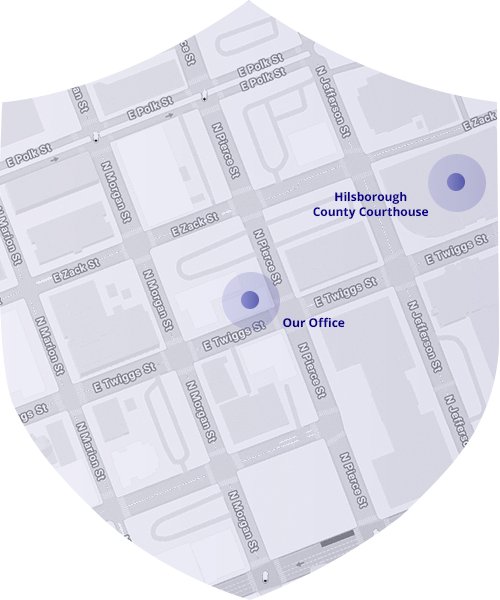
Visit Us

Tampa, FL 33602
Contact Us Now
Free Legal Consultation (813) 727-7159