

From First DUI to Death Penalty



Can Florida Police Wiretap Your Phone and Texts? (2026)


The rule: Yes, but only with a court order that is harder to get than a search warrant, unless someone on the call agreed to the recording. Under Chapter 934, Florida Statutes, and the federal wiretap law known as Title III, police must show a judge probable cause, list a qualifying crime such as drug trafficking or racketeering, and explain why ordinary investigative methods have failed or would fail. Orders last no more than 30 days at a time, officers must minimize what they record, and evidence from a wiretap that broke these rules can be suppressed.
Wiretap cases are often decided on paper long before trial: in the application, the necessity affidavit, and the minimization logs that most defendants never think to request. As founder of The Brancato Law Firm, P.A., a Tampa criminal defense firm, and a former Chief Operations Officer of the Hillsborough County Public Defender’s Office, where I oversaw a staff of over 100 attorneys, I have watched large drug and racketeering prosecutions rise or fall on those documents. I’m Rocky Brancato, and I also taught search and seizure law to officers as a police academy instructor. When a case involves intercepted calls or texts, our attorneys read the entire application file before anything else.
This guide is part of our series on police surveillance in Florida. It covers real-time interception of calls and texts. Searching a phone police have already seized is a different legal question, covered in our guide to whether police can search your cell phone in Florida.
What Counts as a Wiretap Under Florida Law?
A wiretap is the government’s real-time interception of the contents of a phone call, text message, or other communication while it is being sent. Florida’s law, Chapter 934, Florida Statutes, covers “wire, oral, or electronic communications,” so a modern order can reach calls, texts, and messaging traffic on a target phone. Location tracking, call logs, and stored messages fall under different rules.
When people say police “cloned” a phone, they usually mean the State intercepted calls and texts as they happened, often for weeks, and played the recordings at trial. That is a wiretap, and it needs a wiretap order. A one-time search of a phone in an evidence locker is not a wiretap, and tracking a phone’s location with a cell-site simulator is governed by separate rules explained in our post on whether Florida police can use a Stingray without a warrant.
When Can Florida Police Get a Wiretap Order?
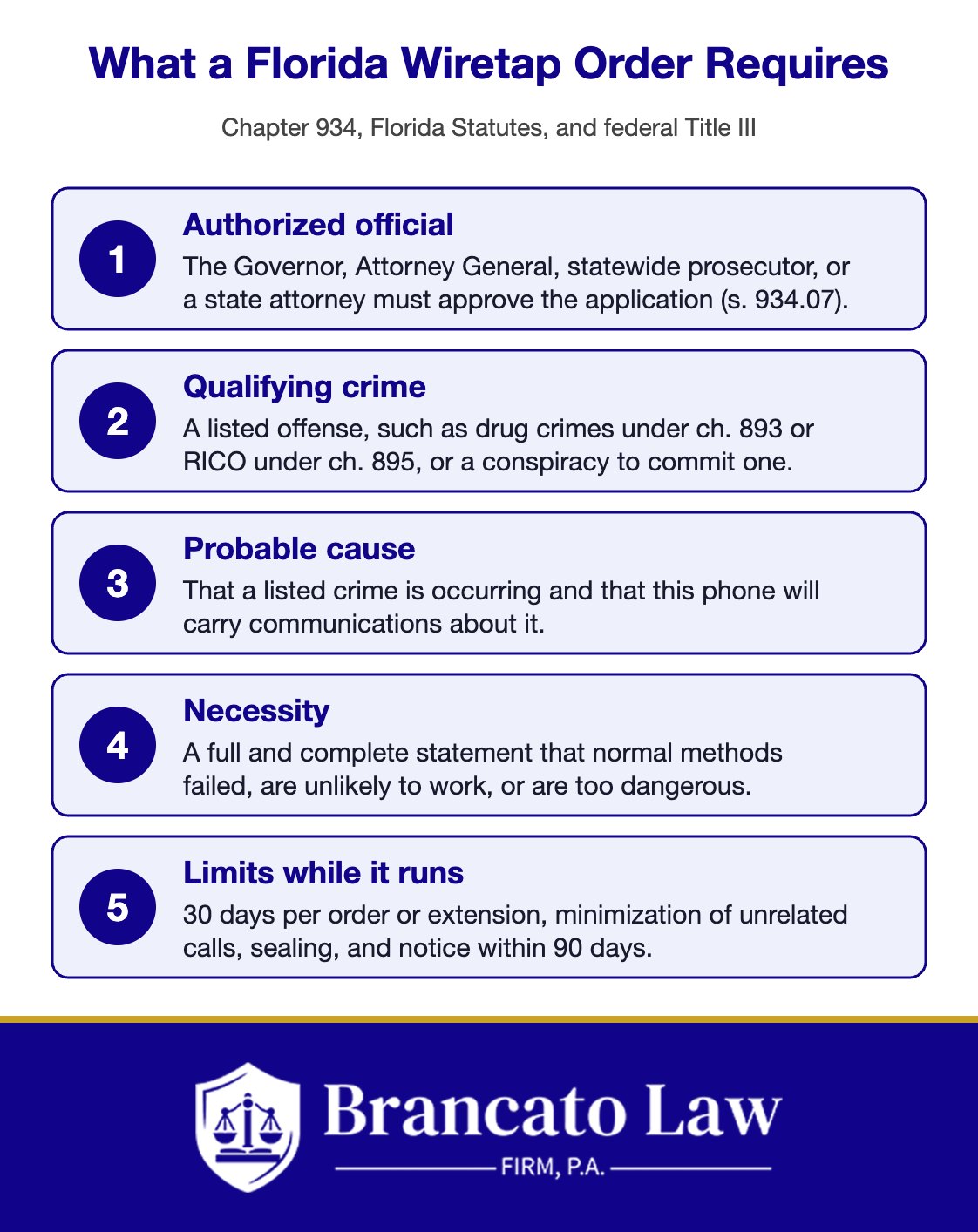
Florida police can get a wiretap order only to investigate crimes listed in section 934.07, Florida Statutes, and only if a specific official authorizes the application. The list includes murder, kidnapping, robbery, any violation of Chapter 893 (the drug statutes), Chapter 895 (Florida’s RICO Act), and several others, plus conspiracy or solicitation to commit them.
Only the Governor, the Attorney General, the statewide prosecutor, or a state attorney may authorize the application. That limit has teeth. In State v. Daniels, 389 So. 2d 631 (Fla. 1980), the Florida Supreme Court held that an assistant state attorney could not authorize a wiretap application, because assistants are not on the statute’s list. The Fifth District later upheld wiretaps authorized by an assistant who had been appointed acting state attorney while the elected state attorney was on leave, in State v. Wright, No. 5D20-1807 (Fla. 5th DCA Aug. 20, 2021), a Seminole County shooting investigation.
For Tampa cases, that means a state wiretap application in Hillsborough County has to be authorized by the elected State Attorney for the Thirteenth Judicial Circuit, the statewide prosecutor, the Attorney General, or the Governor. Our attorneys check the authorization line on every application, because a line signed by the wrong person can be grounds to suppress everything that followed.
What Must the Judge Find Before Approving a Wiretap?
A judge must find four things under section 934.09(3), Florida Statutes: probable cause that a person is committing, has committed, or is about to commit a listed offense; probable cause that particular communications about that offense will be intercepted; probable cause that the target phone or place is being used for the offense or is commonly used by the suspect; and that “normal investigative procedures have been tried and have failed or reasonably appear to be unlikely to succeed if tried or to be too dangerous.”
That last finding is the necessity requirement, and it is what separates a wiretap from an ordinary search warrant. The application must include “a full and complete statement” about other investigative procedures. Federal law has the same rule in 18 U.S.C. section 2518.
Courts do not treat necessity as a last resort requirement. The Eleventh Circuit explained in United States v. Goldstein, 989 F.3d 1178 (11th Cir. 2021), a market-manipulation case, that the affidavit need not show “a comprehensive exhaustion of all possible techniques,” only why techniques that “reasonably suggest themselves” failed or would fail. A Congressional Research Service overview of the federal wiretap law by Charles Doyle (2012) collects decisions to the same effect, including one describing the government’s burden as “not high.” That is why our attorneys focus on what the affidavit left out: an informant who was already producing results, a controlled buy that could have been repeated, or boilerplate copied from an earlier application.
How Long Can a Wiretap Last, and What Rules Apply While It Runs?
A Florida or federal wiretap order can last no longer than necessary and never more than 30 days, though judges can grant 30-day extensions on new findings. While it runs, officers must “minimize” the interception of calls that have nothing to do with the crime, and the recordings must be sealed and the targets notified afterward.
| Rule | Florida (ch. 934) | Federal (Title III) |
|---|---|---|
| Maximum length of each order or extension | 30 days, s. 934.09(5) | 30 days, 18 U.S.C. s. 2518(5) |
| When the 30 days start | First interception or 10 days after the order, whichever is earlier | Same |
| Minimization | Required in every order | Required in every order |
| Emergency interception without an order | Allowed in narrow emergencies if an application follows within 48 hours, s. 934.09(7) | Allowed in narrow emergencies, s. 2518(7) |
| Notice to people named in the order | Inventory within 90 days after the order ends, unless postponed for good cause | Same, s. 2518(8)(d) |
| Copy of the order and application before trial | Disclosed in discovery | At least 10 days before the proceeding, s. 2518(9) |
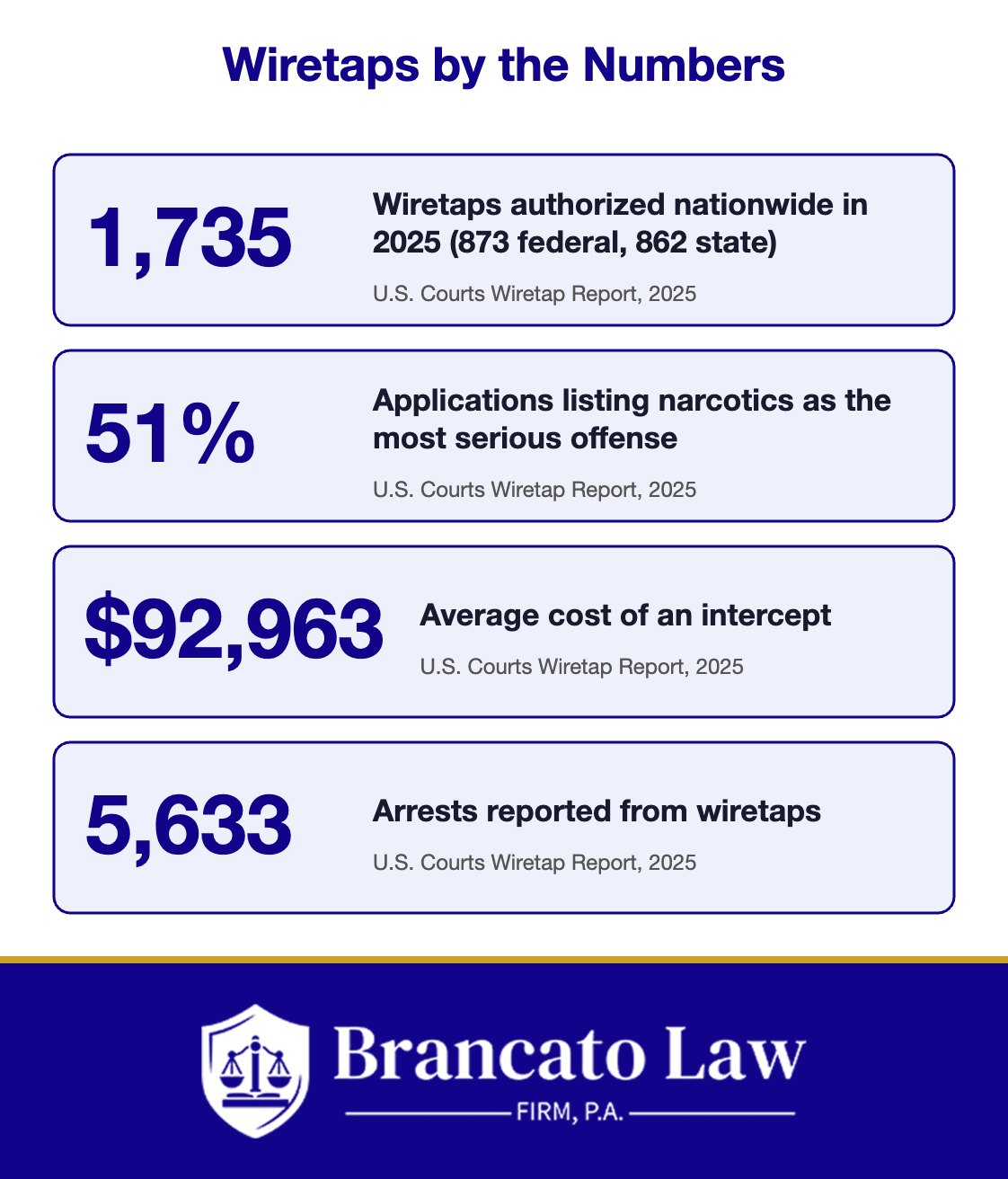
The averages show how long these investigations run. In 2025, installed wiretaps reported to the federal courts lasted an average of 47 days and cost an average of $92,963 each, according to the Administrative Office of the U.S. Courts’ 2025 Wiretap Report. Long, expensive taps usually mean extensions, and each extension needs its own fresh showing.
Why Are Wiretaps So Common in Drug and RICO Cases?
Wiretaps are most common in drug cases because drug organizations run on phone calls and texts, and the statutes make drug crimes qualifying offenses. In 2025, judges authorized 1,735 wiretaps nationwide, 873 federal and 862 state, and 51% of applications listed narcotics as the most serious offense, the 2025 Wiretap Report found. Those wiretaps led to 5,633 reported arrests.
Florida wiretaps produce some of the largest cases in the country. The report notes that Florida’s Ninth Judicial Circuit, covering Orange and Osceola Counties, reported the largest number of arrests from state wiretaps of any jurisdiction, 869, and a series of Ninth Circuit narcotics wiretaps cost a consolidated $2,179,043. The statewide prosecutor can also approve Florida wiretaps under section 934.07, as the statewide prosecutor did in State v. Phipps, 346 So. 3d 1252 (Fla. 5th DCA 2022), an Orange County case.
RICO prosecutions use wiretaps for the same reason: to prove an enterprise and a pattern, the State needs to show people coordinating over time. Our guide to fighting a RICO charge in Florida explains those elements, and our Tampa drug crimes attorney page describes how our firm defends trafficking and conspiracy cases built on intercepted calls.
Can Police Record You Without a Wiretap Order?
Yes, if one person on the call is cooperating with them. Florida is generally an all-party consent state, and recording a private conversation without everyone’s consent is a third-degree felony under section 934.03, Florida Statutes. But subsection (2)(c) makes it lawful for an officer, or a person acting under an officer’s direction, to record when that person is a party to the call or one party consents and “the purpose of such interception is to obtain evidence of a criminal act.”
That exception is how controlled calls work. A detective hands an informant or an alleged victim a recorded line and asks them to call the suspect, and no judge is involved. Our posts on whether it is illegal to secretly record someone in Florida and whether it is legal to film police in Tampa cover the private-citizen side of the same law.
| Myth | Fact |
|---|---|
| Police clone your phone to listen. | A wiretap order lets the State intercept calls and texts as they are sent; a phone already in police hands is searched under separate rules. |
| Any recorded call needs a judge’s approval. | Calls recorded with a cooperating party’s consent at an officer’s direction need no wiretap order under s. 934.03(2)(c). |
| A wiretap means the case is over. | The application, necessity statement, authorization, and minimization can all be challenged, and illegally intercepted calls can be suppressed. |
| If they tapped my phone, they heard everything legally. | Officers must minimize calls unrelated to the crime, and recordings outside the order are subject to suppression. |
How Do You Challenge a Wiretap in Florida?
You challenge a wiretap with a motion to suppress filed before trial. Section 934.09(10)(a) lets any “aggrieved person” move to suppress intercepted communications and evidence derived from them when the communication was unlawfully intercepted, the order is “insufficient on its face,” or the interception did not conform to the order. Federal law uses the same three grounds.
The U.S. Supreme Court read the facial-insufficiency ground in Dahda v. United States, 584 U.S. 440 (2018), a Kansas drug case where each order included a sentence purporting to authorize interception outside the judge’s territory. The Court held that an order missing information the statute requires is facially insufficient, but that the extra sentence there was surplus and did not taint the rest of the order. Florida courts have also rejected suppression for technical slips: in Phipps, the Fifth District reversed suppression where the statewide prosecutor’s written authorization had a scrivener’s error in the phone number but the application, affidavit, and order all had the correct one.
- Authorization: Was the application approved by an official listed in s. 934.07, or the federal equivalent, and before the order issued?
- Probable cause and staleness: Were the facts current enough, and did they tie the specific phone to the crime?
- Necessity: Did the affidavit honestly explain why informants, surveillance, controlled buys, and search warrants were not enough, or did it recite boilerplate?
- Minimization: Did monitors stop listening to privileged, family, or unrelated calls, and do the logs prove it?
- Scope and extensions: Did officers intercept phones, people, or offenses outside the order, or keep going without a valid extension?
- Sealing and notice: Were recordings sealed on time, and were inventories served within 90 days?
A successful motion can suppress the calls themselves and evidence derived from them, such as a traffic stop or search warrant built on what the wire revealed. For the broader suppression process, see our guide to the motion to suppress evidence in Florida.
What Should You Do If You Think Your Phone Was Tapped?
Stop discussing the matter on any phone, do not try to explain anything to investigators, and talk to a defense lawyer. People usually learn of a wiretap after arrests, when discovery arrives, or when they receive the inventory notice the statute requires within 90 days after an order ends. If you have received that notice, or think you are a target of a long-running drug or gang investigation, our representation before charges are filed lets our attorneys respond before an indictment or arrest. Our guide to how a Florida criminal case moves from investigation to trial explains what comes next.
Frequently Asked Questions About Wiretaps in Florida
Can Florida police read my text messages in real time?
Yes, with a wiretap order, because Chapter 934 covers electronic communications as well as calls. Our attorneys at The Brancato Law Firm check whether the order actually authorized text interception for that phone, and whether the State followed the order.
How do I find out if my phone was wiretapped in Florida?
The judge must serve an inventory on people named in the order within 90 days after it ends, though that can be postponed for good cause, and the application and order are disclosed in discovery if you are charged. The Brancato Law Firm requests the full application file, extensions, and monitoring logs in every intercepted-call case.
Can an assistant state attorney approve a wiretap in Florida?
No. Under Daniels, an assistant state attorney is not on section 934.07’s list, although an assistant formally appointed acting state attorney can approve one, as Wright held. That is one of the first things The Brancato Law Firm checks on a Hillsborough County application.
Is a recorded controlled call the same as a wiretap?
No. A controlled call recorded with a cooperating person’s consent at an officer’s direction is lawful under section 934.03(2)(c) without a court order. When a case rests on controlled calls, our attorneys at The Brancato Law Firm examine the informant’s deal, coaching, and gaps in the recordings instead.
Can wiretap evidence be thrown out in a Florida drug case?
Yes, when the interception was unlawful, the order was facially insufficient, or officers did not follow the order. The Brancato Law Firm’s drug crimes defense team files these motions before trial, as section 934.09(10) requires.
Do federal or state rules apply to my wiretap case?
It depends on who obtained the order: federal agents use Title III and federal judges, while Florida agencies use Chapter 934 and state circuit judges. Joint task forces sometimes use both, so The Brancato Law Firm sorts out which order covered which calls before choosing a challenge.
Sources
- Chapter 934, Florida Statutes, including s. 934.03, s. 934.07, and s. 934.09
- 18 U.S.C. section 2518
- Dahda v. United States, 584 U.S. 440 (2018)
- United States v. Goldstein, 989 F.3d 1178 (11th Cir. 2021)
- State v. Daniels, 389 So. 2d 631 (Fla. 1980)
- State v. Wright, No. 5D20-1807 (Fla. 5th DCA Aug. 20, 2021)
- State v. Phipps, 346 So. 3d 1252 (Fla. 5th DCA 2022)
- Administrative Office of the U.S. Courts, Wiretap Report 2025
- Charles Doyle, Congressional Research Service, Privacy: An Overview of the Electronic Communications Privacy Act (2012)
Talk to a Tampa Defense Attorney About a Wiretap Case
Wiretap challenges have to be raised before trial, and the application file is long, so the work should start as soon as discovery arrives or an inventory notice shows up in the mail. The Brancato Law Firm, P.A., founded by Tampa Criminal Defense Attorney Rocky Brancato, can begin reviewing the authorization, necessity, and minimization records right away; call (813) 727-7159 at any hour. Our firm has Spanish-speaking staff, and attorney Jean-Luc Adrien speaks Spanish, Haitian Creole, and French, which matters in cases where intercepted calls are in Spanish or Creole and the translations need checking.
For more about our defense strategies, visit our Drug Crimes page.
The Brancato Law Firm, P.A.
620 E. Twiggs Street, Suite 205, Tampa, FL 33602
(813) 727-7159
Serving Hillsborough, Pinellas, and Pasco Counties
The Brancato Law Firm, P.A. is a Tampa-based criminal defense practice. We are not affiliated with any other Brancato-named law firms.
Visit Us

Tampa, FL 33602

Contact Us Now
Free Legal Consultation (813) 727-7159
