- Free Consultation 24/7: (813) 727-7159 Tap Here To Call Us


From First DUI to Death Penalty


Is It Illegal to Secretly Record Someone in Florida?


Rewrite/update date: September 2, 2026
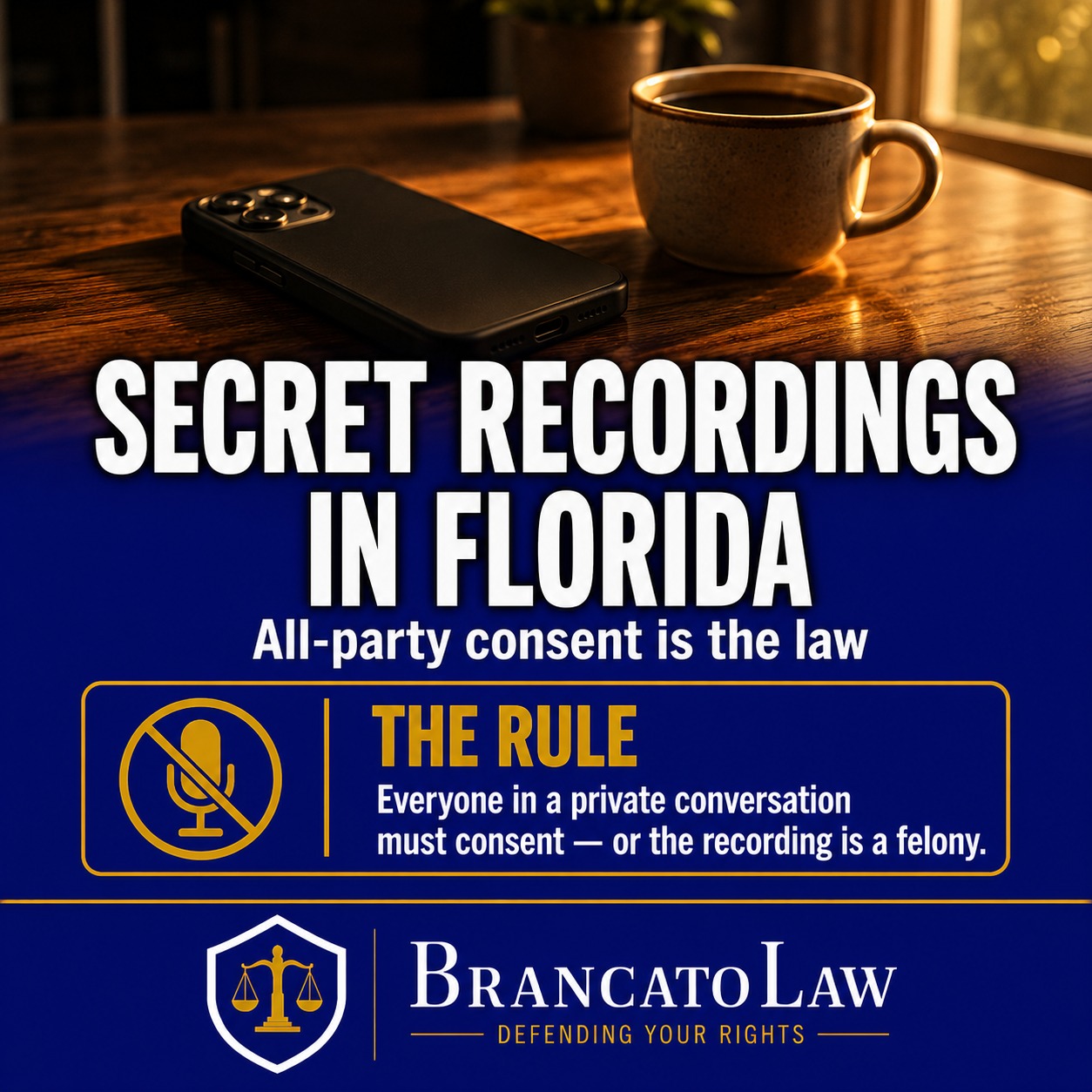
| Yes — in Florida, secretly recording a private conversation is a crime. Florida is an “all-party consent” state: under Fla. Stat. § 934.03, every person in a private conversation must consent before it can be lawfully recorded, and violating the statute is a third-degree felony. Just as important, an illegal recording is inadmissible in court under Fla. Stat. § 934.06 — a rule with real teeth, as a Florida appellate court showed in June 2026 when it reversed a conviction because the State’s key evidence was a secret home recording. |
I’m Rocky Brancato, founder of The Brancato Law Firm, P.A., a Tampa criminal defense firm. As a former police academy legal instructor, I taught officers the rules that govern intercepted communications, and I served as Chief Operating Officer of the Hillsborough County Public Defender’s Office. Our attorneys see secret recordings surface in cases from domestic battery to fraud — sometimes as the charge itself, sometimes as evidence that never should have reached a jury.
What Is Florida’s Two-Party Consent Law?
Florida law makes it illegal to intentionally intercept — which includes secretly recording — any wire, oral, or electronic communication unless an exception applies. The rule lives in the Florida Security of Communications Act, and its core provision, Fla. Stat. § 934.03, prohibits intercepting a communication and separately prohibits disclosing or using what was illegally intercepted. The statute’s consent exception is what makes Florida an “all-party” (often called two-party) consent state: recording is lawful only “when all of the parties to the communication have given prior consent.”
The protection has a built-in limit that decides most real cases: the statute protects “oral communications,” which the law defines as words spoken with an expectation of privacy that the circumstances justify. A conversation in your living room qualifies. A speech to a crowd, a shouting match in a parking lot, or a statement to a stranger on a public sidewalk generally does not. So the legal question in almost every secret-recording dispute is the same one our attorneys litigate in search-and-seizure cases: did the speaker have a reasonable expectation of privacy where the words were spoken?
What Are the Penalties for Illegally Recording Someone in Florida?
Illegally intercepting a private communication is a felony — one of the few surprises in Florida law that catches ordinary people, spouses in divorces, and even well-meaning parents. The penalty structure under § 934.03(4):
| Conduct | Charge level | Maximum penalty |
|---|---|---|
| Intentionally intercepting (secretly recording) a private oral, wire, or electronic communication | Third-degree felony | Up to 5 years in prison and a $5,000 fine |
| Disclosing or using a communication you know was illegally intercepted | Third-degree felony | Up to 5 years in prison and a $5,000 fine |
| Narrow first-offense category involving certain unscrambled radio/cordless transmissions, not for any improper purpose | First- or second-degree misdemeanor | Up to 1 year or 60 days in jail |
The disclosure prong deserves emphasis, because it reaches people who never pressed “record.” Forwarding a recording you know was made illegally — say, a friend’s secret tape of her ex — can itself be charged. In our experience, most people charged under § 934.03 in the Tampa Bay area had no idea the statute existed; they thought that because they were being wronged, they were allowed to document it. Florida law says otherwise.
What Did the Court Decide in Judkins v. State?
In June 2026, Florida’s First District Court of Appeal threw out a domestic battery conviction because the State’s central evidence was a secret recording made inside a home — a vivid demonstration that the exclusion rule protects everyone, including defendants. In Judkins v. State, No. 1D2024-2610 (Fla. 1st DCA June 3, 2026), a teenager secretly recorded, from the next room, an altercation between Mark Judkins and the girlfriend with whom he lived. Neither of the people recorded knew it was happening. The trial court admitted the audio; the jury convicted.
The First District reversed. Because neither speaker consented, the recording violated § 934.03, and under Fla. Stat. § 934.06 — the Act’s exclusion rule — the audio and anything derived from it were inadmissible “in any legal or governmental proceeding.” The court rejected the State’s argument that the home’s thin walls destroyed the speakers’ expectation of privacy, and it found the error harmful enough to require a new trial without the recording. The evergreen lesson cuts both ways: a secret recording that seems to prove your case may be worthless in court — and if the State’s case against you rests on one, our attorneys can move to exclude it.
Can a Child Record Abuse in Florida?
Yes — Florida law now contains a specific exception, and the story of how it got there explains the law’s strictness. In McDade v. State, 154 So. 3d 292 (Fla. 2014), a stepdaughter secretly recorded her stepfather’s sexually abusive statements to prove what was happening to her — and the Florida Supreme Court held the recordings were inadmissible under chapter 934, because the Act contained no exception for victims. The decision was widely criticized, and the Legislature responded by adding what is now § 934.03(2)(k): a child under 18 may lawfully record a conversation the child is a party to, if the child reasonably believes the recording will capture a statement about an unlawful sexual act or an act of physical force or violence committed, being committed, or intended against the child.
That exception is deliberately narrow. It belongs to the child, it requires the child to be a participant in the conversation, and it is tied to sexual or violent acts against that child. It did not exist in McDade, and it did not apply in Judkins — where the teen who recorded was not a party to the conversation and the exception’s conditions were not at issue. Anyone tempted to generalize it into “recording is fine if you’re documenting wrongdoing” is walking into a felony.
When Is It Legal to Record Someone in Florida?
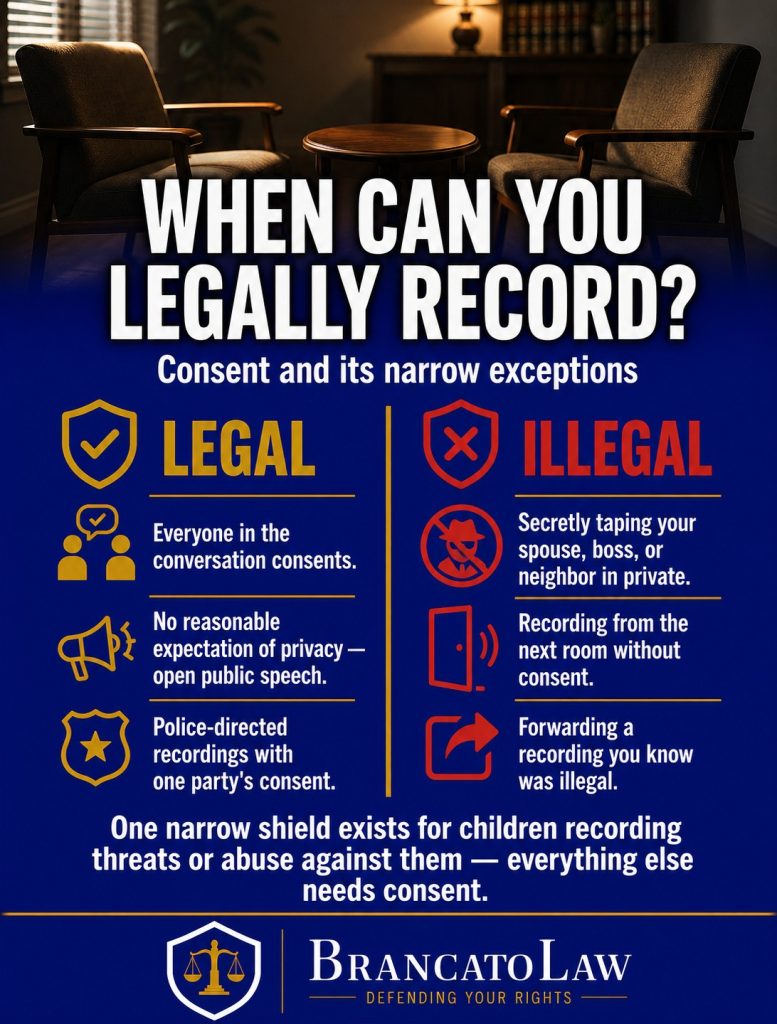
Recording is lawful in Florida when consent or a statutory exception covers it — and the list of exceptions is shorter than most people assume.
| Situation | Legal in Florida? |
|---|---|
| Everyone in the conversation agrees to the recording | Yes — all-party consent under § 934.03(2)(d) |
| Conversation with no reasonable expectation of privacy (public speech, open shouting in public) | Generally yes — it is not a protected “oral communication” |
| Police or someone acting at their direction records with one party’s consent to gather evidence of a crime | Yes — § 934.03(2)(c), the law-enforcement exception |
| A child records a conversation they are part of, to capture sexual or violent acts against the child | Yes — § 934.03(2)(k) |
| Secretly recording your spouse, partner, boss, or neighbor in a private setting | No — third-degree felony |
| Silent video (no audio) of areas where you have a right to film | Chapter 934 governs communications — but other laws, like video voyeurism statutes, can apply |
Two practical notes from Tampa Bay cases. First, the law-enforcement exception explains controlled calls: detectives frequently have an alleged victim place a recorded phone call to a suspect. That recording is lawful — and often the most damaging evidence in the case — because an officer directed it and one party consented. If you receive an unexpected call inviting you to talk about an accusation, assume it is being recorded and say nothing without a lawyer. Second, recording on-duty police officers performing their duties in public is a different question entirely — officers speaking in public generally have no reasonable expectation of privacy in those communications, though the safest practice is to record openly rather than surreptitiously.
Can an Illegal Recording Be Used Against You in Court?
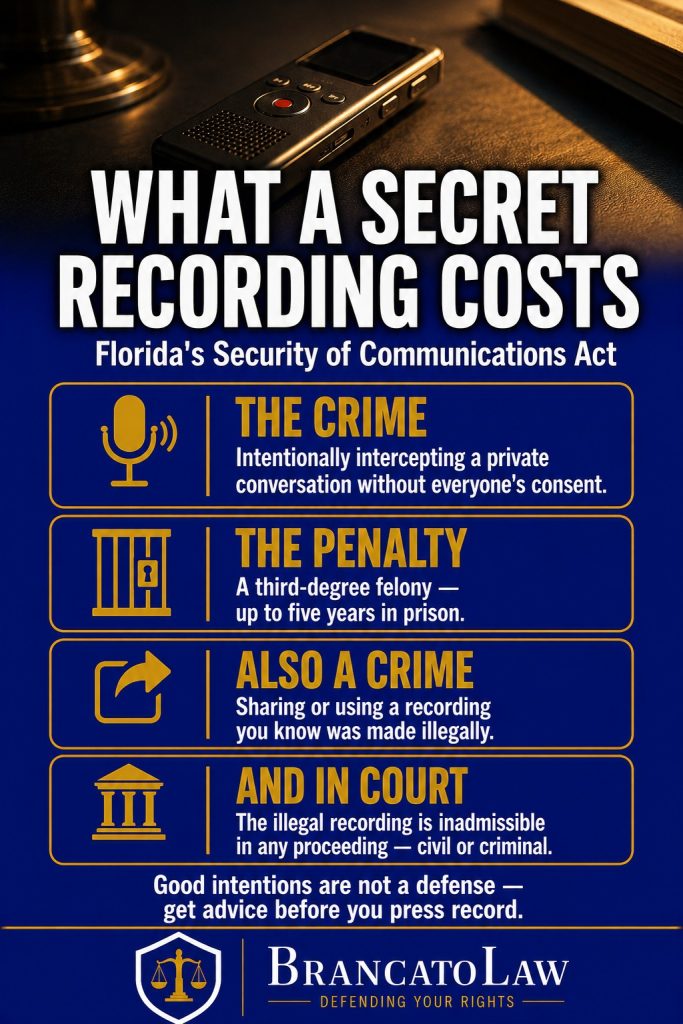
No — § 934.06 excludes illegally intercepted communications, and evidence derived from them, from virtually every proceeding: criminal, civil, and administrative. This is broader than the constitutional exclusionary rule in two ways that matter. It applies to recordings made by private citizens, not just the government, and it applies in civil cases — which is why secret recordings so often blow up in divorce and custody litigation instead of helping. When a recording appears in discovery in one of our cases, the first questions are always the statute’s: Who recorded it? Who consented? Where were the speakers, and did the circumstances justify an expectation of privacy? Judkins shows a conviction being reversed on exactly that analysis.
There is a flip side defendants should understand: challenging the recording does not always end the case. The State may still proceed on witness testimony and other evidence, and Florida appellate courts reviewing the sufficiency of evidence consider everything admitted at trial, even evidence admitted in error. That is why the fight over a recording belongs at the trial level, by motion, before the jury ever hears it — the same early-suppression posture we take with stop-and-frisk evidence and medical records the State subpoenas.
Does Florida’s Recording Law Cover Text Messages and Emails?
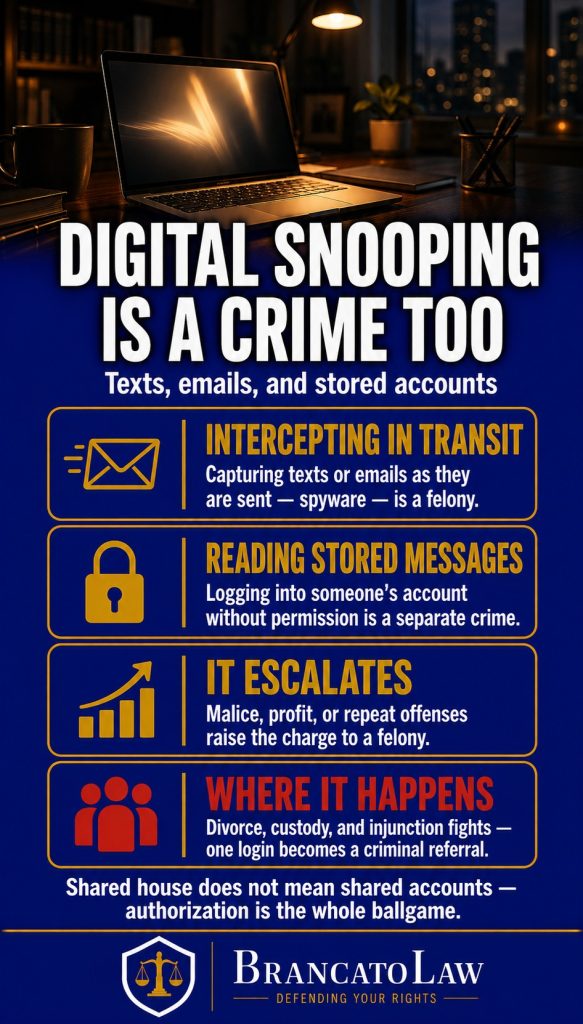
Yes — chapter 934 reaches digital snooping two different ways, and the distinction decides what crime is charged. Intercepting an electronic communication in transit — capturing texts or emails as they are sent, with spyware, for example — falls under § 934.03 itself, the same all-party consent statute, with the same third-degree felony exposure. Reading communications that are already sitting in storage is a separate offense: Fla. Stat. § 934.21 makes it unlawful to intentionally access without authorization — or beyond your authorization — a facility providing electronic communication service and thereby obtain, alter, or block a stored communication.
This is the statute that reaches the everyday scenario: logging into a partner’s email or cloud account without permission to read saved messages. The base offense is a second-degree misdemeanor, but it climbs to a first-degree misdemeanor and then a third-degree felony when done for commercial advantage, malicious destruction, or private gain, or on repeat offenses. The statute has its own exceptions — including access authorized by the service provider or by a user “with respect to a communication of or intended for that user” — and those exception fights (was the account shared? whose name is on it? was consent implied?) are where these cases are won. We see § 934.21 allegations most often tangled inside divorce, stalking, and injunction cases in the Tampa Bay area, where one login can convert a family dispute into a criminal referral.
What Should You Do If You Are Charged — or Illegally Recorded?
If you are charged with illegal interception, treat it as the felony it is, and do not try to explain your good intentions to detectives — intent to document wrongdoing is not a defense, and your explanation is a confession to the elements. If the State’s case against you relies on someone’s secret recording, get it in front of a defense lawyer immediately: a successful motion under § 934.06 can remove the centerpiece of the prosecution, and the time to build that motion is before trial, not after. In Hillsborough County, interception charges and recording-evidence fights both move through the 13th Judicial Circuit, and the State Attorney’s Office makes its filing decisions within weeks of arrest — the window where our attorneys put suppression problems and statutory defenses in front of the prosecutor. If you were just arrested, our guide to what to do after being arrested in Tampa covers the first steps.
For more about our defense strategies, visit our Hillsborough County criminal defense page.
Frequently Asked Questions
Can I secretly record my spouse in Florida?
No. A private conversation with your spouse is a protected oral communication, and recording it without consent is a third-degree felony under Fla. Stat. § 934.03 — marriage is not an exception. The recording would also be inadmissible in a divorce or criminal case, so it carries all risk and no benefit. Our attorneys regularly see these recordings backfire on the person who made them.
Is Florida a one-party or two-party consent state?
Florida is an all-party consent state: every participant in a private conversation must consent before it is recorded. Many states (and federal law) allow recording with one party’s consent, which is why out-of-state habits get people in trouble here. The rule comes from § 934.03(2)(d).
Can I record a phone call if the other person is in another state?
This is a trap. Even if the other person is in a one-party consent state, Florida’s all-party rule applies to your conduct in Florida, and courts have applied Florida law to interstate calls involving Florida participants. The safe rule: get everyone’s consent on the recording itself, or don’t record. The Brancato Law Firm, P.A. can advise before you press record — which is far cheaper than defending a felony after.
Can I use a secret recording to prove I was threatened or abused?
Generally no — that was exactly the situation in McDade, where the Florida Supreme Court excluded a victim’s own recordings, and in Judkins, where a recording of an altercation was thrown out on appeal. The narrow exception is § 934.03(2)(k), which lets a child under 18 record sexual or violent acts committed or threatened against the child in a conversation the child participates in. Adults documenting abuse should call law enforcement, whose one-party-consent recordings are lawful.
Is my Ring camera or security system legal in Florida?
Video-only surveillance of your own property is generally outside chapter 934, which governs communications — but most modern cameras record audio, and audio of private conversations triggers the all-party consent rule. Disable audio or post clear notice where conversations may be captured. If a camera recording has become an issue in a criminal case, we can assess whether chapter 934 makes it excludable.
What happens if the police secretly recorded me?
Different rules apply. Under § 934.03(2)(c), officers — or someone acting at their direction, like a cooperating witness — may lawfully record a conversation if one party consents and the purpose is gathering evidence of a crime. That is why controlled calls are admissible. But the exception has limits, and warrant requirements govern other kinds of interception; if a recording by law enforcement appears in your case, The Brancato Law Firm, P.A. will scrutinize whether it actually fits the exception claimed.
Secret-recording law is one of the sharpest double-edged blades in Florida evidence — the same statute that can put a recorder in prison can take the State’s best exhibit away from a jury. If you have been charged under chapter 934, or a secret recording is being used against you anywhere in Tampa Bay, call the attorneys of The Brancato Law Firm, P.A. — founded by Tampa Criminal Defense Attorney Rocky Brancato — at (813) 727-7159 now, while the motion that decides the case can still be filed.
The Brancato Law Firm, P.A.
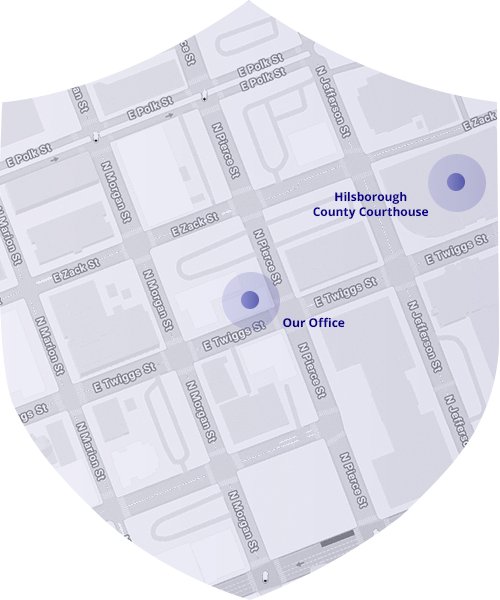
620 E. Twiggs Street, Suite 205, Tampa, FL 33602
(813) 727-7159
Serving Hillsborough, Pinellas, and Pasco Counties
The Brancato Law Firm, P.A. is a Tampa-based criminal defense practice. We are not affiliated with any other Brancato-named law firms.
Visit Us
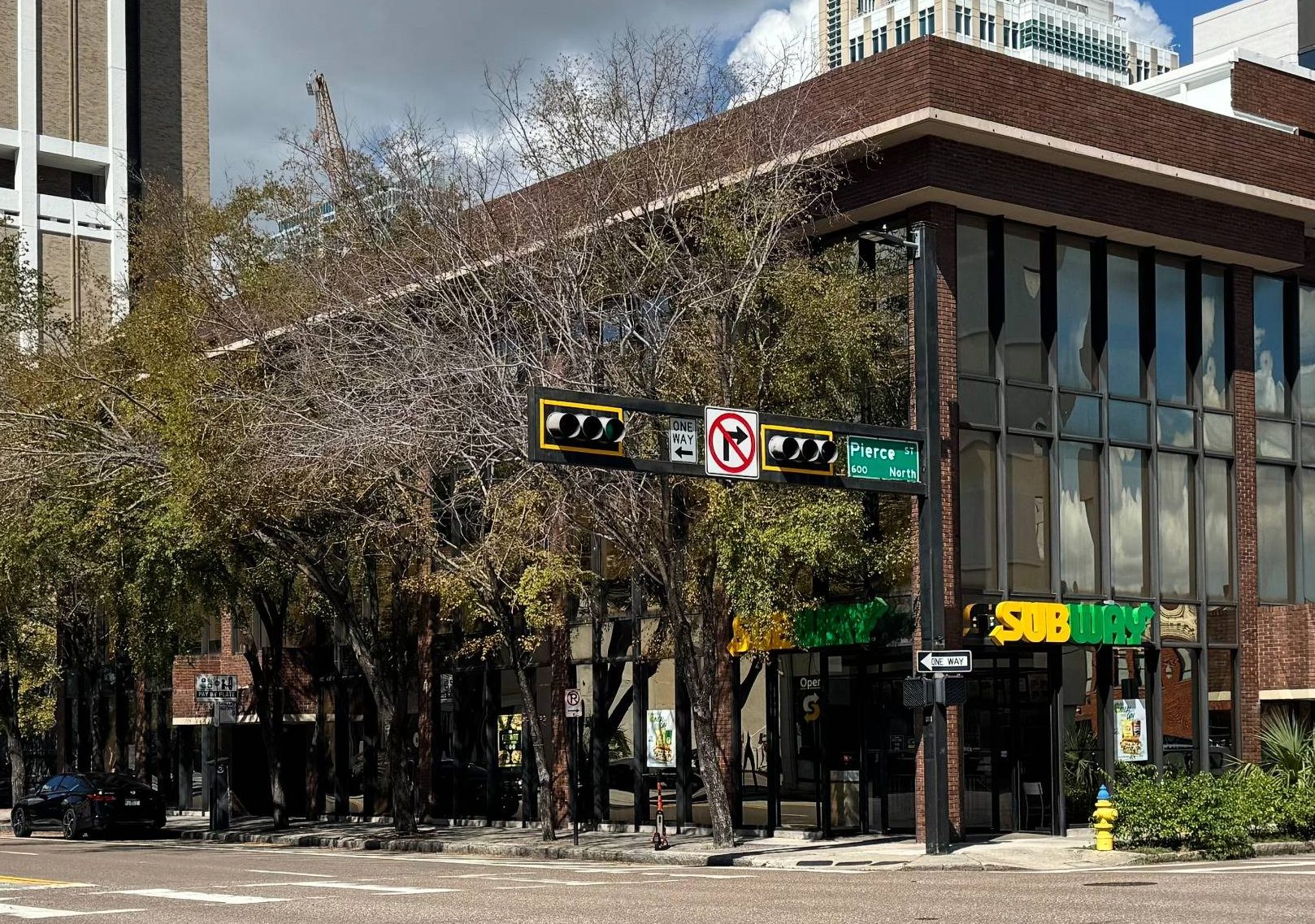
Tampa, FL 33602
Contact Us Now
Free Legal Consultation (813) 727-7159