- Free Consultation 24/7: (813) 727-7159 Tap Here To Call Us


From First DUI to Death Penalty



What Happens If You Reject a Plea Deal in Florida? (2026)



| If you reject a plea deal in Florida, the offer usually ends and your case moves toward trial. The prosecutor can withdraw any offer until a judge formally accepts it, so a rejected deal may never come back, although new offers often follow as the defense exposes weaknesses in the State’s case. If the case is tried, a jury decides guilt. If you are convicted, the judge can, and often does, impose a sentence harsher than the offer. Florida law allows that “trial tax” unless the judge took part in the plea negotiations or tied the sentence to your choice to go to trial. |
A prosecutor’s plea offer is a forecast of what a jury would do with the case. As founder of The Brancato Law Firm, P.A., a Tampa criminal defense firm, and a former Chief Operations Officer of the Hillsborough County Public Defender’s Office, where I oversaw a staff of over 100 attorneys, I have watched that forecast drive outcomes in Hillsborough County courtrooms for more than 25 years. I have also tried more than 150 jury trials to verdict. Our attorneys prepare every case so that turning down a bad offer is a real option, and the felony trial described below shows what happens when the State’s forecast is wrong.
How often do Florida criminal cases go to trial?
Very few Florida criminal cases go to trial, because most end in a plea. In Missouri v. Frye, 566 U.S. 134 (2012), the U.S. Supreme Court noted that 94 percent of state convictions come from guilty pleas, relying on 2006 Bureau of Justice Statistics data, and called ours “a system of pleas, not a system of trials.”
Hillsborough County’s own numbers show the same pattern. The Hillsborough County Clerk of Court’s FY24 Annual Report lists 177 criminal jury trials for the fiscal year that ran from October 1, 2023, to September 30, 2024. Meanwhile, the Clerk’s monthly outputs report for County Fiscal Year 2024-25 shows 6,144 new circuit criminal (felony) cases opened from October 2024 through January 2025 alone, roughly 1,500 a month.
That gap is the reason trial experience is scarce. A lawyer can practice for years in Tampa without trying many cases to a jury. At The Brancato Law Firm, our attorneys build each case for trial from the first week, because the State’s offers reflect whether it believes the defense will actually try the case.
What happens right after you reject a plea offer?
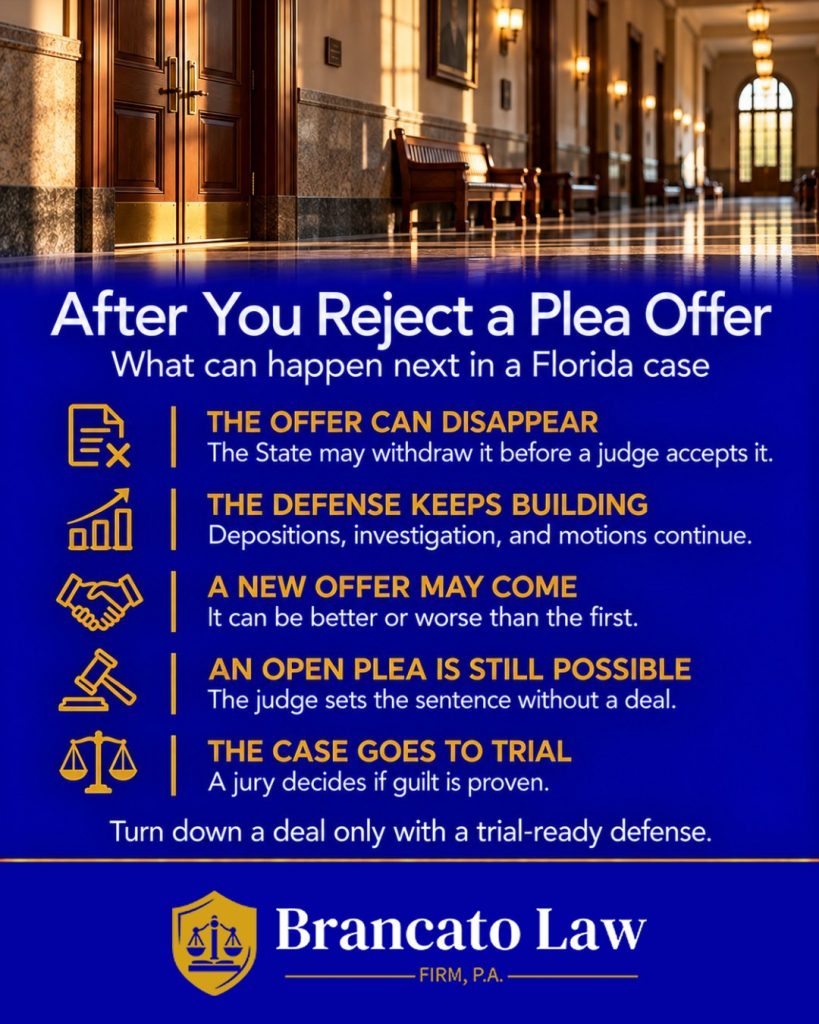
After you reject a plea offer, the case stays open and moves toward trial on the original charges. In practice, five things can happen:
- The offer can disappear. Florida Rule of Criminal Procedure 3.172(g) lets the prosecutor withdraw a plea offer at any time before the judge formally accepts it, as the Florida Supreme Court explained in Alcorn v. State, 121 So. 3d 419 (Fla. 2013). A rejected offer is not held for you.
- The defense keeps building the case. Depositions, investigation, and motions continue. A successful motion to suppress or a damaging deposition can change the State’s view of its own case.
- A new offer may come. Prosecutors reassess cases as evidence develops. A later offer can be better or worse than the first one.
- You can still plead without a deal. A defendant can enter an open plea to the court, with no agreement, and let the judge decide the sentence within the range Florida law allows. When the scoresheet calls for prison, the defense can ask for a downward departure sentence below the guidelines.
- The case goes to trial. A jury hears the evidence and decides whether the State proved every element beyond a reasonable doubt.
| Your option after rejecting the offer | What it means | The main risk |
|---|---|---|
| Wait for a better offer | The defense keeps investigating and litigating | The State may never improve the offer, or may withdraw it |
| Open plea to the court | You plead without an agreement and the judge sets the sentence | The sentence can be higher than the offer you turned down |
| Jury trial | Six or twelve jurors decide guilt | A conviction carries the full range of penalties for the charge |
| Pretrial motion | Ask the court to suppress evidence or dismiss the charge | A denied motion leaves the State’s case intact |
Each path has a cost, so the choice should come from a hard look at the evidence. Our guide on how to decide whether to accept a plea bargain in Florida walks through the factors our attorneys weigh with clients, and our explainer on how many jurors sit on a Florida criminal trial covers what the trial itself looks like.
Is there a trial tax in Florida?
Often, yes. Florida judges routinely sentence defendants more harshly after a guilty verdict than the plea offer they turned down, a gap defense lawyers call the “trial tax,” and the law generally allows it. The offer usually comes from the prosecutor, and after trial the judge sentences on everything the evidence showed. The line is the judge’s own role in plea negotiations. In Wilson v. State, 845 So. 2d 142 (Fla. 2003), the Florida Supreme Court held that when a judge took part in plea discussions and then imposed a harsher sentence after trial, courts look at the totality of the circumstances: whether the judge started the plea talks, whether the judge’s comments suggested the sentence would depend on going to trial, the size of the gap between the offer and the sentence, and whether anything in the record explains the increase other than the trial itself.
When a judge negotiated the plea, or said on the record that the sentence would depend on going to trial, a harsher sentence can be presumed vindictive under Wilson v. State, 845 So. 2d 142 (Fla. 2003). If the State cannot rebut that presumption, the remedy is resentencing before a different judge. The defendant does not get the rejected offer back. That is why the trial tax belongs in the decision from the start: the real comparison is the offer against the sentence this judge is likely to impose after a conviction. Our article on vindictive sentencing and the “trial tax” explains how our attorneys build that record.
Does your lawyer have to tell you about every plea offer?
Yes. Your defense lawyer must tell you about every formal plea offer the State makes. The U.S. Supreme Court held in Missouri v. Frye, 566 U.S. 134 (2012) that a lawyer who lets a formal offer expire without telling the client fails to provide the effective assistance the Sixth Amendment requires.
When bad advice causes a client to reject an offer, Florida law gives a path to relief. Under Alcorn v. State, 121 So. 3d 419 (Fla. 2013), the defendant must show a reasonable probability that he would have taken the offer with correct advice, that the prosecutor would not have withdrawn it, that the court would have accepted it, and that the result under the offer would have been less severe than the sentence imposed.
The final decision belongs to you. Our attorneys give a direct recommendation, but the client decides whether to plead or go to trial. A client of our firm once rejected an offer against advice on a cocaine possession charge and won at trial, a story told in our case study It’s the Client’s Call.
Why does trial experience matter when plea negotiations fail?
Trial experience matters because a prosecutor’s offer depends on how believable the threat of trial is. Law professor Stephanos Bibas made this point in Plea Bargaining Outside the Shadow of Trial, 117 Harvard Law Review 2463 (2004), writing that a lawyer who always plea bargains “cannot credibly threaten to go to trial.” Prosecutors learn which defense lawyers try cases and which ones do not.
When plea negotiations fail, the client needs a lawyer who can pick a jury, cross-examine the State’s witnesses, and argue reasonable doubt in closing. An attorney without that experience has one tool left, which is to persuade the client to take the deal. Our firm’s approach to trial preparation in Tampa criminal cases starts on day one, so the trial option is real when the State refuses to move.
Case study: a felony license case the State would not negotiate
This Hillsborough County case shows what happens when the State refuses to negotiate and the defense is ready to try the case.
What was the charge and what did the State offer?
I represented a client charged with felony driving while license revoked as a habitual traffic offender, often called felony DWLS. Under section 322.264, Florida Statutes, a driver becomes a habitual traffic offender after three qualifying convictions, such as DUI or driving while suspended, within five years. The license is then revoked for at least five years under section 322.27, Florida Statutes. Driving during that revocation is a third-degree felony under section 322.34(5), Florida Statutes, punishable by up to five years in prison under section 775.082, Florida Statutes.
My client’s driving record was poor. The State offered a prison sentence and refused to discuss probation, a shorter jail term, or any other alternative for a nonviolent driving offense. We tried to negotiate a proportionate result. The State would not move, so we went to trial.
| Florida license offense | Statute | Penalty |
|---|---|---|
| Driving while suspended without knowledge | s. 322.34(1) | Noncriminal moving violation |
| Knowingly driving while suspended, first conviction | s. 322.34(2)(a) | Second-degree misdemeanor |
| Knowingly driving while suspended, second conviction | s. 322.34(2)(b) | First-degree misdemeanor |
| Third or later conviction tied to a DUI, test refusal, serious-injury crash, or fleeing suspension | s. 322.34(2)(c) | Third-degree felony |
| Driving while revoked as a habitual traffic offender | s. 322.34(5) | Third-degree felony, up to 5 years in prison |
Florida expanded the habitual traffic offender law in 2026. Chapter 2026-53, Laws of Florida, effective July 1, 2026, added driving without a valid license under section 322.03 to the list of offenses that count toward habitual traffic offender status in section 322.264, Florida Statutes. More Florida drivers will face this felony as a result. Our guides to driving while license suspended in Florida and to habitual traffic offender defense based on old convictions cover the charge in more depth.
What evidence did the State have?
On paper, the State had everything the law requires. A police officer personally saw my client driving. His license was revoked. The prosecutor introduced a certified driving record from the Florida Department of Highway Safety and Motor Vehicles (DHSMV) in Tallahassee showing the revocation.
Florida law made that paper easy to use. Under section 322.201, Florida Statutes, a certified DHSMV driving record is admitted without further authentication. In Card v. State, 927 So. 2d 200 (Fla. 5th DCA 2006), a Florida appeals court held that a certified driving record is not “testimonial,” so the State may use it without calling anyone from DHSMV. And in Robinson v. State, 329 So. 3d 103 (Fla. 2021), a Pinellas County case, the Florida Supreme Court held that the State does not even have to prove DHSMV notified the driver of the habitual offender revocation.
In our experience in the 13th Judicial Circuit, prosecutors prove the revocation with the certified record and rarely call a DHSMV witness. In this trial, the State relied on the certified record alone, and no one from DHSMV came to the Hillsborough County Courthouse to explain it.
How did the defense win?
The defense won by separating what the law allows into evidence from what a jury must believe. Card v. State, 927 So. 2d 200 (Fla. 5th DCA 2006) and section 322.201, Florida Statutes decide whether a record comes in. They do not decide whether the record proves guilt beyond a reasonable doubt. That question belongs to the jury, so a loss on admissibility does not end the issue.
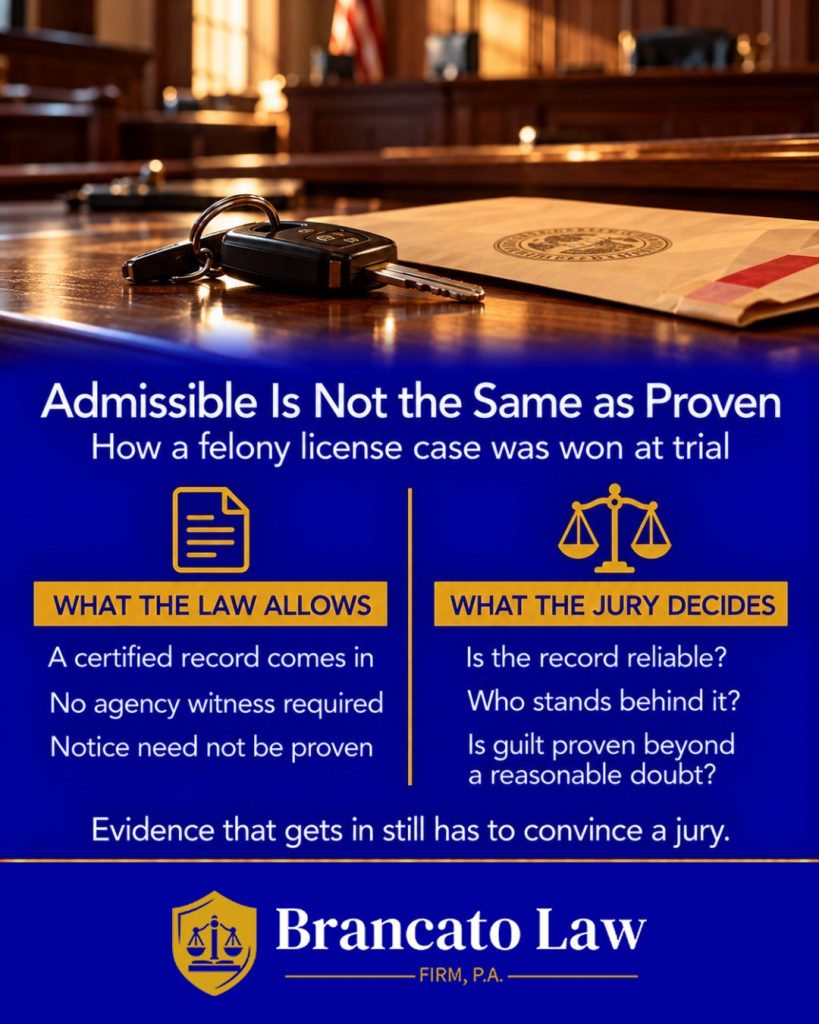
My closing argument to the jury went like this:
| That record came from the government in Tallahassee. We have all dealt with government agencies, and we have all seen them get things wrong. My client’s liberty is at stake. If you are going to take away a man’s liberty based on a piece of paper from Tallahassee, why is there not a single person from that agency in this courtroom? Why can’t we ask anyone whether his license was actually, properly revoked? Is a piece of paper, with no one to stand behind it, proof beyond a reasonable doubt? |
The jury found my client not guilty. The State had the officer, the record, and the law on its side. It lost because it demanded prison when a proportionate offer would very likely have produced a conviction, and a jury held it to its burden of proof.
Each case is unique, and this argument will not fit every case or every jury. Past results do not guarantee future outcomes. The lesson is that a strong case on paper is still only as strong as the State’s ability to persuade six jurors, and an attorney who has tried cases knows how to find that gap. For another case where the State’s paperwork did not hold up at trial, read our case study The Paper Trail Defense.
What should you do before you reject a plea offer?
Before you reject a plea offer, make sure you and your lawyer know exactly what the State can prove and what you face if you lose. Many offers carry a deadline, and under Alcorn v. State, 121 So. 3d 419 (Fla. 2013) the State can pull an offer at any time before a judge accepts it.
Take these steps first:
- Get the full offer in writing, including the charge, the sentence, and the deadline.
- Review the discovery with your attorney: police reports, video, lab results, and witness lists.
- Ask for your scoresheet so you know the lowest permissible sentence and the maximum if convicted.
- Ask your lawyer how many jury trials he or she has tried to verdict, and how recently.
- Decide before the deadline, with time to ask questions.
The Brancato Law Firm reviews plea offers for people charged in Hillsborough, Pinellas, and Pasco Counties. Learn more about our Hillsborough County criminal defense attorneys.
Frequently Asked Questions About Rejecting a Plea Deal in Florida
Can the prosecutor take back a plea offer after I reject it in Florida?
Yes, under Florida Rule of Criminal Procedure 3.172(g) the State can withdraw an offer at any time before the judge formally accepts the plea, as the Florida Supreme Court noted in Alcorn v. State, 121 So. 3d 419 (Fla. 2013). Our attorneys at The Brancato Law Firm get every offer’s terms and deadline in writing so clients can decide while the offer is still open.
Can I get a better plea deal after rejecting the first one?
Sometimes, because offers often improve when the defense uncovers problems with the evidence, wins a motion, or shows the State it is ready for trial, but nothing guarantees a second offer. The Brancato Law Firm keeps investigating after a rejected offer, because new facts are what move prosecutors.
Will I get more time if I lose at trial after turning down a plea?
Usually, yes, and Florida law generally allows that trial tax as long as the judge did not take part in the plea negotiations. The Brancato Law Firm builds the likely post-trial sentence into every plea decision, and when a judge who negotiated the plea sentences more harshly after trial, we challenge the sentence as vindictive under Wilson v. State, 845 So. 2d 142 (Fla. 2003) and seek resentencing before a different judge.
What if my lawyer never told me about a plea offer?
That can be ineffective assistance of counsel, because Missouri v. Frye, 566 U.S. 134 (2012) requires defense lawyers to communicate formal offers. The Brancato Law Firm can review the record to see whether an offer was lost through a lawyer’s error, keeping in mind that Florida requires proof that you would have taken the deal and that the court would have accepted it.
Can I still plead guilty on the day of trial in Florida?
Usually, yes: a defendant can still enter a plea before the trial starts, either to an offer the State still has open or as an open plea to the court, though earlier offers may be gone by then. The Brancato Law Firm tells clients what pleading at that point would likely mean for the sentence, so the choice is an informed one.
Can a felony driving while license revoked charge be beaten at trial in Florida?
Yes, it can be beaten, although the law makes the State’s job easier than in most felonies. Our Tampa criminal traffic attorneys at The Brancato Law Firm have tried this charge to a not guilty verdict by holding the State to its burden of proving, beyond a reasonable doubt, that the client drove and that the license was revoked as a habitual traffic offender.
Talk to a Trial Attorney Before the Offer Expires
For more about our defense strategies, visit our Criminal Traffic Defense page.
If the State has made an offer you cannot accept, the time to prepare for trial is before the offer deadline passes. Call The Brancato Law Firm, P.A., founded by Tampa Criminal Defense Attorney Rocky Brancato, at (813) 727-7159. Our attorneys will review the evidence, the scoresheet, and the offer, and tell you what a jury is likely to hear. You can call us at any hour.
The Brancato Law Firm, P.A.
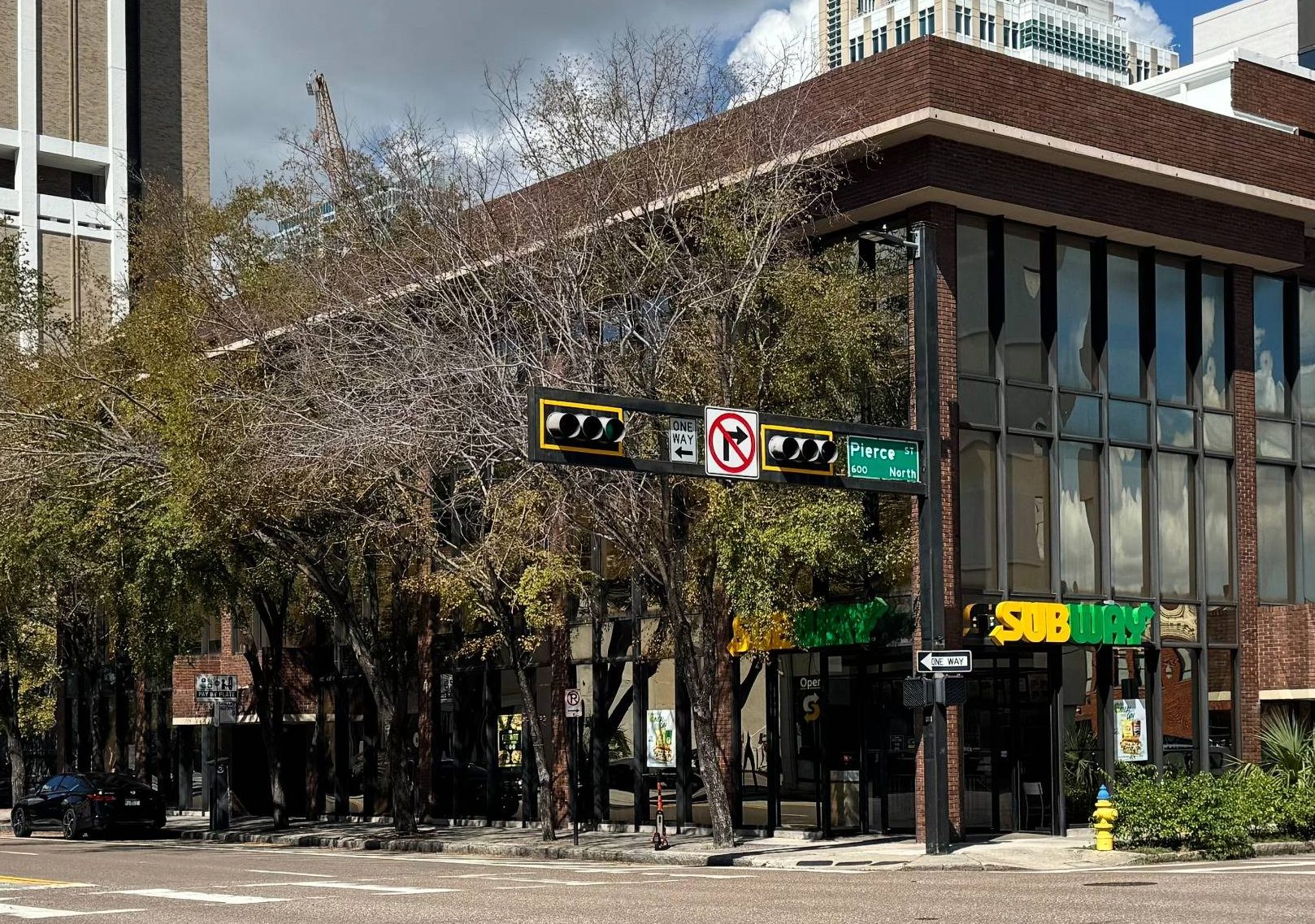
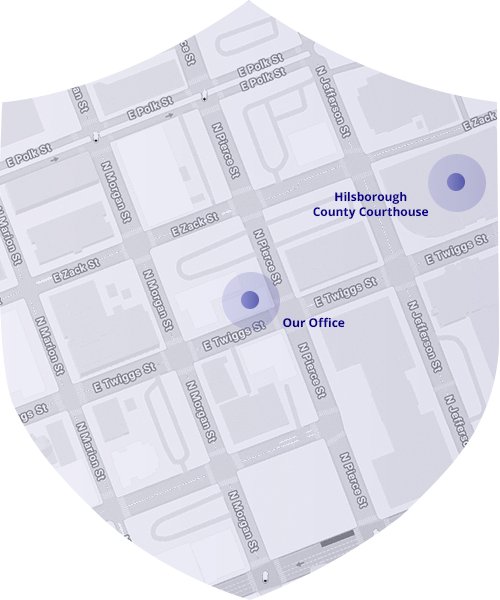
620 E. Twiggs Street, Suite 205, Tampa, FL 33602
(813) 727-7159
Serving Hillsborough, Pinellas, and Pasco Counties
The Brancato Law Firm, P.A. is a Tampa-based criminal defense practice. We are not affiliated with any other Brancato-named law firms.
Visit Us
Tampa, FL 33602
Contact Us Now
Free Legal Consultation (813) 727-7159