- Free Consultation 24/7: (813) 727-7159 Tap Here To Call Us


From First DUI to Death Penalty



How to Get a Downward Departure in Florida (2026 Guide)


Rewrite/update date: October 13, 2026
| A downward departure in Florida is a sentence below the lowest permissible sentence on the Criminal Punishment Code scoresheet. To get one, the defense must prove a valid mitigating circumstance by a preponderance of the evidence, and the judge must then decide that a departure is the right sentence. The judge must file written reasons within 7 days. The State can appeal a departure, and since June 2026 the defense can also appeal a judge’s refusal to depart. |
I’m Rocky Brancato, founder of The Brancato Law Firm, P.A., a Tampa criminal defense firm. I have spent more than 25 years in Hillsborough County courtrooms, including as Chief Operations Officer of the Hillsborough County Public Defender’s Office, where I oversaw a staff of over 100 attorneys. Today our attorneys build departure cases the way appellate courts now require: with a valid legal ground, real evidence, and a clean record.
What is a downward departure in Florida?
A downward departure is any felony sentence below the “lowest permissible sentence” (LPS) that the scoresheet produces. Under section 921.0026, Florida Statutes, a judge may not go below that number “unless there are circumstances or factors that reasonably justify the downward departure.”
The scoresheet assigns points for the main offense, any additional offenses, prior record, victim injury, and legal status such as being on probation. Under section 921.0024, once total points exceed 44, the LPS in prison months is the total points minus 28, multiplied by 0.75. A defendant who scores 100 points faces a minimum of 54 months in state prison.
A “nonstate prison sanction” means county jail of up to 364 days, probation, or community control. That is why judges often pronounce “one year and one day” when they intend a state prison sentence.
| Total sentence points | What the law allows | Authority |
|---|---|---|
| 22 or fewer (qualifying third-degree felony) | Judge must impose a nonstate prison sanction unless the judge makes written findings that it would endanger the public | § 775.082(10) |
| 44 or fewer | Judge may impose a nonstate prison sanction without a departure | § 921.0024 |
| More than 44 | State prison is the minimum. Anything less is a downward departure | §§ 921.0024, 921.0026 |
A departure does not have to mean probation. In Lee v. State, No. 2D2025-0078 (Fla. 2d DCA June 12, 2026), the trial judge believed the only departure option was reinstating probation. The Second District Court of Appeal reversed, explaining that the judge also had the power to impose a prison term shorter than the 77.475-month LPS.
How often do Tampa Bay judges sentence below the scoresheet?
Departures are common, and Hillsborough County departs more often than the state as a whole. In fiscal year 2023-24, Hillsborough County judges sentenced 2,235 of 3,594 felony defendants who scored more than 44 points to county jail, probation, or community control instead of state prison, about 62%, according to the Florida Department of Corrections Criminal Punishment Code report. Because state prison was the minimum for every one of those defendants, each of those sentences was below the scoresheet.
| FY 2023-24, defendants scoring more than 44 points | Sentenced below prison | Sentenced to state prison | Share below prison |
|---|---|---|---|
| 13th Circuit (Hillsborough) | 2,235 | 1,359 | About 62% |
| 6th Circuit (Pinellas and Pasco) | 1,208 | 1,211 | About 50% |
| Statewide | 15,128 | 17,426 | About 46% |
Source: Florida Department of Corrections, Florida’s Criminal Punishment Code: Assessment and Analysis (FY 2023-24), pp. 26, 28-29. Percentages are calculated from the report’s counts. The report notes that scoresheet submission was 77.4% complete statewide, and shorter prison terms below the LPS are not separated out, so the true departure rate is likely higher.
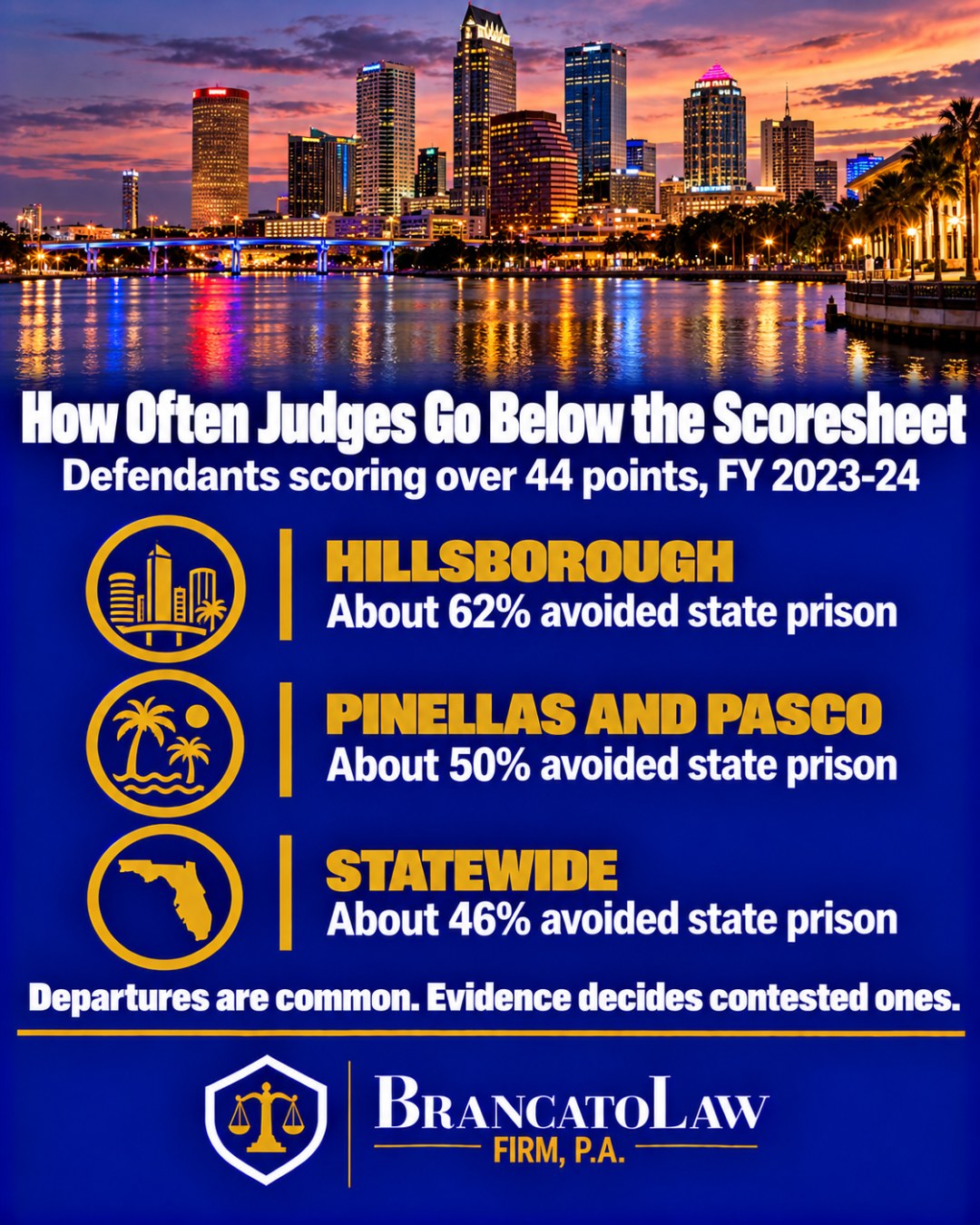
Most of these sentences come from negotiated pleas, where the State agrees to the departure. The rest come from contested hearings where the defense proves a mitigating circumstance over the State’s objection. That second group is where the quality of the evidence decides the outcome.
The data also undercut the idea that departures are a public safety risk. A 2019 study by the Florida Legislature’s Office of Program Policy Analysis and Government Accountability (OPPAGA Report 19-01) compared matched offenders who scored above 44 points. Offenders who received community supervision had a two-year felony reconviction rate of 23.4%, compared with 28.8% for similar offenders released from prison. The same 2019 report estimated that at least 41% of statewide cases scoring above 44 points ended in a departure.
What are the legal grounds for a downward departure in Florida?
Section 921.0026(2) lists 14 mitigating circumstances. Proving any one of them by a preponderance of the evidence gives the judge legal authority to depart. Only one valid reason is needed to support a departure.
| Ground | What it means in plain English | Key authority |
|---|---|---|
| (a) Plea bargain | The State agrees to the departure as part of a legitimate, uncoerced plea deal. An open plea to the judge does not count | State v. Beck, 763 So. 2d 506 (Fla. 4th DCA 2000) |
| (b) Minor participant | The defendant was an accomplice and a relatively minor player | § 921.0026(2)(b) |
| (c) Substantially impaired capacity | The defendant’s ability to appreciate the criminal nature of the conduct, or to follow the law, was substantially impaired | State v. Caulkins, 390 So. 3d 255 (Fla. 2d DCA 2024) |
| (d) Need for specialized treatment | The defendant needs specialized treatment for a mental disorder unrelated to substance abuse, or for a physical disability, and is amenable to treatment | State v. Chubbuck, 141 So. 3d 1163 (Fla. 2014) |
| (e) Restitution | The victim’s need for restitution outweighs the need for prison | § 921.0026(2)(e) |
| (f) Victim’s role | The victim initiated, willingly participated in, or provoked the incident | § 921.0026(2)(f) |
| (g) Duress or domination | The defendant acted under extreme duress or under another person’s domination | § 921.0026(2)(g) |
| (h) Victim compensated | The victim was substantially compensated before the defendant was identified | § 921.0026(2)(h) |
| (i) Cooperation | The defendant helped the State resolve this offense or another one. A confession and guilty plea alone do not qualify | State v. Lindsay, 163 So. 3d 721 (Fla. 5th DCA 2015) |
| (j) Unsophisticated, isolated, remorseful | All three are required: an unsophisticated offense, an isolated incident, and genuine remorse | State v. Sweeney, 67 So. 3d 1154 (Fla. 2d DCA 2011) |
| (k) Too young to appreciate consequences | The defendant’s youth kept them from appreciating the consequences | § 921.0026(2)(k) |
| (l) Youthful offender | The defendant is being sentenced as a youthful offender | § 921.0026(2)(l) |
| (m) Drug court | A nonviolent felony, 60 points or fewer, and the defendant is amenable to a post-adjudicatory drug court program | § 921.0026(2)(m) |
| (n) Overdose assistance | The defendant was making a good faith effort to get or provide medical help for a drug overdose | § 921.0026(2)(n) |
Ground (j) trips up more defendants than any other because remorse is not enough by itself. In State v. Sweeney, the Second District reversed a departure where the defendant was remorseful but the offense was neither unsophisticated nor isolated. By contrast, in State v. VanBebber, 848 So. 2d 1046 (Fla. 2003), the Florida Supreme Court upheld a (j) departure in a felony DUI case and held that the statute’s intoxication bar does not block the other mitigators.
Youthful offender sentencing has its own rules, which we cover in our guide to youthful offender sentencing in Florida.
Can a judge depart for a reason that is not on the statutory list?
Yes, but only if the reason fits Florida’s sentencing policy. The statutory list “includes, but is not limited to” the 14 grounds, and courts have upheld unlisted reasons supported by competent, substantial evidence. In State v. Stephenson, 973 So. 2d 1259 (Fla. 5th DCA 2008), the court said a judge may depart “for reasons not delineated in section 921.0026, so long as the reason given is supported by competent, substantial evidence and not otherwise prohibited.”
The Second District, which hears appeals from Hillsborough, Pinellas, and Pasco Counties, adds a limit. An unlisted reason must be “consistent with legislative sentencing policies,” and it generally has to reduce the defendant’s culpability for the crime. In Rafferty v. State, 799 So. 2d 243 (Fla. 2d DCA 2001), the court explained that mitigating circumstances “ameliorate the level of the defendant’s culpability.” A reason that says nothing about the crime, the defendant’s conduct, or the defendant’s mental state is unlikely to survive an appeal.
What did the court decide in State v. Mathis about volunteer work and small drug amounts?
In State v. Mathis, No. 2D2025-2309 (Fla. 2d DCA Oct. 9, 2026), the Second District held that a small drug quantity, volunteer work in jail, and community service talks are not valid grounds for a downward departure.
Wayne Mathis was convicted by a Manatee County jury of selling 0.8 grams of crack cocaine within 1,000 feet of a church. His lowest permissible sentence was 69.75 months in prison. His record included 18 prior felonies, and he qualified as a violent felony offender of special concern. His own lawyer did not ask for a departure and conceded there was no legal basis for one.
The trial judge departed anyway. He sentenced Mathis to one year of community control followed by two years of drug offender probation, citing three reasons:
- The small amount of cocaine.
- Mathis’s 5,776 hours of volunteer work in the jail kitchen while awaiting trial.
- His talks to young people at Teen Court.
The State appealed and won. The Second District rejected all three reasons:
- Drug quantity. “Departing based on the quantity of drugs involved in the offense is not consistent with legislative sentencing policy,” because the Legislature already uses quantity to set drug penalties.
- The judge’s view of the guidelines. A judge’s personal belief that the LPS “overstates the seriousness of the offense” is not a valid reason.
- Volunteer and community work. The court called the jail work “undeniably laudable” but held that it “does not relate to the nature of the crime itself or to Mathis’s offense conduct or level of culpability.” The court added that it “could find no ‘case law that suggests that good work in the community is a valid basis for departure.’”
The court also noted that rewarding good behavior in custody is the Department of Corrections’ job through gain time under section 944.275. A departure on that basis was “an impermissible end run around the Department.”
The case went back for resentencing. The trial judge may still depart on a different, valid ground, as the Florida Supreme Court allowed in Jackson v. State, 64 So. 3d 90 (Fla. 2011).
The lesson for anyone facing sentencing in Tampa Bay is direct. Good character, steady work, and community service still matter when a judge picks a sentence inside the legal range. On their own, they are not a legal basis to go below the scoresheet, and a departure built only on them invites a State appeal and a second sentencing hearing.
Which departure reasons do Florida courts reject?
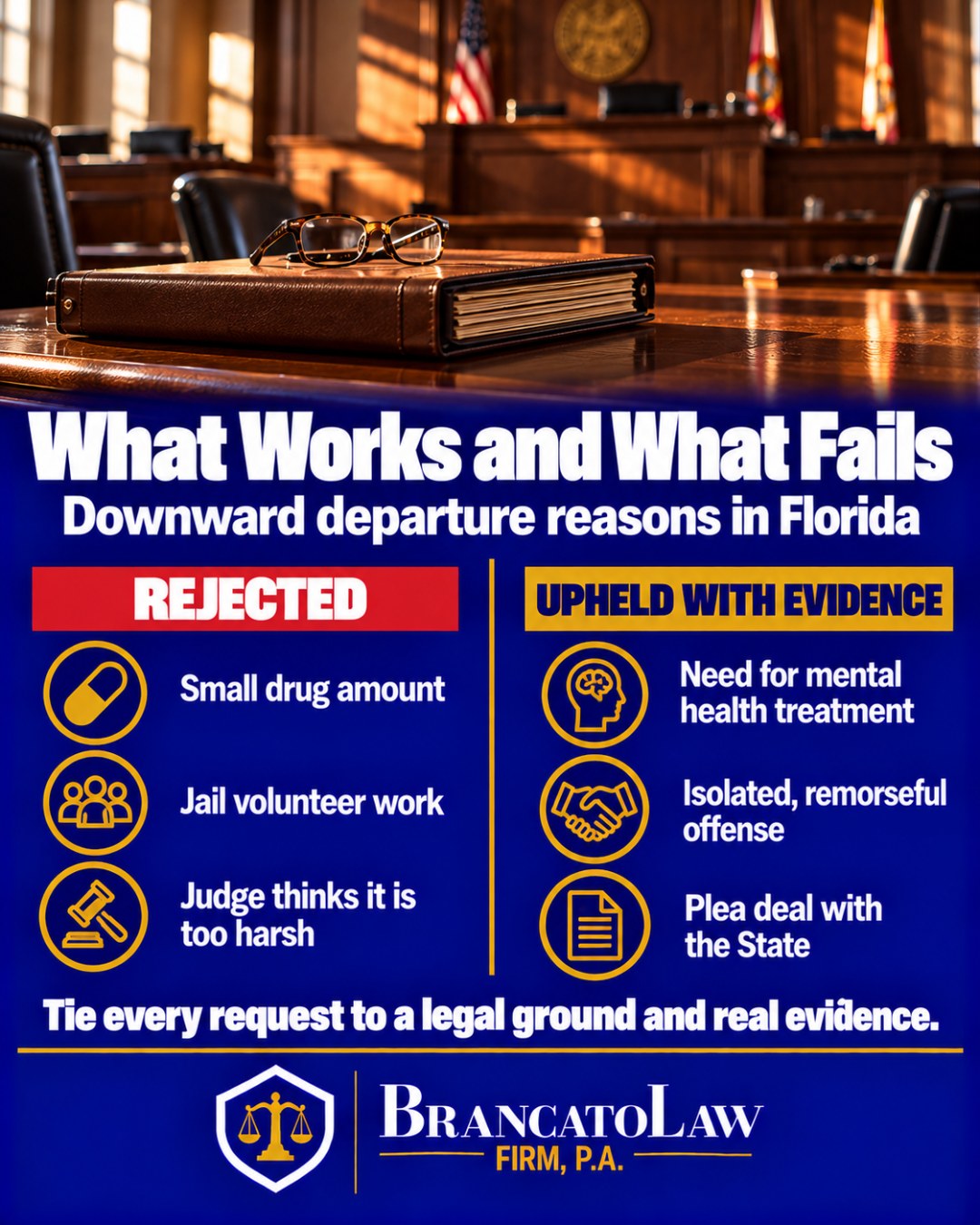
Courts reject reasons that have nothing to do with the crime or the defendant’s culpability, and reasons the Legislature has already accounted for. The table below compares rejected grounds with grounds that held up when the defense presented the right evidence.
| Rejected reasons | Case | Reasons that held up with proper evidence | Case |
|---|---|---|---|
| Small drug quantity | Mathis (2d DCA 2026); Atwaters v. State, 519 So. 2d 611 (Fla. 1988) | Mental disorder needing treatment, proved by a treating psychiatrist despite a contrary State expert | State v. Coleman, 780 So. 2d 1004 (Fla. 4th DCA 2001) |
| Judge thinks the guideline sentence is too harsh | Mathis; Caulkins (2d DCA 2024) | Unsophisticated, isolated felony DUI with genuine remorse | VanBebber (Fla. 2003) |
| Jail volunteer work or community service | Mathis; State v. Paulk, 813 So. 2d 152 (Fla. 3d DCA 2002) | Autism evidence that the trial judge wrongly believed it could not consider | Morgan v. State, No. 2D2024-0125 (Fla. 2d DCA Dec. 31, 2025) |
| Need to support a family | Rafferty (2d DCA 2001); Stephenson (5th DCA 2008) | Need for specialized treatment, without proving prison cannot provide it | Chubbuck (Fla. 2014) |
| Lack of a prior record, standing alone | State v. Randall, 746 So. 2d 550 (Fla. 5th DCA 1999) | ||
| Drug addiction or intoxication (outside the drug court ground) | § 921.0026(3) |
We wrote about the Morgan autism case in detail in Florida Court Reverses Sentence: Judge Ignored Autism Evidence.
Does drug addiction count as a reason for a downward departure?
Not by itself. Section 921.0026(3) says a defendant’s “substance abuse or addiction, including intoxication at the time of the offense, is not a mitigating factor” and “does not, under any circumstances, justify a downward departure.” The statute carves out one exception: ground (m), the drug court mitigator.
Ground (m) applies when the offense is a nonviolent felony, the scoresheet total is 60 points or fewer, and the judge finds the defendant amenable to a post-adjudicatory treatment-based drug court program. In Hillsborough County, that program runs through Adult Drug Treatment Court, Division “W.” Administrative Order S-2026-002, effective February 2, 2026, sets the same 60-point and nonviolent-felony limits for its post-adjudicatory track. You can read more about local procedure on our Hillsborough County criminal defense page.
A defendant who struggles with addiction may also qualify under ground (d) if a separate mental health condition exists independently of the substance use. A qualified evaluator must document that the disorder is “unrelated to substance abuse or addiction.” For defendants whose mental illness drives the case, Hillsborough also operates a Mental Health Criminal Division, Division “M,” under Administrative Order S-2023-046. Our Tampa criminal mental health lawyer page explains how we build those cases.
How do you prove a mitigating circumstance at a sentencing hearing?
You prove it with evidence, usually expert evidence, by a preponderance of the evidence. Arguments from counsel and letters from family rarely carry a contested departure. Under Banks v. State, 732 So. 2d 1065 (Fla. 1999), the judge decides two questions. First, can the court depart, meaning is there a valid legal ground supported by evidence? Second, should the court depart, considering the whole case?
The Second District enforces the first step strictly. In State v. Caulkins, a Hillsborough County case, the trial judge departed after hearing about the defendant’s upbringing, abuse, and addictions. The Second District reversed because no expert testimony connected those facts to a statutory ground. Without competent, substantial evidence, the departure could not stand.
For the mental health ground, the Florida Supreme Court held in Chubbuck that the defense does not have to prove the Department of Corrections cannot provide treatment. The defense must prove three things: a qualifying mental disorder or physical disability, a need for specialized treatment, and amenability to that treatment. The State may still argue that prison treatment is adequate, and the judge may weigh that at step two.
There are two ways to build this evidence:
| Standard evaluation | Comprehensive mitigation report |
|---|---|
| Confirms a diagnosis exists independently of substance use | Documents the full life history, trauma, and events that led to the offense |
| Usually one evaluation session | Multiple sessions plus interviews with family, employers, and teachers |
| Checks a statutory box | Explains how the condition contributed to the conduct |
| Gives the prosecutor paperwork to approve a negotiated deal | Gives the judge evidence that treatment will work |
| General treatment recommendation | A specific treatment plan with named providers |
A standard evaluation often works when the State is willing to agree to a departure. When the State opposes it, the judge needs more. Licensed counselors and clinical social workers who work as mitigation specialists in capital cases can build the same kind of life history in a serious noncapital case. Our post on why a comprehensive mitigation report sets our firm apart explains how our attorneys put these packages together.
The plan matters as much as the diagnosis. Judges are elected, and every departure is a judgment call that the judge has to defend if the defendant reoffends. A package with identified treatment providers, a work plan, and documented family support gives the judge a record to stand on.
| Case result | Outcome |
|---|---|
| Solicitation to commit human trafficking, jury trial (July 2025) | After conviction, the mitigation work and the client’s participation in treatment before trial led the judge to depart from the guidelines and impose probation |
Past results do not guarantee future outcomes.
Can the State appeal a downward departure sentence?
Yes. Section 921.0026(1) makes a sentence below the LPS subject to appellate review, but “the extent of downward departure is not subject to appellate review.” The State can argue that the reason was legally invalid or unsupported by evidence. It cannot argue that the judge went too far below the guidelines.
The State does not need to make a detailed objection to preserve the issue in the Second District. In Mathis, a general objection and a statement that the State reserved its right to appeal were enough.
If the State wins, what happens next depends on how the case was resolved. The judge may depart again on a valid ground at resentencing under Jackson. A defendant who entered an open plea generally cannot withdraw it and faces a guidelines sentence if no valid ground exists, as in State v. Brannum, 876 So. 2d 724 (Fla. 5th DCA 2004). A defendant whose plea depended on the departure may be offered the choice to withdraw the plea, as in Paulk.
Can you appeal if the judge refuses to grant a downward departure?
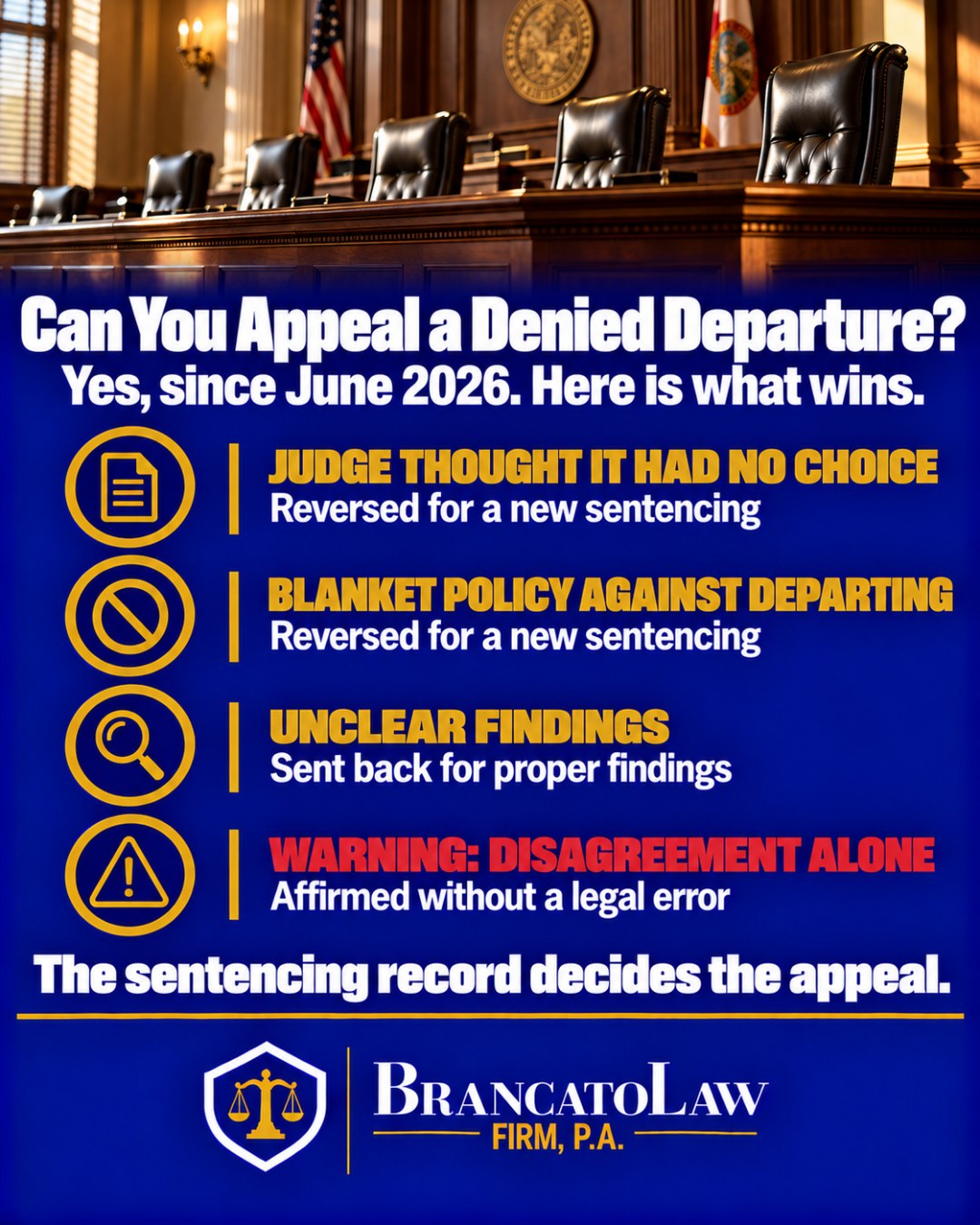
Yes. In Parrish v. State, No. SC2022-1457 (Fla. June 18, 2026), the Florida Supreme Court held that “a district court has jurisdiction to review a denial of a downward departure.” Before Parrish, the First District had refused to hear these appeals at all.
Having the right to appeal is not the same as winning. On remand, the First District affirmed Parrish’s 30-year sentence, applying its earlier en banc decision in Gazoombi v. State, 406 So. 3d 371 (Fla. 1st DCA 2025): “a bald assertion that the trial court should have imposed a sentence different from the one it did is not a cognizable claim for appellate relief.” Appellate courts reverse refusals to depart when the judge made a legal error.
| Error by the sentencing judge | Second District example | Result |
|---|---|---|
| Believed there was no legal discretion to depart | Soto v. State, 377 So. 3d 1232 (Fla. 2d DCA 2024); Morgan (2025) | Reversed for resentencing, in Morgan before a different judge |
| Applied a blanket policy against departing in a type of case | Barnhill v. State, 140 So. 3d 1055 (Fla. 2d DCA 2014) | Reversed, resentencing before a different judge |
| Thought probation was the only departure option | Lee (2026) | Reversed for resentencing |
| Left the record unclear about which Banks step failed | Manyak v. State, 414 So. 3d 263 (Fla. 2d DCA 2025) | Remanded for the judge to apply both steps |
| Simply chose not to depart after weighing valid evidence | Gazoombi (1st DCA 2025); Parrish on remand | Affirmed |
The First District disagreed with the Second District’s approach in Manyak in a September 2026 decision, so the Florida Supreme Court may eventually resolve that split. For now, the Second District’s rule governs sentencing in Hillsborough, Pinellas, and Pasco Counties. That makes the hearing record decisive: the defense should ask the judge for findings on each Banks step.
A related problem arises when the LPS is higher than the statutory maximum. We explain that situation in what happens when the lowest permissible sentence exceeds the maximum.
What should you do before your sentencing date?
Start building the departure case as soon as you are charged, not the week before sentencing. A credible evaluation, collateral interviews, and a treatment plan take weeks to assemble, and treatment you begin before sentencing is itself evidence of amenability.
A practical timeline looks like this:
- Right after arrest or charging: have counsel score the case so you know whether you are above 44 points and what the LPS is.
- During discovery: identify which statutory ground fits the facts and retain the right evaluator or mitigation specialist.
- Before plea negotiations: share the mitigation package with the prosecutor, because a negotiated ground (a) departure is the most common path.
- At a contested hearing: present live expert testimony, and ask the judge to make findings on both Banks steps.
- Within 7 days after sentencing: confirm the judge filed written reasons, as section 921.00265(2) requires.
Mitigation can begin even before charges are filed. Our pre-file advocacy work sometimes puts mitigation in front of prosecutors before they decide what to charge. Deciding whether to accept an offer is its own decision, which we cover in how to decide whether to accept a plea bargain in Florida.
For more about our defense strategies, visit our Criminal Mental Health page.
Frequently asked questions about downward departures
Does community service or volunteer work count toward a downward departure in Florida?
Not as a stand-alone legal ground in the Second District. State v. Mathis held in October 2026 that volunteer work in jail and community service talks do not relate to the crime or the defendant’s culpability, so they cannot justify a sentence below the scoresheet. At The Brancato Law Firm, we still present a client’s work and service history, but we tie the departure request to a statutory ground backed by evidence.
Can drug addiction get you a downward departure in Florida?
Only through the drug court ground or a separate mental health condition. Section 921.0026(3) bars addiction as a mitigator except under ground (m), which requires a nonviolent felony, 60 points or fewer, and amenability to a post-adjudicatory drug court program. As a Tampa drug crimes attorney practice, The Brancato Law Firm screens clients for Hillsborough’s Division “W” drug court track and for independent mental health diagnoses that can support ground (d).
Can I appeal if the judge denies my motion for downward departure?
Yes, but you need a legal error to win. Parrish v. State (Fla. 2026) confirmed that appellate courts can review a denial, and the Second District reverses when a judge misunderstood its discretion, applied a blanket policy, or failed to make clear findings. Our attorneys at The Brancato Law Firm make the record at the sentencing hearing with that appeal in mind, including asking for findings on both Banks steps.
What happens if the State appeals my downward departure and wins?
You return for resentencing, and the judge may depart again on a valid ground. If you entered an open plea, you generally cannot withdraw it, and the judge must impose a guidelines sentence unless a valid departure ground exists. The Brancato Law Firm prepares a backup ground with its own evidence so a reversed departure does not automatically mean prison.
Does an open plea count as a plea bargain for a downward departure?
No. Ground (a) requires a “legitimate, uncoerced plea bargain,” which means an agreement with the State that the court approves, as State v. Beck explains. When there is no agreement, The Brancato Law Firm builds the departure case on another statutory ground supported by expert testimony.
Can a downward departure be a shorter prison sentence instead of probation?
Yes. In Lee v. State (Fla. 2d DCA 2026), the Second District reversed because the judge did not realize it could impose a prison term below the LPS rather than only probation. When probation is not realistic, our attorneys at The Brancato Law Firm ask for a reduced prison term and explain to the court that it has that option.
Do I have to prove the prison system cannot treat my mental illness?
No. State v. Chubbuck (Fla. 2014) held that ground (d) does not require proof that the Department of Corrections cannot provide treatment, although the judge may consider prison treatment when deciding whether to depart. Through our criminal mental health defense practice, The Brancato Law Firm presents a specific community treatment plan so the judge can compare it with what prison offers.
How long does the judge have to file written reasons for a downward departure?
Seven days. Section 921.00265(2) requires a written statement of reasons, or a transcript of reasons stated orally, filed within 7 days after sentencing. Our team at The Brancato Law Firm checks the court file after every departure to confirm the reasons were filed and match what the judge said.
Talk to a Tampa criminal defense attorney about your sentencing
If you or someone you love is facing a felony that scores prison, the attorneys of The Brancato Law Firm, P.A., founded by Tampa Criminal Defense Attorney Rocky Brancato, can evaluate whether a downward departure is realistic and start building the evidence now. Call (813) 727-7159. The sooner the mitigation work starts, the more of it a judge will see.
The Brancato Law Firm, P.A.
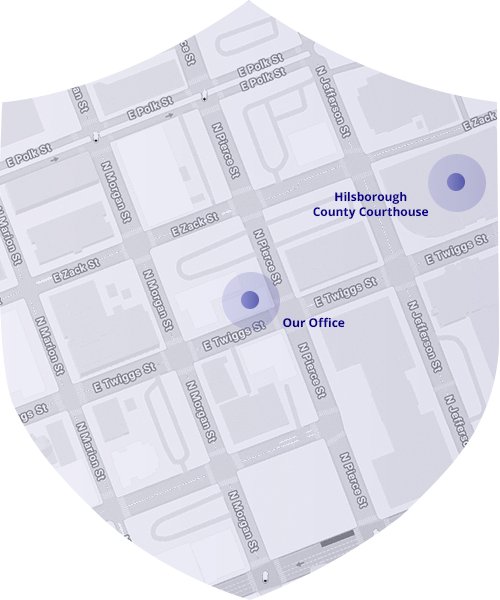
620 E. Twiggs Street, Suite 205, Tampa, FL 33602
(813) 727-7159
Serving Hillsborough, Pinellas, and Pasco Counties
The Brancato Law Firm, P.A. is a Tampa-based criminal defense practice. We are not affiliated with any other Brancato-named law firms.
Visit Us
Tampa, FL 33602
Contact Us Now
Free Legal Consultation (813) 727-7159