- Free Consultation 24/7: (813) 727-7159 Tap Here To Call Us


From First DUI to Death Penalty



What Is Driving While License Suspended in Florida?



Originally published on February 22, 2026. Completely rewritten and updated September 1, 2026.
| Key Takeaway: Driving while license suspended under section 322.34, Florida Statutes, is a crime only when you knew about the suspension — without knowledge it is a civil moving violation. With knowledge, penalties climb from a second-degree misdemeanor to a third-degree felony carrying up to five years in prison for certain repeat offenders and habitual traffic offenders. And under an August 2026 appellate decision, a driver convicted of driving on a suspended license cannot be ordered to pay criminal restitution for the accident that happened during the drive — because the suspension did not cause the crash. |
I’m Rocky Brancato, founder of The Brancato Law Firm, P.A., a Tampa criminal defense firm. I spent 25 years in Hillsborough County courtrooms — including as Chief Operations Officer of the Public Defender’s Office — and driving-while-suspended charges are among the most common, most underestimated cases our attorneys handle. They look small. They snowball.
How Does Florida Define Driving While License Suspended?
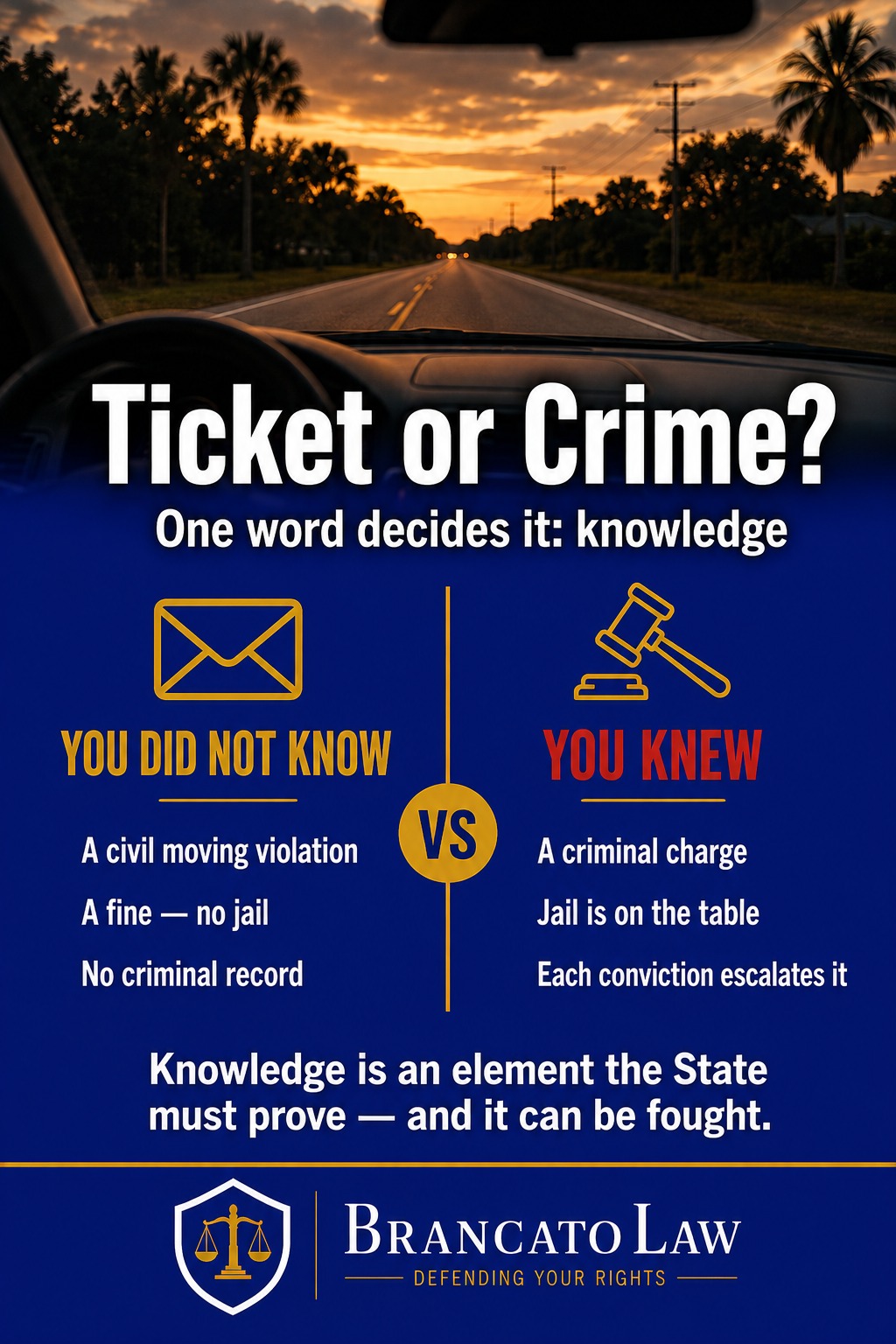
Section 322.34, Florida Statutes splits the offense in two, and everything turns on one word: knowledge.
Driving while your license is canceled, suspended, or revoked without knowledge of the suspension is a noncriminal moving violation under section 322.34(1) — a ticket, handled under chapter 318, with no jail exposure. Driving with knowledge of the suspension is a crime under section 322.34(2), and it escalates with each conviction.
The State can satisfy the knowledge element in three ways: you were previously cited for driving while suspended, you admitted knowing, or the Department of Highway Safety and Motor Vehicles (DHSMV) gave you proper notice. The statute adds a rebuttable presumption of knowledge when a qualifying judgment or order appears in DHSMV records — but that presumption does not apply when the suspension was for failure to pay a traffic fine or a financial responsibility (insurance) violation, which are precisely the suspensions most people never learn about. Notices go to old addresses. Suspensions post without a letter arriving. Our attorneys win these cases on the knowledge element more than on any other issue.
What Are the Penalties for DWLS in Florida?
| Offense | Classification | Maximum Penalty |
|---|---|---|
| DWLS without knowledge — § 322.34(1) | Noncriminal moving violation | Fine only, no jail |
| DWLS with knowledge, first conviction — § 322.34(2)(a) | Second-degree misdemeanor | 60 days jail, $500 fine |
| DWLS with knowledge, second conviction — § 322.34(2)(b) | First-degree misdemeanor | 1 year jail, $1,000 fine |
| DWLS with knowledge, third or subsequent conviction where the current or most recent prior violation involved a suspension for DUI, test refusal, a traffic offense causing death or serious bodily injury, or fleeing — § 322.34(2)(c) | Third-degree felony | 5 years prison, $5,000 fine |
| Driving while designated a habitual traffic offender — § 322.34(5) | Third-degree felony | 5 years prison, $5,000 fine |
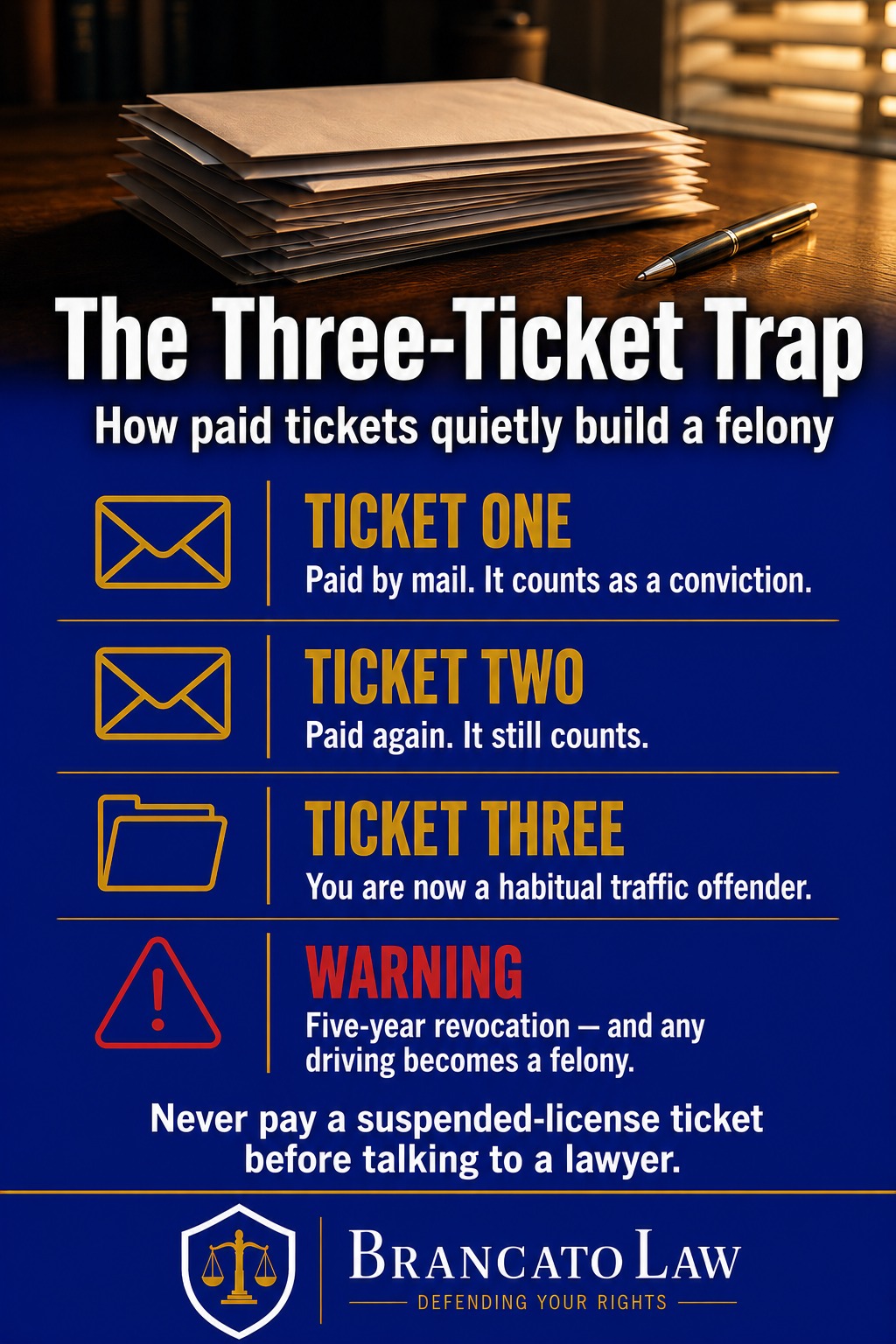
Two traps hide in that table. First, a third or subsequent with-knowledge conviction carries a mandatory minimum of 10 days in jail even when it stays a misdemeanor. Second, the felony versions do not require any bad driving at all — a habitual traffic offender rolling through a Publix parking lot commits a five-year felony just by driving.
What Are the Most Common Reasons Florida Licenses Get Suspended?
Most of our clients’ suspensions have nothing to do with dangerous driving. The usual causes: DUI convictions or the administrative suspension that follows a DUI arrest; accumulating too many points; unpaid traffic fines or court costs; failure to maintain insurance (financial responsibility suspensions); failure to appear in court; failure to complete a court-ordered program such as DUI school; and child support delinquencies under section 322.058. The reason matters legally — as noted above, fine-based and insurance-based suspensions do not get the State its knowledge presumption, and under section 322.27(5)(b), a habitual traffic offender designation built on a third DWLS violation can be removed entirely when you provide proof of compliance for the underlying offenses. Fixing the suspension is often the first step in fixing the case.
What Is a Habitual Traffic Offender — and Why Does It Change Everything?
A habitual traffic offender (HTO) is a driver whose DHSMV record shows, within any five-year period, either three convictions from a list of serious offenses — section 322.264 includes DUI, any felony committed with a motor vehicle, driving while license suspended or revoked, failing to stop and render aid after an injury crash, and manslaughter by vehicle — or fifteen convictions for point-assessable moving violations.
| Warning: Three convictions for driving while license suspended within five years — including tickets you simply paid by mail without ever seeing a judge — can make you a habitual traffic offender. That designation triggers a five-year license revocation under section 322.27(5)(a), and any driving during it is a third-degree felony. The cheapest ticket to pay is often the most expensive plea you will ever enter. |
The five-year revocation comes from section 322.27(5)(a), and driving during it is a third-degree felony under section 322.34(5) regardless of why the original suspensions happened. Our firm regularly unwinds HTO designations by attacking the underlying convictions — we wrote a separate guide on challenging old convictions that created HTO status.
Do You Have to Pay for the Accident If You Were Driving on a Suspended License?
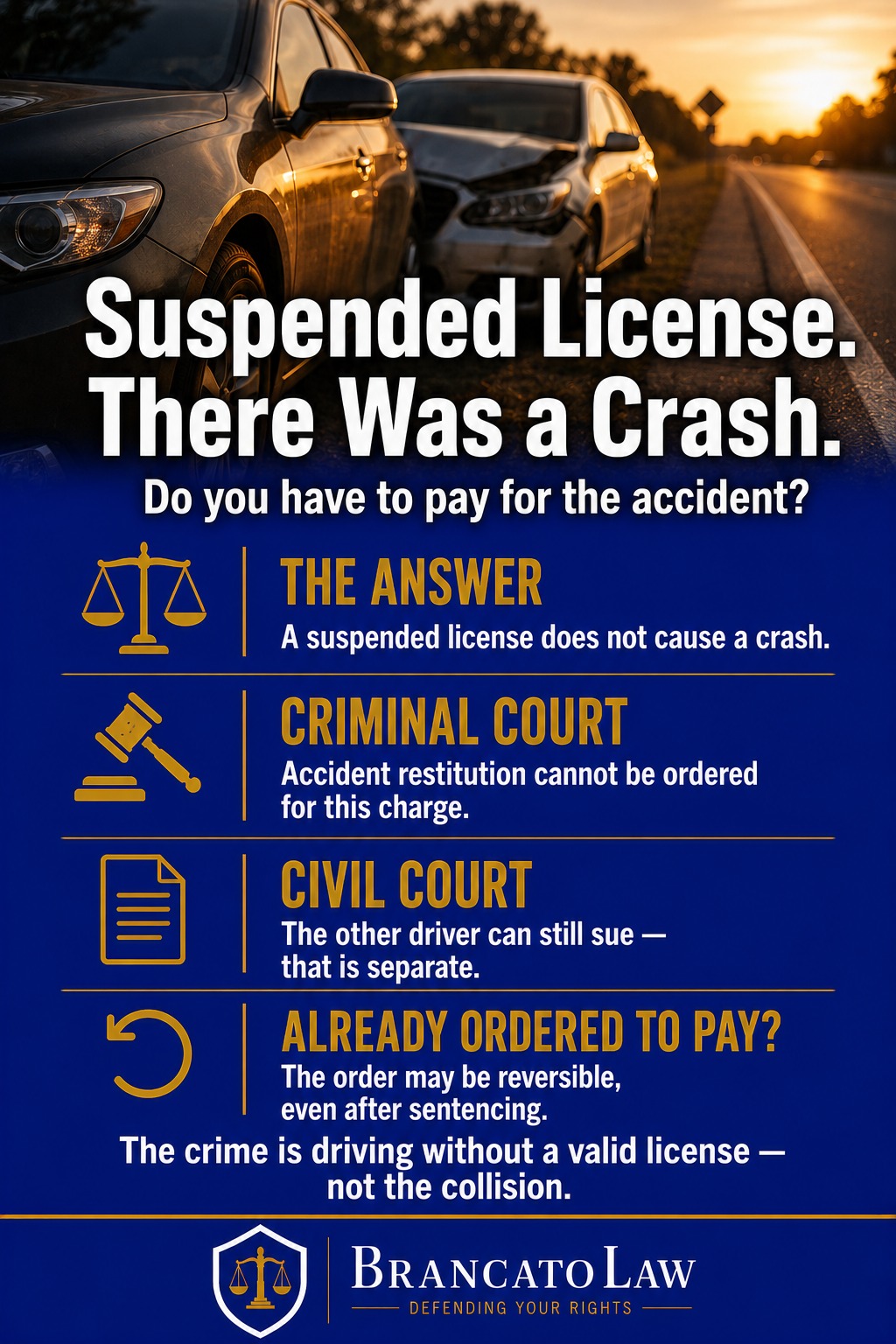
Not as criminal restitution — because your suspended license did not cause the crash. That is the rule Florida’s Fifth District Court of Appeal just enforced in Mahoney v. State, No. 5D2025-0804 (Fla. 5th DCA Aug. 14, 2026), and it matters to anyone charged with DWLS after an accident.
Angela Mahoney was convicted of driving while her license was suspended after a crash in Duval County, and the trial court ordered her to pay restitution for the accident damage. The Fifth District reversed and vacated the restitution order. Under section 775.089, Florida Statutes, restitution requires a loss that is causally connected to the offense and bears a significant relationship to it — and the Florida Supreme Court held in Schuette v. State, 822 So. 2d 1275 (Fla. 2002), approving Cheek v. State, 700 So. 2d 731 (Fla. 5th DCA 1997), that a suspended license is not causally related to a crash. The crime is driving without a valid license; the collision is a separate event.
| Mahoney v. State (Fla. 5th DCA Aug. 14, 2026): “[T]he fact that [the defendant’s] license was suspended was not causally related to the crash.” The Fifth District vacated a restitution order that made a DWLS defendant pay for accident damage — the crime is the driving without a valid license, not the collision. |
Two practical notes from our attorneys. First, Mahoney also confirms this error is fundamental — it can be corrected on appeal even when no one objected at sentencing, so a restitution order already entered in a DWLS case may still be attackable. Second, this rule is about criminal restitution only: the other driver can still pursue a civil claim, and your insurer still matters. One judge on the Mahoney panel wrote separately to urge the Florida Supreme Court to loosen the causation rule, so our firm is watching this issue — but as of today, the law is clear, and we hold sentencing courts to it.
How Do We Defend DWLS Charges?
By attacking the case at four pressure points. First, knowledge: if the notice went to an old address, the suspension was fine-based or insurance-based, or the DHSMV paper trail is sloppy, the criminal charge can collapse into a civil infraction — or nothing. Second, identity: officers write these tickets fast, and our attorneys have had a DWLS charge dismissed when body camera footage showed a different driver entirely. Third, the underlying suspension: reinstating the license or providing proof of compliance before the court date changes the negotiating posture completely, and in third-DWLS HTO cases it can remove the designation itself under section 322.27(5)(b). Fourth, the priors: felony enhancement requires qualifying prior convictions, and DHSMV records are not as reliable as prosecutors assume — our firm has won a not-guilty verdict at trial by making the State try to prove its record evidence.
Real Results in DWLS Cases
Our firm’s results in these cases show how much room there is to fight what looks like a paperwork charge. In a felony DWLS case built on habitual traffic offender status, the jury returned a not-guilty verdict after we challenged the reliability of the DHSMV records. In another case, the charge was dismissed immediately after body camera footage showed the State had charged the wrong person. And where a client faced both a failure-to-appear and a DWLS charge, both were dismissed after we discovered the court date had been changed without notice to him — he was released on his own recognizance. Past results do not guarantee future outcomes, but they illustrate where these cases crack.
What Should You Do If You Are Charged with DWLS?
Move before your court date — this is the rare criminal charge where the week before arraignment can decide the outcome. Pull your complete DHSMV record, identify why the license is suspended, and fix what can be fixed: pay the old fine, reinstate the insurance, complete the program, clear the child-support issue. A defendant who walks into a Hillsborough County courtroom with a valid license and proof of compliance is in a different case than one who walks in still suspended. Then let counsel fight the knowledge element and the priors. Do not just pay the ticket to make it go away — as the warning above explains, that “conviction” may be the third strike that makes you a habitual traffic offender.
Frequently Asked Questions About DWLS in Florida
Is driving on a suspended license a felony in Florida?
It can be. A third or subsequent conviction is a third-degree felony when the current or most recent prior violation involved a suspension for DUI, test refusal, a traffic offense causing death or serious bodily injury, or fleeing — and any driving while designated a habitual traffic offender is a third-degree felony, punishable by up to five years. Our attorneys always examine whether the State can actually prove the qualifying priors.
What if I did not know my license was suspended?
Then the offense is a noncriminal moving violation, not a crime. Knowledge is an element the State must prove, and the statutory presumption of knowledge does not apply to suspensions for unpaid fines or insurance lapses — the most common kinds. If your notice went to an old address, tell your lawyer immediately; in our experience the knowledge element is the most winnable issue in DWLS cases.
Can I be ordered to pay for the accident if I was driving while suspended?
Not as criminal restitution. In Mahoney v. State (Fla. 5th DCA Aug. 14, 2026), the court vacated a restitution order for accident damage because a suspended license is not causally related to a crash — a rule the Florida Supreme Court set in Schuette v. State in 2002. A civil claim by the other driver is a separate matter. If a court has already ordered accident restitution in your DWLS case, The Brancato Law Firm, P.A. can evaluate whether the order is attackable — this error can be raised even after sentencing.
Can I get a hardship license if my license is suspended?
Often, yes — Florida allows hardship or business-purpose-only licenses for many suspension types through the DHSMV and, for habitual traffic offenders, after a minimum period of the revocation has run. The right move depends on why you are suspended, and it is usually worth doing before your criminal court date. Our attorneys routinely walk clients through reinstatement as part of the defense.
What happens if I am caught driving as a habitual traffic offender?
You face a third-degree felony under section 322.34(5) — up to five years in prison — even if the driving itself was flawless. But HTO designations are more fragile than they look: if the designation rests on a third DWLS violation, proof of compliance for the underlying offenses can remove it, and attacking one of the three underlying convictions can dissolve the whole classification. That is exactly the work our firm’s habitual traffic offender defense focuses on.
Can a DWLS charge be dismissed?
Yes — through the knowledge element, identity problems, defective DHSMV records, or by resolving the underlying suspension and negotiating from strength. The Brancato Law Firm, P.A. has won dismissals and a not-guilty verdict in DWLS cases in Hillsborough County. Call (813) 727-7159 before your court date; the earlier we start, the more of these options stay open.
For more about our defense strategies, visit our Hillsborough County Criminal Defense Attorney page.
Related reading: What Is Driving Without a License in Florida? · What Is DUI in Florida? · What Happens After a DUI Arrest in Hillsborough County? · Tampa Habitual Traffic Offender Defense · What Is Fleeing and Eluding in Florida? · What Is Leaving the Scene of an Accident in Florida?
A Suspended-License Charge Is Small — Until It Isn’t
If you have been cited or arrested for driving while license suspended in Hillsborough, Pinellas, or Pasco County, what you do before your first court date matters more than in almost any other criminal case — and simply paying the ticket can be the worst move available. Call the attorneys of The Brancato Law Firm, P.A. — founded by Tampa Criminal Defense Attorney Rocky Brancato — at (813) 727-7159 before you pay anything or enter any plea. Three of these tickets is a felony waiting to happen; one phone call is how it stops.
The Brancato Law Firm, P.A.
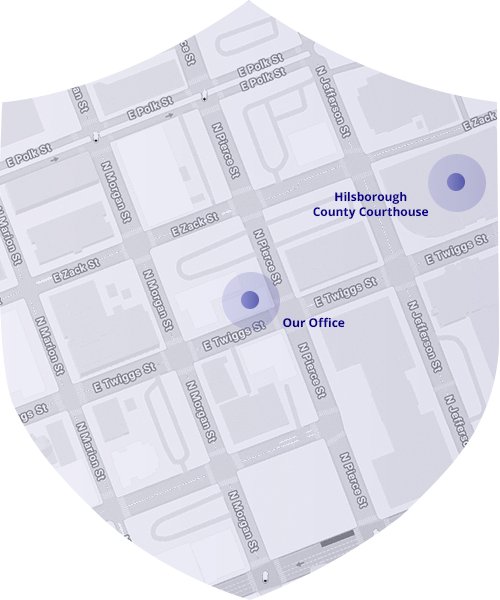
620 E. Twiggs Street, Suite 205, Tampa, FL 33602
(813) 727-7159
Serving Hillsborough, Pinellas, and Pasco Counties
The Brancato Law Firm, P.A. is a Tampa-based criminal defense practice. We are not affiliated with any other Brancato-named law firms.
Visit Us
Tampa, FL 33602
Contact Us Now
Free Legal Consultation (813) 727-7159