

From First DUI to Death Penalty



How Do U.S. Marshals Track Fugitives in Florida? (2026)


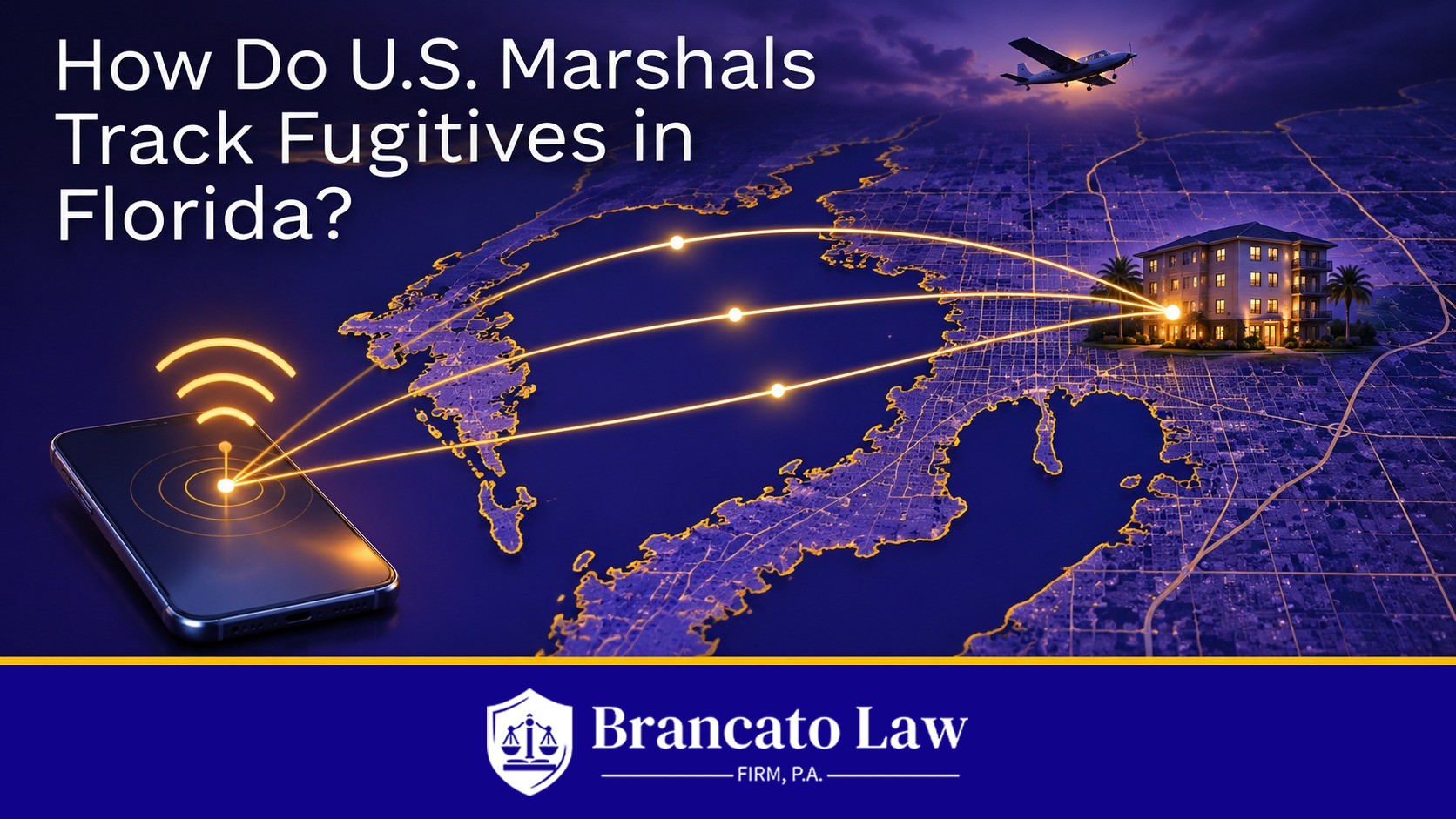
What to know: U.S. Marshals task forces often find people with open warrants by following their phones and their data. Their tools include carrier “pings” of a phone’s GPS location, cell-site records, cell-site simulators such as the StingRay, aircraft-mounted simulators, and license plate and database searches. In Florida, the arrest itself is hard to undo because police found you the wrong way, since your identity is not suppressible. Evidence found because of illegal tracking can be thrown out, though: a gun in a house, drugs in a car, or statements and phone data that came from it.
Many fugitive arrests in Tampa Bay are made not by the detective who wrote the warrant but by a U.S. Marshals task force, sometimes days or weeks later, after someone spent that time following a phone. I learned how location evidence gets built, and how it falls apart, as a police academy instructor teaching criminal procedure and later as former Chief Operations Officer of the Hillsborough County Public Defender’s Office, where I oversaw a staff of over 100 attorneys. As founder of The Brancato Law Firm, P.A., a Tampa criminal defense firm, I can tell you that when a report says “the task force located the defendant,” our attorneys want to know exactly how.
Why Do U.S. Marshals Work Florida State Warrants?
U.S. Marshals work state warrants because Congress built the fugitive task forces to do exactly that. Under 34 U.S.C. § 41503, the Attorney General must set up permanent Fugitive Apprehension Task Forces made of federal, state, and local officers, directed and coordinated by the Marshals Service, “for the purpose of locating and apprehending fugitives.” Most of what those task forces do is state work.
In fiscal year 2025, the Marshals Service reported 73,323 fugitives arrested or cleared, and 44,790 of them were state and local fugitives, according to its 2026 Fugitive Apprehension fact sheet. That is about 61 percent. The same report counts 87,984 warrants cleared by Marshals arrests that year.
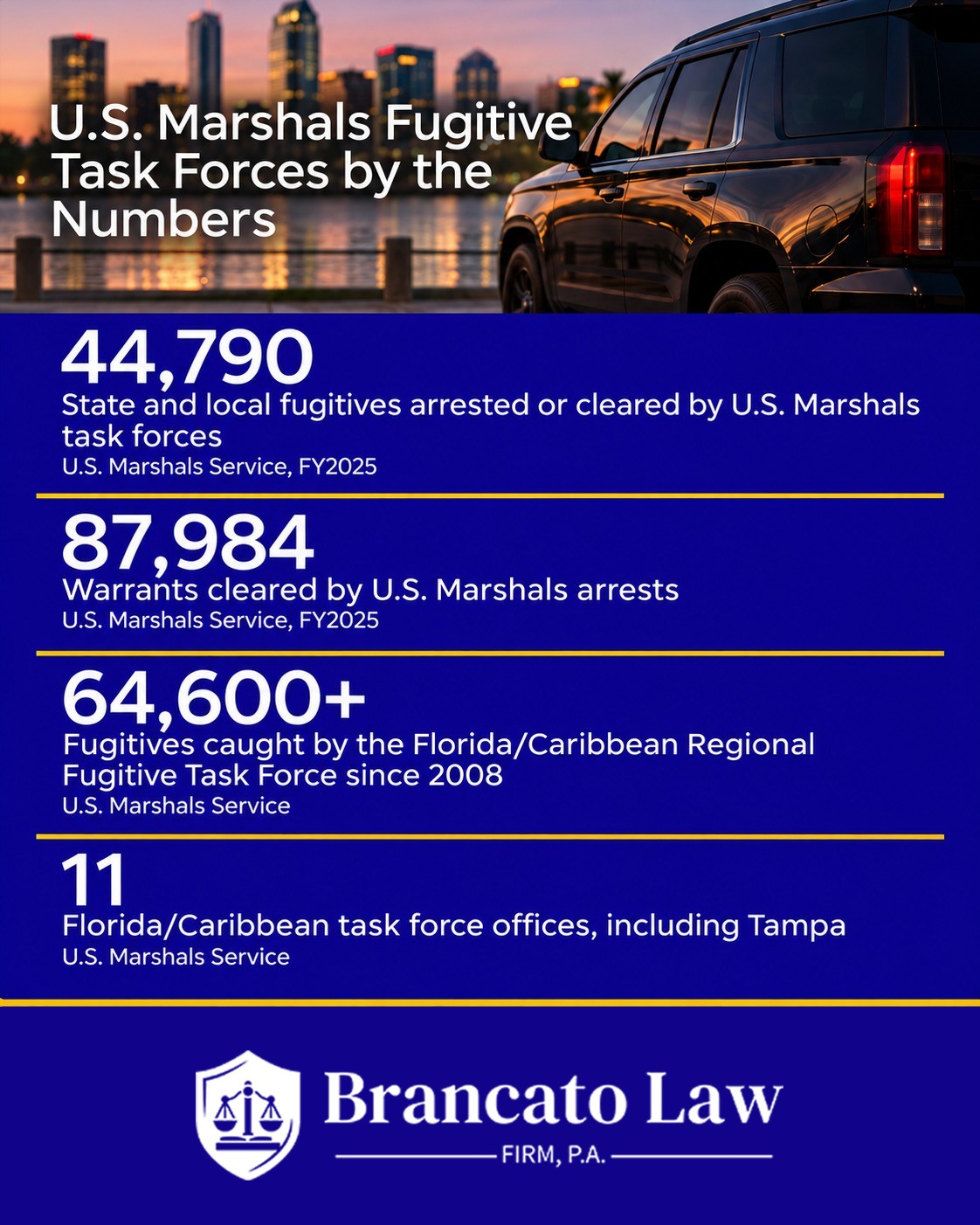
Florida has its own regional unit. The Florida/Caribbean Regional Fugitive Task Force began operations in July 2008, is headquartered in Orlando, runs 11 offices including one in Tampa, and partners with more than 90 federal, state, and local agencies. The Marshals report it has apprehended more than 64,600 fugitives since it started. In Hillsborough, Pinellas, and Pasco Counties, that means a state probation warrant or a state felony warrant can end with federal agents and deputized local officers at the door.
Who Is Actually on a Marshals Task Force?
A Marshals task force puts local police under a federal hat. The Marshals Service says task force officers are state and local officers who receive special deputations with the Marshals, and its 2025 fact sheet adds that while on a task force they can exercise Marshals authorities, such as crossing jurisdictional lines. A Tampa Police officer or Hillsborough deputy on the task force may sign the affidavits, run the phone tracking, and make the arrest.
That dual role matters in a Florida courtroom for two reasons. First, the officer may have used federal paperwork or federal equipment to find a person wanted on a state warrant. Second, as the Sarasota records fight below shows, the federal label has been used to keep those records away from the public and the defense. When our firm sees a task force arrest, we ask who the officers were working for on the day they tracked the client, because that answer decides which rules and which records apply.
What Tools Do U.S. Marshals Use to Find People?
Phone and data tracking sits at the center of how the Marshals find people, backed by aircraft and specialized surveillance units. A Marshals policy directive on its Technical Operations Group, published by the Electronic Frontier Foundation in 2016, says technical operations include electronic surveillance, aerial surveillance, and wireless communications, and that the group supports federal, state, and local agencies as well as the Marshals. The same directive describes an Air Surveillance Operations unit with pilot-inspectors and aircraft. The table below lists the main tools and how Florida law treats each one.
| Tool | What it reveals | Paperwork police usually use | Florida rule |
|---|---|---|---|
| Carrier “pings” (E911 or GPS precision location) | Where the phone is right now, often within meters, updated every few minutes | Court warrant or order to the carrier, or an emergency request with no court involved | Real-time tracking is a search that needs probable cause |
| Historical cell-site records | Which towers the phone used over days or weeks | Court order or warrant to the carrier | Carpenter v. United States, 585 U.S. 296 (2018) generally requires a warrant |
| Cell-site simulator (StingRay, Hailstorm) | The phone’s exact location, even inside a building | Should be a warrant that names the device; often hidden inside a tracking order | Warrant required, and Florida courts have suppressed simulator evidence |
| Airborne simulator (“dirtbox”) | Phone locations across a wide area from an aircraft | Federal approval; rarely disclosed | Same Fourth Amendment rules as a ground simulator |
| Tower dumps | Every phone that used a tower in a time window | Court order or warrant | Contested; see our tower dump post |
| License plate readers and databases | Where a car was seen; addresses, utilities, relatives | Often no court paperwork | Depends on the system and how long the data reaches back |
Two of these tools have their own posts in our surveillance series. Our attorneys explain how simulators work and when Florida judges throw out their results in whether Florida police can use a Stingray without a warrant, and we cover area-wide phone sweeps in whether police cell tower dumps are legal in Florida.
How Do Task Forces Track a Phone Without Going to Court?
They can ask the phone company to treat the request as an emergency. Under 18 U.S.C. § 2702(c)(4), a carrier may hand customer records to the government if it believes in good faith that “an emergency involving danger of death or serious physical injury to any person requires disclosure without delay.” No judge reviews that request before the carrier answers it.
Federal agents face one more internal rule. Since 2015, Justice Department policy has told its components, which include the Marshals Service, to get a search warrant before using a cell-site simulator, with exceptions for exigent circumstances and for undefined “exceptional circumstances.” A policy is not a statute, and breaking it does not by itself suppress anything, but it gives our attorneys a standard to question an agent against.
Some fugitive cases are real emergencies. A person wanted for a shooting who is threatening a witness is one. A probationer who missed two appointments is not. When a case file shows pings with no warrant or order behind them, our attorneys ask for the emergency request itself, and compare its stated danger to what officers knew at the time.
Florida’s own statute sets a low bar even when officers do go to court. Under section 934.42, Florida Statutes, an officer can apply for an order to install and use a “mobile tracking device” by certifying that the information is “relevant to an ongoing criminal investigation.” Relevance is not probable cause. Bills filed in Tallahassee from 2019 through 2022 to require a probable cause warrant for real-time tracking did not pass, so the statute still reads the old way. The Florida Supreme Court’s Fourth Amendment rulings fill that gap, as the next sections explain.
Did the Marshals Hide Stingray Use From Florida Courts?
Yes, the public record shows that they did, at least in the Sarasota area. In June 2014 the ACLU of Florida released internal police emails in which a Sarasota police sergeant wrote that, “at the request of the U.S. Marshals,” officers described simulator help in reports and depositions as information “received from a confidential source regarding the location of the suspect.” The emails, published by the ACLU of Florida, show the sergeant asking a North Port detective to file a new probable cause affidavit and seal the old one because it had described the method used to find the suspect.
Two weeks before those emails came out, the ACLU had an appointment to inspect a Sarasota detective’s simulator applications and orders under Florida’s public records law. Hours before it, the city canceled. According to the ACLU’s account, the Marshals Service said it had deputized the detective, claimed the records were federal property, and had marshals drive down from their Tampa office, take the files, and move them to an unknown location.
The secrecy has a contract behind it. In United States v. Patrick, 842 F.3d 540 (7th Cir. 2016), the dissenting judge described an FBI agreement with the Milwaukee Police Department in which the department agreed to dismiss cases rather than disclose simulator use. She also wrote that the government appeared to have purposefully hidden the device from the magistrate, the trial court, defense counsel, and the appeals court, admitting it only after an amicus brief raised it. Scholars saw the pattern early. Stephanie K. Pell, a former federal prosecutor in the Southern District of Florida, and technologist Christopher Soghoian gave a full section of their article Your Secret StingRay’s No Secret Anymore, 28 Harv. J.L. & Tech. 1 (2014) to the government’s lack of disclosure to courts.
A report that says the task force “developed information” or got a tip from “a confidential source” about where you were may be describing a phone-tracking device, and our attorneys ask what was behind the phrase.
If Police Tracked You Illegally, Can Your Arrest Be Thrown Out?
No, usually not the arrest itself. In INS v. Lopez-Mendoza, 468 U.S. 1032 (1984), the U.S. Supreme Court held that the “body” or identity of a defendant is never itself suppressible as the fruit of an unlawful arrest. A person with a valid warrant cannot make the warrant disappear by proving police found them the wrong way.
Federal courts have applied that idea directly to phone tracking. In United States v. Patrick, 842 F.3d 540 (7th Cir. 2016), Milwaukee police used a cell-site simulator to find a parole violator with a valid arrest warrant and arrested him in a public place. The court refused to suppress, reasoning that the simulator did not create the probable cause for the arrest and that “a fugitive cannot be picky about how he is run to ground.”
The same thinking reached a Middle District of Florida courtroom. In United States v. Ponce, No. 2:16-cr-139-FtM-99MRM, 2017 WL 3251494 (M.D. Fla. July 31, 2017), a Lee County probationer tested positive for drugs, a violation warrant issued, and he disappeared for about two weeks. A Marshals task force officer got a state court warrant/order, and Metro PCS pinged his phone about every 15 minutes until officers found him. The federal court held that the arrest warrant plus reasonable suspicion that he was using the phone allowed the tracking, and that the state warrant/order was valid too. It refused to suppress the guns, ammunition, and statements.
Ponce is the case prosecutors cite against Tampa Bay defendants who were found while on the run. The government won Ponce on specific facts. Officers had a warrant/order from a judge, a phone number the defendant had given his own probation officer, and his mother’s confirmation that he used it. Remove those facts and the result can change.
What Evidence Can Be Suppressed After Illegal Tracking?
Evidence found because of the illegal tracking can be suppressed even when the arrest stands. Florida courts have done it repeatedly. In Tracey v. State, 152 So. 3d 504 (Fla. 2014), Broward deputies had an order for a pen register and trap and trace device, which only records numbers dialed, but used real-time cell-site data from the carrier to follow Tracey on public roads. The Florida Supreme Court held that real-time tracking is a search requiring probable cause, even on public roads, that good faith did not apply, and that the evidence should have been suppressed.
In State v. Sylvestre, 254 So. 3d 986 (Fla. 4th DCA 2018), a Broward sergeant used a cell-site simulator to pin a phone to a Fort Lauderdale residence after carrier data narrowed it only to several square blocks. The court affirmed suppression of the guns found in the house, holding that police must have probable cause and court authorization before using a simulator. In State v. Martin, 287 So. 3d 645 (Fla. 4th DCA 2019), detectives admitted it was not their practice to tell the judge they planned to use a simulator. The court applied good faith to the carrier data but not to the simulator, and suppression stood.
The closest fit to a fugitive case comes from Maryland. In State v. Andrews, 227 Md. App. 350, 134 A.3d 324 (Md. Ct. Spec. App. 2016), Baltimore police had an arrest warrant for Andrews and used a Hailstorm simulator to find him inside a house. The court held that the arrest warrant did not authorize the tracking, that the FBI nondisclosure agreement could not keep the court from learning how the search was done, and that the gun found in the couch had to be suppressed because the only link between Andrews and that house came from the illegal tracking. Maryland’s highest court later applied good faith in a different simulator case, State v. Copes, 165 A.3d 418 (Md. 2017), where officers had a court order and the State conceded the device use was a search, but it did not overrule Andrews’s analysis.
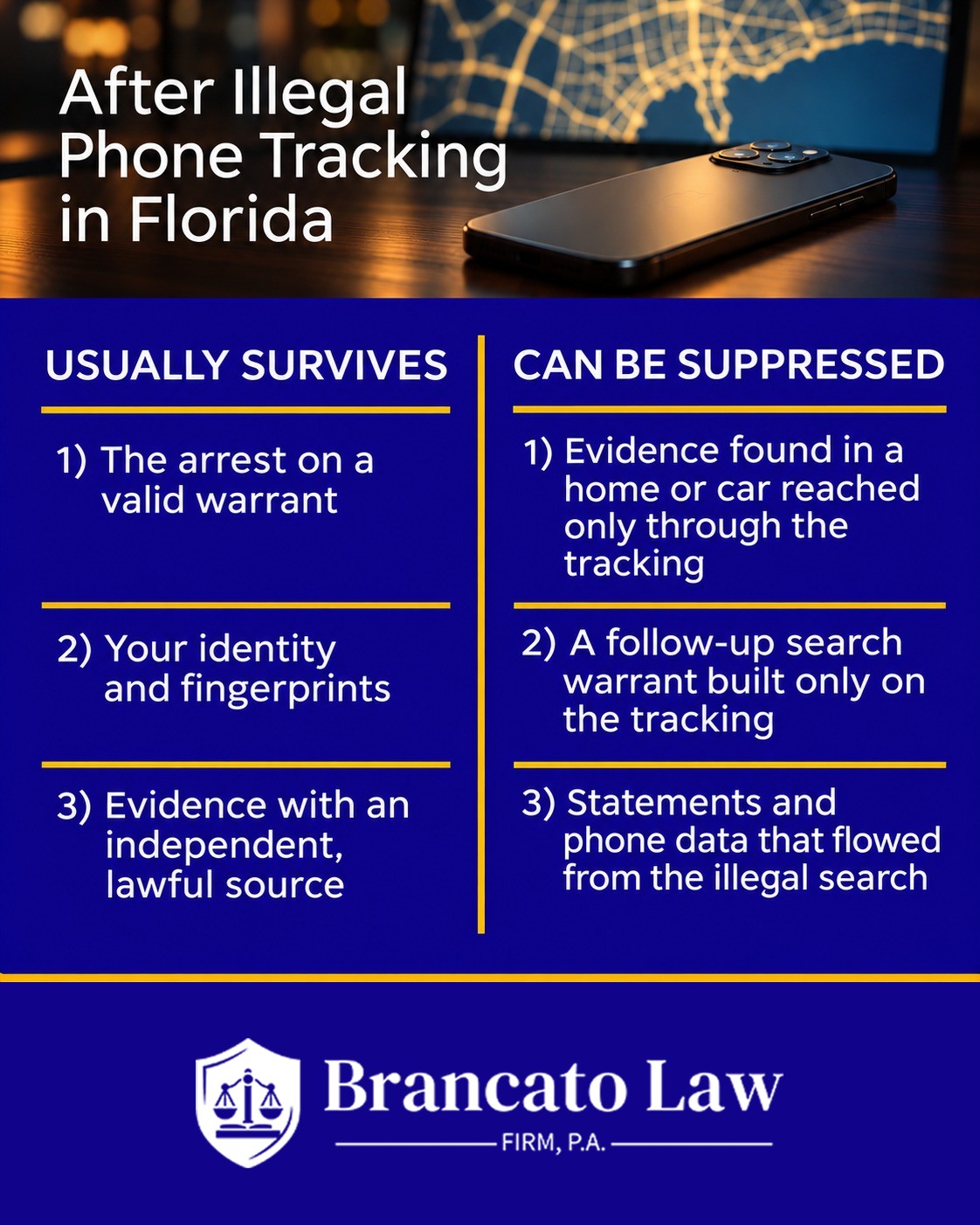
| Usually survives | Can be suppressed |
|---|---|
| The arrest on a valid warrant (Lopez-Mendoza) | Physical evidence found in a home or car that police reached only through the tracking (Andrews, Sylvestre) |
| Your identity and fingerprints | A follow-up search warrant whose only link to the place came from the tracking, once that information is cut out |
| Evidence with an independent, lawful source | Statements and phone data that flowed from the illegal search, unless the State proves attenuation |
Does an Outstanding Warrant Save the State’s Evidence?
Sometimes, and this is the State’s strongest argument. In Utah v. Strieff, 579 U.S. 232 (2016), the U.S. Supreme Court held that discovering a valid, preexisting arrest warrant after an illegal stop can break the link to the illegality, so drugs found in a search incident to that arrest came in. Florida reached a similar rule earlier in State v. Frierson, 926 So. 2d 1139 (Fla. 2006), which tells courts to weigh three factors: how much time passed, whether there was an intervening circumstance such as a warrant, and the purpose and flagrancy of the police misconduct.
Florida courts follow the U.S. Supreme Court on this. Article I, section 12 of the Florida Constitution requires the state search-and-seizure right to be construed in conformity with the Fourth Amendment as the U.S. Supreme Court interprets it. So Strieff applies here.
Hidden-tracking cases usually turn on the third Frierson factor. In Strieff and Frierson, the officers made honest mistakes during a street stop. A task force that runs a simulator without telling the judge, writes “confidential source” in the report, and keeps the device out of discovery has made a deliberate choice. Our attorneys build the record of that concealment because flagrancy is what defeats attenuation. Attenuation also helps the State far less when the evidence came from searching a place, rather than a pat-down incident to the arrest. A house search built on a tainted affidavit is the Andrews problem, and a warrant for the person does not fix a search warrant for the building.
Can Task Force Officers Enter a Friend’s or Relative’s Home to Arrest You?
Not on an arrest warrant alone, unless the friend consents or a true emergency exists. Under Payton v. New York, 445 U.S. 573 (1980), an arrest warrant carries limited authority to enter the suspect’s own home when there is reason to believe the suspect is inside. Under Steagald v. United States, 451 U.S. 204 (1981), officers need a search warrant to enter a third party’s home to look for the person named in an arrest warrant.
This rule matters in fugitive cases because people who are avoiding a warrant often stay with a girlfriend, a cousin, or a friend. If a task force tracked a phone to that apartment and walked in without a search warrant or valid consent, anything they found there may be suppressible. The homeowner may have claims of their own, too.
Say a Hillsborough County probationer stops reporting, a violation warrant issues, and two weeks later carrier pings place his phone at his cousin’s apartment in Brandon. Officers knock, the cousin opens the door, and they walk in and find a pistol in the living room. Hypothetically, three questions decide that case: what legal authority the pings came from, whether the cousin truly consented to entry, and whether officers had any lawful link to that apartment other than the tracking.
What Happens When Someone Absconds From Probation in Florida?
An absconding probationer faces arrest with or without a warrant, and the task force is often how it happens. Under section 948.06(1), Florida Statutes, any officer who knows of a probationer’s status may arrest them without a warrant when there are reasonable grounds to believe they violated probation in a material respect, and the sentencing judge may issue an arrest warrant on a sworn affidavit.
The violation hearing and the new-charge case run on different rules. Evidence suppressed in a new criminal case may still be used at the probation hearing, so a strategy for one has to account for the other. Our Tampa violation of probation attorney page explains how our attorneys handle the hearing, and our Hillsborough County criminal defense team handles warrants out of the 13th Judicial Circuit.
What Should You Do if You Have an Open Warrant in Tampa Bay?
Arrange a surrender through a lawyer before a task force finds you. An arrest at home, at work, or at a relative’s house creates the search-and-seizure problems this post describes, and it often adds charges such as resisting or possession when officers find something. A planned surrender through a lawyer avoids most of that. It also lets your attorney prepare a bond argument before your first appearance, the arrest stage covered in our guide to the stages of a Florida criminal case.
- Do not try to outlast the warrant. Florida warrants do not expire because time passes.
- Do not change phones, wipe data, or ask someone to hide you. Those steps can create new charges for you and for them.
- Do not talk about the case on the phone. Jail calls and many cell records end up in discovery.
- Call a criminal defense attorney to verify the warrant, its charge, and whether a bond is already set, then plan a surrender.
If you were already arrested by a task force, write down everything you remember about where you were, who was with you, how officers got in, and what they said about how they found you.
How Does Our Firm Challenge Task Force Location Evidence?
Our attorneys start by finding out exactly how the client was located, because most task force reports do not say. That means discovery requests and depositions aimed at the following:
- Every warrant, order, and emergency request sent to a carrier, with the carrier’s responses and timestamps
- Whether a cell-site simulator or aircraft was used, and whether the judge was told
- Whether the officers were acting as deputized task force members, and which agency holds their records
- Any phrase like “confidential source” or “developed information” in a report, and what was behind it
- How officers got into the home where the client was found, and who gave consent
One of my first suppression motions as a young lawyer turned on an officer’s claim that my client drove over a concrete curb. I went to the scene and photographed it. There was no curb, and the motion was granted on credibility. Location cases work the same way: when a report says officers found someone through a tip, our attorneys check that story against the carrier records, the timestamps, and the scene.
Our surveillance series covers each tool in more depth, starting with the Florida police surveillance guide. We also explain whether police need a warrant to put a GPS tracker on your car and whether police can search your cell phone in Florida. For violent felony warrants, which are the cases task forces prioritize, our Tampa violent crime lawyer page explains how our attorneys defend them.
Frequently Asked Questions
Can the U.S. Marshals arrest me on a Florida state warrant?
Yes. Marshals-led task forces include state and local officers with special federal deputations, and in fiscal year 2025 they arrested or cleared 44,790 state and local fugitives nationwide, per the Marshals Service. Our attorneys at The Brancato Law Firm first confirm what warrant the task force was serving and whether a bond was set, as explained on our violation of probation defense page for probation warrants.
Do the Marshals need a warrant to ping my phone in Florida?
Usually yes, unless there is a real emergency. The Florida Supreme Court held in Tracey v. State that real-time cell-site tracking is a search requiring probable cause, though a federal court in Ponce allowed tracking of an absconding probationer who already had an arrest warrant. The Brancato Law Firm asks for every carrier request in the file, because an “emergency” ping with no real emergency is a common weak point.
Will I find out if police used a Stingray to find me?
Not always, because reports often describe simulator help in vague terms. Florida police emails released in 2014 showed officers calling it information “from a confidential source” at the request of the Marshals. When a report is vague about how a client was found, our attorneys at The Brancato Law Firm press the issue in depositions and discovery, using the methods described in our Stingray warrant post.
Can my charges be dropped if the task force tracked me illegally?
Sometimes, when the key evidence came from the illegal tracking and gets suppressed. The warrant charge itself usually survives because your identity is not suppressible, but a new gun or drug charge based on what officers found can collapse without that evidence. Whether The Brancato Law Firm can get a new charge dismissed depends on the source of the evidence and how flagrant the misconduct was, which is why our attorneys build that record early. Our surveillance hub lists the other tools that raise the same issue.
Can police search my girlfriend’s apartment to arrest me?
No, not on an arrest warrant alone. Under Steagald v. United States, officers need a search warrant, consent, or a real emergency to enter a third party’s home to arrest a guest. If officers walked into someone else’s home to find you, our attorneys at The Brancato Law Firm look first at who consented and what officers knew before they went in.
Is it better to turn myself in on a warrant in Hillsborough County?
Yes, in almost every case. A planned surrender lets a lawyer verify the warrant, prepare the bond argument, and avoid a home or workplace arrest that can add charges. The Brancato Law Firm arranges surrenders for clients with open warrants in Hillsborough, Pinellas, and Pasco Counties.
Sources
- 34 U.S.C. § 41503, Fugitive Apprehension Task Forces
- 18 U.S.C. § 2702(c)(4), emergency disclosure of customer records
- Section 934.42, Florida Statutes, mobile tracking device authorization
- Section 948.06, Florida Statutes, violation of probation
- Article I, section 12, Florida Constitution
- INS v. Lopez-Mendoza, 468 U.S. 1032 (1984)
- Payton v. New York, 445 U.S. 573 (1980)
- Steagald v. United States, 451 U.S. 204 (1981)
- Utah v. Strieff, 579 U.S. 232 (2016)
- Carpenter v. United States, 585 U.S. 296 (2018)
- Tracey v. State, 152 So. 3d 504 (Fla. 2014)
- State v. Frierson, 926 So. 2d 1139 (Fla. 2006)
- State v. Sylvestre, 254 So. 3d 986 (Fla. 4th DCA 2018)
- State v. Martin, 287 So. 3d 645 (Fla. 4th DCA 2019)
- United States v. Patrick, 842 F.3d 540 (7th Cir. 2016)
- United States v. Ponce, No. 2:16-cr-139-FtM-99MRM, 2017 WL 3251494 (M.D. Fla. July 31, 2017)
- State v. Andrews, 227 Md. App. 350, 134 A.3d 324 (Md. Ct. Spec. App. 2016)
- State v. Copes, 165 A.3d 418 (Md. 2017)
- U.S. Marshals Service, Fugitive Apprehension fact sheet (FY2025 data, 2026)
- U.S. Marshals Service, Florida/Caribbean Regional Fugitive Task Force
- U.S. Department of Justice, Policy Guidance: Use of Cell-Site Simulator Technology (Sept. 3, 2015)
- Stephanie K. Pell & Christopher Soghoian, Your Secret StingRay’s No Secret Anymore, 28 Harv. J.L. & Tech. 1 (2014)
- ACLU of Florida, Internal Police Emails Show Efforts to Hide Use of Cell Phone Tracking (June 20, 2014)
- ACLU, U.S. Marshals Seize Local Cops’ Cell Phone Tracking Files (June 3, 2014)
Talk to a Tampa Defense Lawyer About a Task Force Arrest
Location evidence is easiest to challenge while carrier records and officers’ memories are fresh, and some carriers keep records only for a limited time. Before your next court date, call The Brancato Law Firm, P.A., founded by Tampa Criminal Defense Attorney Rocky Brancato, at (813) 727-7159. You can call us at any hour, and our office is two blocks from the courthouse. Our firm has Spanish-speaking staff, and attorney Jean-Luc Adrien speaks Spanish, Haitian Creole, and French.
The Brancato Law Firm, P.A.
620 E. Twiggs Street, Suite 205, Tampa, FL 33602
(813) 727-7159
Serving Hillsborough, Pinellas, and Pasco Counties
The Brancato Law Firm, P.A. is a Tampa-based criminal defense practice. We are not affiliated with any other Brancato-named law firms.
Visit Us

Tampa, FL 33602

Contact Us Now
Free Legal Consultation (813) 727-7159
