

From First DUI to Death Penalty



Do You Have a Right to a Jury Trial in Florida? (2026)


Quick answer
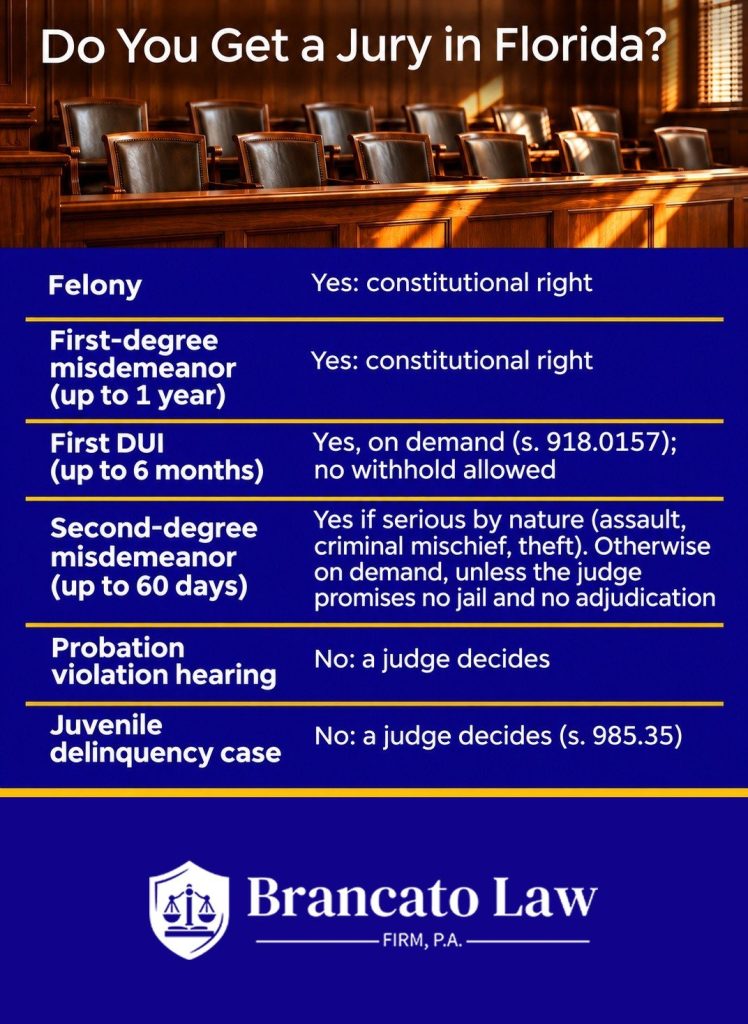
Yes. Every felony in Florida, every misdemeanor punishable by more than six months in jail, and any lesser charge that is serious by its nature (a crime indictable at common law, a crime of moral turpitude, or a crime that is malum in se, such as assault or criminal mischief) carries a constitutional right to a jury trial. For other minor offenses, section 918.0157, Florida Statutes, still gives you a jury if you ask for one, unless the judge announces when the case is set for trial that you will not go to jail and will not be adjudicated guilty. Juvenile delinquency cases and probation violation hearings are heard by a judge alone, and an adult can give up a jury only through a knowing waiver that the State agrees to.
If a prosecutor has offered to drop a count in exchange for a “judge trial,” or a judge has asked whether you want a jury, your answer decides who will weigh the evidence against you. I’m Rocky Brancato, founder of The Brancato Law Firm, P.A., a Tampa criminal defense firm, and I have tried more than 150 jury trials to verdict over more than 25 years in Hillsborough County courtrooms. Our attorneys treat the jury-or-judge choice as a strategy decision made with the client, after looking at the charge, the defenses, and the judge.
Which Florida criminal cases come with a constitutional right to a jury?
Any Florida charge that carries more than six months in jail or prison comes with a constitutional right to a jury, and so does a shorter-sentence charge that is serious by its nature, as explained below. The Florida Constitution promises an “impartial jury” to the accused in Article I, section 16 and declares in Article I, section 22 that “the right of trial by jury shall be secure to all and remain inviolate.” The federal guarantee reaches state courts through Duncan v. Louisiana, 391 U.S. 145 (1968), where the U.S. Supreme Court held that the Fourteenth Amendment requires states to give jury trials in serious criminal cases, and reversed a Louisiana battery conviction tried to a judge.
Where is the line between serious and petty? Two years later, in Baldwin v. New York, 399 U.S. 66 (1970), the Court drew it at six months: no offense can be treated as petty when more than six months of imprisonment is authorized. In Florida, that means every felony and every first-degree misdemeanor gets a jury, because a first-degree misdemeanor carries up to one year in jail under section 775.082(4), Florida Statutes.
| Offense level | Maximum jail or prison | Source of the jury right |
|---|---|---|
| Any felony | More than one year | Florida and U.S. Constitutions |
| First-degree misdemeanor | 1 year (s. 775.082(4)(a)) | Florida and U.S. Constitutions |
| First DUI | 6 months (s. 316.193(2)(a)) | Section 918.0157 on demand; a withhold is barred for DUI, so the no-jury exception cannot be used |
| Second-degree misdemeanor | 60 days (s. 775.082(4)(b)) | Florida and U.S. Constitutions if the offense is serious by its nature (for example, assault or criminal mischief); otherwise section 918.0157 on demand, unless the judge makes the no-jail, no-adjudication announcement |
| Juvenile delinquency case | Commitment, not a jail sentence | No jury; a judge decides (s. 985.35(2)) |
| Indirect criminal contempt | Set by the judge | Jury required only if the judge may impose six months or more (Aaron) |
| Probation violation hearing | Any sentence the original charge allowed | No jury; a judge decides (Peters) |
What is a petty offense, and why does six months matter?
A petty offense is a charge minor enough that the Constitution allows a trial without a jury. Two questions decide it: how much punishment the law allows, and what kind of crime it is. The Florida Supreme Court set out the test in Whirley v. State, 450 So. 2d 836 (Fla. 1984), a case about a drunk-driving charge that then carried 90 days and a $250 fine. The court held that the federal petty-offense exception also applies under the Florida Constitution, found that the charge fit none of the classes of serious crime, and ruled that the driver had no constitutional right to a jury.
Can a charge with six months or less still require a jury in Florida?
Yes. A Florida charge punishable by six months or less still carries a constitutional right to a jury when the nature of the offense makes it serious. Whirley listed four classes of serious crimes, and a charge that falls in any one of them gets a jury:
- Crimes that were indictable at common law, meaning crimes that could be charged by indictment under the English common law that Florida inherited.
- Crimes that involve moral turpitude, meaning conduct the law treats as base, vile, or dishonest.
- Crimes that are malum in se, meaning wrong in themselves, as opposed to malum prohibitum offenses that are wrong only because a statute forbids them.
- Crimes that carry a maximum of more than six months in jail or prison.
The first three classes turn on the crime itself, and a short maximum sentence does not cancel them. In Reed v. State, 470 So. 2d 1382 (Fla. 1985), a man was charged with breaking a glass door panel at a St. Augustine bank, a second-degree misdemeanor criminal mischief charge punishable by 60 days in jail. The Florida Supreme Court held that a maximum under six months “does not necessarily place a crime in the petty crime category.” Criminal mischief grew out of the common-law crime of malicious mischief, which is malum in se and was indictable at common law, so Reed had a jury right under both the Florida and U.S. Constitutions.
Other Florida appeals courts have applied the same classes. In Antonacci v. State, 504 So. 2d 521 (Fla. 5th DCA 1987), the Fifth District held that a 60-day assault charge carries a jury right because assault was indictable at common law and is malum in se. In Rodriguez Sanchez v. State, 503 So. 2d 436 (Fla. 4th DCA 1987), the Fourth District held that a woman accused of taking a blouse worth less than $100 was entitled to a jury because retail theft grew out of larceny, a malum in se crime. The table below collects these rulings.
| Charge | Maximum jail in the case | Ruling | Case |
|---|---|---|---|
| Criminal mischief (second-degree misdemeanor) | 60 days | Jury required: malum in se and indictable at common law | Reed (Fla. 1985) |
| Assault under s. 784.011 | 60 days | Jury required: indictable at common law and malum in se | Antonacci (Fla. 5th DCA 1987) |
| Retail theft of a blouse worth under $100 | Misdemeanor (maximum not stated in the opinion) | Jury required: grew out of larceny, a malum in se crime | Rodriguez Sanchez (Fla. 4th DCA 1987) |
| Criminal mischief under a city ordinance | 60 days | Jury required, even with adjudication withheld | Weber (Fla. 4th DCA 1996) |
| Driving with an unlawful blood alcohol level (1979 law) | 90 days | No constitutional jury right: fit none of the four classes | Whirley (Fla. 1984) |
| Driving without a valid license | 60 days | No constitutional jury right; statutory right under s. 918.0157 only | McCants (Fla. 1st DCA 2026) |
The nature-of-the-offense rule also limits the section 918.0157 shortcut discussed below. In Weber v. City of Fort Lauderdale, 675 So. 2d 696 (Fla. 4th DCA 1996), a defendant tried without a jury on a city ordinance charge of criminal mischief had adjudication withheld. The Fourth District held that his jury right “springs from the nature of the offense and not the nature of the penalty,” so a withhold could not take it away.
Penalties other than jail can also make a charge serious. In Blanton v. City of North Las Vegas, 489 U.S. 538 (1989), the U.S. Supreme Court said an offense with a six-month maximum is presumed petty, but a defendant can still show a right to a jury when the other penalties the legislature attached are so severe that they show it considered the offense serious. That standard is hard to meet, so for low-level charges Florida’s statute does most of the work.
Stacking petty charges together does not create a jury right. In Weber, the same defendant also faced battery, disorderly conduct, and trespass ordinance charges, each carrying up to 60 days. The court held that adding up the maximum penalties was not a basis for a jury on those counts, because a petty offense does not become serious just because it is tried alongside others. Before a short-sentence case is set for trial, our attorneys check whether each charge falls into one of the four classes.
Does Florida give you a jury even for petty offenses?
Yes, in most cases. Section 918.0157, Florida Statutes, gives a defendant “upon demand” the right to a jury for any state law or local ordinance violation “punishable by imprisonment,” which covers misdemeanors the Constitution would let a judge decide alone. A judge can try a charge punishable by six months or less without a jury only by announcing, at the time the case is set for trial, that if you are convicted of that charge or any lesser included offense, you will not be sentenced to jail and will not be adjudicated guilty.
The announcement binds the judge, and it has to come when the case is set for trial. It does not apply when the Constitution already guarantees a jury, including for the short-sentence charges that are serious by nature described above. A judge who wants the option of jail, or who will not commit to a withhold of adjudication (a sentence in which the court does not formally convict you), has to give you a jury if you ask for one. The promise also lasts for the life of the case: in Blankenbaker v. State, 744 So. 2d 573 (Fla. 2d DCA 1999), the Second District held that a county court that promised no jail to deny a reckless driving defendant a jury could not later jail him for violating his probation.
DUI shows how the pieces fit together. A first DUI carries up to six months in jail under section 316.193(2)(a), Florida Statutes, but section 316.656(1), Florida Statutes, forbids any court from withholding adjudication for a DUI. Because a judge cannot promise “no adjudication” on a DUI, the section 918.0157 exception is not available, and a driver who demands a jury gets one. Our Tampa DUI lawyer page explains how our attorneys prepare DUI cases for that jury.
How often do Florida misdemeanor and DUI cases go to a jury?
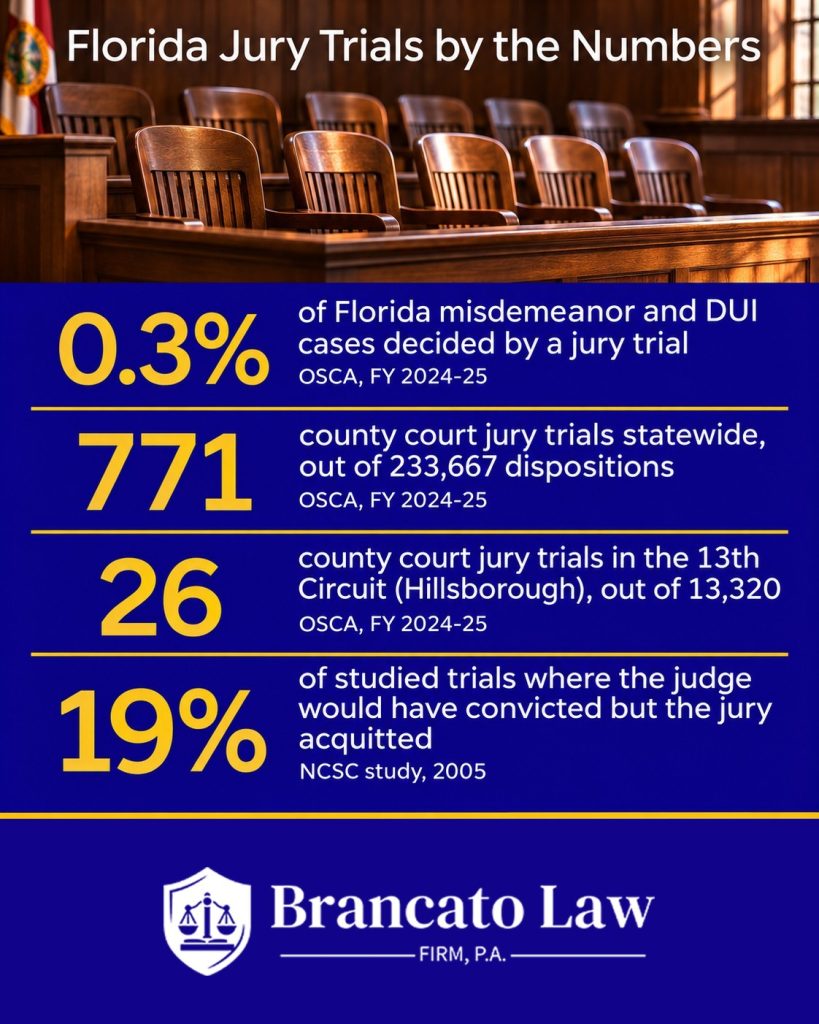
Very few do. In fiscal year 2024-25, Florida county courts recorded 771 jury trials out of 233,667 misdemeanor, ordinance, and DUI dispositions, a jury trial rate of 0.3 percent, according to the Florida Office of the State Courts Administrator’s FY 2024-25 Statistical Reference Guide, Chapter 7 (page 7-18). In the Thirteenth Judicial Circuit, which covers Hillsborough County, the same report counts 26 jury trials out of 13,320 county criminal dispositions, or 0.2 percent. Felony numbers are higher but still small, as our post on how jury selection works in a Florida criminal trial shows.
Most cases end in pleas, dismissals, or diversion, and the plea offer usually reflects what the State expects a jury to do. A defendant who is ready to demand a jury, and whose lawyer is ready to try the case, negotiates from a different position than one who is not. For Hillsborough County criminal defense, that readiness is part of how our attorneys approach every misdemeanor and DUI case.
What happened in McCants v. State?
In McCants v. State, No. 1D2025-1438 (Fla. 1st DCA Nov. 25, 2026), a driver charged in Escambia County Court with driving without a valid license and giving a false name to an officer had his case set for a bench trial with no jury. At a pretrial hearing, the prosecutor asked to set the case for a “judge trial” and said the State would drop the false-name count in exchange. Defense counsel did not object, but nothing in the record showed a waiver of the jury, and the judge never made the no-jail, no-adjudication announcement section 918.0157 requires.
The judge found the driver guilty, called the evidence “a very close one,” withheld adjudication, and imposed court costs and a $100 fine. Driving without a valid license is a second-degree misdemeanor punishable by up to 60 days in jail, so the First District Court of Appeal agreed there was no constitutional right to a jury. It also agreed the driver had a statutory right to one, and that the trial court denied it by skipping the announcement.
Why did the appeals court affirm McCants without a jury?
The First District held that violating the statutory jury right in section 918.0157 is not fundamental error, so it had to be raised in the trial court to be fixed on appeal. Denying the constitutional jury right is fundamental error that requires reversal even without an objection, but the court treated the statutory right the way Florida courts treat the statutory twelve-person jury in capital cases: important, but lost if no one objects.
Two facts sealed the result. The sentence stayed within what section 918.0157 allows for a bench trial (no jail and a withhold), and the defense had accepted the bench trial in exchange for the State dropping the second charge. The lesson for anyone facing a minor charge is to object on the record the moment the court moves toward a bench trial you did not agree to, and to make any trade for a bench trial a deliberate choice rather than a quiet one.
How do you waive a jury trial in Florida?
You waive a jury trial in Florida by giving it up knowingly and voluntarily, with the State’s consent. Florida Rule of Criminal Procedure 3.260 says a defendant “may in writing waive a jury trial with the consent of the state,” so the prosecutor can insist on a jury even when the defense would rather try the case to the judge.
A written form is not the only route. In Tucker v. State, 559 So. 2d 218 (Fla. 1990), the Florida Supreme Court upheld an oral waiver made in open court by a defendant who had a lawyer and was questioned by the judge about the choice. The court added that the better practice is both an on-the-record colloquy and a signed waiver. When our attorneys advise a client to waive a jury, we make sure the record shows the client understood what was being given up.
Should you choose a bench trial instead of a jury?
Usually not, but it depends on the defense. Research suggests judges convict more readily than juries. A 2005 study in the Journal of Empirical Legal Studies, Judge-Jury Agreement in Criminal Cases, by researchers from Cornell Law School and the National Center for State Courts, compared jury verdicts in 290 criminal trials from 2000 and 2001 with how the presiding judge would have decided. Judge and jury agreed in 75 percent of the cases; when they disagreed, the judge would have convicted where the jury acquitted in 19 percent of all cases, versus 6 percent the other way.
A bench trial can still make sense in narrow situations. The questions our attorneys work through with a client include:
- Is the defense mainly legal (for example, whether the facts the State can prove meet the statute) rather than a credibility contest?
- Are the facts likely to inflame jurors even though the law favors the defense?
- Is the State offering something concrete, like dropping a charge, in exchange for a bench trial, and is that trade worth it?
- What do we know about how this judge rules on the issue at the center of the case?
Whether you will testify is a separate decision, covered in our post on whether to testify at your own trial in Florida.
From the courtroom: I started my career at the Escambia County Public Defender’s Office in Pensacola, first as a certified legal intern and then, from 2000, as a misdemeanor attorney in the same county court system where the McCants case was tried. I learned there that a jury is the defendant’s right to claim, and that a case set for a bench trial without a clear waiver should draw an objection on the spot.
Do juveniles get a jury trial in Florida?
No. Juvenile delinquency cases in Florida are decided by a judge. Section 985.35(2), Florida Statutes, states that adjudicatory hearings “shall be conducted without a jury by the court.” The U.S. Supreme Court held in McKeiver v. Pennsylvania, 403 U.S. 528 (1971), that a jury in the adjudicatory stage of juvenile court is not a constitutional requirement. A teenager charged as an adult in circuit court does have the full jury right; our Tampa juvenile defense attorney page covers how cases move between the two courts.
Which other Florida proceedings are decided without a jury?
Probation violation hearings, criminal contempt cases where the judge limits the sentence to less than six months, and civil traffic infractions are decided without a jury. A probation violation hearing does not count as a criminal prosecution: in Peters v. State, 984 So. 2d 1227 (Fla. 2008), the Florida Supreme Court held that revocation proceedings “are not criminal prosecutions” and noted that there is no right to a jury before probation is revoked. A judge decides whether a violation happened and then sentences, which is why our attorneys build the defense to a violation around what that one judge will weigh.
Criminal contempt follows the six-month line. In Aaron v. State, 284 So. 2d 673 (Fla. 1973), the Florida Supreme Court held that a judge trying indirect criminal contempt (contempt committed outside the judge’s presence, such as disobeying a court order) must empanel a jury when a sentence of six months or more is contemplated, unless the defendant waives it. A judge who denies a pretrial jury demand cannot later impose six months or more.
How many jurors will hear a Florida criminal trial?
Most Florida criminal trials use six jurors, the minimum the Florida Constitution allows, and capital cases use twelve. In June 2026 the U.S. Supreme Court agreed to reconsider whether six-person juries are constitutional, a pending review the McCants opinion itself notes. Our post on how many jurors a Florida criminal trial has tracks that case and explains how to preserve the issue.
Where does the jury trial fit in the life of a case? Trial comes after arraignment, discovery, and motions, and only after plea talks fail. Our Florida criminal case process guide walks through each stage from arrest to sentencing.
Frequently asked questions about jury trials in Florida
Can I get a jury trial for a misdemeanor in Florida?
Yes, for nearly every misdemeanor that carries jail time. First-degree misdemeanors and second-degree misdemeanors that are serious by nature, such as assault, carry a constitutional jury right, and section 918.0157 gives a jury on demand for other second-degree misdemeanors unless the judge promises no jail and no adjudication before setting trial. The Brancato Law Firm files the jury demand early so the court cannot quietly set the case for a bench trial.
Do I get a jury for a 60-day assault, theft, or criminal mischief charge in Florida?
Yes. Florida courts have held that assault, low-value retail theft, and criminal mischief are serious by nature because they were crimes at common law or are malum in se, so the constitutional jury right applies even though each carried 60 days or less in those cases (Antonacci v. State, 504 So. 2d 521 (Fla. 5th DCA 1987) is one example). At The Brancato Law Firm, we raise that right on the record so a judge cannot use the section 918.0157 announcement to move the case to a bench trial.
Is a DUI trial in Florida decided by a jury?
Yes, if you ask for one. Because section 316.656 bars a withhold of adjudication for DUI, a judge cannot make the promise needed to deny a jury under section 918.0157. When a DUI case is headed for trial, our attorneys at The Brancato Law Firm prepare it for six jurors, including the breath-test and video issues jurors weigh most.
Can the prosecutor refuse my request for a bench trial?
Yes. Rule 3.260 lets a defendant waive a jury only “with the consent of the state,” so the prosecutor can insist on a jury. Before recommending a bench trial, The Brancato Law Firm’s attorneys find out whether the State will agree and what, if anything, it is offering in return.
Do I get a jury for a civil traffic ticket in Florida?
No. Section 918.0157 covers offenses “punishable by imprisonment,” and a civil traffic infraction carries no jail, so it is heard by a judge or hearing officer. Criminal traffic charges are different, and our Tampa criminal traffic lawyer page explains which ones carry jail and a jury right, which is where The Brancato Law Firm focuses its traffic defense.
What happens if a judge holds a bench trial without my jury waiver?
It depends on which right was denied. Denying a constitutional jury right is fundamental error that an appeals court will reverse even without an objection, but under McCants the statutory right under section 918.0157 must be raised in the trial court. That is why our attorneys at The Brancato Law Firm object on the record whenever a case drifts toward a bench trial the client has not chosen.
Does a bench trial get a case over faster in Hillsborough County?
Sometimes, because a bench trial needs no jury selection and can be set on a judge’s calendar more easily. Speed is rarely worth giving up six citizens’ judgment, and at The Brancato Law Firm we weigh the time saved against the research showing judges convict more often than juries.
Sources
- Fla. Const. art. I, sections 16 and 22
- Section 918.0157, Florida Statutes (right to trial by jury)
- Section 775.082, Florida Statutes and section 775.083, Florida Statutes (misdemeanor penalties and fines)
- Section 316.193, Florida Statutes and section 316.656, Florida Statutes (DUI penalties; no withhold)
- Section 985.35, Florida Statutes (juvenile adjudicatory hearings)
- Florida Rule of Criminal Procedure 3.260 (waiver of jury trial)
- McCants v. State, No. 1D2025-1438 (Fla. 1st DCA Nov. 25, 2026)
- Whirley v. State, 450 So. 2d 836 (Fla. 1984); Tucker v. State, 559 So. 2d 218 (Fla. 1990)
- Reed v. State, 470 So. 2d 1382 (Fla. 1985); Antonacci v. State, 504 So. 2d 521 (Fla. 5th DCA 1987); Rodriguez Sanchez v. State, 503 So. 2d 436 (Fla. 4th DCA 1987); Weber v. City of Fort Lauderdale, 675 So. 2d 696 (Fla. 4th DCA 1996)
- Aaron v. State, 284 So. 2d 673 (Fla. 1973); Peters v. State, 984 So. 2d 1227 (Fla. 2008); Blankenbaker v. State, 744 So. 2d 573 (Fla. 2d DCA 1999)
- Duncan v. Louisiana, 391 U.S. 145 (1968); Baldwin v. New York, 399 U.S. 66 (1970); Blanton v. City of North Las Vegas, 489 U.S. 538 (1989); McKeiver v. Pennsylvania, 403 U.S. 528 (1971)
- Florida OSCA, FY 2024-25 Statistical Reference Guide, Chapter 7: County Criminal (page 7-18)
- Eisenberg et al., Judge-Jury Agreement in Criminal Cases, 2 J. Empirical Legal Stud. 171 (2005)
A trial date can be set at an early hearing, and the time to demand a jury or object to a bench trial is before that date is locked in. Call The Brancato Law Firm, P.A., founded by Tampa Criminal Defense Attorney Rocky Brancato, at (813) 727-7159 so our attorneys can review your charge, file the jury demand, and prepare the case for trial. You can call us at any hour. Our firm has Spanish-speaking staff, and attorney Jean-Luc Adrien speaks Spanish, Haitian Creole, and French. For more about how a case moves from arrest to verdict, visit our Florida criminal case process page.
The Brancato Law Firm, P.A.
620 E. Twiggs Street, Suite 205, Tampa, FL 33602
(813) 727-7159
Serving Hillsborough, Pinellas, and Pasco Counties
The Brancato Law Firm, P.A. is a Tampa-based criminal defense practice. We are not affiliated with any other Brancato-named law firms.
Visit Us

Tampa, FL 33602

Contact Us Now
Free Legal Consultation (813) 727-7159
