

From First DUI to Death Penalty



Should I Testify at My Own Criminal Trial in Florida? (2026)


Whether to testify at your own criminal trial in Florida is your decision, made after advice from your lawyer. If you stay silent, the prosecutor may not comment on it, and on request the judge tells the jury it must not be influenced by your choice. If you testify, the State may cross-examine you and may ask whether you have been convicted of a felony or a crime of dishonesty, and how many times. The right call depends on how strong the State’s evidence is, what your record looks like, and whether your own testimony is the only way to put your defense in front of the jury.
Near the end of every Florida criminal trial, after the State rests, the defense reaches a question that only the defendant can answer: will you take the stand? The Florida Supreme Court has said it is advisable for the trial judge to ask the defendant about that choice on the record, before the defense rests. I am Rocky Brancato, founder of The Brancato Law Firm, P.A., a Tampa criminal defense firm, and I have tried more than 150 jury trials to verdict in more than 25 years in Hillsborough County courtrooms. Our attorneys start preparing for that moment months ahead by testing the State’s evidence, checking the client’s record against Florida’s impeachment rules, and running practice cross-examinations, so the client makes the decision with the full picture in front of them.
Who decides whether you testify at a Florida criminal trial?
You do. A criminal defendant has a constitutional right to testify in his or her own defense, and an equal right to refuse. In Rock v. Arkansas, 483 U.S. 44 (1987), the U.S. Supreme Court struck down an Arkansas rule that automatically barred a defendant’s hypnotically refreshed testimony, and held that a defendant’s right to take the stand comes from the Due Process Clause, the Sixth Amendment right to call witnesses, and the Fifth Amendment. Florida Rule of Criminal Procedure 3.250 says the accused “may choose to be sworn as a witness in the accused’s own behalf,” and that no accused person “shall be compelled to give testimony against himself.”
Your lawyer advises; you decide. In Torres-Arboledo v. State, 524 So. 2d 403 (Fla. 1988) the Florida Supreme Court held that the right to testify does not have to be waived personally on the record, but it recommended that trial judges ask the defendant, just before the defense rests, whether he understands the right and that the decision is his own after talking with counsel.
When a defendant later claims a lawyer talked him out of testifying, Florida courts ask two questions. In Hayes v. State, 79 So. 3d 230 (Fla. 2d DCA 2012), the Second District, which hears appeals from Hillsborough, Pinellas, and Pasco, explained that the court first asks whether the defendant voluntarily agreed not to testify, and then asks whether the advice was deficient because “no reasonable attorney would have discouraged” the defendant from testifying. Hayes’s claim was sent back for him to amend because he never said what his testimony would have been. At The Brancato Law Firm, our attorneys give the client a clear recommendation and the reasons for it, and the client makes the decision, a point we also made in our case study It’s the Client’s Call.
What happens if you do not testify?
If you do not testify, the jury may not treat your silence as evidence of guilt. The Fifth Amendment and Article I, Section 9 of the Florida Constitution both say no person may be compelled to be a witness against himself in a criminal case. In Griffin v. California, 380 U.S. 609 (1965), a murder defendant did not testify, the prosecutor stressed his silence, and the judge told jurors they could draw unfavorable inferences from it. The Supreme Court reversed and held that the Constitution forbids “either comment by the prosecution on the accused’s silence or instructions by the court that such silence is evidence of guilt.”
The jury also hears about the right directly. In Carter v. Kentucky, 450 U.S. 288 (1981), the defendant chose not to testify and asked for an instruction that his silence could not be used against him, and the judge refused. The Supreme Court reversed and held that a trial judge must, on proper request, “minimize the danger that the jury will give evidentiary weight to a defendant’s failure to testify.” Florida’s version is Standard Jury Instruction (Criminal) 3.9(a), which the judge gives if the defendant requests it. It tells jurors that the defendant “exercised a fundamental right by choosing not to be a witness in this case” and that they “must not view this as an admission of guilt or be influenced in any way” by that decision.
Whether to ask for that instruction is itself a strategy call. Some defense lawyers prefer not to remind the jury that the defendant stayed silent. Our attorneys make that call with the client, case by case.
Can the prosecutor tell the jury you did not testify?
No. Florida’s test is broad: any comment that is “fairly susceptible” of being read as a comment on the defendant’s silence is error. The Florida Supreme Court applied that test in State v. DiGuilio, 491 So. 2d 1129 (Fla. 1986), a cocaine case where an officer told the jury that the defendant had said he “felt like he should speak to his attorney.” The court held that such errors are reviewed for harmless error, that the State must prove beyond a reasonable doubt that the comment did not affect the verdict, and that the State could not meet that burden in DiGuilio’s case.
The rule reaches jury selection, too, and one of the leading cases began in Hillsborough County. In Marston v. State, 136 So. 3d 563 (Fla. 2014), the defendant was charged with sexual battery, kidnapping, and other offenses arising from an attack on a bridge in Hillsborough County. During voir dire, the prosecutor told prospective jurors the defendant could “sit there and not say a word,” “read magazines,” or “play on Facebook all day long,” and added, “I can’t put him on the stand.” Defense counsel objected and asked for a curative instruction, which the trial court did not give. The Second District affirmed the convictions. The Florida Supreme Court quashed that decision, holding that the remarks “demeaned” the right to remain silent and that the later jury instructions did not cure the harm.
The lesson from Marston is practical. Silence-comment errors are won by objecting when they happen, so our attorneys listen for them from the first question of jury selection through the last sentence of closing argument, and we ask for a curative instruction on the record.
What happens if you do testify?
If you testify, you are treated like any other witness. Florida’s standard instruction tells jurors that the defendant “has become a witness” and that they “should apply the same rules” to that testimony as to everyone else’s. You can be cross-examined by an assistant state attorney who has prepared for you. Under section 90.612(2), Florida Statutes, cross-examination is limited to the subject matter of your direct testimony and matters affecting your credibility, but the judge has discretion to permit questions on additional matters.
Credibility is the opening the State uses most. The jury instruction lists the questions jurors may ask about any witness, including whether the witness made a statement “at some other time” that is inconsistent with the trial testimony, and whether the witness has been convicted of a felony or a crime involving dishonesty. Anything you told a detective, wrote in a text, or said on a recorded jail call can come back during your cross-examination if it does not match what you say on the stand. A false answer under oath can also become a separate perjury charge.
Can the State bring up your prior record if you testify in Florida?
Yes, within limits. Under section 90.610, Florida Statutes, a party may attack the credibility of “any witness, including an accused,” with a prior conviction for a crime punishable by death or more than one year in prison, or for any crime that “involved dishonesty or a false statement regardless of the punishment.” Juvenile adjudications are not admissible under that section, and a pending appeal or a pardon does not keep a conviction out.
Florida restricts how the State asks. In Fulton v. State, 335 So. 2d 280 (Fla. 1976), a Fourth District murder case, the prosecutor named the specific charge pending against a defense witness, and the Florida Supreme Court ordered a new trial. The court explained the general rule: “only the fact of the conviction can be brought out,” and if the witness admits it, the questioning “may not be pursued to the point of naming the crime.” The usual questions are whether you have ever been convicted of a felony or a crime of dishonesty and, if so, how many times.
The defendant’s own answers can widen the door. In Tilus v. State, 121 So. 3d 1145 (Fla. 4th DCA 2013), the court said that when a defendant tries to mislead the jury about his prior convictions, or describes them in a favorable light, the State may ask follow-up questions about them. Tilus himself answered “possibly” because he could not keep track of his records, and the appeals court held that this did not open the door and ordered a new trial. Before any client testifies, our attorneys pull the certified record, count the qualifying convictions, and rehearse the exact answer.
| Type of record | Usable to impeach under s. 90.610? | What the jury usually hears |
|---|---|---|
| Felony conviction (punishable by more than 1 year) | Yes | That you have been convicted of a felony, and how many times |
| Misdemeanor involving dishonesty or false statement | Yes | That you have been convicted of a crime of dishonesty, and how many times |
| Other misdemeanors | No | Nothing, unless another evidence rule applies |
| Juvenile adjudications | No | Nothing under s. 90.610 |
| Conviction on appeal or pardoned | Yes | The conviction; the pending appeal may also be shown |
| You misstate the number or downplay the convictions | The door opens wider | Follow-up questions about the convictions themselves |
How does a prior record change the decision to testify?
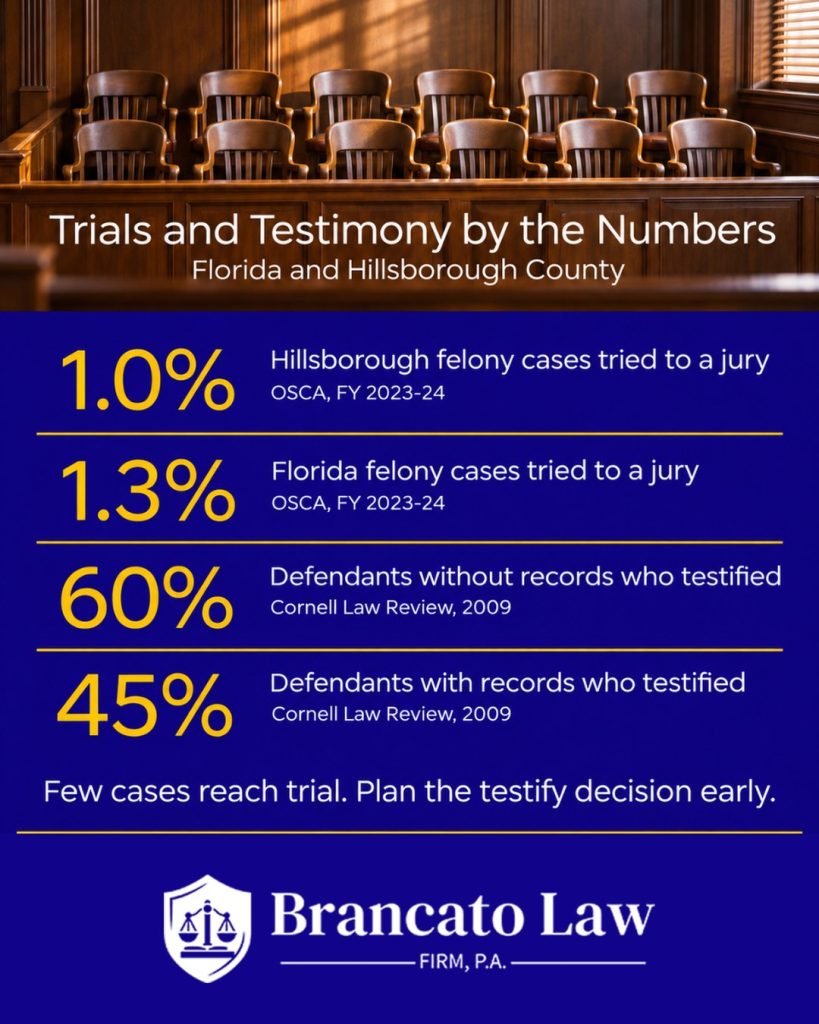
A prior record makes testifying riskier, and the research shows defendants know it. In Taking a Stand on Taking the Stand: The Effect of a Prior Criminal Record on the Decision to Testify and on Trial Outcomes, 94 Cornell L. Rev. 1353 (2009), Professors Theodore Eisenberg and Valerie P. Hans studied more than 300 criminal trials in four large counties. They found that 60 percent of defendants without criminal records testified, compared with 45 percent of defendants with records. Juries rarely learned about a record unless the defendant testified, and in cases with weak evidence, a jury learning of the record was associated with conviction.
That finding matches what Florida’s impeachment rule would predict. A defendant with no qualifying convictions gives up little by testifying on that front. A defendant with several felony convictions hands the State a credibility attack that the jury would not otherwise hear, which matters most when the State’s case is thin. Our attorneys at The Brancato Law Firm weigh that risk against the value of the testimony itself, with the client, before trial begins.
How often does a Florida case reach the point where you decide?
Rarely. According to the Florida Office of the State Courts Administrator’s FY 2023-24 Statistical Reference Guide, only 1.3 percent of circuit criminal (felony) dispositions statewide came from a jury trial: 2,119 of 156,827. In the Thirteenth Judicial Circuit, which is Hillsborough County, the figure was 1.0 percent, or 126 jury trial dispositions out of 12,277. Of those 126 Hillsborough jury trial dispositions, 28 were acquittals or dismissals, 2 were pleas, and 96 were convictions.
Those numbers explain why the testify question is so heavy when it does arise. Most Hillsborough County felony cases end in a plea or another resolution long before a jury is sworn,. If you are still deciding whether to accept a plea, how you would do on the witness stand belongs in that analysis, because the honest answer to “should I testify?” can change what a trial is worth.
What do our attorneys weigh before you take the stand?
Our attorneys work through the same questions with every client who goes to trial. The answers decide the recommendation, and the client makes the final call.
- Has the State proved every element? If the State’s case has a hole, testimony can fill it for the prosecution.
- Is your testimony the only source of the defense? Self-defense, consent, and lack of knowledge often depend on what the defendant saw, heard, or believed. When no other witness or exhibit can prove it, silence can mean the defense never reaches the jury.
- What does your record look like under section 90.610? We count the qualifying convictions and prepare the exact answer.
- What have you said before? We compare your planned testimony against every prior statement: interviews with detectives, texts, social media posts, and jail calls.
- How do you hold up under cross-examination? We prepare you with practice cross-examination before trial.
- Do you need an interpreter? Testimony through a court interpreter changes the rhythm of cross-examination, and we prepare for that.
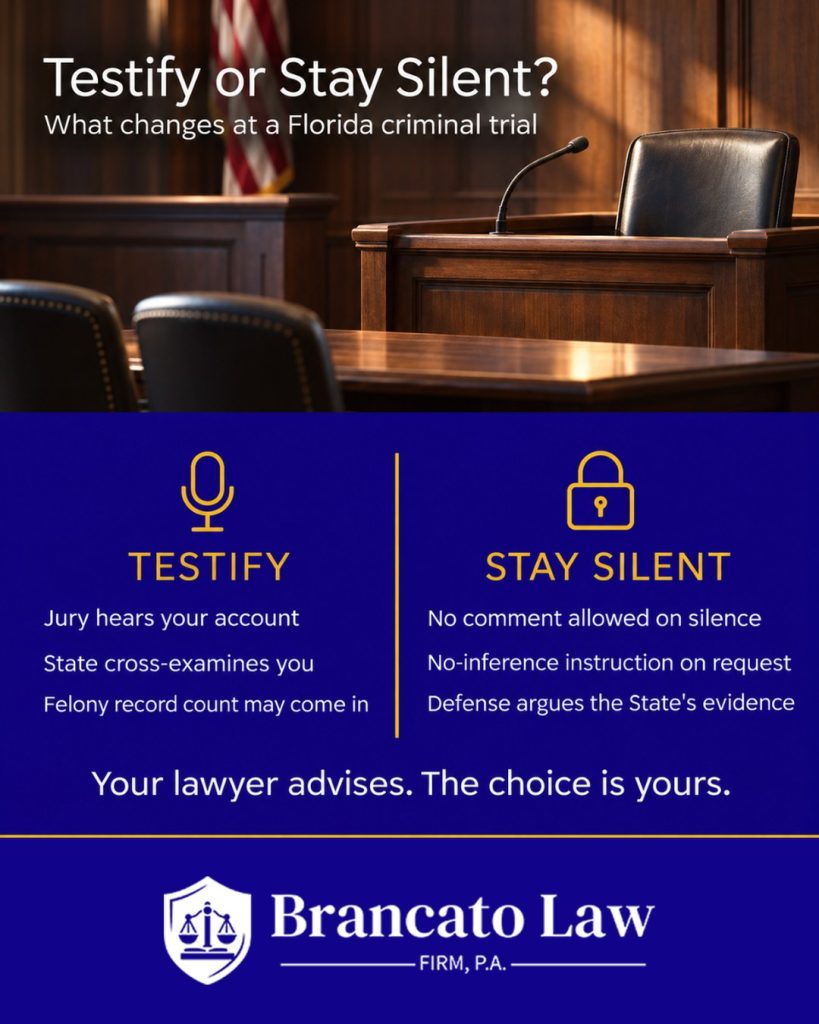
| Issue | If you testify | If you stay silent |
|---|---|---|
| Who tells your side | You do, under oath | Your lawyer argues from the State’s evidence and any defense witnesses |
| Cross-examination | Yes, on your direct testimony and your credibility (s. 90.612(2)) | None |
| Prior convictions | Felony and dishonesty convictions can be raised by number (s. 90.610) | Generally not raised through impeachment |
| Prior statements | Inconsistent statements can be used to challenge you | The State may still offer them as evidence, but not to impeach you as a witness |
| Comment on your choice | The jury weighs your testimony like any other witness’s | No comment allowed; no-inference instruction on request (Instruction 3.9(a)) |
| Risk of a new charge | A knowingly false statement can lead to a perjury charge | None from testimony |
Does the decision about talking start before trial?
Yes. The choice to testify at trial is the last of several decisions about speaking, and the earlier ones shape it. Every statement a person gives to detectives becomes material the State can use to challenge trial testimony. Our firm decides case by case what, if anything, to provide to detectives during an investigation, and through our representation before charges are filed, we work to keep the client’s account consistent from the first contact through trial. A client who has already talked with law enforcement should tell us exactly what was said, because that statement will be part of the testify decision later.
Language matters at this stage as well. A defendant who testifies in Spanish or Haitian Creole speaks through a court interpreter, and you have a right to an interpreter in court. Our firm has Spanish-speaking staff, and attorney Jean-Luc Adrien speaks Spanish, Haitian Creole, and French, so we can prepare a client for cross-examination in the client’s own language.
When do you have to decide whether to testify?
You decide during the defense case, after the State rests and before the defense rests. Until then, the decision stays open, and it often depends on how the State’s witnesses held up on cross-examination and how the judge ruled on a motion for judgment of acquittal. The groundwork has to be laid much earlier: the record check, the review of prior statements, and practice sessions all happen before trial. If your case is set for trial in Hillsborough, Pinellas, or Pasco County, that preparation should start now. Our Florida criminal case process guide shows where trial falls among the stages of a case.
FAQs about testifying at your own trial in Florida
Can the prosecutor force me to testify at my own trial in Florida?
No. The Fifth Amendment, Article I, Section 9 of the Florida Constitution, and Rule 3.250 all bar the State from compelling a defendant to testify. At The Brancato Law Firm, our attorneys object to any question or argument that suggests otherwise, including in jury selection, as the defense did in Marston.
Can my lawyer refuse to let me testify?
No. The decision belongs to you after advice from counsel, and a lawyer who overrides it can face an ineffective assistance claim under the two-part test in Hayes v. State. Our attorneys at The Brancato Law Firm give a clear recommendation, explain the reasons, and then follow the client’s decision, as described in our case study It’s the Client’s Call.
Will the jury hear about my prior convictions if I do not testify?
Usually not through impeachment, because section 90.610 applies to witnesses and a defendant who does not testify is not a witness. The Brancato Law Firm still reviews whether any other evidence rule could bring a prior offense in, since a record can matter for other reasons, such as when a prior conviction is an element of the charge.
Do misdemeanors count against me if I testify in Florida?
Only misdemeanors involving dishonesty or a false statement can be used to impeach a witness under section 90.610; juvenile adjudications cannot be used under that section. Our attorneys at The Brancato Law Firm pull the certified record before trial so the client knows the exact number the State can ask about.
Can I testify about only one part of the case?
Partly. Under section 90.612(2), cross-examination is limited to the subject matter of your direct testimony and your credibility, though the judge may allow more. Our attorneys at The Brancato Law Firm plan the scope of direct examination with that rule in mind and object when cross-examination goes beyond it.
If I have no prior record, should I testify?
Not automatically. A clean record removes the section 90.610 impeachment risk, but cross-examination, prior statements, and the strength of the State’s evidence still drive the decision. The Brancato Law Firm reviews all three with each client, and our post on how jury selection works in a Florida criminal trial explains how we learn early what a panel thinks about defendants who do or do not testify.
For more about how a case moves from arrest to verdict, visit our Florida Criminal Case Process page, and for the related trial right to question the State’s witnesses, see our post on the right to confrontation in Florida.
The decision to testify is made at trial, but the work that makes it a good decision starts the day a lawyer is hired. Call The Brancato Law Firm, P.A., founded by Tampa Criminal Defense Attorney Rocky Brancato, at (813) 727-7159 as soon as a trial date is on the calendar. Our attorneys will review your record, your prior statements, and the State’s evidence, and prepare you for either choice. You can call us at any hour, and our office is two blocks from the courthouse. Our firm has Spanish-speaking staff, and attorney Jean-Luc Adrien speaks Spanish, Haitian Creole, and French.
The Brancato Law Firm, P.A.
620 E. Twiggs Street, Suite 205, Tampa, FL 33602
(813) 727-7159
Serving Hillsborough, Pinellas, and Pasco Counties
The Brancato Law Firm, P.A. is a Tampa-based criminal defense practice. We are not affiliated with any other Brancato-named law firms.
Visit Us

Tampa, FL 33602

Contact Us Now
Free Legal Consultation (813) 727-7159
