

From First DUI to Death Penalty



What Is a Withhold of Adjudication in Florida? (2026)


In plain terms
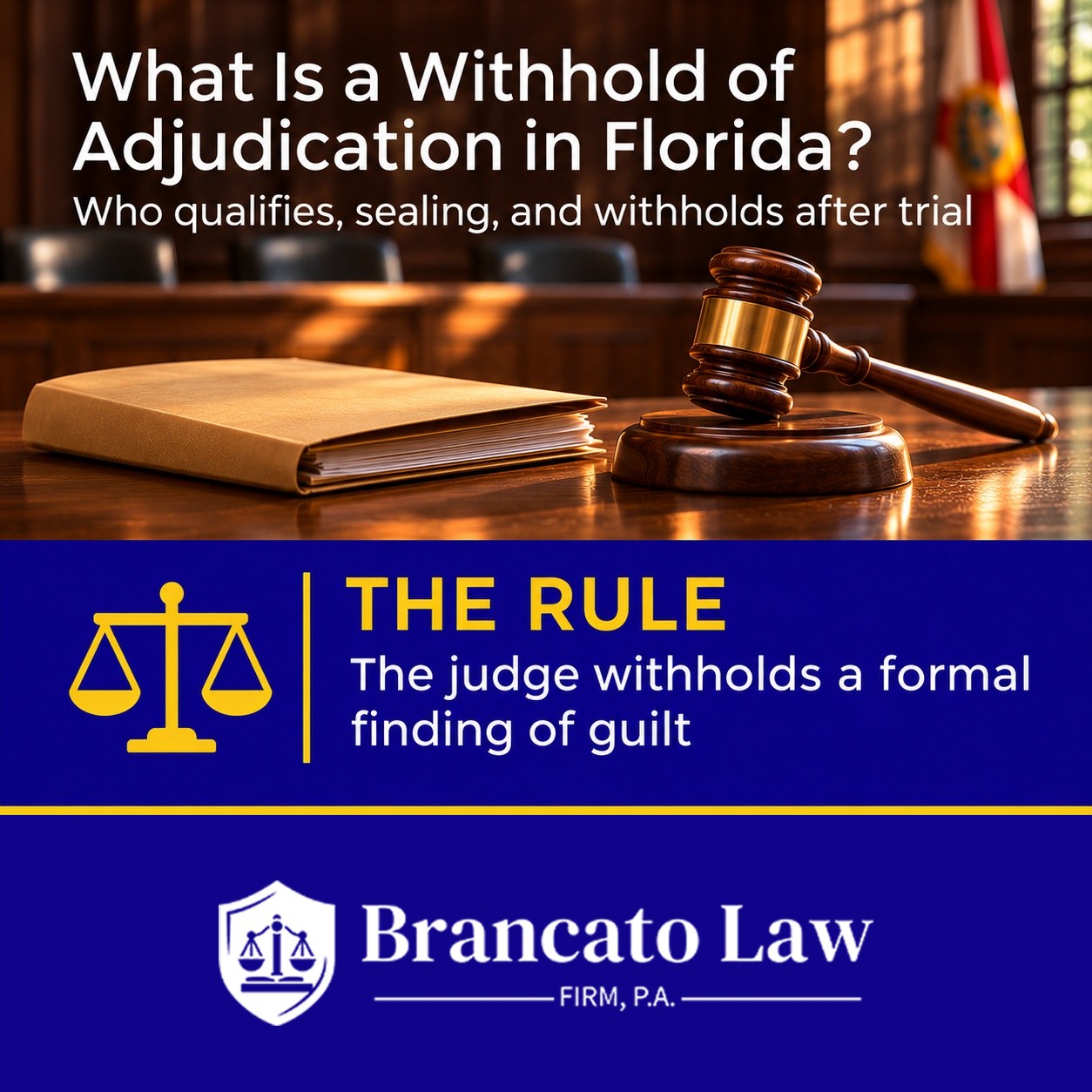
A withhold of adjudication is a sentence in which a Florida judge finds you guilty but does not formally convict you. Under section 948.01(2), the judge may withhold adjudication after finding that you are not likely to commit another crime and that justice does not require the full penalty, unless a statute forbids it, as Florida law does for first-degree felonies and DUI. A withhold keeps the door open to sealing your record, and a judge may not refuse to consider one just because a jury found you guilty.
A Florida judge can withhold adjudication only after deciding, at a sentencing hearing, that you are unlikely to reoffend and that justice does not require the full penalty. I have spent more than 25 years in Hillsborough County courtrooms asking judges to make that finding, first as a public defender and now as founder of The Brancato Law Firm, P.A., a Tampa criminal defense firm. Our attorneys build the record for a withhold from the first meeting, because what the judge hears at sentencing depends on what we gathered months earlier.
What does withhold of adjudication mean in Florida?
A withhold of adjudication means the judge accepts the plea or verdict of guilty but stops short of formally adjudicating you guilty. Section 948.01(2), Florida Statutes, allows it when “the defendant is not likely again to engage in a criminal course of conduct” and “the ends of justice and the welfare of society do not require that the defendant presently suffer the penalty imposed by law.” In a felony case the judge must then place you on probation; in a misdemeanor case, the judge may impose probation or another sentence.
If you complete the sentence, the case ends without an adjudication of guilt on your record. If you violate probation, the judge can revoke it, adjudicate you guilty, and sentence you to anything the original charge allowed.
Is a withhold of adjudication a conviction?
A withhold avoids a formal adjudication, but several laws still count it as a conviction. The biggest practical difference is sealing: under section 943.059(1), Florida Statutes, you cannot seal a record if you were adjudicated guilty of any act stemming from that arrest, or if you have ever been adjudicated guilty of a criminal offense in Florida. A withhold, by contrast, leaves sealing available if you meet the other requirements.
| Consequence | Adjudicated guilty | Adjudication withheld |
|---|---|---|
| Sealing the record (s. 943.059) | Not eligible | Eligible if all other requirements are met |
| Later expunction (s. 943.0585(1)(h)) | Not eligible | Possible after the record has been sealed for at least 10 years |
| Felony civil rights (voting, jury service) | Lost until restored (Fla. Const. art. VI, s. 4) | Not lost |
| Federal immigration law (8 U.S.C. s. 1101(a)(48)(A)) | Conviction | Usually still a conviction if guilt was found or admitted and any punishment was ordered |
| Future felony sentencing in Florida | Counts as prior record (s. 921.0021) | Also counts as prior record (s. 921.0021(2)), and prior felony withholds limit later withholds (s. 775.08435) |
Immigration is the trap people miss. Federal law defines “conviction” to include a case where “adjudication of guilt has been withheld” if the person pleaded guilty or no contest, or was found guilty, and the judge ordered “some form of punishment, penalty, or restraint,” under 8 U.S.C. section 1101(a)(48)(A). A withhold that protects a citizen’s record can still trigger removal for a noncitizen, so the plea has to be built around immigration advice before it is entered. Sex offenses carry their own registration rules, covered in our post on whether a withhold avoids the sex offender registry.
When can’t a Florida judge withhold adjudication?
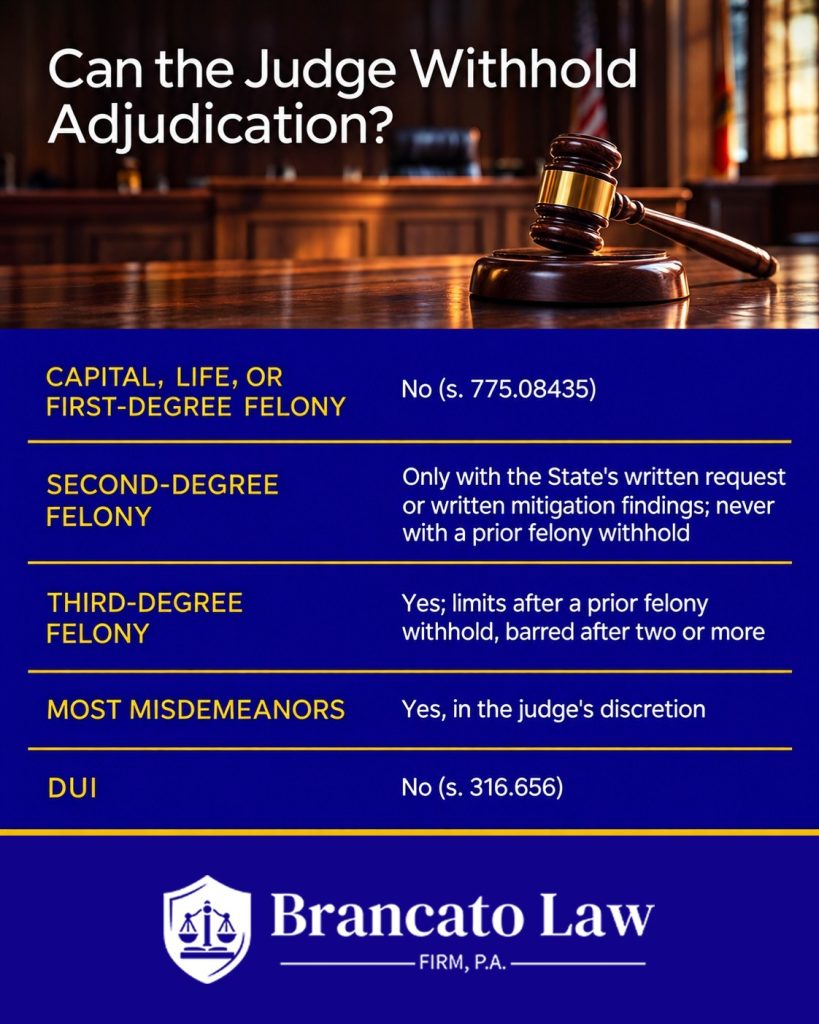
A judge cannot withhold adjudication when a statute forbids it. Section 775.08435, Florida Statutes, bars a withhold for any capital, life, or first-degree felony. For a second-degree felony, a withhold requires a written request from the State Attorney or written findings that it is justified under the mitigation factors of section 921.0026, and it is barred entirely if you already have a felony withhold from a different case. For a third-degree felony, one prior felony withhold triggers the same written-request-or-findings requirement, and two or more prior felony withholds bar it.
Some offenses carry their own bans. Section 316.656(1), Florida Statutes, says that “no court may suspend, defer, or withhold adjudication of guilt” for DUI, DUI manslaughter, or vehicular homicide.
Can you get a withhold of adjudication after losing at trial?
Yes. Going to trial does not take a withhold off the table, and a judge who refuses to consider one for that reason commits reversible error. In Borges-Pinar v. State, No. 3D25-0150 (Fla. 3d DCA Nov. 25, 2026), a Miami-Dade County jury found a man guilty of resisting an officer without violence under section 843.02, Florida Statutes, a misdemeanor. The Third District affirmed the conviction, but it found that the county judge “erred in automatically rejecting the possibility of imposing a withhold because a jury found” him guilty. It reversed the sentence and sent the case back for resentencing.
The court relied on Vicaria v. State, 743 So. 2d 644 (Fla. 1st DCA 1999), where a judge sentencing a man who pleaded guilty to a Medicaid fraud scheme mistakenly believed he could not withhold adjudication once the State asked for an adjudication. The First District reversed, holding that a judge may adjudicate or withhold “in its discretion” under section 948.01(2) “unless a withholding of adjudication is specifically proscribed.” Read together, the two cases say the judge must actually exercise discretion: not a blanket rule against withholds after trial, and not automatic deference to the prosecutor.
The State in Borges-Pinar conceded the error. For anyone deciding whether to demand a jury trial in Florida, the case removes one reason to plead: you do not give up the chance at a withhold by making the State prove its case.
How often do Florida misdemeanor cases end in a guilty disposition?
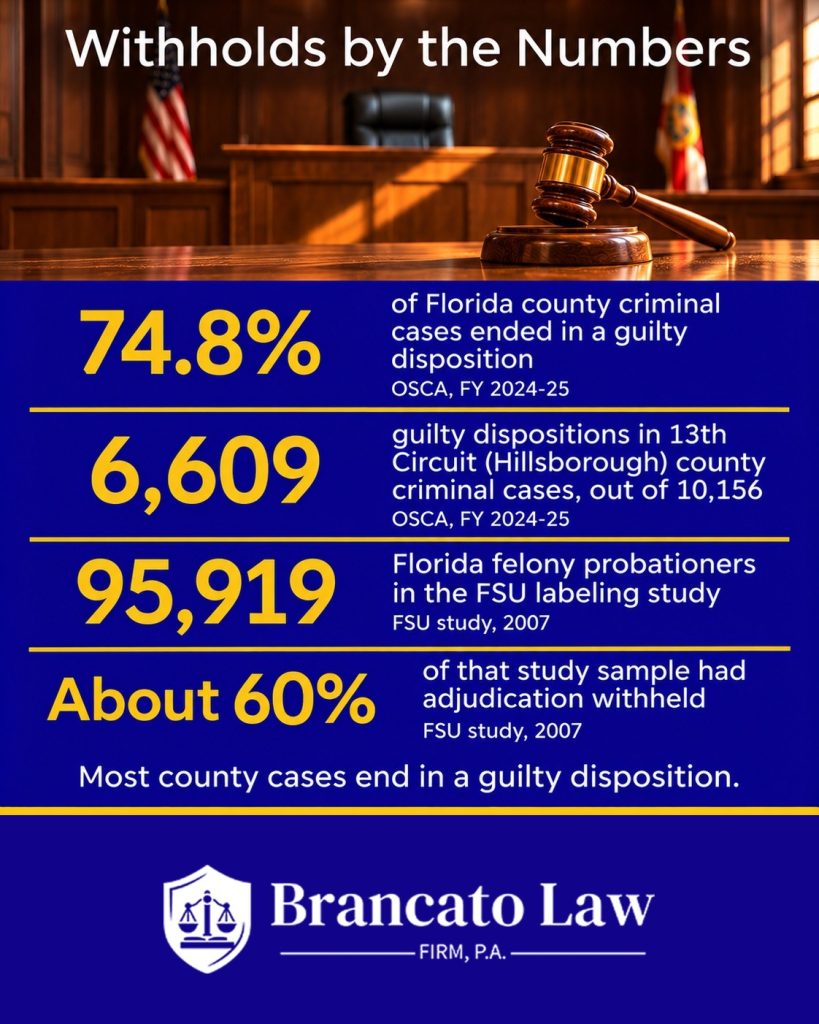
Most do, which is why the withhold question matters to so many people. In fiscal year 2024-25, 123,825 of 165,472 county criminal dispositions in Florida, or 74.8 percent, were guilty dispositions (pleas and convictions), according to the Florida Office of the State Courts Administrator’s FY 2024-25 Statistical Reference Guide, Chapter 7 (page 7-18). In the Thirteenth Judicial Circuit, which covers Hillsborough County, the same table counts 6,609 guilty dispositions out of 10,156, or 65.1 percent. Each of those cases ended with a choice between an adjudication and a withhold, unless a statute removed the choice.
Does a withhold of adjudication reduce reoffending?
Florida research says it may. A study by Florida State University criminologists Ted Chiricos, Kelle Barrick, William Bales, and Stephanie Bontrager, The Labeling of Convicted Felons and Its Consequences for Recidivism, Criminology 45(3) (2007), followed 95,919 people sentenced to felony probation in Florida from 2000 to 2002. Those formally adjudicated felons were significantly more likely to be convicted of a new crime within two years than those whose adjudication was withheld. FSU’s summary of the study reported that adjudication was withheld for about 60 percent of the people in the sample.
That research is useful at sentencing. Section 948.01(2) asks whether you are “likely again to engage in a criminal course of conduct,” and a study showing that the felony label itself raises that risk speaks directly to the question the judge must answer.
How do you ask a Florida judge for a withhold?
You ask with evidence, not just a request. The judge has to find that you are unlikely to reoffend, so the defense has to show it. Depending on the case, our attorneys present:
- Proof of work, school, family responsibilities, and community ties.
- Completed treatment, counseling, or classes, with records from the provider.
- Letters from employers and people who know you well.
- A clean or minimal prior record, and how the offense differs from who you are.
- The concrete harm an adjudication would cause, such as losing a professional license or the ability to seal the record.
When mental health or substance use played a role, a mitigation evaluation can carry real weight; our Tampa criminal mental health lawyer page explains how our attorneys use it. In Hillsborough County, a better outcome is sometimes available before sentencing at all: pretrial intervention (PTI) ends in a dismissal rather than a withhold when the program is completed.
What usually happens: first-time offenders charged with misdemeanors and lower-level felonies are the strongest candidates for a withhold, and a prior record, a statutory bar, or a serious injury to a victim makes one much harder to get. No lawyer can promise a withhold, because the decision belongs to the judge. Sentencing is the last stage before appeal on our Florida criminal case process guide.
Frequently asked questions about withholds of adjudication in Florida
Can I get a withhold of adjudication on a DUI in Florida?
No. Section 316.656 bars a withhold for DUI, so the realistic goals in a DUI case are a reduction to reckless driving or a defense at trial, which is where The Brancato Law Firm focuses its DUI work.
Can a judge give me a withhold if the prosecutor objects?
Yes, for most offenses. Under Vicaria, the State’s request for an adjudication does not take away the judge’s discretion, although a second-degree felony requires the State’s written request or written mitigation findings. Our attorneys at The Brancato Law Firm present the evidence the judge needs to make those findings.
Does a withhold of adjudication show up on a background check?
Yes, until the record is sealed. The arrest and the disposition stay on the public record, but a withhold makes you potentially eligible to seal it under section 943.059, and The Brancato Law Firm can review whether you qualify once your sentence is complete.
Is a withhold a conviction for immigration purposes?
Usually, yes. Under 8 U.S.C. section 1101(a)(48)(A), a withhold counts as a conviction if guilt was found or admitted and any penalty was imposed. When a client is not a U.S. citizen, The Brancato Law Firm addresses immigration consequences before any plea, and our Spanish-speaking staff and attorney Jean-Luc Adrien can explain the options in Spanish, Haitian Creole, or French.
What happens if I violate probation after a withhold?
The judge can revoke probation, adjudicate you guilty, and impose any sentence the original charge allowed. That makes the withhold worth protecting, and our attorneys at The Brancato Law Firm defend violation-of-probation cases with the goal of keeping it in place.
Can I get a withhold if I went to trial and lost?
Yes. Borges-Pinar held that a judge cannot automatically refuse to consider a withhold because a jury found the defendant guilty. At The Brancato Law Firm, we prepare the sentencing presentation before trial so it is ready if the verdict goes against us.
Sources
- Section 948.01, Florida Statutes; section 775.08435, Florida Statutes; section 316.656, Florida Statutes
- Section 921.0021, Florida Statutes (scoresheet definitions); section 943.059, Florida Statutes (sealing); section 943.0585, Florida Statutes (expunction)
- 8 U.S.C. section 1101(a)(48)(A); Fla. Const. art. VI, section 4
- Borges-Pinar v. State, No. 3D25-0150 (Fla. 3d DCA Nov. 25, 2026)
- Vicaria v. State, 743 So. 2d 644 (Fla. 1st DCA 1999)
- Florida OSCA, FY 2024-25 Statistical Reference Guide, Chapter 7: County Criminal (page 7-18)
- Chiricos, Barrick, Bales and Bontrager, The Labeling of Convicted Felons and Its Consequences for Recidivism, 45 Criminology 547 (2007)
The sentencing hearing is the one chance to ask for a withhold, and the evidence for it takes weeks to gather. Call The Brancato Law Firm, P.A., founded by Tampa Criminal Defense Attorney Rocky Brancato, at (813) 727-7159 before you accept a plea or reach a sentencing date, and our attorneys will tell you whether a withhold is available and what it will take. You can call us at any hour. Our firm has Spanish-speaking staff, and attorney Jean-Luc Adrien speaks Spanish, Haitian Creole, and French. For more about defending cases in local courts, visit our Hillsborough County criminal defense page.
The Brancato Law Firm, P.A.
620 E. Twiggs Street, Suite 205, Tampa, FL 33602
(813) 727-7159
Serving Hillsborough, Pinellas, and Pasco Counties
The Brancato Law Firm, P.A. is a Tampa-based criminal defense practice. We are not affiliated with any other Brancato-named law firms.
Visit Us

Tampa, FL 33602

Contact Us Now
Free Legal Consultation (813) 727-7159
