Strategic Defense,
From First DUI to Death Penalty
From First DUI to Death Penalty





| Is your child facing a juvenile charge in Tampa? The Brancato Law Firm, P.A. defends children and teenagers in juvenile delinquency cases in Hillsborough, Pinellas, and Pasco Counties. Our attorneys handle the case for the family from the first police contact: we appear at the detention hearing, press for diversion, fight any move to adult court, and work to keep the record sealable. Call (813) 727-7159 for a free, confidential consultation. |
When a child is arrested in Hillsborough County, the first 24 hours decide where the child sleeps and set the direction of the case. Our attorneys at The Brancato Law Firm, P.A., a Tampa criminal defense firm founded by Rocky Brancato, defend juvenile cases from the first call from a school resource officer through disposition. Rocky chaired the 13th Judicial Circuit Juvenile Justice Advisory Board from 2022 to 2024, after serving as a member from 2016 to 2022, and he is a former Chief Operations Officer of the Hillsborough County Public Defender’s Office, where he oversaw a staff of over 100 attorneys.
Juvenile court in Florida runs on its own statute, chapter 985, with its own deadlines, its own sentencing options, and different rules for records. Rocky has spent more than 25 years in Hillsborough County courtrooms and has tried more than 150 jury trials to verdict. Our attorneys use that experience to keep a child’s case in juvenile court, out of a detention cell, and off a permanent record whenever the law allows.
This page covers children charged in the juvenile system. College students and young adults facing campus discipline or Title IX proceedings should see our separate student conduct and Title IX defense page.
On this page:
A child taken into custody in Florida is either released to a parent or screened for detention, and a child held in detention must see a judge within 24 hours under section 985.255, Florida Statutes. Florida law treats anyone under 18, or anyone accused of an offense committed before turning 18, as a child under section 985.03, Florida Statutes. The juvenile court keeps jurisdiction over a child on probation until age 19, and over a child committed to the Department of Juvenile Justice until age 21, under section 985.0301, Florida Statutes.
The case then moves through stages that look like the adult system but run on shorter clocks. Our guide to the Florida criminal case process explains the adult stages; the table below shows where juvenile court differs.
| Issue | Juvenile court (chapter 985) | Adult criminal court |
|---|---|---|
| Charging document | Petition for delinquency | Information or indictment |
| Who decides guilt | A judge, with no jury (s. 985.35) | A jury, unless waived |
| Speedy trial clock | 90 days (Fla. R. Juv. P. 8.090) | A longer clock under Fla. R. Crim. P. 3.191 |
| Possible outcome | Withhold, adjudication, probation, or commitment | Conviction, jail or prison, probation |
| Records | Automatically expunged at 21 or 26 in most cases (s. 943.0515) | Permanent unless sealed or expunged |
Most of the protections in the left column disappear if the case is transferred to adult court, so our attorneys treat every juvenile felony as a possible adult case from the first day.
Yes, for many first-time misdemeanors. Every Florida judicial circuit must run a prearrest delinquency citation program for misdemeanors under section 985.12, Florida Statutes, and offenses involving the use or possession of a firearm are excluded by statute. In Hillsborough County that program is JAAP, the Juvenile Arrest Avoidance Program, and our guide to JAAP juvenile civil citations explains who qualifies.
Civil citations are issued by the officer at the scene. A defense lawyer cannot get a child into JAAP after an arrest, so the decision belongs to the deputy or officer who responds. When a child is arrested instead, our attorneys ask the State Attorney’s Office for post-arrest diversion, which can still lead to diversion expunction under section 943.0582, Florida Statutes. Our Hillsborough County diversion programs guide compares the options.
Rocky served for many years on Hillsborough’s juvenile civil citation committee, which developed and expanded the county’s use of civil citations, and he regards civil citation as the gold standard for reducing recidivism among first-time offenders. When he worked at the Public Defender’s Office around 2004, Hillsborough’s juvenile caseload was roughly 12,000 cases a year. After civil citations took hold, it fell to about 2,000.
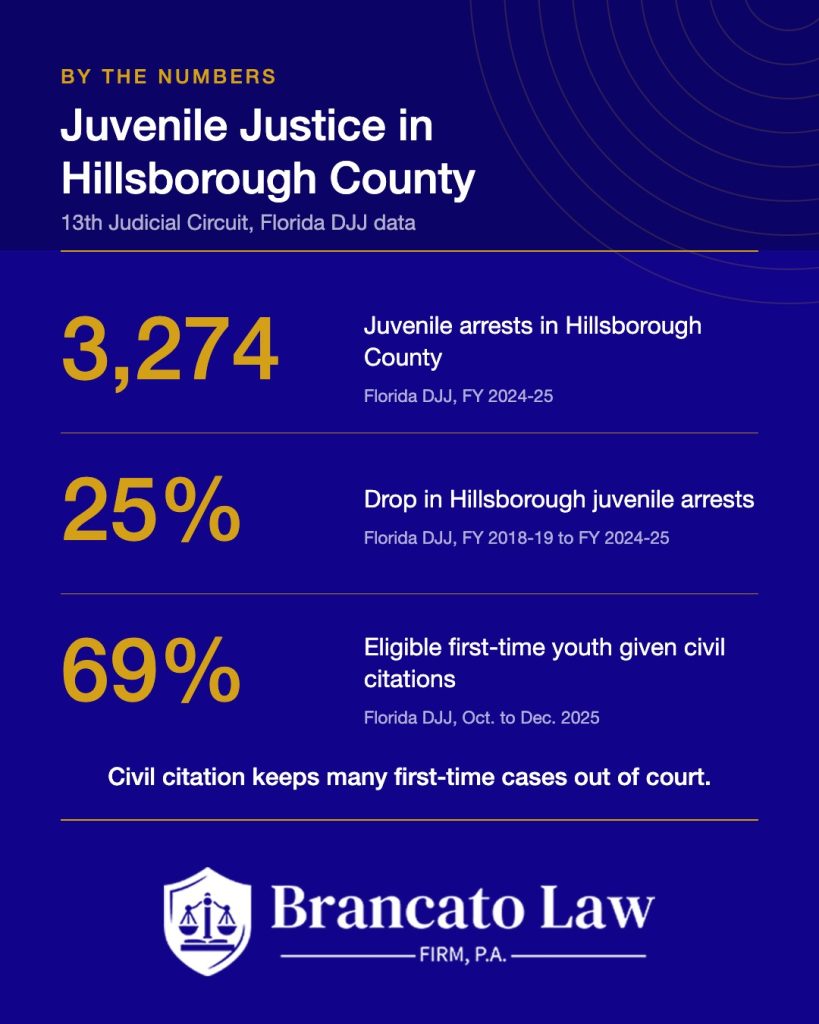
State data shows the same direction. The Department of Juvenile Justice’s Delinquency Profile reports 3,274 juvenile arrests in the 13th Judicial Circuit, which is Hillsborough County, in fiscal year 2024-25, down 25% from 4,358 in fiscal year 2018-19. DJJ’s prearrest delinquency citation report shows that from October through December 2025, officers in the 13th Circuit issued civil citations to 151 of 218 eligible first-time misdemeanor youth, a 69% utilization rate, against 66% statewide.
Research supports the local experience. A Campbell Collaboration systematic review by Petrosino, Turpin-Petrosino, and Guckenburg (2010) examined 29 controlled trials covering 7,304 juveniles and found that formal court processing did not reduce delinquency and appeared to increase it (abstract via the Office of Justice Programs). Roughly one eligible child in three in Hillsborough is still arrested, so an arrest for a first misdemeanor deserves a close look at whether the officer documented a reason.
A child can be held in secure detention before trial only if the court finds a legal basis at a detention hearing held within 24 hours of custody. Under section 985.255, Florida Statutes, the judge decides whether there is probable cause for the charge and whether the Department of Juvenile Justice risk assessment, or another listed ground, supports continued detention. The judge can order a more or less restrictive placement than the risk assessment shows, but must give clear and convincing reasons in writing.
Detention has hard time limits under section 985.26, Florida Statutes, so the State cannot hold a child until it is ready for trial.
| Detention rule | Time limit | Source |
|---|---|---|
| Held without a court order | 24 hours | s. 985.26(1) |
| Secure detention before the adjudicatory hearing | 21 days, unless the hearing has begun in good faith | s. 985.26(2)(a) |
| Extension for serious charges (capital, life, first- or second-degree felony, violent third-degree felony, or a firearm offense) | Up to 21 more days at a time, with a hearing and written findings | s. 985.26(2)(b) |
| Detention after an order of adjudication | 15 days | s. 985.26(3) |
| Domestic violence charge where the risk assessment does not call for detention | 48 hours unless the court orders more | s. 985.255(2) |
Some charges change the starting point. For murder, armed robbery or armed burglary involving a firearm, having a firearm while committing a felony, delinquent in possession of a firearm, and the other offenses listed in section 985.255(1)(g), the law presumes the child is a danger to the community and requires secure detention unless the judge finds, by clear and convincing evidence, that supervised release with electronic monitoring is safe. Our guide to juvenile felonies and gun rights covers how firearm charges follow a child into adulthood.
Our attorneys prepare for the detention hearing before it starts. We gather school records, a parent’s plan for supervision, and the facts that weaken probable cause, because a child released at the first hearing is in a far better position to fight the charge.
The adjudicatory hearing is the juvenile trial, and a judge decides it without a jury under section 985.35, Florida Statutes. The State files a petition for delinquency, and the child must be brought to an adjudicatory hearing within 90 days of being taken into custody or served with a summons, whichever comes first, under Florida Rule of Juvenile Procedure 8.090 (the Florida Rules of Juvenile Procedure are published by The Florida Bar). A child may also file a demand for speedy trial, which requires trial within 60 days, with a remedy if the hearing has not begun within 50 days of the demand.
The rules of evidence that apply in adult criminal cases also apply here. That means our attorneys can move to suppress statements and searches, depose witnesses, and challenge forensic interviews just as they would in an adult case. Chapter 22 of our parents’ guide, Juvenile Court and the Question of Adult Court, walks families through this stage.
A withhold of adjudication means the judge finds the child committed the offense but does not formally adjudicate the child delinquent, and section 985.35 lets the judge place the child on probation with conditions. If the child later violates those conditions, the court can hold a hearing and enter an adjudication without new evidence of the original offense. An adjudication is the formal finding of delinquency, and it gives the court full authority to impose any disposition chapter 985 allows.
At disposition, the court chooses among outcomes that range from probation at home to commitment to a residential program. Florida’s residential commitment levels, defined in section 985.03, are:
Probation can include restitution, community service, a curfew, school attendance, and treatment. In juvenile sex cases, a rehabilitation plan can shape the disposition, as explained in our guide to rehabilitation plans in Hillsborough County juvenile sex cases. Our attorneys build the disposition case early, with evaluations, school records, and a plan the judge can trust.
A Florida child can be moved to adult court in three ways: direct file by the State Attorney, waiver by a judge, or indictment by a grand jury. Each route has its own age limits and charge requirements.
| Route | Who decides | When it applies |
|---|---|---|
| Discretionary direct file (s. 985.557) | State Attorney | Age 14 or 15 at the time of a listed offense, such as robbery, sexual battery, aggravated battery, burglary with an assault or battery, carjacking, or home invasion robbery; age 16 or 17 for any felony, and for a misdemeanor only with two prior adjudications or withholds, one a felony |
| Waiver (s. 985.556) | Juvenile judge after a hearing | Age 14 or older on the State’s motion; the State must request transfer or give written reasons in specified repeat-violent-offense cases; a child may also demand adult trial with a parent |
| Indictment (s. 985.56) | Grand jury | A child of any age charged with an offense punishable by death or life imprisonment |
The statutes are section 985.557, section 985.556, and section 985.56, Florida Statutes. The most important window is the time before the State Attorney makes the filing decision, which is why our attorneys contact the prosecutor early through our representation before charges are filed.
Adult court carries adult sentences, though the U.S. Supreme Court has set an outer limit. In Graham v. Florida, 560 U.S. 48 (2010), Terrance Graham was 16 when he took part in an attempted robbery of a Jacksonville restaurant; his prosecutor charged him as an adult, and after a probation violation he received a life sentence. The Court held that the Eighth Amendment forbids life without parole for a juvenile who did not commit homicide, and that the State must give a meaningful opportunity to obtain release based on demonstrated maturity and rehabilitation.
Turning 18 changes the picture again. Chapter 23 of our parents’ guide, When You’re 18: The Adult System, covers what happens when the accused is no longer a juvenile.
Youthful offender sentencing is an adult-court sentence that caps the total sentence at 6 years for a person who committed a felony before turning 21, under section 958.04, Florida Statutes. It applies to a person who is at least 18 or who was transferred to adult court under chapter 985, who has not been sentenced as a youthful offender before, and who was not found guilty of a capital or life felony.
The judge can impose probation or community control of up to 6 years, a period of incarceration as a condition of that supervision, a split sentence with 1 to 4 years in a state facility, or commitment to the Department of Corrections for up to 6 years. For a child who has been direct filed, youthful offender status is often the most important goal of the case, and our youthful offender sentencing guide explains how to get there.
Yes. Most Florida juvenile records are expunged automatically: at age 21 for most minors, or at age 26 for a minor classified as a serious or habitual juvenile offender or committed to a maximum-risk program, under section 943.0515, Florida Statutes. A young adult from 18 to under 21 can apply for early expunction if there have been no charges or findings in the 5 years before applying, with the approval of the State Attorney in each circuit where an offense occurred.
A child who completes diversion after an arrest for a misdemeanor, or a felony other than a forcible felony or a firearm or weapon felony, can have the arrest record expunged under section 943.0582, Florida Statutes if the child has never been charged with or found to have committed another offense. There are exceptions. A juvenile record is merged into the adult record if the person is charged with or convicted of a forcible felony at 18 or older before the juvenile record is destroyed, and records of adjudications that require sex offender registration are kept. Our juvenile expungement guide walks through each path.
Sometimes. A child adjudicated delinquent on or after July 1, 2007, for a qualifying offense committed at age 14 or older must register under section 943.0435, Florida Statutes. The qualifying offenses are sexual battery under section 794.011 (other than subsection (10)), lewd or lascivious battery where the victim was under 12 or the court finds force or coercion, and lewd or lascivious molestation where the court finds unclothed genitals, or force or coercion and unclothed genitals.
The court must make written findings on the child’s age and, for the lewd or lascivious offenses, on the victim’s age and the other facts that trigger registration. Our attorneys contest those findings, because they decide whether registration applies. Our guide to juvenile sex offender registration in Florida explains which adjudications trigger the registry and how removal works.
Families hire our firm because juvenile cases are decided by people who know how the 13th Circuit’s juvenile system works from the inside. These are the credentials behind our juvenile practice:
| Credential | Why it matters in a juvenile case |
|---|---|
| Chair, 13th Judicial Circuit Juvenile Justice Advisory Board (2022 to 2024); member from 2016 to 2022 | Years of work with the judges, agencies, and providers who run Hillsborough’s juvenile system |
| Many years on Hillsborough’s juvenile civil citation committee | Helped develop and expand the county’s civil citation program |
| Vice Chair, youth and gun violence committee, Safe and Sound Hillsborough (2015 to 2024) | Designed a mock trial program for hundreds of at-risk Hillsborough County teens, held in community centers, public schools, and the courthouse, with USF surveying participants before and after |
| 13th Judicial Circuit Problem-Solving Courts Oversight Committee (2012 to 2023) | Knowledge of the treatment-based alternatives courts can use |
| Former Chief Operations Officer, Hillsborough County Public Defender’s Office, overseeing a staff of over 100 attorneys | Inside knowledge of how the 13th Judicial Circuit charges and resolves cases |
| More than 150 jury trials to verdict and more than 25 years in Hillsborough County courtrooms | Prosecutors know the case is ready for trial if a child is direct filed |
Our office is at 620 E. Twiggs Street, two blocks from the Hillsborough County Courthouse. Our firm has Spanish-speaking staff, and attorney Jean-Luc Adrien speaks Spanish, Haitian Creole, and French. That matters in juvenile court, where a parent often has to understand the detention order and the release conditions on the first day.
Call before your child answers questions, and no later than the detention hearing, which must happen within 24 hours of custody. Police and school resource officers often ask to speak with a child before any arrest, and a child’s statement is usually the strongest evidence in the file. Our Hillsborough County criminal defense attorneys can step in at that stage, speak with the investigator, and press for civil citation or diversion before a petition is filed.
After a petition is filed, the 90-day speedy trial clock and the State’s direct file decision move quickly. A child arrested at a large gathering faces the same timeline; our guide to teen takeover arrests in Tampa Bay describes what happens next. When a college student is arrested, our guide on what parents should do after a college arrest in Tampa covers the criminal case and campus discipline together.
11 guides for parents of children facing juvenile charges in Hillsborough, Pinellas, and Pasco Counties. Each link opens our guide to that stage or issue: what the law says and how our attorneys handle it.
JAAP Civil Citations | Hillsborough Diversion Programs | Juvenile Expungement | Youthful Offender Sentencing | Juvenile Sex Offender Registration | Juvenile Rehabilitation Plans | Juvenile Felonies and Gun Rights | Teen Takeover Arrests | College Student Arrests | Chapter 22: Juvenile Court and Adult Court | Chapter 23: When You’re 18
Yes. The State Attorney’s Office can decline to file a petition, divert the case, or drop it by nolle prosequi when the evidence does not hold up. The Brancato Law Firm pushes for that result early by presenting the defense to the prosecutor before the filing decision through our pre-file advocacy practice.
No. Your child should politely say he or she wants a parent and a lawyer, and should not explain, deny, or apologize. Our attorneys at The Brancato Law Firm speak with the investigator for the family, which keeps the child’s own words out of the State’s file.
No. JAAP civil citations are issued by the officer at the scene in place of an arrest, so a lawyer cannot place a child in JAAP once the arrest has happened. The Brancato Law Firm instead asks the State Attorney’s Office for post-arrest diversion, which can still lead to expunction of the arrest record, as our Hillsborough diversion guide explains.
Usually no more than 21 days unless the adjudicatory hearing has begun, under section 985.26. For serious felonies and firearm offenses, the judge can extend detention in increments of up to 21 days after a hearing with written findings, so The Brancato Law Firm prepares a release plan for the first detention hearing.
Usually not forever. Most juvenile records are automatically expunged at 21, or at 26 for serious or habitual juvenile offenders, but they can appear on background checks until then. The Brancato Law Firm reviews which path can clear a record sooner, and our juvenile expungement guide explains early expunction from 18 to 20.
Yes. Under section 985.557, the State Attorney may direct file a felony against a child who was 16 or 17 when the offense was committed, and a misdemeanor only if the child has two prior adjudications or withholds, one for a felony. The Brancato Law Firm works to keep the case in juvenile court, and when that is not possible, to secure youthful offender sentencing.
Juvenile defense is usually charged as a flat fee based on the charge and the complexity of the case. The Brancato Law Firm offers free, confidential consultations to parents and lets families pay half up front with the balance while the case is pending.
Before your child answers another question from a detective, deputy, or school official, call The Brancato Law Firm, P.A., founded by Tampa Criminal Defense Attorney Rocky Brancato, at (813) 727-7159. A detention hearing happens within 24 hours of custody, so call us at any hour, and our attorneys will tell you what to bring, what your child should not say, and what we will do first.
The Brancato Law Firm, P.A.
620 E. Twiggs Street, Suite 205, Tampa, FL 33602
(813) 727-7159
Serving Hillsborough, Pinellas, and Pasco Counties
The Brancato Law Firm, P.A. is a Tampa-based criminal defense practice. We are not affiliated with any other Brancato-named law firms.
This page is for informational purposes only and does not constitute legal advice. Each case is unique, and outcomes depend on the individual facts and circumstances involved. Past results do not guarantee future outcomes.


Tampa, FL 33602

Free Legal Consultation (813) 727-7159
