- Free Consultation 24/7: (813) 727-7159 Tap Here To Call Us


From First DUI to Death Penalty



How Does Jury Selection Work in a Florida Criminal Trial? (2026)


Short answer: Jury selection in a Florida criminal trial, called voir dire, is the process of questioning a group of randomly summoned county residents to choose six jurors, or twelve in a capital case, who can decide the case fairly. The judge and the lawyers ask about each person’s background and beliefs. Either side can ask the judge to remove a juror “for cause” when there is a reasonable doubt about that juror’s impartiality, and each side also gets a fixed number of peremptory strikes: 10 when the charge carries life or death, 6 for other felonies, and 3 for misdemeanors.
As founder of The Brancato Law Firm, P.A., a Tampa criminal defense firm, and a former Chief Operations Officer of the Hillsborough County Public Defender’s Office, where I oversaw a staff of over 100 attorneys, I have picked juries in more than 150 jury trials to verdict. I also designed the trial-skills programs that trained hundreds of Tampa Bay attorneys, who now practice in every area of law and include some who now sit as judges. Jury selection was always the first block of that training. Our attorneys treat it as the first chance to learn who will decide your case and to remove the people who cannot be fair. This guide walks through each step, the Florida law behind it, and the research on what actually works.
How does jury selection work in a Florida criminal trial?
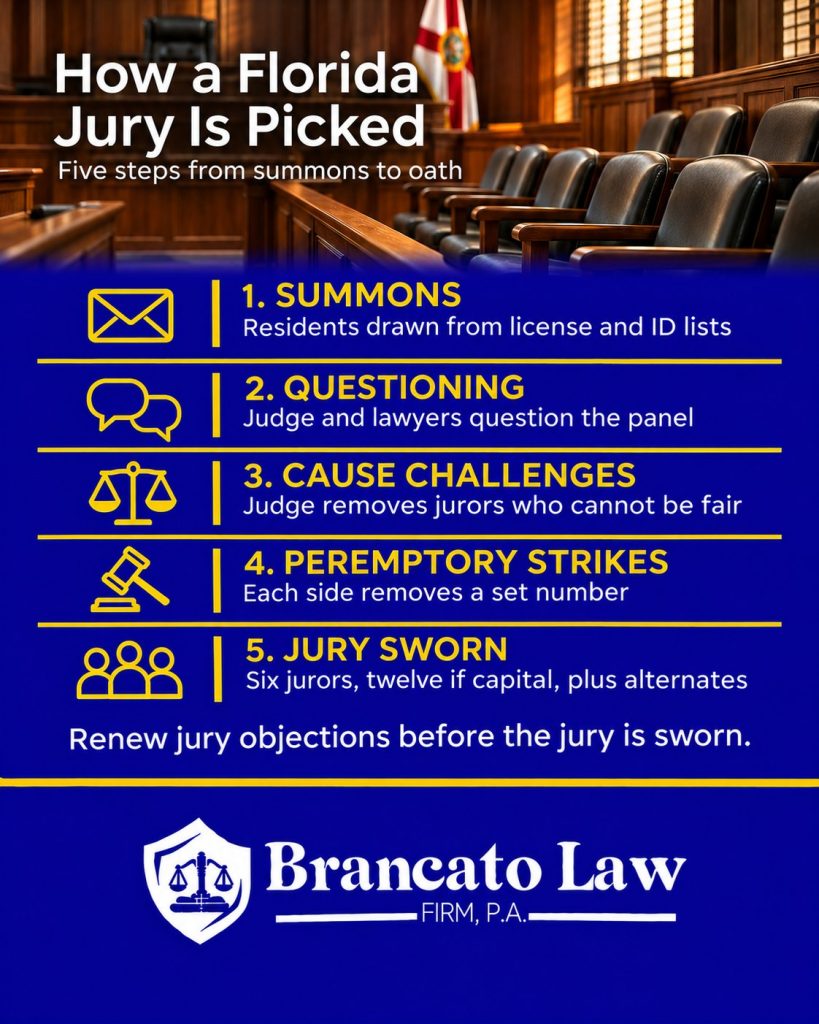
Jury selection in Florida follows the same basic sequence in every county, from a DUI misdemeanor to a capital murder case. The main differences are the size of the jury, the number of strikes, and how much time the judge allows. Here is the order of events:
- Summons. The Clerk mails jury summonses to residents drawn from the state’s driver license and ID card list.
- Jury assembly. Prospective jurors report to the courthouse, check in, and wait to be called to a courtroom.
- The panel (venire). A group of prospective jurors, usually far more than the number needed, is sent to the trial courtroom.
- Oath. The panel swears or affirms to answer questions truthfully.
- Questioning (voir dire). The judge asks general questions, then the prosecutor and the defense lawyer question the panel.
- Challenges for cause. Either side asks the judge to excuse jurors who cannot be fair. There is no limit on the number.
- Peremptory strikes. Each side removes a limited number of jurors without giving a reason, subject to the ban on discrimination.
- Swearing the jury. The remaining jurors and any alternates are sworn, and the trial begins.
Where do Florida jurors come from?
Florida jurors come from a list of county residents who hold a Florida driver license or state ID card. Under section 40.011, Florida Statutes, the Department of Highway Safety and Motor Vehicles delivers that list to each county’s Clerk of Court every quarter, and the Clerk generates juror candidate lists from it. Residents who are not on the list can volunteer by signing an affidavit at the Clerk’s office.
In Hillsborough County, the Clerk of Court’s jury services page explains that all potential jurors are contacted by U.S. mail and report to the Edgecomb Courthouse at 800 E. Twiggs Street in Tampa by 8 a.m. The volume is large. For Monday, November 16, 2026, the Clerk told jurors with numbers 1 through 1,400 to report and told numbers 1,401 through 2,700 they did not need to come in. The Clerk lists mandatory disqualifications, including a felony conviction without civil rights restored, a pending prosecution, and no longer living in the county, and allows people 70 or older to be excused on request.
Our office is two blocks from that courthouse. If you are a defendant with a trial date, our post on what to expect at the Hillsborough County Courthouse covers parking, security, and timing.
How many jurors and strikes does each Florida case get?
A Florida criminal jury has six members unless the case is capital, in which case it has twelve. That rule is in section 913.10, Florida Statutes. The number of peremptory strikes each side receives is set by section 913.08, Florida Statutes and depends on the maximum penalty.
| Type of case | Jurors | Peremptory strikes per side |
|---|---|---|
| Capital felony (death possible) | 12 | 10 |
| Felony punishable by life | 6 | 10 |
| Other felony (more than 12 months possible) | 6 | 6 |
| Misdemeanor and other offenses | 6 | 3 |
When two or more defendants are tried together, each defendant gets the full number of strikes, and the State gets as many as all of the defendants combined. In a capital penalty phase, section 921.141, Florida Statutes requires at least eight of twelve jurors to vote for death before the jury can recommend a death sentence, and any finding of an aggravating factor must be unanimous.
Florida’s six-person juries may change. The U.S. Supreme Court has agreed to decide whether a defendant charged with a serious felony has a right to twelve jurors. Our post on how many jurors a Florida criminal trial has tracks that case, Kian v. Florida, and explains how to preserve the issue now.
What is voir dire, and what do the lawyers ask?
Voir dire is the questioning of prospective jurors to uncover bias, experiences, and relationships that could affect how they view the case. Under Florida Rule of Criminal Procedure 3.300, both the prosecutor and the defense have the right to question jurors orally, and the judge may question jurors one at a time or as a group. Judges often set time limits, so lawyers have to prioritize.
Our attorneys focus on the topics that most often reveal a juror who cannot be fair:
- Ties to law enforcement, the State Attorney’s Office, or the courthouse, including family and close friends.
- Whether the juror, a relative, or a friend has been the victim of a similar crime.
- What the juror has read, watched, or posted about the case or the people involved.
- Whether the juror can hold the State to proof beyond a reasonable doubt and presume the defendant innocent.
- Whether the juror would hold it against the defendant for not testifying.
- Views on specific evidence in the case, such as forensic testing, eyewitness identification, or police body camera video.
Research shows why careful questioning matters. In a study of 31 criminal trials in Washington, D.C., published in the Journal of Criminal Justice in 1991, Seltzer, Venuti, and Lopes interviewed 190 jurors after trial. About 25% said they or a family member had been a crime victim, and almost 30% said they knew a police officer, even though they had not disclosed those facts when asked during voir dire. A 1987 study in Law and Human Behavior by S.E. Jones found that people changed their answers almost twice as much when a judge questioned them as when an attorney did, which supports a lawyer’s right to ask the questions directly.
What is a challenge for cause?
A challenge for cause is a request that the judge remove a juror for a legal reason, such as bias or a disqualifying relationship. Each side can make as many cause challenges as the facts support. Section 913.03, Florida Statutes lists the grounds, including that the juror is related within the third degree to the defendant, the victim, or “the attorneys of either party,” or has a state of mind that will prevent impartial service.
The standard favors removal when there is real doubt. In Busby v. State, 894 So. 2d 88 (Fla. 2005), a capital case in which a prospective juror gave equivocal answers about whether he could be impartial, the Florida Supreme Court held that a juror “must be excused for cause if any reasonable doubt exists” about the juror’s impartiality. The Court reversed the conviction and death sentence and ordered a new trial because the trial judge refused to excuse that juror.
Busby also shows how to preserve the issue. When a judge wrongly denies a cause challenge, the defense must use a peremptory strike on that juror, use up its remaining strikes, ask for more, and identify a specific objectionable juror who then sits on the jury. Our attorneys make that record every time, because an appellate court will not fix an error the trial lawyer did not preserve.
| Challenge for cause | Peremptory strike | |
|---|---|---|
| Number allowed | Unlimited | 10, 6, or 3 per side, depending on the charge |
| Reason required | Yes, a legal ground the judge must accept | No reason required unless the other side objects to discrimination |
| Who decides | The judge | The party using the strike, subject to the judge’s ruling on any objection |
| Common examples | Admitted bias, relationship to a party or lawyer, inability to follow the law | A juror whose answers or experiences suggest risk, even without legal cause |
What is a peremptory strike, and when is it illegal?
A peremptory strike lets a lawyer remove a juror without stating a reason. The one firm limit is discrimination. In Batson v. Kentucky, 476 U.S. 79 (1986), the U.S. Supreme Court held that the Equal Protection Clause forbids a prosecutor from striking potential jurors “solely on account of their race.” Florida applies the same principle to both sides.
Florida’s procedure comes from Melbourne v. State, 679 So. 2d 759 (Fla. 1996). The objecting party makes a timely objection, shows the juror is a member of a distinct racial group, and asks the court to require a reason for the strike. The striking party must then give a neutral explanation. The judge decides whether that explanation is genuine or a pretext; the reason does not have to be wise, but it has to be real. Under Joiner v. State, 618 So. 2d 174 (Fla. 1993), the objecting lawyer must renew the objection, or accept the jury subject to it, before the jury is sworn, or the issue is waived.
Who sits on the jury can change the result. A study of more than 700 non-capital felony trials in Sarasota and Lake Counties, Florida, from 2000 to 2010, published in the Quarterly Journal of Economics in 2012 by Anwar, Bayer, and Hjalmarsson, found that juries drawn from all-white pools convicted Black defendants 81% of the time and white defendants 66% of the time. When the pool included at least one Black member, the rates were nearly equal, 71% and 73%. About 40% of the jury pools in the study had no Black members at all.
What happens when a juror hides something during jury selection?
When a juror fails to disclose material information during questioning, the defense can ask for a new trial. Florida courts apply the three-part test from De La Rosa v. Zequeira, 659 So. 2d 239 (Fla. 1995): the information was relevant and material to jury service, the juror concealed it during questioning, and the defense’s failure to learn it was not caused by a lack of diligence.
The concealment does not have to be intentional. In Feagin v. State, No. 2D18-3002 (Fla. 2d DCA Nov. 25, 2020), a Hendry County armed robbery case, an alternate juror who had not mentioned during voir dire that he was a good friend of one of the victims revealed it in a note during trial and was later seated on the jury. The Second District Court of Appeal reversed the jury-tried convictions and ordered a new trial, explaining that a “willful falsehood” is “not essential” when a juror gives false information that the parties rely on.
A recent Hillsborough County example
A recent case involving a Hillsborough County assistant state attorney shows how quickly this issue can surface. According to the Tampa Bay Times report of November 13, 2026, a colleague texted the trial prosecutor on the morning jury selection began in a September 2026 sexual battery trial that her sister was on the panel. The sister never disclosed the connection, was seated, and became the foreperson of the six-person jury, which returned a guilty verdict. The trial prosecutor disclosed the relationship to the defense several days after the verdict.
The Public Defender’s Office moved for a new trial. The State conceded that a new trial was warranted under “the totality of the circumstances,” while denying misconduct, and the circuit judge ordered a new trial without making a finding of misconduct. The prosecutor resigned. Our post on what prosecutorial misconduct is in Florida explains the prosecutor’s disclosure duties in more detail.
Speed matters in these cases. A motion to interview jurors must be filed within 10 days of the verdict under Florida Rule of Criminal Procedure 3.575. A concealment claim raised years later in a postconviction motion faces a harder test: under Martin v. State, 322 So. 3d 25 (Fla. 2021), the defendant must prove the juror was dishonest and actually biased.
How is jury selection different in high-profile cases?
High-profile cases call for more time, more prospective jurors, and more tools to uncover what jurors already believe. The judge controls these tools, so the defense has to ask for them and justify the request. The most common are:
- Written juror questionnaires. Florida’s rules do not require them, but a judge can approve a questionnaire that jurors fill out before questioning. Questionnaires surface sensitive information, such as prior victimization, that some jurors will not volunteer in front of a room of strangers. The 1991 Seltzer study recommended questionnaires for exactly that reason.
- Individual questioning. Rule 3.300 lets the judge question jurors one at a time. Our attorneys ask for individual questioning on pretrial publicity, so one juror’s comment about a news story does not spread to the whole panel.
- Larger panels and more days. In Pinellas County’s 2019 Jonchuck murder trial, a nationally covered case, WFLA reported that 67 prospective jurors went through questioning over four days, 48 remained after excusals, and the court seated 12 jurors and 4 alternates, with 10 strikes for each side.
- Change of venue. When publicity makes a fair jury unlikely, the defense can ask to move the trial. In State v. Huggins, 788 So. 2d 238 (Fla. 2001), an Orange County murder case was transferred to Duval County for trial.
- Death qualification. In capital cases, jurors are questioned about their views on the death penalty. Under section 913.03, Florida Statutes, a juror whose beliefs would prevent a guilty verdict can be removed for cause.
Our Tampa homicide attorney page explains how our firm prepares murder and capital cases, where these tools matter most.
Can you hire a jury consultant in a Florida criminal case?
Yes. Nothing in Florida law prevents the defense from hiring a jury consultant, and in serious cases a consultant can add useful research. Consultants typically run mock trials or focus groups to test themes, help draft questionnaires, review jurors’ public social media, and watch jurors’ reactions in court. Lawyers and consultants may look at what jurors post publicly but may not contact or “friend” a juror.
The research on scientific jury selection is mixed. A 2011 review in Current Directions in Psychological Science by Joel Lieberman of the University of Nevada, Las Vegas concluded that the technique may have some value but that “methodological flaws associated with existing research prevent clear conclusions from being drawn.” In our experience, a consultant supplements an experienced trial lawyer’s judgment and does not replace it. In serious felony and capital cases, our attorneys weigh whether a consultant, a mock jury, or a questionnaire is worth the cost for the specific facts.
How often do Florida criminal cases go to a jury?
Few Florida criminal cases reach a jury. In fiscal year 2024-25, only 2,069 of the 155,206 felony cases resolved in Florida circuit courts, about 1.3%, were decided after a jury trial, according to the Florida Office of the State Courts Administrator’s Statistical Reference Guide (pages 20 to 22). In Hillsborough County’s Thirteenth Judicial Circuit, 108 of 10,862 felony dispositions, about 1.0%, came after a jury trial.
Juries do say no. Statewide in fiscal year 2024-25, 514 of the 2,069 felony jury trials, about 24.8%, ended in an acquittal or dismissal. In the Thirteenth Circuit, 26 of the 108 felony jury trials, about 24.1%, ended the same way. Those numbers help explain why a prosecutor’s offer often improves when the defense is ready to pick a jury.
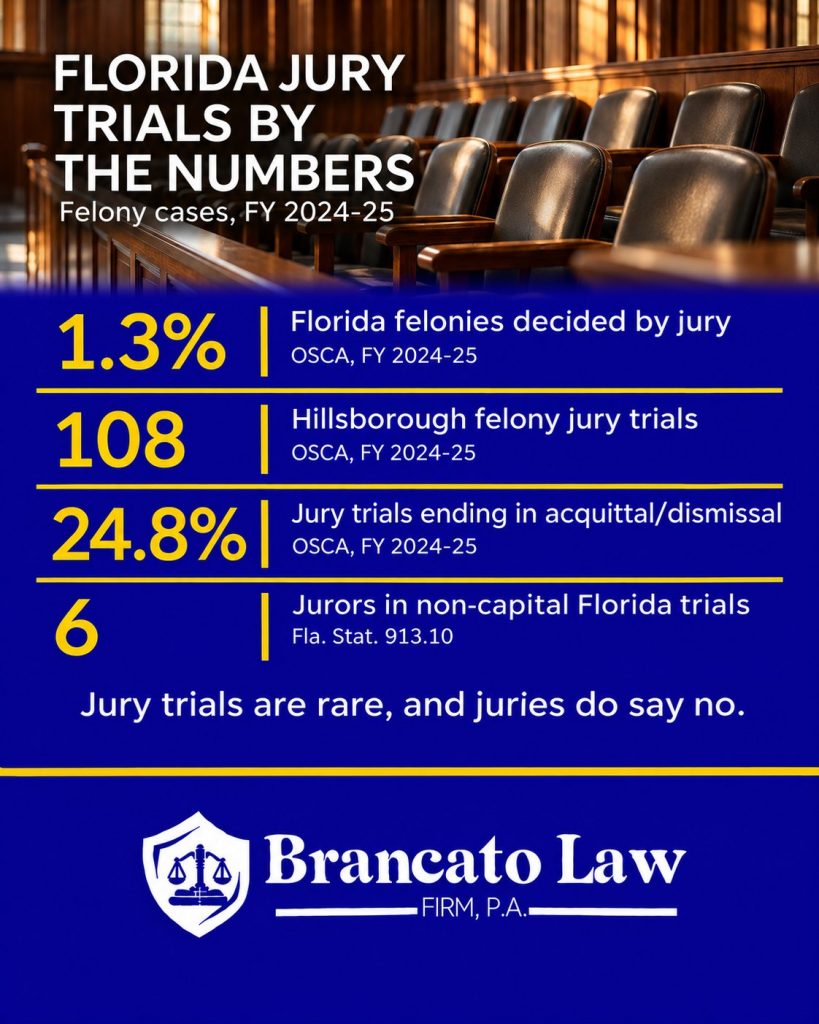
| Measure (felony cases, FY 2024-25) | Florida statewide | Thirteenth Circuit (Hillsborough) |
|---|---|---|
| Total felony dispositions | 155,206 | 10,862 |
| Decided after a jury trial | 2,069 (about 1.3%) | 108 (about 1.0%) |
| Jury trials ending in acquittal or dismissal | 514 (about 24.8%) | 26 (about 24.1%) |
How can you help your lawyer during jury selection?
You can help most by staying calm, paying attention, and telling your lawyer right away if you recognize anyone on the panel. Jurors watch the defendant from the first minute, in the courtroom and in the hallways. Our attorneys prepare every client with these points before jury selection begins:
- Dress as you would for an important job interview, and arrive early.
- Do not react to answers, roll your eyes, or talk to anyone near jurors in the hallway, elevator, or parking garage.
- Write down your impressions of jurors and share them with your lawyer at breaks.
- Tell your lawyer immediately if you know a juror, or know someone a juror mentions.
- Stay off social media about your case for the entire trial.
Our post on jury selection in a polarized world discusses how personal experience and politics shape what jurors see, and how our attorneys question around it.
Frequently asked questions about jury selection in Florida
How long does jury selection take in a Florida criminal trial?
Jury selection in a typical Florida misdemeanor or non-capital felony trial usually takes a few hours to one day, while high-profile and capital cases can take several days or weeks. The Brancato Law Firm asks the judge for enough time and for individual questioning when the facts of a case or its publicity call for it.
Can the defendant help pick the jury?
Yes. The defendant sits at counsel table during jury selection, can share impressions with the lawyer, and must be present under Florida’s rules. Our attorneys at The Brancato Law Firm talk through every strike decision with the client before using it.
What happens if a juror lies during voir dire in Florida?
If a juror conceals material information and the defense raises it promptly, the court can order a new trial under the test in De La Rosa v. Zequeira, 659 So. 2d 239 (Fla. 1995), even if the concealment was not intentional. The Brancato Law Firm files the motion for new trial and any motion to interview jurors within the 10-day deadlines that follow a verdict.
Can a prosecutor strike jurors because of race in Florida?
No. Striking a juror because of race violates equal protection under Batson v. Kentucky, 476 U.S. 79 (1986), and Florida requires the striking party to give a genuine, neutral reason when the other side objects. Our attorneys at The Brancato Law Firm make and renew those objections before the jury is sworn so the issue is preserved for appeal.
Are jury questionnaires allowed in Florida criminal cases?
Yes, if the trial judge approves them; Florida’s rules neither require nor forbid written questionnaires. The Brancato Law Firm asks for questionnaires in cases with heavy publicity or sensitive subject matter, such as murder and sex crime cases, and our Hillsborough County criminal defense attorneys draft them for the specific facts.
Do I get a twelve-person jury in a Florida felony case?
Not unless the case is capital; Florida law provides six jurors for all other criminal cases under section 913.10, Florida Statutes. The Brancato Law Firm preserves a twelve-person jury objection in serious felony trials while Kian v. Florida is pending in the U.S. Supreme Court.
Talk to a Tampa trial attorney before your jury is picked
Jury selection starts long before the trial date, with the questions you research, the motions you file, and the record you build. Our attorneys at The Brancato Law Firm, P.A., founded by Tampa Criminal Defense Attorney Rocky Brancato, prepare every case as if it will be tried, and we can review yours as soon as you call (813) 727-7159. You can call us at any hour. Our firm has Spanish-speaking staff, and attorney Jean-Luc Adrien speaks Spanish, Haitian Creole, and French. For more about our defense strategies, visit our Homicide page.
The Brancato Law Firm, P.A.
620 E. Twiggs Street, Suite 205, Tampa, FL 33602
(813) 727-7159
Serving Hillsborough, Pinellas, and Pasco Counties
The Brancato Law Firm, P.A. is a Tampa-based criminal defense practice. We are not affiliated with any other Brancato-named law firms.
Visit Us

Tampa, FL 33602

Contact Us Now
Free Legal Consultation (813) 727-7159
