

From First DUI to Death Penalty



How Do You Challenge an Eyewitness Identification in Florida? (2026)


To challenge an eyewitness identification in Florida, the defense attacks it in two places. Before trial, a motion to suppress asks the judge to exclude an out-of-court identification if police used an unnecessarily suggestive procedure that created a substantial likelihood of misidentification. At trial, the defense uses cross-examination, Florida’s lineup statute (section 92.70), the standard eyewitness jury instruction 3.9(c), and in some cases an expert witness to show the jury why the identification may be wrong. Police who skip any lineup requirement in section 92.70 hand the defense evidence it can use at both stages.
By the time an eyewitness points across a courtroom at the defense table, the witness has usually seen the accused’s face several times: in a photo array, maybe at a deposition, and every day of trial. Each viewing makes the witness more certain, whether or not the first identification was right. I am Rocky Brancato, founder of The Brancato Law Firm, P.A., a Tampa criminal defense firm, and I learned how much rides on that first identification in the Major Crimes Unit and over more than 150 jury trials to verdict. As a former Chief Operations Officer of the Hillsborough County Public Defender’s Office, where I oversaw a staff of over 100 attorneys, I have spent more than 25 years in Hillsborough County courtrooms watching identification cases rise or fall on details nobody wrote down. Our attorneys start every identification case by rebuilding the first viewing: who ran the lineup, what the witness was told, and what the witness said in his or her own words before anyone confirmed the pick.
How often do eyewitnesses get it wrong?
Mistaken identification is one of the most common factors in proven wrongful convictions, in Florida and nationwide. In 2017, the Florida Senate Criminal Justice Committee reported that eyewitness misidentification contributed to 64 percent of the Florida cases in which DNA later exonerated the defendant, nine of the 14 DNA exonerations in the state, and that more than 70 percent of 349 DNA exonerations nationwide involved a mistaken identification (Florida Senate bill analysis of CS/SB 312, February 22, 2017). The problem has not gone away since Florida passed its lineup law. The National Registry of Exonerations reported that 38 of the 147 exonerations it recorded for 2024, or 26 percent, rested at least in part on a mistaken witness identification (National Registry of Exonerations, 2024 Annual Report).
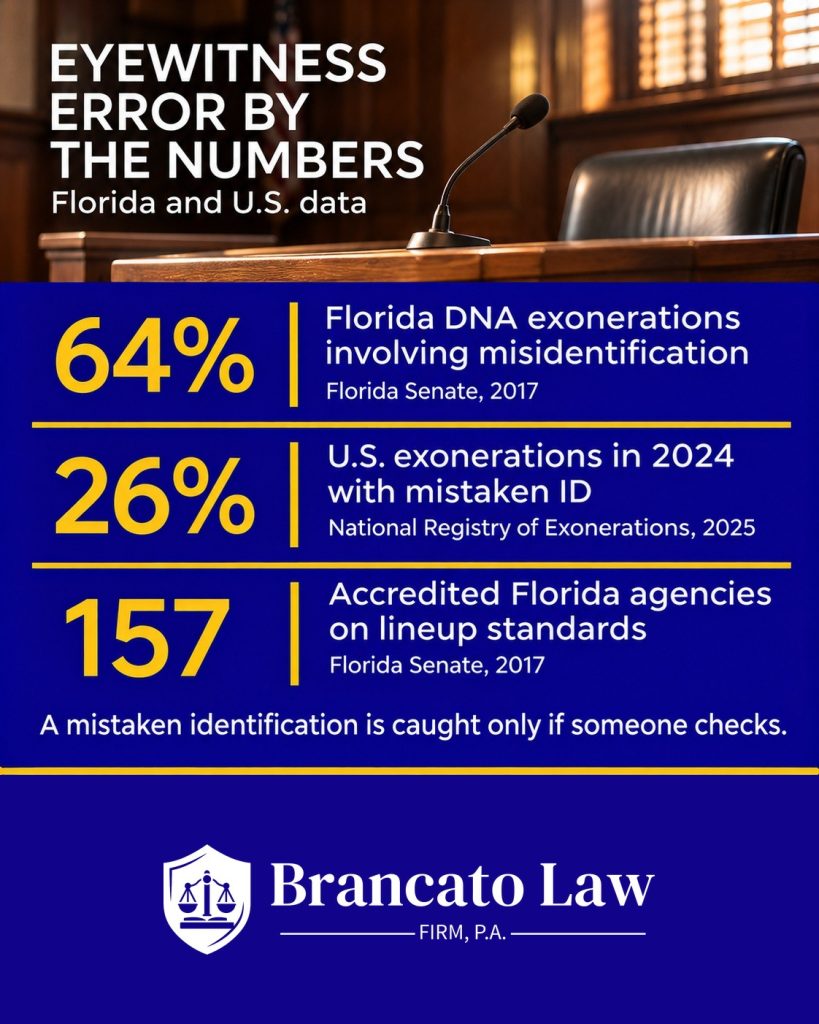
Those numbers come from cases where DNA or other proof later showed the witness was wrong. Most robbery, burglary, and battery cases have no DNA at all, so a mistaken identification there is caught only if the defense catches it. That is why our firm treats the identification itself as evidence to investigate, the same way we would treat a lab report.
What does Florida’s eyewitness identification law require police to do?
Florida’s eyewitness identification statute, section 92.70, Florida Statutes, sets rules for every photo lineup and live lineup a Florida law enforcement agency conducts. The law took effect October 1, 2017. It requires an independent administrator, meaning a person who did not take part in the investigation and does not know which person in the lineup is the suspect. For photo lineups, an agency may instead use an alternative method that keeps the administrator from knowing which photo the witness is viewing, such as a computer program or shuffled, numbered folders. Before the statute, Florida relied on voluntary lineup standards that FDLE and the state’s sheriffs, police chiefs, and prosecutors adopted in 2011; the same 2017 Senate analysis reported that 157 accredited law enforcement agencies maintained compliance with those standards, and the statute made the core rules mandatory for every agency.
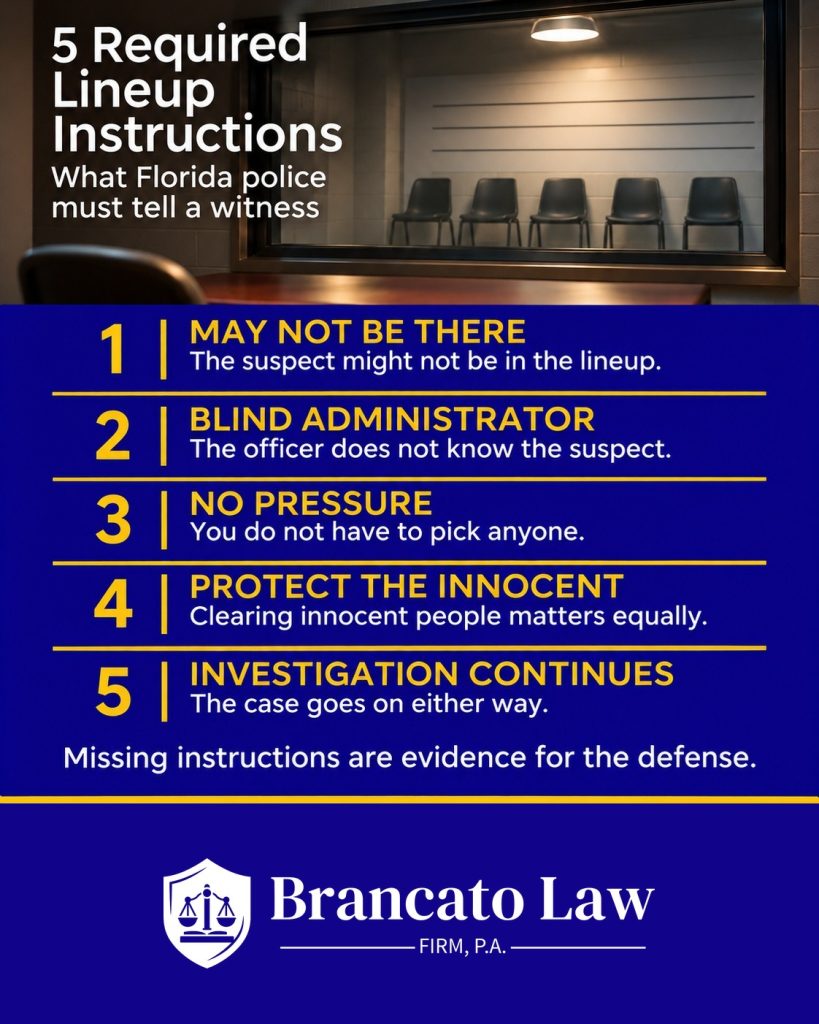
Before any lineup, section 92.70 requires police to give the eyewitness five instructions, and the witness must acknowledge them in writing (or the administrator must document the refusal and sign the form):
- The perpetrator might or might not be in the lineup.
- The administrator does not know the suspect’s identity (not required when an approved alternative method is used).
- The eyewitness should not feel compelled to make an identification.
- It is as important to exclude innocent persons as it is to identify the perpetrator.
- The investigation will continue with or without an identification.
The statute also has teeth. A failure to follow any of its requirements must be considered by the judge on a motion to suppress, it is admissible at trial to support a misidentification defense, and when compliance or noncompliance comes up at trial, the jury must be told it may consider that evidence in judging the identification’s reliability. The table below lists what our attorneys check for each requirement.
| Requirement | What we check in discovery | Why it matters |
|---|---|---|
| Independent administrator (or approved blind method) | Who ran the lineup, and whether that person worked the case or knew the suspect | A detective who knows the suspect can cue the witness without meaning to |
| Five pre-lineup instructions | The instruction form, the recording, and the witness’s deposition testimony | Without them, witnesses tend to assume the suspect is in the lineup and pick someone |
| Written acknowledgment | The signed form or the administrator’s documented refusal | A missing form is direct proof of noncompliance |
| Neutral photo or live lineup | Whether the client stands out in age, build, hair, clothing, or photo background | A suspect who stands out is a suggestive lineup under Florida case law |
Section 92.70 has a gap that matters in practice. It does not require police to record how confident the witness was at the moment of the first identification. The National Research Council’s 2014 report Identifying the Culprit: Assessing Eyewitness Identification recommends that police document the witness’s confidence, in the witness’s own words, at the time of the first identification, and it found that confidence expressed at trial is not a reliable predictor of accuracy. When a witness hesitated at the lineup and is certain on the stand, the gap between those two moments is often the best cross-examination in the case.
When will a Florida judge suppress an eyewitness identification?
A Florida judge suppresses an out-of-court identification when the defense shows two things: police used an unnecessarily suggestive procedure, and that procedure created a substantial likelihood of irreparable misidentification. The Florida Supreme Court set out that test in Grant v. State, 390 So. 2d 341 (Fla. 1980), a case in which the court upheld a witness’s lineup identification because it found nothing suggestive in how police obtained it. For the second step, Florida courts weigh five reliability factors from the U.S. Supreme Court’s decision in Neil v. Biggers, 409 U.S. 188 (1972). The table below shows both steps and what the defense brings to each.
| Step | Question the judge asks | What the defense shows |
|---|---|---|
| 1. Suggestiveness | Did police use an unnecessarily suggestive procedure? | Officer comments, a lineup where the client stands out, repeated showings, a non-blind administrator |
| 2. Reliability | Opportunity to view the offender at the time of the crime | Distance, lighting, seconds of viewing, a weapon drawing the witness’s eyes |
| Witness’s degree of attention | Stress, chaos, the witness doing something else | |
| Accuracy of the prior description | The 911 call and first report compared to the client | |
| Level of certainty at the confrontation | Hesitation, “I think,” a pick made only after prompting | |
| Time between the crime and the identification | Days or weeks that let memory fade or be filled in |
Two Florida cases show what a winning record looks like. In Walton v. State, 208 So. 3d 60 (Fla. 2016), a Jacksonville detective showing photo arrays kept drawing the witness back to one photo after she said she was not sure she recognized anyone. The Florida Supreme Court held the procedure impermissibly suggestive, found the witness “did not display a high level of certainty,” reversed the convictions, and ordered a new trial without her identification. In Willis v. State, 242 So. 3d 1195 (Fla. 1st DCA 2018), an officer read the standard instructions to a store employee and then added, “this was the getaway driver, I think,” before a showup. The witness hesitated and said yes only after the officer asked “yes or no?” The First District held the identification should have been suppressed and ordered the convictions vacated.
Is a showup identification legal in Florida?
A showup, where police bring a witness to look at one detained person, is legal in Florida, but courts call it inherently suggestive because the witness sees only one suspect. In Alahad v. State, 362 So. 3d 190 (Fla. 2023), the Florida Supreme Court reviewed a Broward County murder case in which the eyewitness identified the defendant at a showup about three hours after the shooting. The court held that a showup becomes unnecessarily suggestive only when police aggravate its suggestiveness, and that handcuffs, flanking officers, or a general statement that the suspect matches the description do not do that on their own. A specific statement, like the “getaway driver” comment in Willis, can.
Alahad changed something else that shapes our strategy. The court held that appellate courts review a trial judge’s ruling on an identification suppression motion for abuse of discretion, a deferential standard. In plain terms, the suppression hearing in the trial court is where the identification issue is usually won or lost. Our attorneys prepare that hearing like a trial: the body camera and in-car video, the radio traffic, the timeline, the first description, and the officer’s exact words to the witness.
Can a witness still identify you in court if the lineup is thrown out?
Yes, if the State proves the witness’s in-court identification rests on an independent memory of the crime that was not influenced by the flawed procedure. The Second District, which hears appeals from Hillsborough, Pinellas, and Pasco Counties, applied that rule in Walker v. State, 354 So. 3d 626 (Fla. 2d DCA 2023), a Hillsborough County probation case. The shooting victim testified that he knew the defendant, had seen him several times before, and was “100% sure” who shot him, so the court held that even if the out-of-court identification should have been excluded, it would not have stopped the in-court identification.
Walker shows where suppression helps most: cases involving strangers. When the witness knew the accused before the crime, the defense usually shifts from suppression to motive, bias, and opportunity to observe. When the witness saw a stranger for a few seconds, the first identification is often the only memory the witness has, and suppressing it can leave the State with no reliable identification at all. The doctrine also survives a lost motion. If the judge denies suppression, every fact developed at the hearing is still available to show the jury why the identification is weak.
How do defense attorneys challenge an eyewitness at trial?
At trial, the defense challenges an eyewitness with cross-examination, section 92.70 evidence, the standard jury instruction on eyewitness identification, and sometimes an expert. These are the five steps our attorneys use in a typical identification trial:
- Lock in the first description. The 911 call, the first officer’s report, and the witness’s first statement are compared item by item with the client’s height, build, age, hair, tattoos, and clothing.
- Reconstruct the viewing conditions. We visit the scene at the same time of day when lighting matters and measure distances, because “across the parking lot” means something different once it is 90 feet.
- Prove each lineup failure. Missing instructions, a non-blind administrator, or an unsigned acknowledgment form goes in front of the jury under section 92.70(4).
- Request instruction 3.9(c). Florida’s standard jury instruction on eyewitness identification is given when identification is disputed and the defense asks for it.
- Build the other evidence. Alibi witnesses, phone location data, surveillance video, and fingerprints or DNA that point to someone else give the jury a reason to doubt beyond the witness’s memory.
Instruction 3.9(c), as amended in In re Standard Jury Instructions in Criminal Cases, Report 2018-07, 259 So. 3d 743 (Fla. 2018), tells jurors they may consider nine factors, including the witness’s opportunity to observe based on time, lighting, and distance; whether the identification came from the witness’s own memory or from influence or suggestiveness; any inconsistent identifications or failures to identify; the time between the event and the identification; and whether the witness and the offender are of different races or ethnic groups. When a lineup is involved, the instruction also explains the section 92.70 requirements and tells jurors they “may consider compliance or noncompliance” in judging reliability. Alibi cases are usually eyewitness cases too, which our post on the alibi defense in Florida explains.
Can you use an eyewitness identification expert in Florida?
Yes, a Florida judge may allow expert testimony on the science of eyewitness memory, but the decision is left to the judge’s discretion. In McMullen v. State, 714 So. 2d 368 (Fla. 1998), a shooting case where two witnesses identified the defendant and he presented an alibi, the Florida Supreme Court held that “the admissibility of expert testimony regarding the reliability of eyewitness testimony is left to the sound discretion of the trial judge” and found no abuse of discretion in excluding the defense expert. Today the expert must also meet section 90.702, Florida Statutes: specialized knowledge that will help the jury, based on sufficient facts or data and reliable methods reliably applied.
An eyewitness expert explains research the average juror does not know, such as how stress and a visible weapon narrow attention, how cross-racial identifications are less accurate, and how feedback after a lineup inflates a witness’s confidence. The National Research Council recommends that these experts explain the general research and stop short of saying whether a particular witness is right. Our firm works with qualified experts in memory and perception through our Tampa criminal forensic science attorney practice and decides case by case whether an expert or a focused cross-examination will land better with the jury.
What should you do if you were picked from a photo lineup but not yet charged?
If a detective tells you a witness picked your photo, do not explain, offer an alibi, or agree to a live lineup without a lawyer. An identification is often the moment a robbery or battery investigation turns toward one person, and anything you say can fill gaps the identification leaves open. The weeks before the State Attorney’s Office makes a filing decision are when representation before charges are filed can change the outcome.
Nearly every month, cases our firm handles never get filed because of our front-end advocacy with prosecutors. In an identification case, that advocacy may mean showing the prosecutor the lineup flaws, the mismatch with the first description, or alibi proof before a charging decision is made. Our attorneys decide case by case what, if anything, to provide to detectives, because some evidence is stronger when it first appears in front of a judge. Every stage of the process, from investigation through trial, is mapped in our guide to the Florida criminal case process.
Identification disputes come up most often in robbery and violent crime cases, including armed robbery and home invasion robbery, and our Tampa violent crime lawyer page covers how we defend those charges. Police in some cases now use software instead of witnesses, which our post on facial recognition arrests in Florida covers.
Frequently asked questions about eyewitness identification in Florida
Can charges be dropped in Florida if the only evidence is one eyewitness?
Yes. A prosecutor can drop or decline to file a case built on one eyewitness when the identification is weak, suppressed, or contradicted by other evidence. The Brancato Law Firm presents those weaknesses to the State Attorney’s Office early, before trial preparation hardens the State’s position, through our pre-file advocacy and later through suppression motions.
What happens if Florida police did not give the lineup instructions?
The identification is not automatically thrown out, but the failure must be considered by the judge on a motion to suppress and can be shown to the jury under section 92.70. Our attorneys at The Brancato Law Firm request the instruction form, the acknowledgment, and any recording of the lineup in discovery so the failure is documented before the hearing.
Does a confident eyewitness mean the identification is accurate?
No. Research summarized by the National Research Council found that confidence expressed at trial is not a reliable predictor of accuracy, because confidence grows with repeated viewings and feedback. The Brancato Law Firm compares the witness’s words at the first identification with the witness’s certainty on the stand, as the Florida Supreme Court did in Walton.
Does Florida’s lineup law apply to showups and in-court identifications?
Section 92.70 defines a lineup as a photo lineup or a live lineup and does not set separate rules for showups, so showups are judged under the two-step suggestiveness test from Grant and Alahad. Our attorneys at The Brancato Law Firm challenge showups through the officer’s words, the video, and the witness’s first description, and we ask the court to address any in-court identification before the witness takes the stand.
Who pays for an eyewitness identification expert in a Florida criminal case?
In a privately retained case, the client pays the expert’s fee as a case cost, separate from the attorney fee. The Brancato Law Firm discusses whether an expert is worth the cost at the start of the case, and our forensic science defense page explains how we use experts.
How long after a robbery can police show a witness a lineup?
Florida law sets no deadline, but the time between the crime and the identification is one of the reliability factors courts and juries weigh. When weeks pass before a lineup, The Brancato Law Firm uses that delay, along with anything the witness saw on social media or the news in between, to show how the memory may have changed.
Talk to a Tampa defense attorney about an eyewitness identification
For more about our defense strategies, visit our forensic science defense practice page.
Ask for the lineup paperwork before anything else, because recordings and forms are easier to get early and the suppression hearing is where most identification cases turn. Call The Brancato Law Firm, P.A., founded by Tampa Criminal Defense Attorney Rocky Brancato, at (813) 727-7159, and our attorneys will start by requesting the lineup records, the body camera video, and the first description the witness gave. You can call us at any hour, and our office is two blocks from the courthouse. Our firm has Spanish-speaking staff, and attorney Jean-Luc Adrien speaks Spanish, Haitian Creole, and French.
The Brancato Law Firm, P.A.
620 E. Twiggs Street, Suite 205, Tampa, FL 33602
(813) 727-7159
Serving Hillsborough, Pinellas, and Pasco Counties
The Brancato Law Firm, P.A. is a Tampa-based criminal defense practice. We are not affiliated with any other Brancato-named law firms.
Visit Us

Tampa, FL 33602

Contact Us Now
Free Legal Consultation (813) 727-7159
