

From First DUI to Death Penalty



How to Fight a Tracking Device Charge in Florida (2026)


To fight a tracking device or AirTag charge in Florida, the defense tests each element the State must prove under section 934.425: that the item was a tracking device or tracking application, that the accused knowingly installed, placed, or used it, that it tracked another person or another person’s property, and that the person had not consented. Since October 1, 2024, the offense is a third-degree felony punishable by up to 5 years in prison, and since October 1, 2025, it is a second-degree felony punishable by up to 15 years when used to commit or facilitate a dangerous crime such as stalking or domestic violence. Consent, the statute’s exemptions, and proof of who actually placed the device are the most common defenses.
If police have told you an AirTag or a tracking app was found on someone’s car or phone and your name is attached to it, you are facing a felony that did not exist in this form three years ago. Florida made unauthorized tracking a third-degree felony in 2024 and added a second-degree felony version in 2025. I’m Rocky Brancato, founder of The Brancato Law Firm, P.A., a Tampa criminal defense firm, and a former Chief Operations Officer of the Hillsborough County Public Defender’s Office, where I oversaw a staff of over 100 attorneys. I have spent more than 25 years in Hillsborough County courtrooms. Many tracking accusations involve people who once shared a home, a car, or a phone plan, so our attorneys start by reconstructing who bought the device, who registered it, and what the people involved had agreed to.
What does Florida’s tracking device law prohibit?
Florida’s tracking device law makes it a crime to knowingly install or place a tracking device or tracking application on another person’s property without consent, or to use one to determine the location or movement of another person or another person’s property without consent. The statute is section 934.425, Florida Statutes. It covers Bluetooth item finders such as AirTags and Tiles, GPS units hidden on cars, and location-tracking software installed on phones.
The statute defines the key terms narrowly, and those definitions are where many defenses begin:
- A “tracking device” is any device “whose primary purpose is to reveal its location or movement by the transmission of electronic signals.”
- A “tracking application” is any software program “whose primary purpose is to track or identify the location or movement of an individual.”
- A “person” is an individual, not a business entity.
The words “primary purpose” matter. A dedicated GPS tracker or an AirTag fits the definition easily. A phone’s built-in map application, a fitness app, or a car’s factory navigation system was designed for something else, and our attorneys examine whether the software at issue truly had tracking as its primary purpose before conceding that element.
What are the penalties for an illegal tracking device in Florida?
Unauthorized tracking is a third-degree felony in Florida, punishable by up to 5 years in prison under section 775.082. It becomes a second-degree felony, punishable by up to 15 years, when the person tracks someone “to commit a dangerous crime or to facilitate the commission of a dangerous crime” as defined in section 907.041(5)(a). That list includes stalking and aggravated stalking, any act of domestic violence, kidnapping, burglary of a dwelling, and home invasion robbery.
The penalties have climbed fast. The law was created in 2015 as a second-degree misdemeanor. Chapter 2024-114, Laws of Florida made it a third-degree felony and added the “use” prohibition, effective October 1, 2024. Chapter 2025-71, Laws of Florida added the second-degree felony for tracking connected to a dangerous crime, effective October 1, 2025. The date of the alleged tracking decides which version applies, so our attorneys pin down exactly when a device was placed and when it was last used.
| Date of alleged offense | Charge level | Maximum prison term |
|---|---|---|
| Before October 1, 2024 | Second-degree misdemeanor (installation only) | 60 days in jail |
| October 1, 2024 and later | Third-degree felony (installation, placement, or use) | 5 years |
| October 1, 2025 and later, when tied to a dangerous crime | Second-degree felony | 15 years |
A tracking charge rarely travels alone. Prosecutors often file it next to stalking charges or a charge for violating an injunction, and a petitioner may use the same evidence to seek an injunction for protection in civil court. Our Tampa domestic violence defense attorney team defends the criminal case and the injunction hearing together, so a statement made in one does not damage the other.
How common is location tracking in stalking cases?
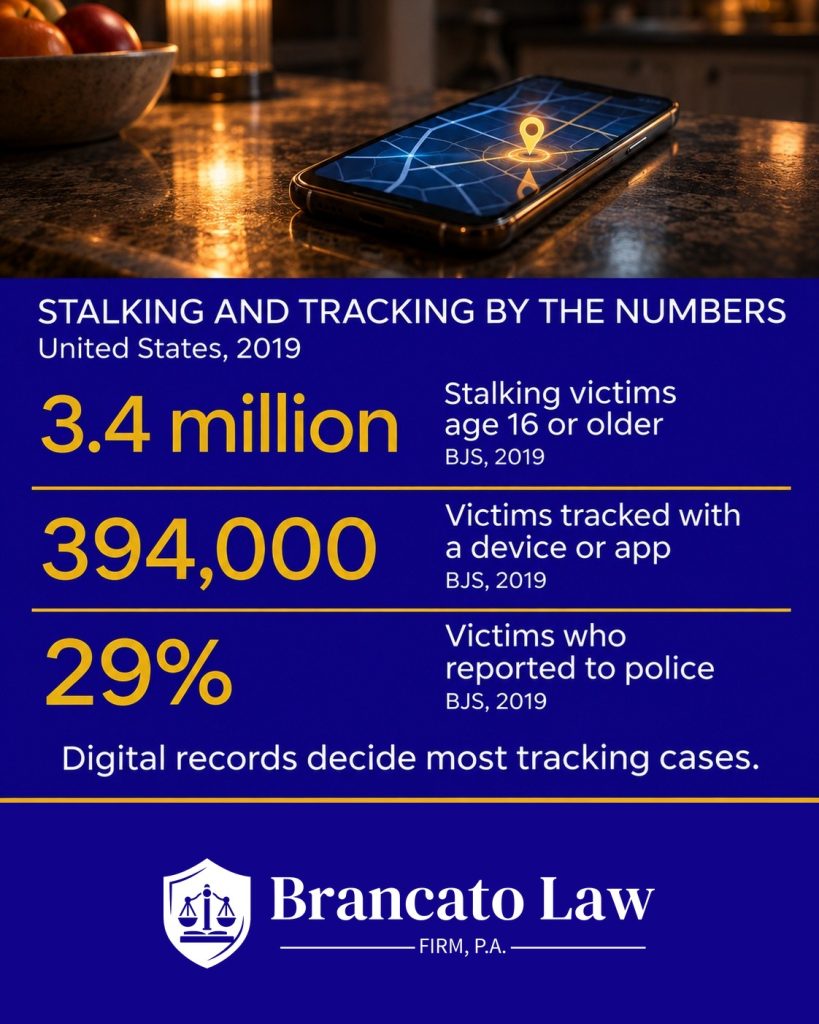
Electronic tracking is a measurable part of stalking nationwide. In 2019, about 3.4 million people age 16 or older were victims of stalking in the United States, and an estimated 394,000 of them had their whereabouts tracked with an electronic device or application, according to the Bureau of Justice Statistics report Stalking Victimization, 2019. The same report found that 29% of stalking victims reported the stalking to police in 2019.
Those figures predate the 2021 release of Apple’s AirTag, a limit the Congressional Research Service flagged in its 2022 report Stalking Concerns Raised by Bluetooth Tracking Technologies: In Brief. That report, by analysts Emily J. Hanson and Kristin Finklea, explains that AirTags separated from their owner’s device play a sound and that iPhone users with Find My enabled can receive alerts, while warning that these protections reach only some potential victims. An alert like that can be how the person being tracked first finds the device and calls the police.
What are the defenses to a tracking device charge in Florida?
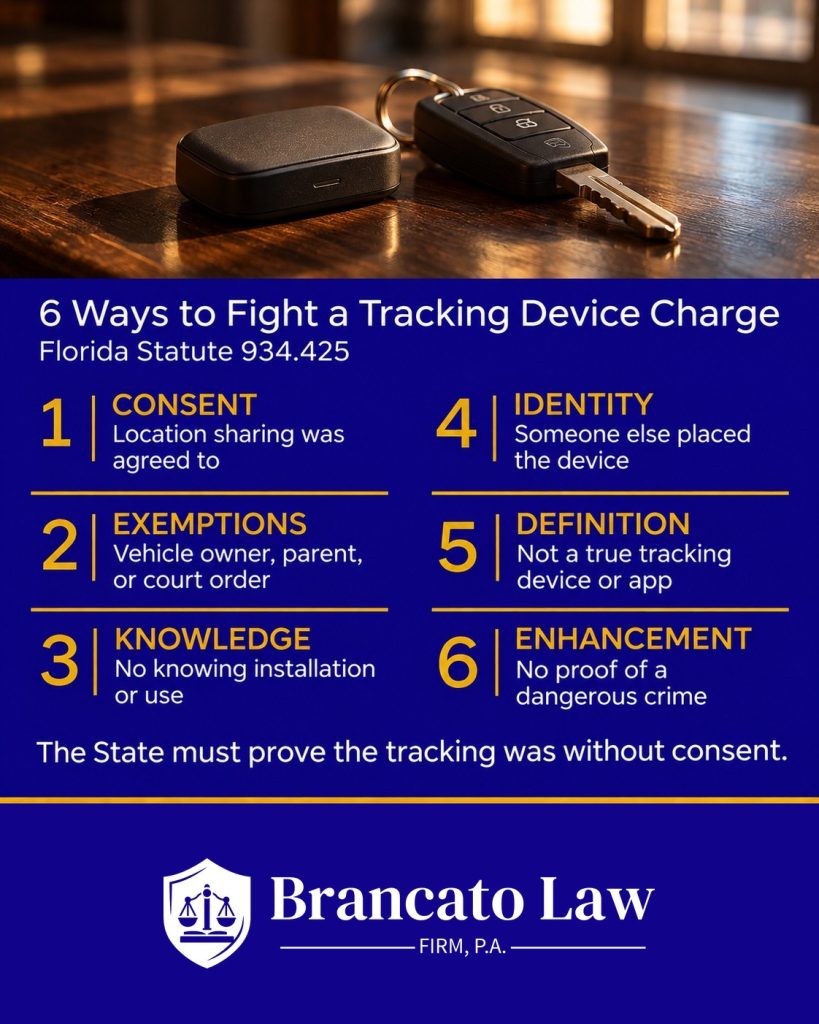
The strongest defenses come from the statute’s own elements and exemptions. Our attorneys build the defense around these questions:
- Consent. Did the other person agree to location sharing, for example through a family sharing plan, a shared app, or a device both people used? The State must prove the tracking happened without consent.
- Revoked consent. Section 934.425(3) presumes consent is revoked when a spouse files for divorce or either person files for an injunction for protection. Outside those two events, whether consent continued is a question of fact, and the earlier agreement is evidence for the defense.
- Statutory exemptions. The law does not apply to a vehicle’s owner or lessee tracking that vehicle (with conditions when it is sold or the lease ends), a parent of a minor child under the custody and consent rules in the statute, a caregiver acting on a physician’s certification, a business acting in good faith for a legitimate purpose, or anyone acting under a court order.
- Knowledge. The State must prove the accused knowingly installed, placed, or used the tracker. A forgotten AirTag in a returned bag, or a location-sharing setting that stayed on after a breakup, raises a real question about knowledge.
- Identity. Who bought, registered, and placed the device? The CRS report notes that each AirTag has a serial number that may help identify its owner, and the defense can demand the records that tie the device to an account.
- Definition. Was the item a “tracking device” or “tracking application” whose primary purpose is tracking, or general-purpose software that happens to show location?
- The dangerous-crime enhancement. For the second-degree felony, the State must also prove the tracking was done to commit or facilitate a dangerous crime. Tracking alone does not prove that purpose.
The vehicle exemption deserves a careful look in divorce cases. The statute exempts “an owner or lessee of a motor vehicle” who installs or uses a tracking device on that vehicle during the ownership or lease. Its text does not say the owner must be the only owner. When a car is titled to both spouses, the title and lease records can decide the case, and our attorneys obtain them early.
How do police and prosecutors prove who placed a tracker?
Most tracking cases are built on digital records rather than eyewitnesses. Detectives typically look at purchase records, the account the device or app was registered to, phone extractions, and location history. When the State seeks those records with a subpoena or search warrant, our attorneys review whether the warrant was properly limited and whether any search of a phone went beyond what the law allows, a subject covered in our article on cell phone location data and the Fourth Amendment.
A Second District case shows how tracking evidence can follow a person for years. In Parker v. State, No. 2D19-2013 (Fla. 2d DCA Dec. 11, 2020), a Manatee County man pleaded no contest in 2017 to stalking and installing a tracking device, then later to aggravated stalking. While he was on probation, his probation officer reviewed his court-ordered GPS monitor, saw a travel pattern matching the victim’s routine, searched his home without a warrant, and found drone photos of the victim’s condominium complex on his phone. The Second District held the warrantless phone search was reasonable for a probationer in those circumstances and affirmed the revocation of his probation and a five-year prison sentence.
The lesson from Parker is that a plea to a tracking charge is not the end of the exposure. Probation in these cases often comes with no-contact orders, electronic monitoring, and searches, and any later allegation can lead to prison. Before advising a client to accept any plea, our attorneys weigh those conditions as carefully as the sentence itself.
Is it illegal to track my spouse or my child in Florida?
Tracking a spouse without consent is illegal in Florida, and the statute has no exception for marriage. Tracking a minor child is allowed only under the conditions in section 934.425(4)(e): parents who are married and living together can track if either consents; a sole surviving parent or a parent with sole custody can track; and parents who are divorced, separated, or living apart both must consent. A separated parent who hides a tracker in a child’s backpack without the other parent’s consent can be charged.
| Situation | Generally lawful? | Why |
|---|---|---|
| Married parents living together track their minor child, and either consents | Yes | Parent exemption, s. 934.425(4)(e)1. |
| Divorced or separated parent tracks the child without the other parent’s consent | No | Both parents must consent when they live apart, s. 934.425(4)(e)4. |
| Spouse hides an AirTag in the other spouse’s car without consent | No, unless the vehicle exemption applies | No marriage exception; consent is presumed revoked once a divorce petition is filed |
| Owner or lessee tracks a vehicle during ownership or lease | Yes, with conditions | Vehicle exemption, s. 934.425(4)(h) |
| Business tracks company property for a legitimate purpose | Yes, if in good faith | Business exemption, s. 934.425(4)(g) |
| Private investigator tracks someone for a client | Only if the client could lawfully do it | s. 934.425(4)(g) |
What should you do if you are accused of tracking someone?
Do not talk to detectives, and do not delete anything. Deleting an app or throwing away a device after you learn of an investigation can lead to a separate charge for tampering with evidence and looks like consciousness of guilt to a jury. Contact a lawyer first, and let the lawyer decide what to preserve and what to say.
Many tracking investigations begin with a report and a detective’s request for an interview, before any arrest. Our firm offers representation before charges are filed, and nearly every month we see cases that never get filed because of that front-end advocacy. We decide case by case what, if anything, to provide to detectives. In a tracking case, that can mean showing the State Attorney’s Office the consent messages, the shared account history, or the vehicle title before a charging decision is made. Our guide to the Florida criminal case process explains what happens at each stage after that.
If a protective injunction has been filed against you, consent is presumed revoked from the moment it is filed, and any tracking after that point carries serious risk. Our attorneys also defend clients in Hillsborough County injunction hearings, which can be set quickly after a temporary injunction is entered.
Frequently asked questions about tracking device charges in Florida
Can tracking device charges be dropped in Florida?
Yes, a tracking charge can be dropped when the evidence shows consent, an exemption, or that someone else placed the device. The Brancato Law Firm gathers that proof, such as shared-account records and vehicle titles, and presents it to prosecutors through pre-file advocacy when it can change the decision.
Is putting an AirTag on someone’s car a felony in Florida?
Yes, since October 1, 2024, knowingly placing an AirTag on another person’s car without consent is a third-degree felony under section 934.425, unless an exemption such as the vehicle owner exemption applies. Our attorneys at The Brancato Law Firm check the title, the lease, and the purchase records first, because ownership of the car can defeat the charge, and our domestic violence defense team handles the related injunction.
Is sharing location on a family phone plan illegal in Florida?
Location sharing that everyone agreed to is not a crime, because the statute only prohibits tracking without consent. The Brancato Law Firm preserves the messages and account settings that show the sharing was agreed to, which is often the best evidence in these cases.
Can I track my teenager’s phone in Florida?
Usually yes, if you are married to the other parent and living together, or if you have sole custody or are the sole surviving parent, but separated parents both must consent. Our attorneys at The Brancato Law Firm review custody orders and parenting plans in these cases, since the custody arrangement controls whether the parent exemption applies.
What makes a tracking charge a second-degree felony in Florida?
Tracking becomes a second-degree felony, punishable by up to 15 years, when it is done to commit or facilitate a dangerous crime listed in section 907.041(5)(a), such as stalking or domestic violence. The Brancato Law Firm challenges that purpose element directly, because tracking by itself does not prove the person planned another crime, and our guide to fighting stalking charges covers the companion charge.
Can a private investigator put a tracker on a car in Florida?
Only if the client who hired the investigator could lawfully do it, such as the vehicle’s owner. The Brancato Law Firm examines the investigator’s engagement terms and the client’s ownership rights when an investigator’s tracking is part of the case.
For more about our defense strategies, visit our Domestic Violence page.
Before you answer a detective’s call about a tracker, call The Brancato Law Firm, P.A., founded by Tampa Criminal Defense Attorney Rocky Brancato, at (813) 727-7159. Our attorneys will review the device records, the consent history, and any injunction deadlines with you, and you can call us at any hour; our office is two blocks from the courthouse. Our firm has Spanish-speaking staff, and attorney Jean-Luc Adrien speaks Spanish, Haitian Creole, and French.
The Brancato Law Firm, P.A.
620 E. Twiggs Street, Suite 205, Tampa, FL 33602
(813) 727-7159
Serving Hillsborough, Pinellas, and Pasco Counties
The Brancato Law Firm, P.A. is a Tampa-based criminal defense practice. We are not affiliated with any other Brancato-named law firms.
Visit Us

Tampa, FL 33602

Contact Us Now
Free Legal Consultation (813) 727-7159
