

From First DUI to Death Penalty



How to Fight an Injunction Violation in Florida? (2026)


To fight an injunction violation charge in Florida, the defense attacks willfulness and knowledge: the State must prove the accused knew the injunction was in effect and knowingly, intentionally, and purposely did one of the specific acts the statute lists. A first violation of a domestic violence, repeat violence, dating violence, sexual violence, or stalking injunction is a first-degree misdemeanor, punishable by up to 1 year in jail. Under the 2026 amendments to section 741.31, a domestic violence injunction violation becomes a third-degree felony after just one prior domestic violence or injunction conviction involving the same victim. Accidental encounters, contact the accused reasonably believed was allowed, and acts the injunction does not actually prohibit are common defenses.
A prosecutor reviewing an injunction violation looks first at two things: proof that the accused was served or otherwise knew about the order, and proof that the contact was deliberate. As founder of The Brancato Law Firm, P.A., a Tampa criminal defense firm, I have spent more than 25 years in Hillsborough County courtrooms, including as former Chief Operations Officer of the Hillsborough County Public Defender’s Office, where I oversaw a staff of over 100 attorneys. Our attorneys defend injunction violation charges by pulling the service records, the injunction’s exact wording, and the phone and location evidence before the State decides whether to file.
What counts as violating an injunction in Florida?
Violating an injunction is a crime only when the accused willfully commits one of the acts listed in the statute. Under section 741.31(4)(a), Florida Statutes, a person violates a domestic violence injunction by:
- Refusing to vacate a shared dwelling.
- Going to, or being within 500 feet of, the petitioner’s residence, school, workplace, or a specified place the petitioner regularly visits.
- Committing an act of domestic violence against the petitioner.
- Making an intentional unlawful threat, word, or act to do violence to the petitioner.
- Telephoning, contacting, or communicating with the petitioner directly or indirectly, unless the injunction specifically allows indirect contact through a third party.
- Knowingly and intentionally coming within 100 feet of the petitioner’s vehicle.
- Defacing or destroying the petitioner’s property.
- Refusing to surrender firearms or ammunition when ordered to.
The same list, with small differences, appears in section 784.047 for repeat violence, sexual violence, and dating violence injunctions, and in section 784.0487 for stalking and cyberstalking injunctions. Conduct the statute does not list may still violate the order’s other terms, but that is usually handled as contempt of court rather than as this crime. Our attorneys compare the arrest affidavit against the statute and the order line by line, because a charge built on the wrong subsection can fail on its face. More about our domestic violence practice is on our Tampa domestic violence defense attorney page.
Is violating an injunction a felony in Florida?
A first violation is a first-degree misdemeanor, but repeat violations against the same person become a third-degree felony, and the threshold depends on the type of injunction. Under the current section 741.31(4)(c), as amended by chapters 2026-16 and 2026-86, Laws of Florida, a person with “one or more prior convictions for a crime of domestic violence or violation of an injunction” who violates any injunction against the same victim commits a third-degree felony. Repeat violence, dating violence, sexual violence, and stalking injunctions still require two or more prior injunction violation convictions. In each statute, a plea of guilty or no contest counts as a “conviction” even when adjudication was withheld.
| Injunction type | Statute | First violation | When it becomes a felony |
|---|---|---|---|
| Domestic violence | 741.31(4) | First-degree misdemeanor: up to 1 year in jail, $1,000 fine | One or more prior convictions for domestic violence or an injunction violation, same victim: third-degree felony, up to 5 years |
| Repeat, dating, or sexual violence | 784.047 | First-degree misdemeanor | Two or more prior injunction violation convictions, same victim |
| Stalking or cyberstalking | 784.0487(4) | First-degree misdemeanor | Two or more prior injunction violation convictions, same victim |
| Any of the above, with repeated following or harassment | 784.048(4) | Aggravated stalking: third-degree felony | Charged as a felony from the start |
| Firearm possession under a final DV or stalking injunction | 790.233 | First-degree misdemeanor | Separate charge; federal firearm law may also apply |
Aggravated stalking is the charge that turns a single case into a felony. Under section 784.048(4), a person who, after an injunction, “knowingly, willfully, maliciously, and repeatedly follows, harasses, or cyberstalks” the protected person commits a third-degree felony. A court that finds a willful violation of a domestic violence injunction must also order a batterers’ intervention program unless it makes written findings explaining why the program would be inappropriate, under section 741.31(5). Our firm’s guide to the domestic violence intervention program in Hillsborough County explains what that program requires.
What does “willfully” mean in an injunction violation case?
“Willfully” means knowingly, intentionally, and purposely, and it is the element most injunction violation defenses are built on. In Hall v. State, 181 So. 3d 581 (Fla. 2d DCA 2016), a Hillsborough County jury convicted a man of violating a domestic violence injunction. It was undisputed that the petitioner’s own statements led him reasonably to conclude the injunction was no longer in effect. The Second District held the trial court should have granted a judgment of acquittal and ordered him discharged on that charge.
Hall is not permission to rely on the petitioner’s word. Only the court can dissolve or modify an injunction, and contact that the petitioner invites can still be charged. Hall shows that the State must prove the accused acted with a guilty state of mind, and that what the accused reasonably believed about the order is evidence. When a petitioner invited contact, our attorneys collect the texts, call logs, and messages that show who reached out and what was said, because that record often decides whether the contact was willful.
Does the State have to prove you knew about the injunction?
Yes. A person cannot willfully violate an order they did not know existed, and the State must connect the accused to the specific order. In Canavan v. State, 38 So. 3d 885 (Fla. 2d DCA 2010), a man received a copy of a temporary injunction, but the permanent injunction was entered a year later at a hearing he did not attend and was not served on him until his arrest. The Second District held that proof of service is sufficient to show knowledge, but the State presented no evidence he knew the permanent injunction existed, so it reversed his aggravated stalking conviction and reduced it to simple stalking.
Temporary injunctions expire, final hearings get continued, and orders get modified. Our attorneys pull the sheriff’s return of service, the hearing notices, and every version of the order, then compare the dates to the alleged contact. A temporary order that lapsed, or a modified order that permitted the contact, can end the case.
How do our attorneys fight an injunction violation charge?
Our attorneys fight these charges by testing each piece of the statute against the evidence: the order, the knowledge, the act, and the intent. These are the approaches The Brancato Law Firm uses most often in Hillsborough, Pinellas, and Pasco County courts.
1. Show the encounter was accidental
Running into the petitioner at a grocery store, a gas station, or a child’s school event is not a willful violation if the accused did not know the petitioner would be there and left. Our attorneys use receipts, phone location data, and store video to show who arrived first and how quickly our client left.
2. Read the injunction’s exact terms
Many injunctions carve out exceptions for child exchanges, attorney communications, family court hearings, or a home the parties both live near. In Shahgodary v. State, 336 So. 3d 8 (Fla. 4th DCA 2022), neighbors across the street from each other were bound by a stalking injunction that let the respondent stay in his own home. The Fourth District reversed his conviction for a new trial because the jury was never required to agree on which of five alleged acts he committed, and it noted that the statute’s communication clause covers contact with the petitioner, not her family or houseguests.
3. Challenge “indirect contact” through third parties and social media
Indirect contact is prohibited, but the State must still prove the accused intended a message to reach the petitioner. A general social media post, a mutual friend’s unprompted comment, or a family member’s call the accused did not request may not qualify. Our attorneys subpoena the account records and interview the third party, because the answer to “who sent this, and to whom” is often different from the petitioner’s first report.
4. Test the petitioner’s account against the records
Injunction cases frequently arise during custody disputes and divorces, where one side has a motive to report a violation. Phone carrier records, GPS data from a car or phone, employer timecards, and building access logs can show the accused was somewhere else. We look for those records in the first days of the case, before they are overwritten.
5. Keep a repeat charge from becoming a felony
Because the felony enhancement depends on prior convictions involving the same victim, our attorneys check every prior case: who the victim was, whether it ended in a finding of guilt, and whether the record actually proves it. Since a withheld adjudication still counts, how a prior misdemeanor was resolved can control the exposure in the next case. That is one reason our attorneys work toward dismissal, rather than a plea, in a first violation case whenever the evidence allows.
6. Work the case before the State decides
When there was no arrest, section 741.31(2) gives law enforcement 20 days to finish its investigation and gives the State Attorney 30 working days to decide whether to file charges, seek criminal contempt, or both. Intake is supervised by a prosecutor assigned to domestic violence cases. That window is when representation before charges are filed matters most: our attorneys put the service records, the messages, and the context in front of that prosecutor before a decision is made.
What is the difference between a criminal charge and contempt for an injunction violation?
An injunction violation can be prosecuted as a crime under section 741.31, as indirect criminal contempt of the court’s order, or both as alternatives. Under section 741.31(3), a judge who believes someone is in immediate danger can appoint the State Attorney to pursue contempt without waiting for the State’s filing decision. Contempt is heard by the judge, not a jury, and it can carry jail time. Our post on contempt of court in Florida explains that process. A violation of a bond condition, as opposed to an injunction, is a different charge, covered in our post on violating a no-contact order in Florida.
Do injunctions actually stop contact, and why does that matter for the defense?
Research shows most protective orders are followed, which is why prosecutors take reported violations seriously and why the defense must answer them with evidence. In a National Institute of Justice-funded study published in Violence and Victims in 2010, Logan and Walker followed 210 women for 6 months after they obtained protective orders and found that half experienced no violation during that period. The same study identified stalking as a significant risk factor for violations. Because judges and prosecutors know that pattern, a stalking-style allegation draws more scrutiny, and our attorneys respond with the records that show what actually happened.
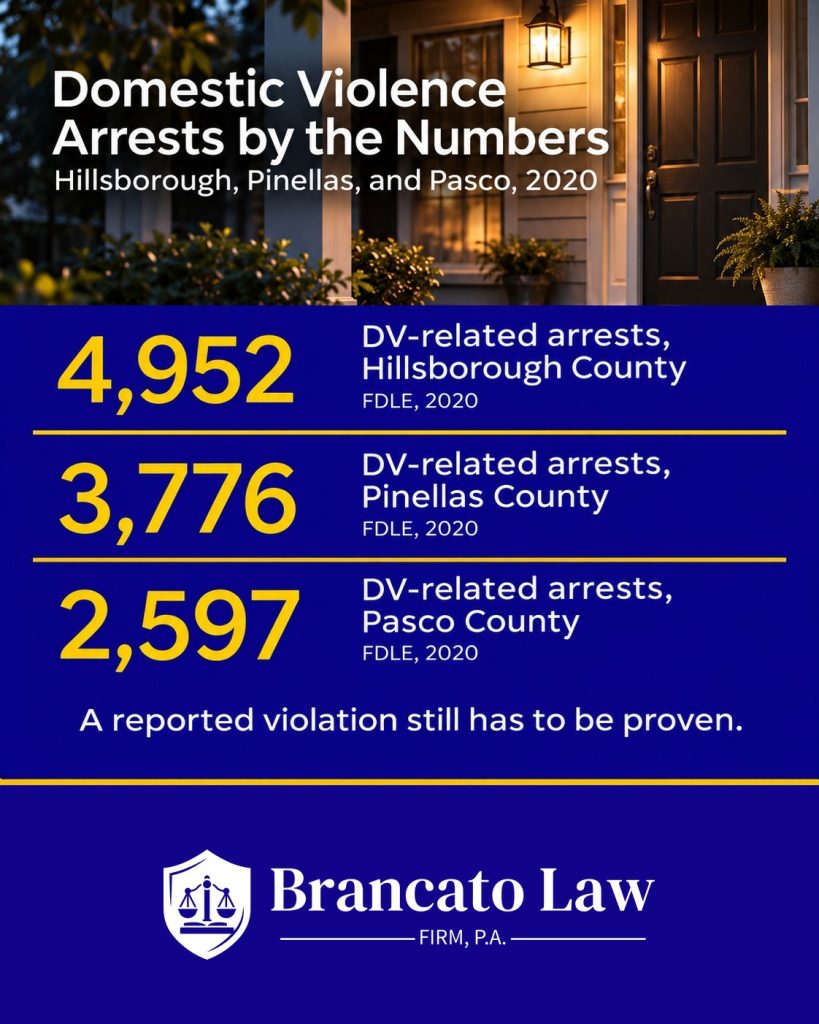
Domestic violence charges are common in our area. In 2020, the Florida Department of Law Enforcement recorded 4,952 domestic violence related arrests in Hillsborough County, 3,776 in Pinellas County, and 2,597 in Pasco County. Those figures count arrests for listed offenses such as assault and stalking, not injunction violations alone.
| County | Arrests |
|---|---|
| Hillsborough | 4,952 |
| Pinellas | 3,776 |
| Pasco | 2,597 |
What happens after an injunction violation arrest in Hillsborough County?
An injunction violation arrest in Hillsborough County goes to first appearance within 24 hours, where a judge reviews probable cause and sets release conditions by video from the jail. Expect a no-contact condition that mirrors the injunction, and in a domestic violence case, a firearm restriction. In our experience, Hillsborough County does not offer pretrial services supervision as a release option, though some neighboring counties do. Our post on Hillsborough first appearance explains that hearing, our Hillsborough County criminal defense page covers local procedure, and our guide to the Florida criminal case process maps every stage after arrest.
Firearms deserve special attention. Under section 790.233, a person subject to a final domestic violence or stalking injunction may not possess a firearm or ammunition, and doing so is a separate first-degree misdemeanor. Our post on domestic violence and gun rights in Florida covers the state and federal firearm consequences.
What should you do if you are accused of violating an injunction?
Stop all contact, even if the petitioner reaches out, and get the paperwork in front of a lawyer. Our attorneys give every client these instructions:
- Do not respond to calls, texts, or social media messages from the petitioner. Save them instead.
- Gather every version of the order, including the temporary injunction, any final injunction, and any modification, plus anything you were served.
- Write down where you were at the time of the alleged violation, and list receipts, apps, or people who can confirm it.
- Turn over firearms as ordered and keep proof that you did.
- Ask the court, not the petitioner, to change the order if circumstances change. Only the judge can modify or dissolve it.
Frequently asked questions about injunction violations in Florida
Can injunction violation charges be dropped in Florida?
Yes, injunction violation charges can be dropped when the State cannot prove the accused knew of the order or acted willfully, or when the act is not one the statute lists. The Brancato Law Firm presents the service records and the message history to the domestic violence intake prosecutor, which is the earliest chance to end the case through pre-file advocacy.
What if the petitioner contacted me first?
The injunction binds only the respondent, so responding to the petitioner’s contact can still be charged. Our attorneys at The Brancato Law Firm use the petitioner’s own messages to show who initiated contact and what the accused reasonably believed, which goes directly to willfulness under Hall v. State.
Is it a violation if I was served after the alleged contact?
Generally not, because the State must prove you knew the injunction was in effect when you acted. The Brancato Law Firm compares the time on the sheriff’s return of service with the time of the alleged contact in every case.
Can a social media post violate an injunction in Florida?
It can, if the post was directed at the petitioner as indirect communication, but a general post not aimed at the petitioner is harder for the State to prove. Our team at The Brancato Law Firm subpoenas account data to show who could see a post and whether it was ever sent to the petitioner.
Will an injunction violation make a future case a felony?
Yes, for a domestic violence injunction, one prior domestic violence or injunction violation conviction involving the same person makes the next violation a third-degree felony, even with a withheld adjudication. The Brancato Law Firm weighs that future risk in every plea discussion, and our domestic violence defense work focuses on avoiding a finding of guilt where possible.
Does the alleged victim get to decide whether the case goes forward?
No, the State Attorney decides whether to prosecute, though the petitioner’s account and wishes influence that decision. Lawyers at The Brancato Law Firm explain the process to petitioners through counsel, and our post on whether a victim can drop domestic violence charges in Florida covers it in depth.
For more about our defense strategies, visit our Domestic Violence page.
The State Attorney has 30 working days to decide on a reported violation when there was no arrest, and phone and location records can be lost sooner. Call The Brancato Law Firm, P.A., founded by Tampa Criminal Defense Attorney Rocky Brancato, at (813) 727-7159, and our attorneys will start by pulling the service records and every version of the order. You can call us at any hour. Our firm has Spanish-speaking staff, and attorney Jean-Luc Adrien speaks Spanish, Haitian Creole, and French. Our office is two blocks from the courthouse, and we defend injunction violation cases in Hillsborough, Pinellas, and Pasco counties.
The Brancato Law Firm, P.A.
620 E. Twiggs Street, Suite 205, Tampa, FL 33602
(813) 727-7159
Serving Hillsborough, Pinellas, and Pasco Counties
The Brancato Law Firm, P.A. is a Tampa-based criminal defense practice. We are not affiliated with any other Brancato-named law firms.
Visit Us

Tampa, FL 33602

Contact Us Now
Free Legal Consultation (813) 727-7159
