- Free Consultation 24/7: (813) 727-7159 Tap Here To Call Us


From First DUI to Death Penalty



Is Violating a No-Contact Order a Crime in Florida? (2026)


| Yes. Since October 1, 2026, willfully violating a no-contact order that a judge set as a bond condition after an arrest for a violent crime such as battery, assault, robbery, stalking, kidnapping, or sexual battery is a separate crime in Florida under section 903.0472. A first violation is a first-degree misdemeanor punishable by up to one year in jail. A second or subsequent violation is a third-degree felony punishable by up to five years in prison, and anyone arrested for a violation is held in jail until a judge sees them at first appearance. |
In Hillsborough County, prosecutors pull recorded jail phone calls and charge one count for every call a defendant makes to the person a no-contact order protects. As founder of The Brancato Law Firm, P.A., a Tampa criminal defense firm, and a former Chief Operations Officer of the Hillsborough County Public Defender’s Office, where I oversaw a staff of over 100 attorneys, I have spent more than 25 years in Hillsborough County courtrooms watching bond conditions decide cases. Under Florida’s new law, those conditions carry more weight than ever, so our attorneys now treat the no-contact order as a second case that starts at first appearance.
This guide explains what the Victim Safety in Pretrial Release Act (CS/CS/HB 397, chapter 2026-155, Laws of Florida) does, why the Legislature passed it, what lawmakers cut out of it along the way, and how to protect yourself or a family member while a violent charge is pending.
What Does Florida’s New No-Contact Order Law Do?
Florida’s new law turns a broken bond condition into a new criminal charge. Under section 903.0472, Florida Statutes, a person commits a first-degree misdemeanor if he or she willfully violates a no-contact condition of pretrial release that a court imposed after an arrest for a listed violent offense. A second or subsequent violation is a third-degree felony.
The law took effect October 1, 2026. Governor DeSantis signed it on June 16, 2026. It does four things:
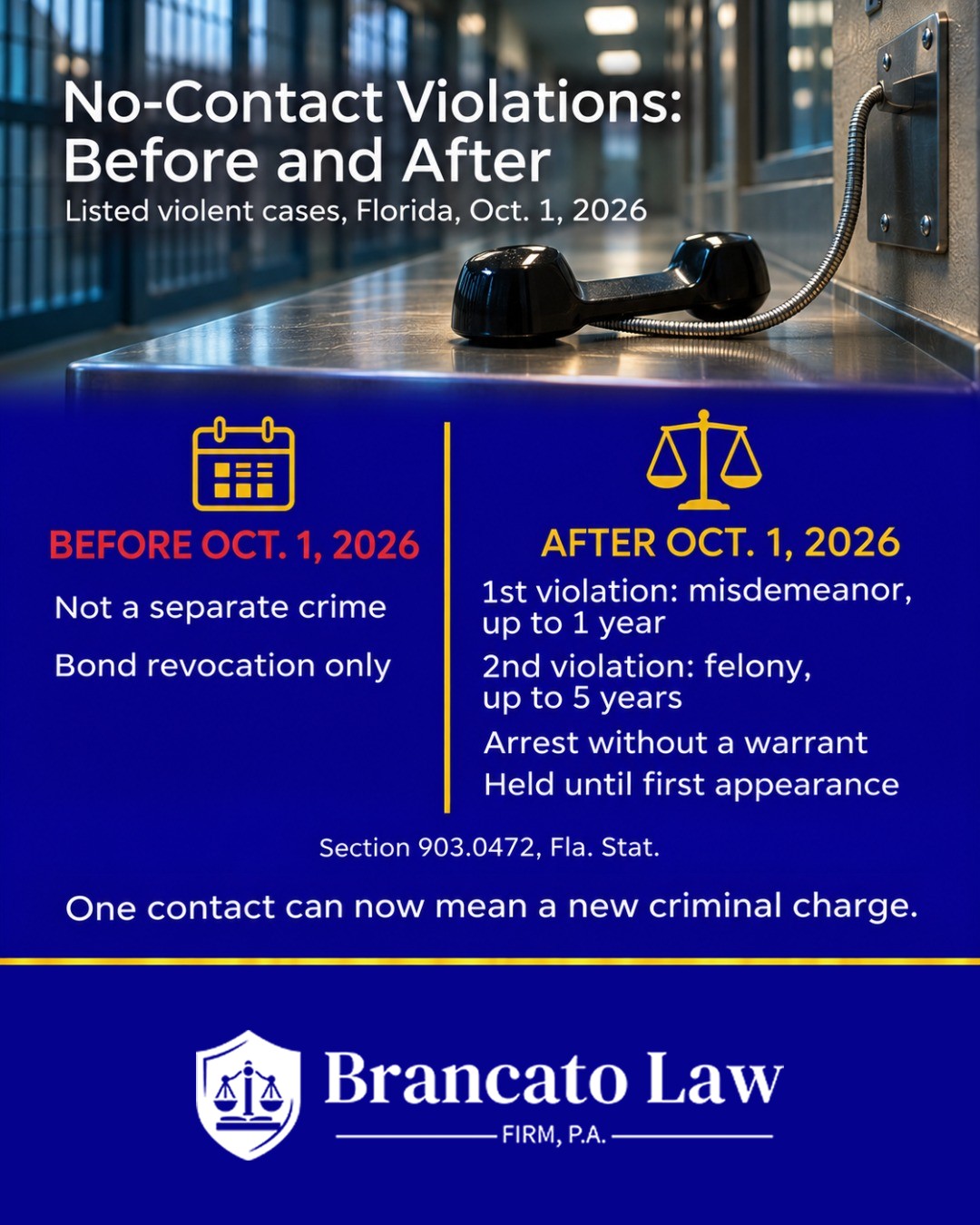
- Creates a new crime. Willfully violating a pretrial no-contact order in a listed violent case is a first-degree misdemeanor, punishable by up to one year in jail and a $1,000 fine.
- Adds a felony tier. A second or subsequent violation is a third-degree felony, punishable by up to five years in prison and a $5,000 fine.
- Allows warrantless arrests. A new subsection (17) of section 901.15 lets an officer arrest on probable cause without a warrant, even if the officer did not see the violation.
- Requires a jail hold. Anyone arrested for a violation, and anyone on pretrial release for a listed offense who is arrested for any new crime, must be held until first appearance. At that hearing the judge must “prioritize the safety of the victim and the public.”
The law also protects officers from civil lawsuits for an arrest made on probable cause under the new section. That provision drew objections from defense groups during committee debate, discussed below.
Which Charges Does the New Law Cover?
The new crime applies only when the no-contact order was imposed after an arrest for one of 15 listed offenses. The list in section 903.0472(1) covers most charges our Tampa violent crimes lawyer team defends every week:
| Category | Offenses that trigger section 903.0472 |
|---|---|
| Homicide | Murder; manslaughter |
| Assault and battery | Assault; aggravated assault; battery; aggravated battery |
| Stalking and threats | Stalking; aggravated stalking; written or electronic threats to kill or do bodily injury |
| Liberty offenses | Kidnapping; false imprisonment |
| Sex offenses | Sexual battery; lewd or lascivious offenses on or in the presence of a child under 16 |
| Robbery | Robbery |
| Catch-all | Any other felony that involves the use or threat of physical force or violence against any individual |
Domestic violence cases were already covered by an older law, discussed in the next section. The practical change is that the alleged victim no longer has to be a family member, a household member, or a dating partner. A bar fight, a road-rage battery, or a robbery between strangers now carries the same no-contact exposure as a domestic battery.
Why Did Florida Pass the Victim Safety in Pretrial Release Act?
Florida passed the law because, before October 1, 2026, breaking a no-contact order in a non-domestic case was not a crime at all. A no-contact order is a bond condition under section 903.047. When a defendant broke one, the only remedy was for the judge to revoke bond under section 903.0471. An officer standing in front of the defendant at the victim’s house could not arrest for the violation itself.
The one exception dates to 1997. Under what is now section 741.29(7), violating a pretrial release condition after a domestic violence arrest has been a first-degree misdemeanor for nearly three decades, with a mandatory hold until first appearance. Dating violence later received the same treatment. Victims of every other violent crime had no equivalent protection.
The Florida Sheriffs Association’s summary of the bill describes the gap directly: officers could only write a report asking a judge to revoke bond, which the summary says caused “dangerous delays.” The sponsors called it a “dangerous loophole.” When Representative Dan Daley presented the bill to a House subcommittee in January 2026, he described it as a way to give officers an on-scene tool to remove a person who violates a court’s stay-away order in a serious violent case.
How Did HB 397 Change on Its Way Through the Legislature?
The bill that became law is much narrower than the bill that was filed. That history matters, because it tells judges and lawyers what the Legislature chose not to criminalize.
The Senate version, SB 760 as filed by Senator Stan McClain, made it a crime to willfully violate any pretrial release condition, not only a no-contact order. That would have covered curfews, GPS monitoring, alcohol bans, and travel limits. It also covered every forcible felony and any offense causing physical injury, and it made a second violation against the same victim, or one involving a new act of violence, a felony.
Committees cut the bill back in three ways. The House Criminal Justice Subcommittee limited the crime to no-contact orders and removed the separate felony for a violation involving a new act of violence. The Senate dropped forcible felonies and substituted a catch-all for felonies involving force or violence against a person. The House Judiciary Committee then added the jail hold for anyone on release for a listed offense who picks up any new charge.
| Date (2026) | Committee or chamber | Vote |
|---|---|---|
| January 14 | House Criminal Justice Subcommittee | 14 to 2 |
| January 21 | House Justice Budget Subcommittee | 10 to 3 |
| January 27 | House Judiciary Committee | 19 to 1 |
| February 2 | Senate Criminal Justice Committee (SB 760) | 8 to 0 |
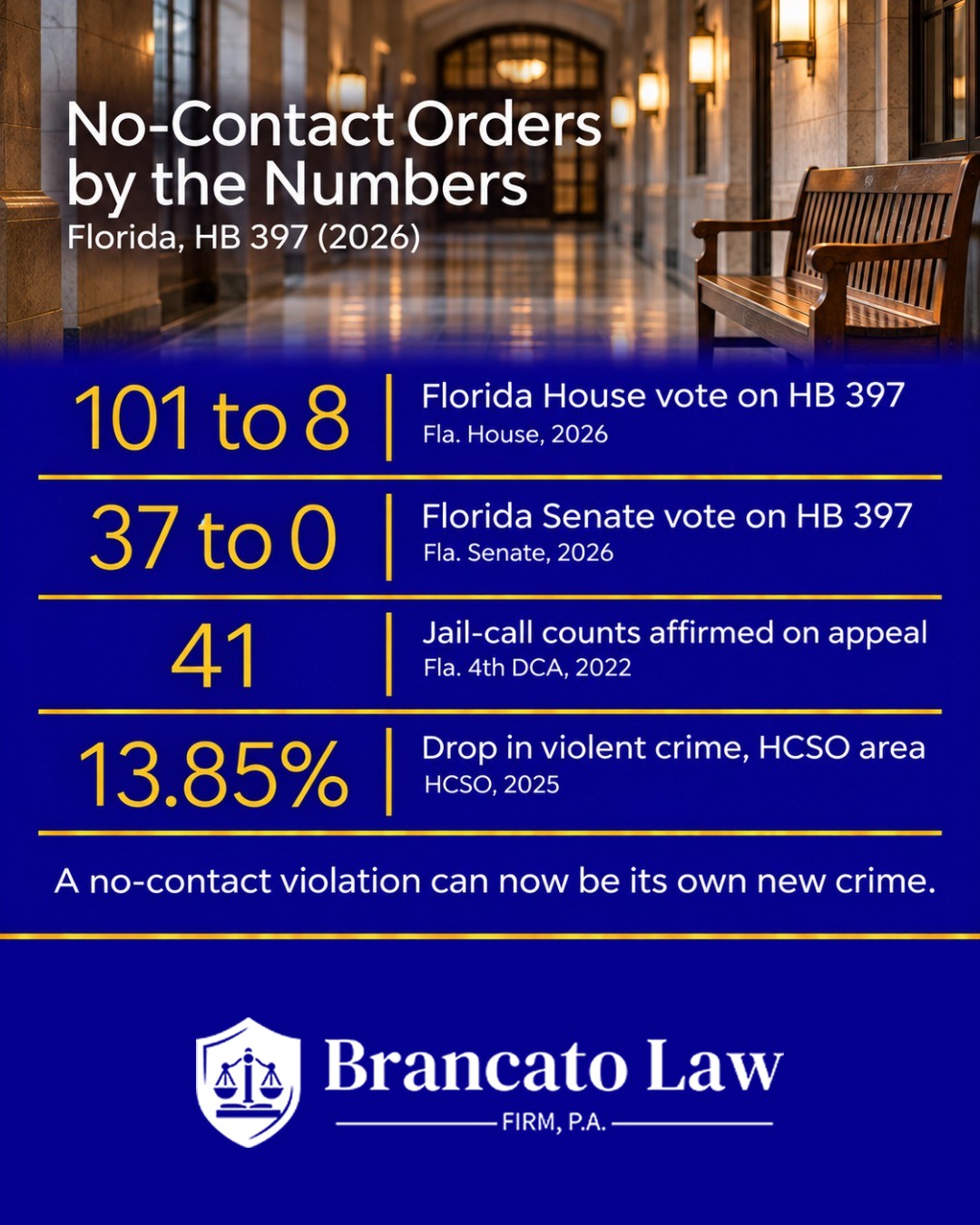
| February 17 | Full House | 101 to 8 |
| February 26 | Full Senate | 37 to 0 |
The bill was bipartisan. Daley is a Democrat and McClain is a Republican, and the Senate never cast a vote against it. The opposition came in the House committees, where criminal defense groups argued that the officer-immunity provision and the lack of any listed affirmative defenses invited arrests without judicial review. The House adopted one amendment in the Judiciary Committee to clarify how the first-appearance hold works in counties that use bond schedules. Vote tallies come from the Florida House bill page and the House and Senate staff analyses.
The takeaway for anyone on bond: a missed curfew or a dead GPS battery can still get bond revoked, but it is not a new crime under section 903.0472. Only the no-contact condition is.
Does the New Law Actually Make Victims Safer?
The best available research says enforcement alone does not move the numbers much. In a randomized experiment funded by the National Institute of Justice, Robert Brame and colleagues studied 466 misdemeanor domestic violence cases in Lexington County, South Carolina, between 2005 and 2007. Half the cases received proactive no-contact order enforcement by dedicated deputies. The researchers found no measurable effect on victim safety or rearrest. Domestic violence rearrest rates were 9.7% with proactive enforcement and 14.0% without it, a difference that was not statistically significant. The study was published in the American Journal of Criminal Justice in 2015.
The law also arrives as reported violent crime is falling locally. The Hillsborough County Sheriff’s Office reported that violent crime in its jurisdiction fell 13.85% in 2025, the fourth straight year of overall crime decline. The Legislature’s own fiscal analysts predicted only an “indeterminate” increase in jail and prison beds, noting in the final House bill analysis that courts could already revoke bond and send violators back to jail.
What the law clearly changes is leverage. A new misdemeanor or felony charge gives the State Attorney’s Office something to trade in plea negotiations and gives the judge a reason to hold a defendant at first appearance. Our attorneys at The Brancato Law Firm plan for both from the first day of the case.
Does a Jail Phone Call Count as Violating a No-Contact Order?
Yes. A no-contact order is effective the moment the judge imposes it, so a call from jail violates it even if the defendant never bonds out. Section 903.047(1)(b) states that “an order of no contact is effective immediately.”
Florida’s Fourth District Court of Appeal applied that rule in Caldwell v. State, No. 4D21-117 (Fla. 4th DCA May 18, 2022). Richard Caldwell was arrested in St. Lucie County for domestic battery and ordered to have no contact with the victim. He never posted bond. From jail, he called the victim again and again, and the State charged 50 counts of violating pretrial release under the domestic violence statute. A jury convicted him on 41 counts, and the appeals court affirmed, holding that a defendant “can violate a condition of pretrial release prohibiting contact with the victim before being released from jail.”
In our experience, prosecutors at the Hillsborough County State Attorney’s Office use the same playbook. They pull recorded calls from the county jails and file one count for each call to the protected person. Under section 903.0472, that practice has a new edge, because a second violation is a felony.
Assume every call from a jail phone is recorded. If a family member is in custody on a violent charge with a no-contact order, the safest rule is simple: no calls, no three-way calls, and no messages passed through anyone else.
Is a Second No-Contact Violation Automatically a Felony?
The statute says a “second or subsequent violation” is a third-degree felony, but it does not say whether the first violation must end in a conviction before the second one counts. That question has not been decided by a Florida appellate court.
The difference is enormous in a jail-call case. If every call after the first is a “subsequent violation,” a person who makes ten calls in one weekend could face one misdemeanor and nine felonies. Our attorneys will argue that the rule of lenity in section 775.021(1) requires the narrower reading. That statute directs that when criminal statutes are “susceptible of differing constructions,” they must be “construed most favorably to the accused.” Until an appeals court rules, expect prosecutors to charge the broader version.
Because the Legislature did not rank the new felony on the offense severity chart, a third-degree violation should score as an unranked Level 1 offense under section 921.0023. It still adds a felony conviction and points to any scoresheet in the underlying violent case.
How Do You Fight a No-Contact Violation Charge in Florida?
The State has to prove every element beyond a reasonable doubt, and most of these cases turn on notice, willfulness, and timing. Here is how our attorneys approach a section 903.0472 charge:
- Prove the order existed and the client knew about it. Section 903.047 requires the defendant to be informed of the order in writing, with the prohibited acts spelled out, before release. In Pilorge v. State, 876 So. 2d 591 (Fla. 5th DCA 2004), the court reversed a conviction for violating a pretrial no-contact condition because the State offered no proof the defendant was ever advised of it; his first appearance sheet said only “Unable” where his signature belonged. The court held the statute “does not create a presumption that the defendant knows.” Hillsborough County first appearance judges routinely give the no-contact order in writing, but we still see paperwork with no signature or a refusal noted, and we check it in every case.
- Challenge willfulness. The violation must be willful. A chance encounter at a store that the client immediately walks away from, or a text the client never answered, is different from a deliberate call or visit. The State also has to prove the 500-foot distance when the claim is about a residence, vehicle, or workplace.
- Confirm the underlying charge qualifies. The new crime applies only if the order followed an arrest for a listed offense. A no-contact order in a theft or drug case does not support a section 903.0472 charge, though it can still lead to bond revocation.
- Check the date. Conduct before October 1, 2026 cannot be charged under the new statute. The order itself may be older, but the violation must come after the effective date.
- Fight the first appearance hold. The judge must weigh the underlying charge, the client’s record of following court orders, and any evidence of intent to intimidate or harass. Proof of steady compliance, a job, and a safe place to live is how we answer those factors.
If police are investigating a possible violation but no charge has been filed yet, early representation before charges are filed can shape what the State Attorney’s Office decides to file.
What Happens at First Appearance After a No-Contact Arrest?
A person arrested under section 903.0472 cannot bond out on a bond schedule. He or she stays in custody until first appearance, which Florida Rule of Criminal Procedure 3.130 requires within 24 hours of arrest. At that hearing, the judge decides whether to order pretrial detention or set new release conditions.
The same hold applies to a broader group than most people realize. Anyone on pretrial release for a listed violent offense who is arrested for any new crime, even a nonviolent one such as driving with a suspended license, must be held until first appearance. Our Hillsborough County criminal defense attorney team prepares for that hearing as soon as a family member calls, because the judge decides with whatever information is in front of him or her that morning.
First appearance is usually not the end of the bond fight. The State can also move to revoke the original bond in the underlying case, and a new bond hearing is often the next step. Our guide to how a bond hearing works in Tampa explains that process.
Can a No-Contact Order Be Lifted or Changed?
Yes, but only by the judge. Under section 903.047(2), the court may modify a no-contact condition on a properly noticed motion if good cause is shown and the interests of justice require it. The alleged victim has the right to be heard, and the State Attorney must notify the victim of the hearing.
Two built-in exceptions help families. If the parties share children, the judge may designate a third person to contact the other parent solely to arrange contact with the children. And the defendant’s lawyer may communicate with a protected person for lawful purposes, consistent with Florida Bar rules.
What does not work is informal permission. An alleged victim who calls, visits, or invites the defendant over does not cancel the order, and the defendant who responds can still be arrested. Our guide for alleged victims who want charges dropped explains the right way for a protected person to ask the court for a change.
| Situation | Before October 1, 2026 | After October 1, 2026 |
|---|---|---|
| Domestic or dating violence case, no-contact violation | First-degree misdemeanor; bond revocation possible | Unchanged under section 741.29(7) |
| Other listed violent case, no-contact violation | Not a crime; bond revocation only | First-degree misdemeanor; warrantless arrest; hold until first appearance |
| Second violation, listed violent case | Not a crime; bond revocation only | Third-degree felony |
| Curfew, GPS, or other non-contact condition | Not a crime outside DV cases; bond revocation possible | Still not a crime under section 903.0472; bond revocation possible |
| Any new arrest while on release for a listed offense | Bond schedule could apply | Held until first appearance |
What Should You Do Right Now If a No-Contact Order Applies to You?
Act before anything happens, because the first violation is now an arrestable crime. These steps protect you whether you are the defendant or a worried family member:
- Read the written order and note every person, address, and distance it covers.
- Block the protected person’s number and social media accounts, and do not reply if they reach out.
- Do not ask friends or relatives to pass along messages; contact “through a third person” is a violation.
- Save proof of any contact the protected person starts, and give it to your lawyer instead of responding.
- If you need contact for children, housing, or property, ask your lawyer to file a motion to modify.
- If you are in jail, call only your lawyer about the case.
This post is part of our guide to the new Florida criminal laws that took effect October 1, 2026, which summarizes all eight laws in one place.
Frequently Asked Questions
Can I be arrested if the alleged victim contacted me first?
Yes. The order binds the defendant, not the protected person, so replying to a call or text the protected person started can still be treated as a violation. The Brancato Law Firm tells clients to save that message and send it to us, because proof that the other person initiated contact matters in court even though it is not a complete defense.
Does the new Florida no-contact law apply to domestic violence cases?
Domestic and dating violence cases are still handled under the older laws, sections 741.29(7) and 784.046(15), which already made a pretrial release violation a first-degree misdemeanor. Our attorneys at The Brancato Law Firm defend those cases through our Tampa domestic violence defense attorney practice, and the defenses on notice and willfulness apply the same way.
Can I be charged for a no-contact violation that happened before October 1, 2026?
No, not under section 903.0472, because the law applies only to conduct on or after its effective date. The Brancato Law Firm checks the date of every alleged contact, since earlier conduct in a non-domestic case can support bond revocation but not a new charge under this statute.
How long can I be held after a no-contact violation arrest in Hillsborough County?
You are held until first appearance, which must take place within 24 hours of arrest, and the judge may then order pretrial detention or set new conditions. Our attorneys at The Brancato Law Firm prepare compliance records and release plans for that hearing, and our violent crimes defense team handles the underlying case at the same time.
Is it a violation to be within 500 feet of the protected person by accident?
The State must prove the violation was willful, so an accidental encounter that you leave right away is a strong defense. The Brancato Law Firm gathers location data, receipts, and witness statements to show when a client was somewhere for an innocent reason and what the client did once he or she saw the protected person.
Will a no-contact violation charge hurt my main case?
Yes, in most cases it does. A new charge can lead to bond revocation, gives the prosecutor leverage in plea talks, and may add points to a scoresheet. Our attorneys at The Brancato Law Firm defend the violation charge and the underlying case together, as described in our guide on how to fight a domestic violence battery charge.
Talk to a Tampa Defense Lawyer Before the Next Hearing
For more about our defense strategies, visit our Violent Crimes practice page.
A first appearance hearing happens within 24 hours of a no-contact arrest, so the time to prepare is now. Our attorneys will review the written order, the jail call records, and the bond paperwork, and we will be ready to argue for release. Call The Brancato Law Firm, P.A., founded by Tampa Criminal Defense Attorney Rocky Brancato, at (813) 727-7159. Call us at any hour; our office is two blocks from the courthouse. Our firm has Spanish-speaking staff, and attorney Jean-Luc Adrien speaks Spanish, Haitian Creole, and French.
The Brancato Law Firm, P.A.
620 E. Twiggs Street, Suite 205, Tampa, FL 33602
(813) 727-7159
Serving Hillsborough, Pinellas, and Pasco Counties
The Brancato Law Firm, P.A. is a Tampa-based criminal defense practice. We are not affiliated with any other Brancato-named law firms.
Visit Us

Tampa, FL 33602

Contact Us Now
Free Legal Consultation (813) 727-7159
